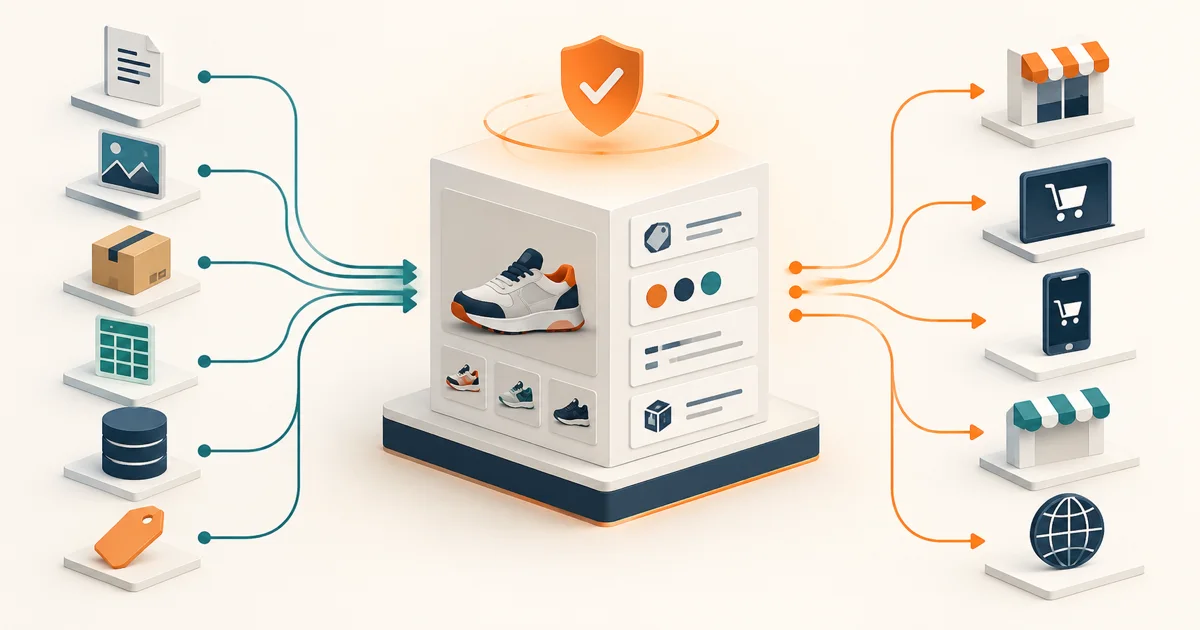
Define product truth before comparing PIM features
A useful PIM system requirements checklist defines the product identity, family and variant model, attributes, assets, languages, sources, owners, validation rules, approvals, destinations, and correction paths that make product data trustworthy. It should also say which system owns each field and how the team proves that an approved change reached every intended channel.
Start with one difficult product family and one complete publish cycle. Model the data, ingest imperfect source records, enrich and approve them, publish to representative channels, handle a rejection, correct the source, replay the export, and retire an item. That rehearsal exposes more than a long list of generic PIM features.
Write a product data contract for one difficult family
Choose a family that contains the complications your ordinary sample avoids: variants, bundles, replacement parts, technical specifications, regulated or substantiated claims, regional restrictions, several languages, supplier-provided values, and channel-specific media. Define the parent product, sellable units, packs, relationships, identifiers, categories, attributes, allowed values, units, assets, claims, availability references, and lifecycle states.
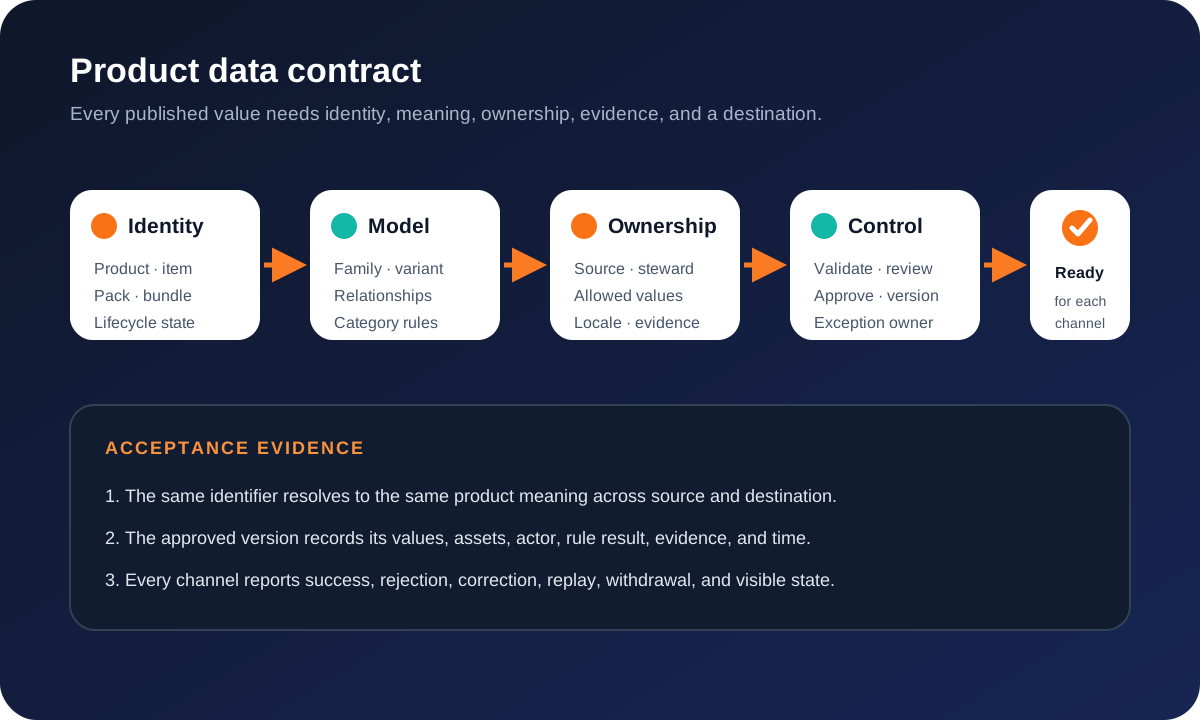
For each field, record its definition, data type, unit, allowed values, required conditions, source, accountable owner, transformation, destinations, locale behavior, evidence, and review trigger. “Material” might be marketing copy in one catalog, a controlled composition in another, and a set of percentage values for a regulated label. A shared label does not guarantee a shared meaning.
The GS1 Global Data Model defines foundational attributes used to list, order, store, move, and sell products. Treat standards as useful semantic inputs, not a substitute for your catalog contract. Your team still needs to decide which products, markets, channels, and obligations apply.
Cover the requirement lanes that make the record usable
Identity and model
Stable product and item IDs, families, variants, packs, bundles, accessories, replacements, relationships, taxonomies, lifecycle states, and controlled referential integrity.
Attributes and localization
Typed fields, units, controlled vocabularies, inheritance, overrides, formulas, locale and market variants, translation status, claims, warnings, and fallback rules.
Assets and documents
Images, video, manuals, certificates, rights, renditions, crops, accessibility text, expiry, locale, product links, DAM ownership, and publication restrictions.
Sources and onboarding
ERP, PLM, suppliers, spreadsheets, portals, APIs, imports, mapping, identity matching, duplicate handling, validation, quarantine, correction, and replay.
Workflow and governance
Roles, assignments, completeness, review, approval, segregation, delegation, due dates, comments, evidence, audit history, bulk work, and controlled exceptions.
Channels and operations
Transformation, selection, scheduling, previews, publication, acknowledgements, rejection queues, retries, withdrawal, monitoring, exports, reporting, backup, and support.
Separate product content from commercial and operational data. The PIM may publish a product description and dimensions while ERP remains authoritative for base commercial records and an order or inventory platform owns current availability. Copying every field into the PIM can create a second source of truth without improving the buying experience.
Also define scale with useful units: active products, sellable items, attributes per family, locales, destinations, asset volume, daily changes, largest imports, concurrent editors, and expected publication windows. Avoid a vague “must scale” line; use a representative workload and observable thresholds.
Turn data quality into owned work, not a dashboard score
Completeness is conditional. A field may be required only for a product class, country, channel, claim, or lifecycle stage. Define every rule with its scope, severity, owner, evidence, override authority, and correction route. Distinguish missing, invalid, conflicting, unverified, expired, untranslated, and rejected data because they need different action.
GS1’s data-quality framework frames quality as governance, product inspection, training, and data sharing—not just validation at export. Build the operating model around named ownership: who creates a value, who can approve a claim, who resolves a supplier conflict, who monitors failed destinations, and who changes the rule itself.
Preserve versions at approval and publication. If a material, warning, dimension, image, or compatibility statement changes, the team should be able to identify affected products and channels, approve the successor, withdraw the old value where needed, and verify propagation. A mutable latest-value table cannot answer what a channel received last week.
Define system boundaries field by field
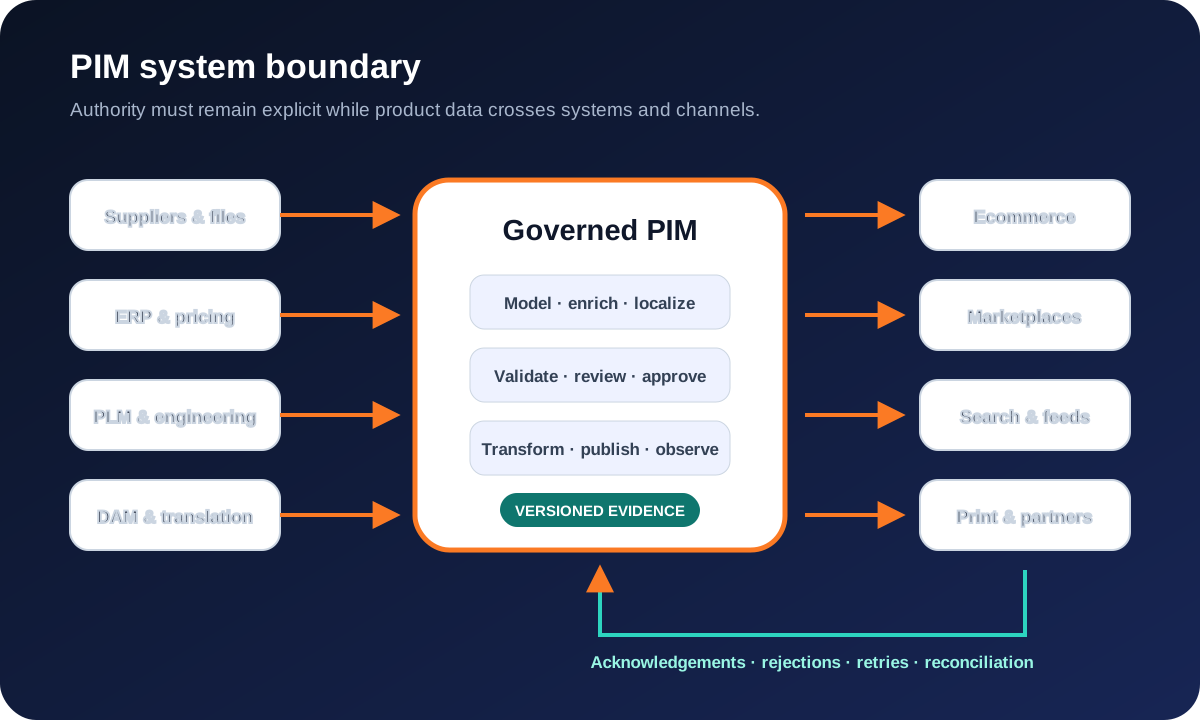
Create an authority matrix for product identity, hierarchy, price, tax class, inventory reference, specifications, claims, media, translations, supplier records, and publication status. For each integration, define identifiers, direction, timing, ordering, versioning, delete behavior, duplicate handling, partial failure, retries, reconciliation, monitoring, and the team that owns mismatches.
Google’s current Merchant Center product-data specification shows why a generic “Google feed” requirement is too shallow: identifiers, variants, images, price, availability, and other attributes have specific formats and conditional rules, while mismatches can produce disapprovals or display issues. Treat each channel contract as versioned configuration with test products and monitored outcomes.
If this boundary is the main problem, the related guide to choosing Shopify, headless commerce, or a custom ecommerce boundary can help separate storefront ownership from product-data and commerce-core ownership.
Choose among configuration, extension, and custom ownership
Buy and configure a mature PIM when your catalog model, enrichment workflow, localization, approvals, and destinations fit supported patterns. Add an integration or focused extension when the core fits but source onboarding, supplier collaboration, specialized validation, or one destination creates a bounded gap. Build a custom product-data system only when the distinctive model or workflow is valuable enough to justify ongoing product ownership.
Compare options using the same scripted scenarios, not vendor tours. Include one new item, a family update, a supplier conflict, a translation, a bulk correction, a rejected channel, a product withdrawal, a permission denial, an integration outage, an export, and a restore. Score fit, configuration, custom code, data migration, operating effort, observability, upgrade impact, and exit access.
A custom web application can be appropriate for a focused orchestration or collaboration layer, but it should not recreate commodity catalog capabilities without a clear advantage. Start with the smallest boundary that makes the product-data decision reliable.
Run a channel rehearsal before committing to rollout
- Select the sample. Include ordinary, variant-heavy, multilingual, regulated, bundled, incomplete, and discontinued products.
- Freeze the contract. Record identities, fields, owners, rules, sources, destinations, and expected evidence.
- Load imperfect data. Use realistic files, duplicates, missing values, invalid units, and conflicting sources.
- Complete the work. Assign enrichment, translation, media, validation, review, approval, and exception decisions.
- Publish and observe. Send exact versions to representative destinations and capture acknowledgements or rejections.
- Break the flow. Simulate an API outage, partial export, stale update, deleted asset, and permission denial.
- Correct and reconcile. Prove retry safety, channel state, audit history, rollback, export, and named support ownership.
End with a decision brief: keep the current process, improve governance first, configure a PIM, add a focused integration, build a collaboration layer, or replace a wider system boundary. List exclusions and assumptions so the implementation estimate is tied to evidence rather than catalog size alone.
PIM system requirements FAQ
What should PIM system requirements include?
Include product and variant identity, family and category models, attribute definitions, units and controlled values, digital assets, supplier onboarding, enrichment, validation, approval, localization, channel-specific transformations, publication status, search, permissions, audit history, integrations, migration, data quality, reporting, administration, and recovery from failed imports or exports.
What is the difference between PIM, ERP, PLM, DAM, and ecommerce?
ERP usually owns commercial and inventory records, PLM owns engineering lifecycle data, DAM manages reusable media, ecommerce presents and sells products, and PIM governs the enriched product information each channel needs. The exact boundary varies, so define an authoritative owner for every object and field rather than assuming one platform should own everything.
Should a business buy a PIM or build a custom product-data system?
Buy or configure a PIM when standard catalog, enrichment, localization, workflow, and syndication patterns fit. Extend or build a focused layer when distinctive product models, supplier workflows, decision rules, legacy integrations, or channel orchestration create durable business value that standard configuration cannot safely express.
How should PIM software be tested before rollout?
Use representative difficult products: variants, bundles, regulated claims, missing supplier values, conflicting sources, locale differences, media rights, discontinued items, and channel-specific restrictions. Prove import, validation, ownership, approval, publication, rejection, correction, replay, audit history, export, and rollback with measurable acceptance evidence.