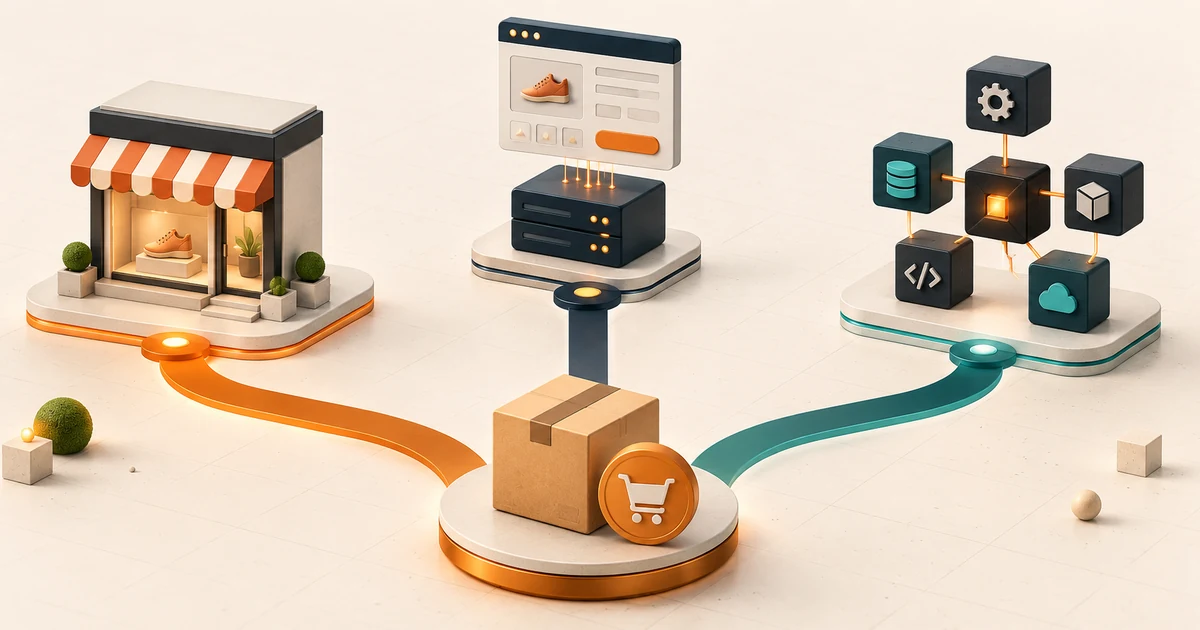
Choose the smallest commerce boundary that preserves your advantage
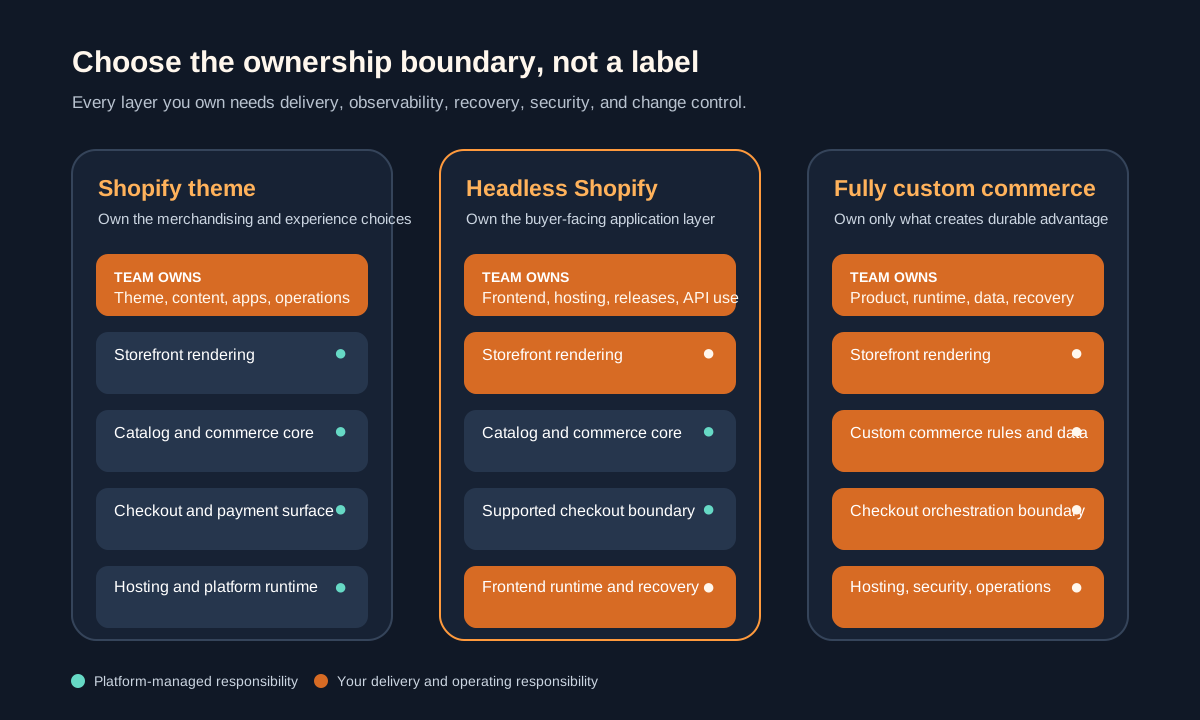
Choose a Shopify theme when your catalog, pricing, checkout, fulfilment, and account model fit supported platform patterns. Choose headless Shopify when the commerce core still fits but the buyer-facing experience needs a separately built frontend. Choose fully custom commerce only when a valuable, proven business rule cannot fit a platform safely and your team is prepared to own the resulting product for years.
“Custom” is not one option. A tailored theme, a Shopify app, a checkout extension, a headless storefront, and a custom commerce engine create very different responsibilities. Start with the business rule that creates pressure, then draw the smallest ownership boundary around it.
If company accounts, location-specific catalogs, negotiated prices, buyer approvals, purchase orders, credit terms, or ERP fulfilment drive the decision, first complete the B2B ecommerce platform requirements checklist. It turns those account-specific rules into testable buying journeys before you compare a theme, headless build, or custom platform.
Compare three operating models, not two technology labels
1. Shopify theme, configuration, apps, and extensions
Shopify provides the catalog, cart, orders, admin, hosted storefront, and checkout foundation. Your team owns product data, merchandising, content, theme behavior, app choices, fulfilment configuration, customer service, analytics, and operating procedures. This is still a designed system; it simply delegates more infrastructure and commerce primitives.
Checkout customization has explicit extension points and plan boundaries. Shopify's current checkout app documentation says apps extend checkout through supported extensions, while some information, shipping, and payment-step UI extensions require Shopify Plus. Verify the current capability and plan for each mandatory rule rather than assuming “Shopify supports customization.”
2. Headless Shopify
Headless keeps Shopify as a commerce backend while a custom web application renders the storefront. Shopify describes its Storefront API as the foundation for custom storefronts, with product, collection, cart, contextual-pricing, and other commerce capabilities. That can unlock a distinct content and discovery experience without rebuilding the commerce core.
It also makes your team responsible for frontend hosting, routing, caching, previews, accessibility, analytics, observability, API-version upgrades, deployment safety, and outage behavior. Headless is an ownership trade, not an automatic performance upgrade. If the real problem is pricing, fulfilment, or ERP data, a new frontend may add cost without moving the constraint.
3. Fully custom commerce
A custom system may own catalog rules, pricing, cart, order orchestration, accounts, integrations, and operator tools while delegating payment collection, tax calculation, shipping, or search to specialists. Even here, “custom” should not mean rebuilding every commodity capability. The design task is to identify the part that must behave differently and keep the rest behind clear provider boundaries.
Use a boundary pressure test before requesting estimates
For every requirement, score platform fit, business value, and ownership cost from 0 to 3. A high-pressure candidate is both valuable and poorly supported by the platform. It still does not justify custom development until the team can describe how it will operate, fail, and change.
Platform fit
Can supported configuration, theme code, apps, functions, extensions, or APIs express the rule without hidden manual repair?
Commercial value
Does the rule change eligibility, price, margin, conversion, retention, service level, or a defendable buyer experience?
Change frequency
Who changes the rule, how often, with what approval, effective date, preview, test, and rollback?
Operational load
Who monitors the flow, resolves exceptions, answers customers, reconciles money and stock, and supports releases?
Data authority
Which system owns product, customer, price, inventory, order, fulfilment, return, tax, and financial facts?
Exit cost
Can the team export usable data, recreate critical rules, replace dependencies, and run a controlled migration?
Reject vague drivers such as “more flexibility” or “future proof.” Rewrite them as a scenario: “A contracted buyer sees its approved catalog and location-specific price; an unauthorized user cannot purchase; a changed contract takes effect on a known date; finance can explain the invoice.” That scenario can be demonstrated in a platform or estimated for a build.
Model the commerce rules that actually change the architecture
Begin with product identity and eligibility: products, variants, bundles, subscriptions, configurable items, digital goods, regions, customer groups, channel availability, and effective dates. Then define price sources, taxes, discounts, contracts, currencies, rounding, shipping restrictions, stock promises, preorder rules, and the evidence shown to the buyer.
B2B requirements deserve concrete tests. Shopify's current B2B plan documentation lists companies, catalogs, payment terms, and self-serve ordering, with some catalog and payment capabilities differing by plan. Do not translate that into either “Shopify handles B2B” or “we need custom.” Test your company hierarchy, locations, buyer permissions, negotiated catalog, price, credit or deposit rule, approval, tax status, reorder, invoice, and service path against the current plan.
Keep payment responsibility explicit. The PCI Security Standards Council explains that eligibility for lighter outsourced ecommerce assessment depends on how completely the payment page is provided by a validated third party. Scope is specific to the implementation, so use qualified payment and security specialists. “We use a payment provider” does not by itself define who can alter the page, handle data, or monitor tampering.
If orders continue into inventory, fulfilment, or returns, use the order management requirements guide to define states and the payment integration checklist to test money movement separately from the storefront.
If product information is assembled from suppliers, ERP, media, translations, and several sales channels, use the PIM system requirements checklist to define product identity, attribute ownership, validation, approval, syndication, and channel-error recovery before making the storefront responsible for catalog governance.
Price the operating model, not only the implementation
Compare a three-year responsibility map without inventing precise totals too early. Include platform plans, apps, transaction or provider fees where applicable, design and development, integrations, content migration, testing, analytics, observability, accessibility, security review, incident response, support, vendor upgrades, release ownership, and future change. Record the uncertainty range and the event that would change the estimate.
- Theme route: who evaluates app permissions, conflicts, renewals, deprecations, storefront performance, and fallback procedures?
- Headless route: who owns frontend uptime, API failures, stale catalog data, preview, cache invalidation, search, redirects, and quarterly API-version work?
- Custom route: who owns fraud controls, order integrity, admin tools, audit history, data migrations, security patches, incident recovery, and every new channel?
A platform can be strategically correct even when it is not the cheapest line item. A custom layer can be strategically correct when it protects a valuable workflow. The warning is paying for ownership without naming the advantage it buys.
Run a commerce exception rehearsal with real data
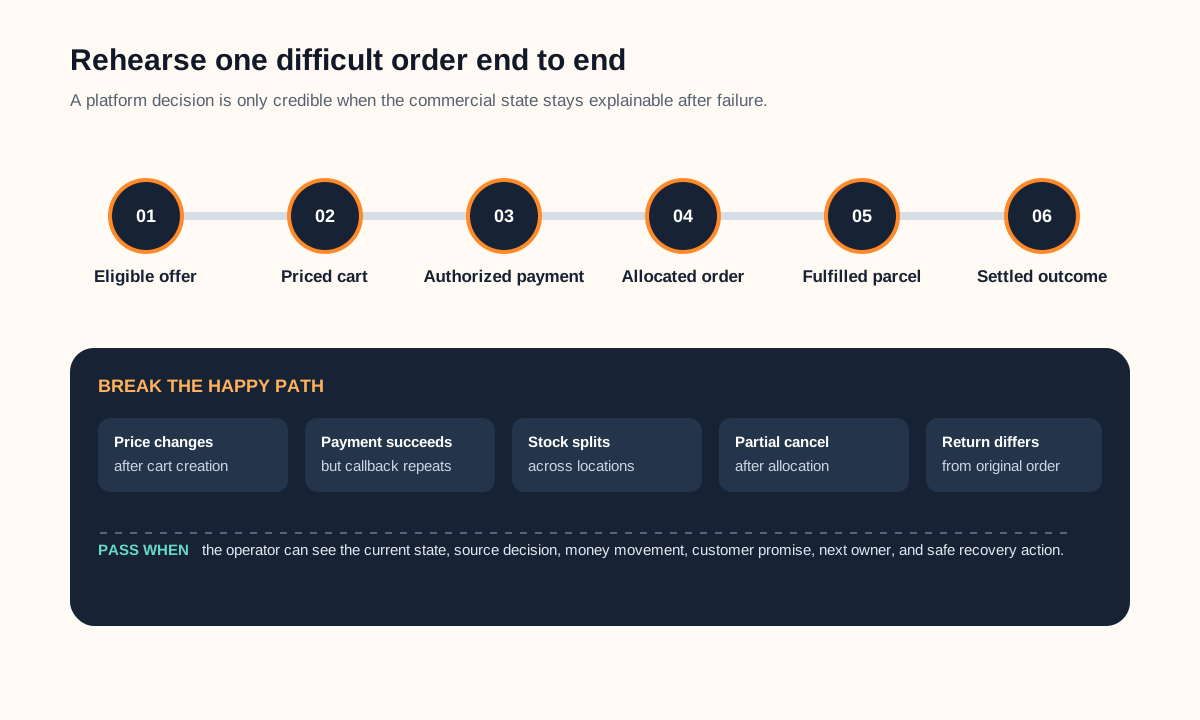
Choose one order that exposes the business: a contracted buyer, regional catalog, bundle, promotion conflict, backordered item, split shipment, failed payment, partial cancellation, exchange, or refund. Rehearse it from product discovery through financial reconciliation.
- Record the customer, channel, eligibility, catalog, price, tax, inventory promise, and promotion decision.
- Create the cart, change a material input, and verify whether the promise is recomputed or preserved.
- Fail or repeat a payment event and prove that the order and money do not duplicate.
- Split allocation or fulfilment, then cancel one line and trace customer communication and stock release.
- Return a different quantity or disposition and reconcile order, payment, inventory, tax, and finance states.
- Ask an operator to explain the current state, decision source, next owner, and safe recovery without engineering access.
Score each option as proven, configurable, custom work, unresolved, or out of scope. A polished demo passes only when the exception path and operator evidence are credible.
Write a one-page commerce architecture decision brief
- Decision: theme, headless, custom, or staged hybrid—and the boundary each term means.
- Buyer and operator: the primary purchase journey and the team that must run it.
- Pressure rules: the few requirements that standard platform behavior does not satisfy.
- Sources of truth: owners for product, price, inventory, customer, order, payment, fulfilment, return, and finance.
- Proof: the difficult order, acceptance evidence, performance and accessibility checks, and recovery drill.
- Ownership: releases, monitoring, support, security, platform upgrades, content, and vendor management.
- Revisit trigger: the measured constraint that would justify moving the boundary later.
If the team still needs to define the broader site, content, analytics, accessibility, and launch responsibilities, pair this brief with the website requirements checklist. Leeonex can help scope a maintainable storefront, custom buyer experience, or connected commerce workflow without treating a larger build as the default answer.
Shopify vs custom ecommerce FAQ
Is Shopify better than a custom ecommerce website?
Shopify is usually the safer starting point when the catalog, promotions, checkout, fulfilment, and account model fit its supported patterns. Custom development becomes reasonable when a valuable business rule cannot be expressed safely through themes, apps, functions, APIs, or a headless storefront, and the team can fund ongoing product ownership.
When should a business use headless Shopify?
Use headless Shopify when the commerce core still fits but the buyer experience needs a separately deployed frontend, unusual content composition, several touchpoints, or deeper product discovery. It adds frontend hosting, preview, caching, observability, API-version, and release responsibilities, so it should solve a measured constraint rather than serve as a default upgrade.
What should be tested before choosing an ecommerce platform?
Test a representative difficult order: customer eligibility, catalog and price, inventory, promotion conflicts, tax and shipping, payment failure, partial allocation, cancellation, fulfilment, refund or return, notifications, finance reconciliation, and operator recovery. Record which system owns each decision and what evidence proves the result.
Does a custom storefront require a custom checkout?
No. A custom or headless storefront can use a platform commerce core and supported checkout. Keeping checkout on a managed platform often reduces payment and operational responsibility. Build or extend checkout only when a validated requirement cannot fit supported mechanisms and qualified security, legal, tax, and payment specialists have reviewed the boundary.