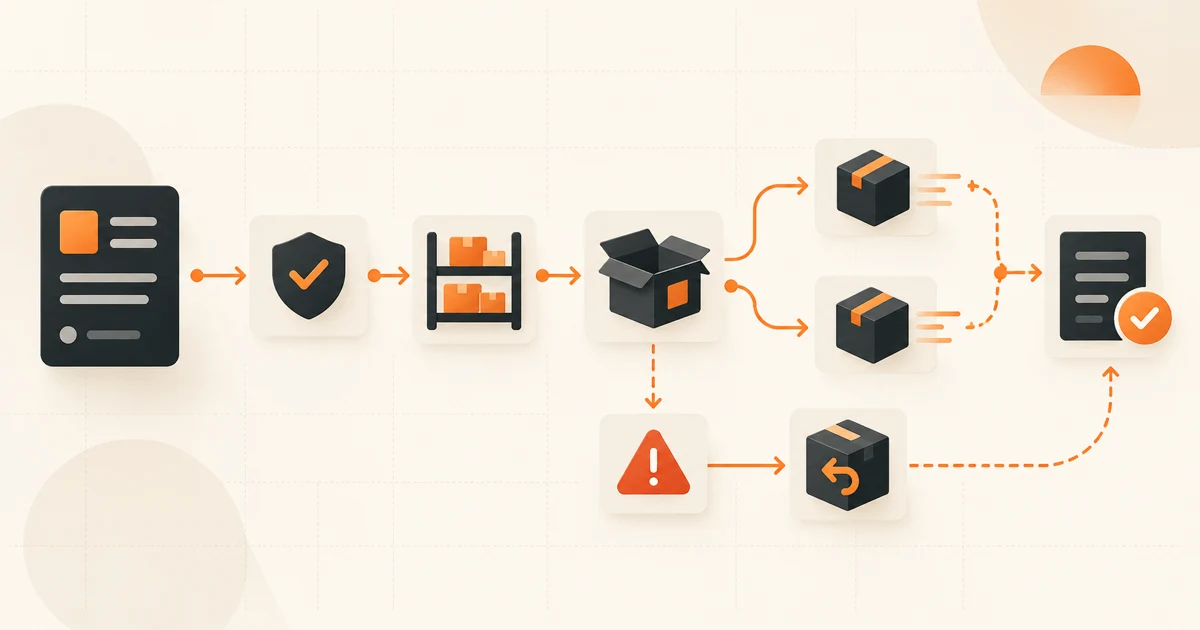
The short answer: define the order lifecycle before the feature list
Order management software requirements should define where orders enter, how lines and prices are validated, which facts permit allocation and fulfilment, how partial outcomes and reversals work, which system owns each record, and how operators detect and repair disagreement. Screens, filters, and status labels matter only after that operating contract is clear.
Start with one representative order from intake to financial closure. Add its hardest likely exception: unavailable stock, a split shipment, a late cancellation, a return, or a payment that succeeds while fulfilment fails. If a proposed system cannot run and explain both paths, a longer feature checklist will not make the choice safer.
Use this guide for the order layer. Pair it with the inventory management requirements checklist when availability and stock movement are in scope, and the payment integration checklist when checkout, refunds, or reconciliation change the order promise. Use the returns management software requirements checklist when authorization, inbound movement, inspection, disposition, and reverse-flow reconciliation need their own operating model.
Write an order state and exception contract
Avoid one status field that tries to mean paid, allocated, shipped, delivered, and closed. Those facts can change independently. An order may be paid but on hold, partly allocated across locations, shipped in two parcels, returned on one line, and still open for a refund. Model order, line, payment, allocation, fulfilment, return, and refund state at the level the business needs to control.
For every transition, name the prior state, triggering fact, permitted actor, validation rule, side effects, customer message, retained evidence, and next legal actions. This turns “support cancellations” into a testable rule: who may cancel, until which fulfilment boundary, what is released or reversed, and what happens if another process changes the order first.
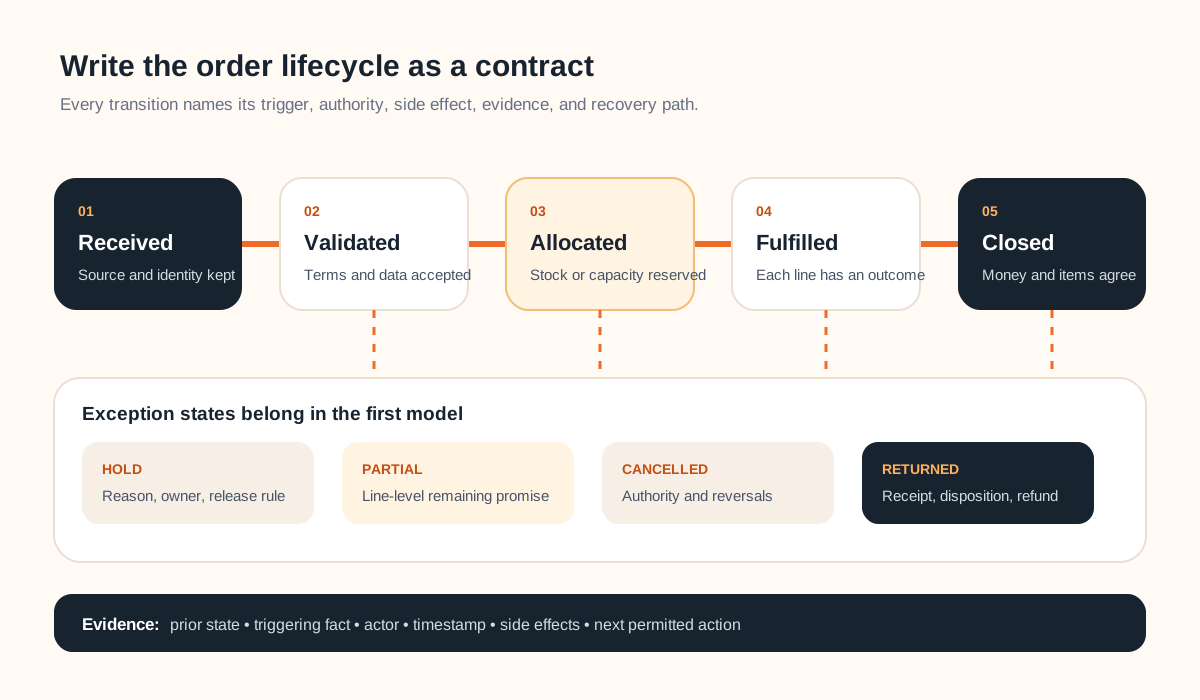
Mature commerce platforms expose this separation because real fulfilment is not one Boolean. Shopify documents that one order can have multiple fulfilments and that fulfilment events record milestones from creation through delivery in its Fulfillment object reference. Its fulfilment-order lifecycle also includes open, on-hold, scheduled, in-progress, incomplete, closed, and cancelled states. Your vocabulary can differ, but it needs the same honesty about work and exceptions.
Define eight requirement lanes around a real order
Use recent orders, support cases, refunds, fulfilment errors, and reconciliation work as evidence. Write each requirement as a behavior and an observable result, not a software menu item.
| Lane | Decision to specify | Evidence |
|---|---|---|
| Intake and identity | Sources, duplicate rule, order and line identifiers | The same request creates one traceable order |
| Commercial terms | Price, tax, discount, currency, credit, and revision authority | The accepted terms can be reconstructed |
| Validation and holds | Required data, risk checks, reasons, owner, release rule | Invalid or held work cannot advance silently |
| Allocation | Eligible stock or capacity, location, reservation, substitution | Promised quantity has an owned source |
| Fulfilment | Split, partial, backorder, collection, shipment, completion | Every line has a visible outcome and remainder |
| Change and reversal | Edit, cancellation, return, exchange, refund, and restock rules | Side effects reverse once and remain linked |
| Communication and support | Promise, notification, exception view, permitted operator action | Customer and support see the same explainable state |
| Control and reconciliation | Permissions, audit, monitoring, comparison, difference owner | Orders, items, money, and downstream records agree |
Treat partial outcomes as normal
A line can be fulfilled, cancelled, returned, or still open while another line follows a different path. Define quantity at each stage—ordered, accepted, allocated, fulfilled, returned, refunded—and the invariant connecting them. Decide whether a customer can accept a split, whether substitutions require approval, when a remainder becomes a backorder, and when the business may close it.
Separate operational and display status
Customers need a small, understandable promise. Operators may need precise sub-states such as allocation failed, label created, carrier collected, return inspected, or refund pending. Map internal states to customer language deliberately; do not expose implementation codes or claim completion before the accountable evidence exists.
Give each system one clear truth to own
List the channels that create or change orders and the systems that own customer, product, price, inventory, payment, fulfilment, messaging, support, and finance facts. For each connection, record direction, identifier mapping, freshness, retry and duplicate behavior, reconciliation method, failure owner, and repair action.
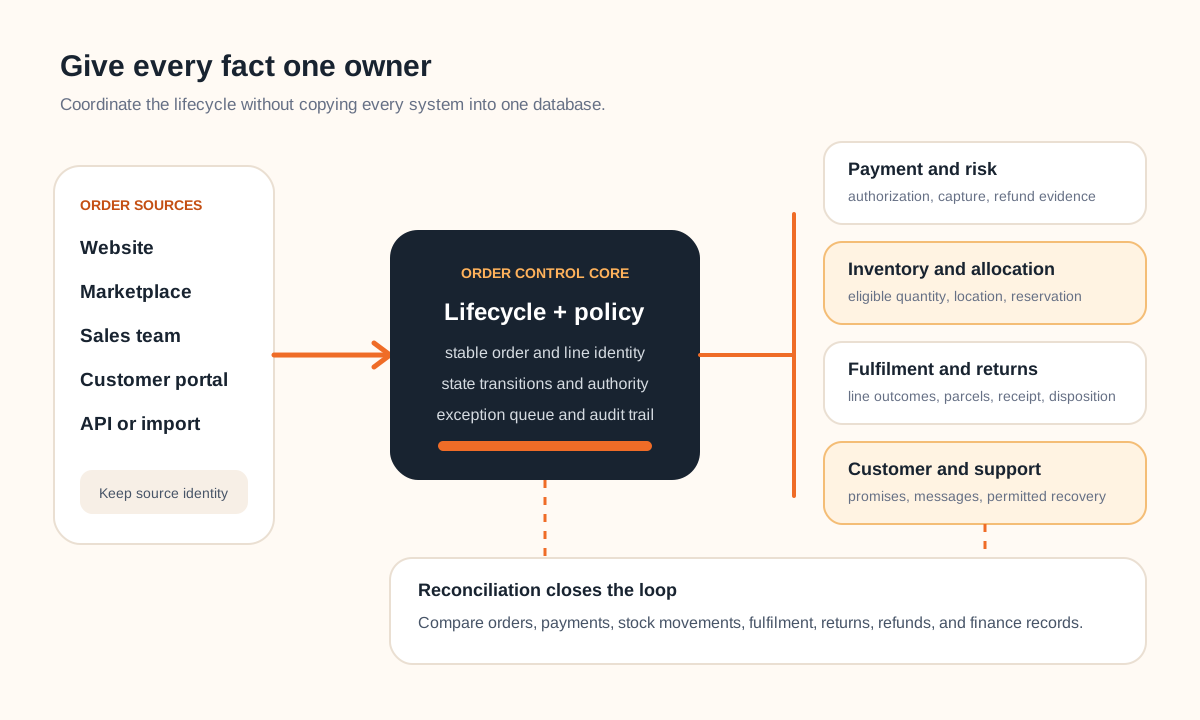
Do not make the order service trust a browser success page or one fragile callback for irreversible work. For example, Stripe's Checkout fulfilment guidance recommends webhook-triggered fulfilment and requires the fulfilment function to be safe when called more than once. Apply the broader rule even outside payments: record incoming events, verify them, make effects idempotent, and reconcile the resulting business records.
Reconciliation is not a dashboard total. It is a repeatable comparison that can identify an order paid but not confirmed, stock reserved without an open order, fulfilled quantity with no customer promise, a return without disposition, or a refund absent from finance. Every mismatch needs severity, owner, allowed correction, and an audit record.
Choose packaged, extended, or custom software from fit
Compare candidates with scenario demonstrations, not feature counts. Give every vendor or implementation option the same normal order, split or partial order, late change, return, and integration failure. Ask the team operating the workflow to score the outcome and the recovery burden.
Configure
Use a packaged platform when standard states, roles, and integrations fit without repeated workarounds.
Extend
Keep the stable platform core when a small number of owned rules or interfaces create the real difference.
Build
Consider custom software when the lifecycle, exception control, or cross-system coordination is central to operations.
Include migration, integration ownership, change control, support access, reporting, vendor limits, and exit or export in the comparison. If the broader question is whether the workflow justifies custom software at all, use the no-code versus custom software decision guide before selecting an architecture.
Break the lifecycle before accepting the system
Test business outcomes across the user interface, integrations, operator tools, customer messages, records, and reports. A passing screen is not enough if a repeated event duplicates a shipment or a correction leaves finance and inventory apart.
- Duplicate intake, invalid fields, conflicting updates, and source-system delays.
- Payment pending or failed, risk hold, unavailable stock, and allocation across multiple locations.
- Partial fulfilment, backorder, substitution, missed service, damaged item, and delivery failure.
- Address or quantity change, cancellation racing fulfilment, full and partial return, exchange, and refund.
- Repeated, delayed, missing, and out-of-order integration events plus safe replay after outage.
- Unauthorized actions, operator correction, audit history, alerting, reconciliation mismatch, and rollback.
Use the software acceptance criteria checklist to turn these scenarios into owners, inputs, expected results, tolerances, and release evidence.
A one-order decision brief
Complete this worksheet before requesting a proposal or build estimate:
- Buyer, channel, order type, line types, and promised outcome.
- Order, line, customer, payment, stock, and fulfilment identity.
- Normal states, exception states, and transition authority.
- Pricing, validation, allocation, fulfilment, and reversal rules.
- Systems of record, integration contracts, and failure owners.
- Operator permissions, customer messages, and retained evidence.
- Migration sample, acceptance scenarios, reconciliation, and launch gate.
This gives a custom business application team enough context to identify a sensible first release without pretending every future channel and exception belongs in v1.
Frequently asked questions
What should order management software requirements include?
Include order sources, identifiers, line and price rules, validation, inventory allocation, payment and risk gates, fulfilment, split and partial outcomes, cancellation, returns, refunds, customer communication, permissions, integrations, audit history, reconciliation, reporting, migration, support tools, and acceptance scenarios. Define states and exceptions, not only screens and features.
Should a business buy or build order management software?
Buy or configure a packaged system when the operation can adopt its order lifecycle and integrations. Extend a platform when a few differentiating rules sit around a stable core. Consider custom software when order decisions, exceptions, permissions, or cross-system coordination are central to the business and packaged workarounds create repeated risk. Prove the choice with representative order scenarios before committing.
How do you test an order management system before launch?
Test one complete normal order plus duplicates, invalid data, payment delays, unavailable stock, split allocation, partial fulfilment, address changes, cancellation races, returns, refunds, integration outages, delayed and repeated events, permission failures, reconciliation mismatches, and migration samples. Verify customer messages, operator actions, downstream records, audit evidence, and recovery for each case.