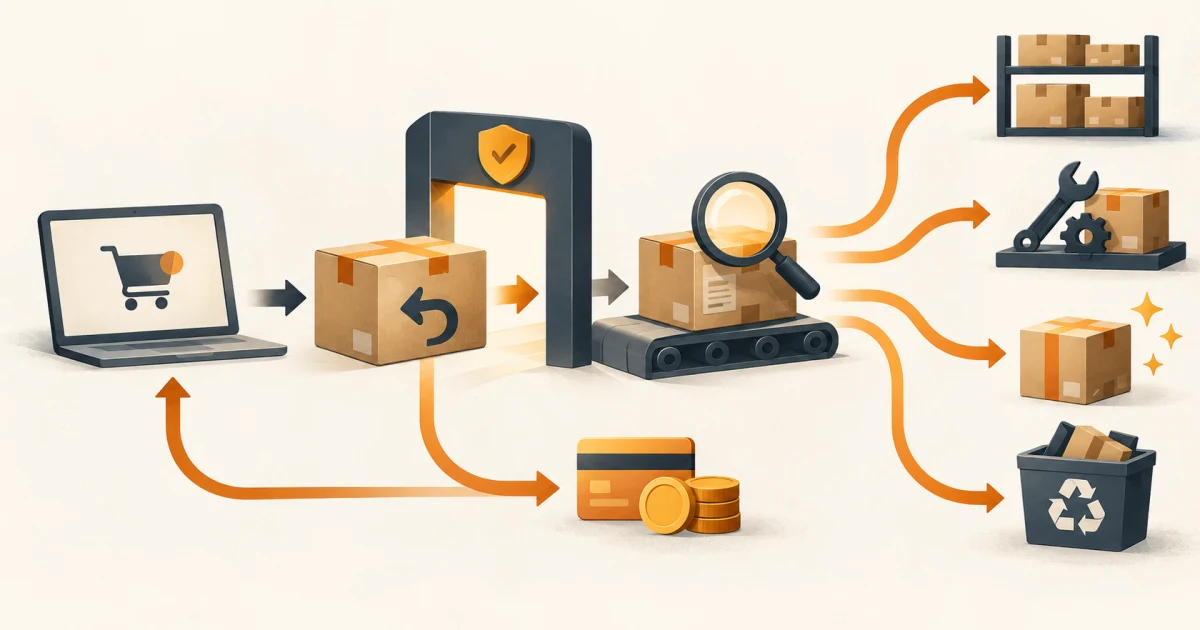
Define the reverse transaction from request to reconciliation
A useful returns management software requirements checklist defines how an order line becomes an authorized return, how the expected item travels back, what receiving and inspection prove, who chooses a disposition, and how customer, inventory, vendor, repair, replacement, and financial outcomes reconcile.
Cover original-order lookup, eligibility, item and serial identity, reasons and evidence, authorization, labels, inbound tracking, receiving, inspection, quarantine, disposition, refund, credit, exchange, replacement, repair, return to vendor, notifications, permissions, integrations, audit history, reporting, and exception recovery. Then walk the same difficult returns through every vendor or build option.
Write a return decision contract before comparing software
Choose a real return with enough friction to expose the process: a partial quantity, serialized item, advance replacement, repair, missing accessory, or item that may not return to saleable stock. Record the original order and entitlement, requester, item, quantity, serial or lot, reason, evidence, policy version, authorization, expected arrival, inspection, disposition, customer promise, financial result, and owner.
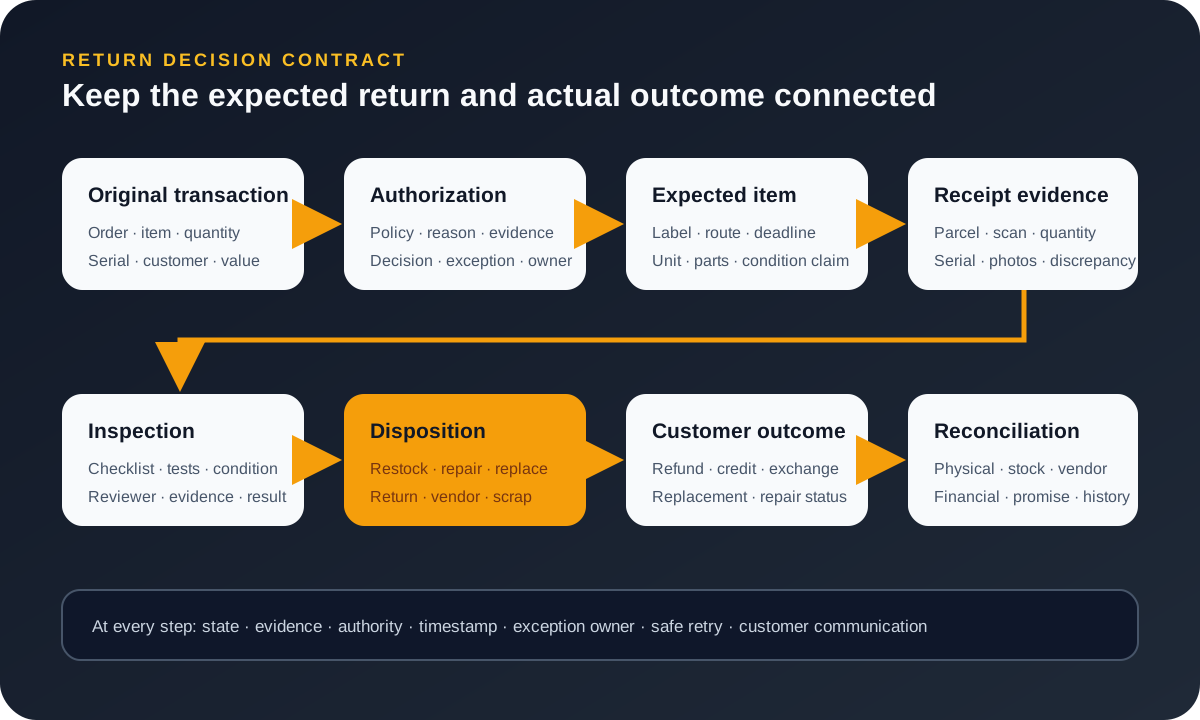
Separate facts from decisions. “Box arrived” is a receiving event. “Unit is resaleable” is an inspection decision. “Restock it” is a disposition. “Refund approved” is a financial decision. Combining them in one status makes partial receipts, reversals, disagreements, and audit questions difficult to explain.
Microsoft’s current Returns Management documentation describes distinct credit, replacement, advance cross-ship, and repair-and-return paths, plus vendor returns and scrap. Your system may use different names, but it still needs explicit physical and financial outcomes rather than one generic “closed” state.
Cover the requirement lanes that keep returns explainable
Policy and eligibility
Original transaction, customer, channel, item, quantity, reason, dates, geography, warranty or contract context, exclusions, fees, evidence, exception authority, and policy version.
Authorization and logistics
RMA number, lines, labels or QR codes, carrier, drop-off, packaging, pickup, expected item, inbound tracking, expiry, cancellation, shipment exceptions, and customer status.
Receiving and inspection
Dock, parcel and line matching, barcode or serial capture, quantities, accessories, photos, condition, test result, split receipts, unknown items, quarantine, and discrepancy ownership.
Disposition and work
Restock status, refurbish, repair, replace, exchange, return to customer, scrap, recycle, vendor return, transfer, work orders, approval, and location changes.
Customer and finance
Refund, credit, replacement, charges, taxes, payment method, timing, approvals, notifications, disputes, duplicate prevention, posting, and reconciliation.
Operations and governance
Roles, permissions, history, reason and disposition administration, integrations, migration, dashboards, exports, retention, privacy, support queues, and exception aging.
Model the RMA at line level. One parcel may contain several items, only some may arrive, and each unit can receive a different inspection and disposition. Shopify’s current ReturnLineItem documentation exposes separate requested, processable, processed, refundable, and refunded quantities. That is a useful reminder that one “return quantity” cannot describe the complete lifecycle.
Make eligibility and authorization reproducible
Identify the original sale, fulfillment, shipment, invoice, item, serial or lot, customer, contract, warranty or entitlement, and policy version used for the decision. Capture facts such as delivery date, requested quantity, reason, condition claim, photos, missing parts, and desired outcome without presenting a customer’s selection as verified inspection evidence.
Write rules for auto-approval, human review, decline, and exception. Name what happens when the order cannot be found, the request is late, the quantity exceeds the fulfilled quantity, the serial belongs to another order, the item is hazardous, a promotion changed the paid amount, or the customer asks for a different outcome. Keep the rule version and reviewer with the decision.
Authorization should create an expected return, not pretend the item has arrived. Define label generation, carrier or drop-off, packaging instructions, pickup, expiry, cancellation, lost parcel, duplicate shipment, and customer-visible status. Decide whether a refund, credit, or advance replacement can happen before receipt and what control prevents duplicate value from being issued.
Separate receipt, inspection, disposition, and settlement
Receiving should capture what physically arrived: facility, dock or location, parcel, carrier event, timestamp, operator, RMA, line, item, serial or lot, quantity, accessories, obvious damage, and evidence. Support unmatched parcels, wrong items, missing paperwork, split receipts, over-receipt, and packages that combine more than one authorization.
Inspection applies a versioned checklist to the received unit. Record condition, tests, photos, measurements, defect code, missing parts, resale grade, safety hold, reviewer, and decision. Microsoft documents disposition actions including credit, credit-only, scrap, replace-and-credit, replace-and-scrap, and return-to-customer in its Dynamics 365 disposition guidance. The important principle is that a disposition has both physical and financial consequences.
Store events rather than overwriting history. GS1’s EPCIS 2.0 standard models events with business steps and dispositions that describe an object’s condition after an event. You do not need to adopt EPCIS to use the lesson: retain the item, time, place, action, condition, business context, and source evidence needed to reconstruct the return.
Assign authority across customer, warehouse, inventory, and finance
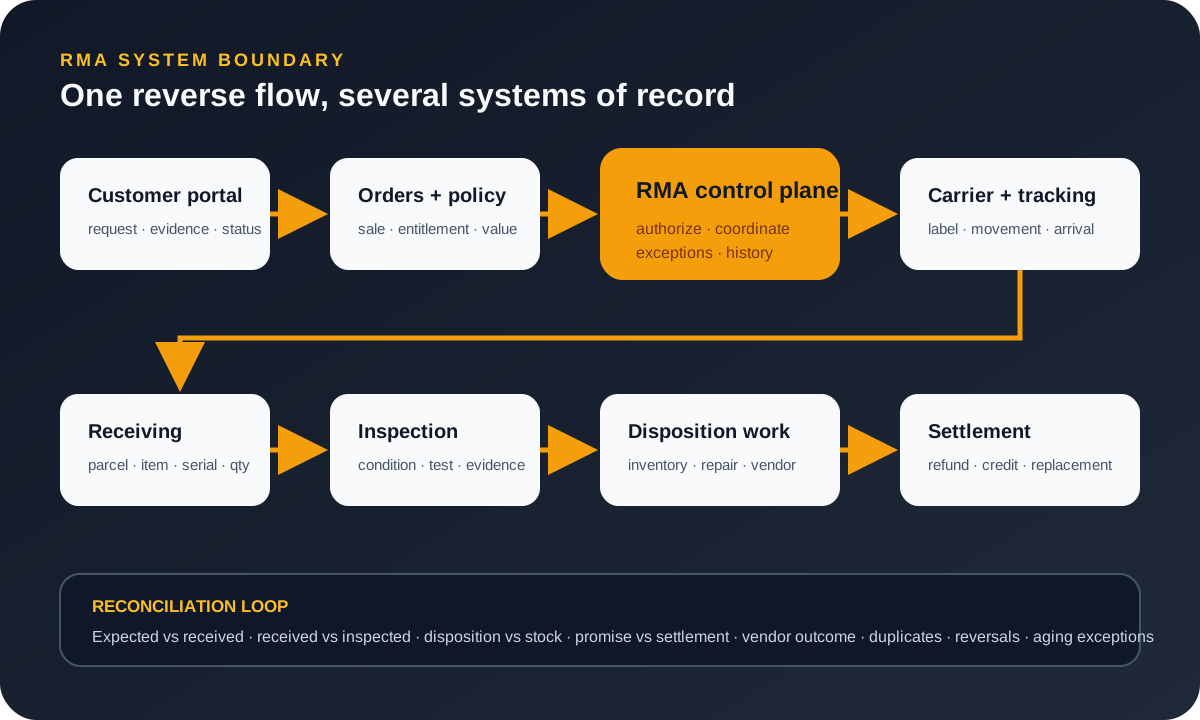
The commerce or order system usually owns the original sale and fulfilled quantity. The RMA workflow owns authorization and the expected return. Warehouse tools own physical receipt and location evidence. Quality or repair processes own inspection and work. Inventory owns stock state, while finance or payment systems own posted credits and refunds. Document which system may change each record and how every other system learns about it.
Use stable identifiers and idempotent commands for labels, receipt, disposition, restock, replacement, and refund. A retry must not create a second parcel, stock movement, order, or credit. Preserve source timestamps, correlation IDs, payload versions, and failure details. Reconcile orphan authorizations, unreceived parcels, received-but-uninspected items, disposition without stock movement, replacements without a return, and refunds that failed after operational approval.
The order management requirements checklist covers the forward transaction, while the inventory management requirements checklist helps define stock identity and state. Returns software should connect those sources without silently becoming the authority for both.
When a failure may be covered by a versioned product promise, the warranty management software requirements checklist separates entitlement, diagnosis, adjudication, remedy, and supplier recovery from the physical return and refund path.
Choose buy, extend, or build by exception fit
Buy and configure
A packaged product supports the real customer channels, item identity, policy rules, logistics, warehouse steps, dispositions, finance outcomes, integrations, administration, and reporting.
Extend an ERP or commerce platform
The system of record handles the core transaction, but a customer portal, warehouse workflow, carrier connection, vendor path, repair step, notification, or exception console is missing.
Build a focused product
Returns are inseparable from a distinctive service, serialized asset, repair network, multi-party workflow, or operational rule set that packaged products repeatedly force into manual workarounds.
Do not custom-build policy, carrier, payment, or accounting behavior that a suitable platform already handles well. Do not keep a packaged product whose status model cannot represent the physical and financial truth. A focused portal or orchestration layer can be enough when system-of-record boundaries are clear. Leeonex’s custom web app development service starts with that workflow and boundary map.
Complete this RMA scenario worksheet
- Original transaction: Record order, fulfillment, invoice, item, quantity, serial or lot, customer, channel, and paid value.
- Request: Capture requester, reason, evidence, desired outcome, requested quantity, and missing information.
- Decision: State the policy version, eligibility result, exception, reviewer, charges, deadline, and customer promise.
- Movement: Define label or drop-off, carrier, packaging, tracking, expected item, expiry, and lost-parcel behavior.
- Receipt: Specify parcel matching, item and serial capture, quantities, condition evidence, discrepancies, and quarantine.
- Disposition: Name the allowed outcomes, authority, work order, stock state, vendor path, and required evidence.
- Settlement: Define refund, credit, replacement, repair, fees, posting, notification, and duplicate prevention.
- Exceptions: Walk no arrival, wrong item, partial receipt, failed label, duplicate event, failed refund, integration outage, reversal, and reconciliation.
Run the worksheet with customer service, warehouse, quality, finance, inventory, IT, and the person who owns return policy. Their disagreements are requirements. Resolve them before a demo turns one team’s happy path into the system design.
Returns management software requirements FAQ
What should returns management software requirements include?
Include original-order lookup, return eligibility and exceptions, item and serial identity, reasons and evidence, authorization, labels or drop-off, inbound tracking, receiving, inspection, quarantine, disposition, refunds, credits, exchanges, replacements, repairs, return-to-vendor, inventory and finance integration, notifications, permissions, audit history, reporting, reconciliation, administration, and recovery from partial or failed steps.
What is the difference between an RMA and a refund?
An RMA authorizes and tracks the return of an item or related service process. A refund is one possible financial outcome. A return may instead result in credit, replacement, repair, rejection, return to the customer, restock, scrap, or return to a vendor, and physical receipt may occur before or after a financial decision depending on policy.
Should returns software be part of the ERP or a separate product?
Keep it in the ERP when the ERP supports the real return paths, warehouse work, dispositions, credits, replacements, and reporting with acceptable user experience. Add a focused portal or orchestration layer when customer initiation, partner workflows, carrier connections, or exception handling are weak. A separate custom product still needs explicit authority and reconciliation boundaries with the ERP.
How should RMA software be tested before rollout?
Run ordinary and difficult scenarios: ineligible items, partial quantities, wrong items, missing serials, damaged packaging, no parcel arrival, split receipts, failed labels, advance replacement, rejected inspection, repair, vendor return, duplicate webhook, partial refund, and integration outage. Verify physical location, customer promise, inventory state, financial state, evidence, ownership, and recovery after every step.