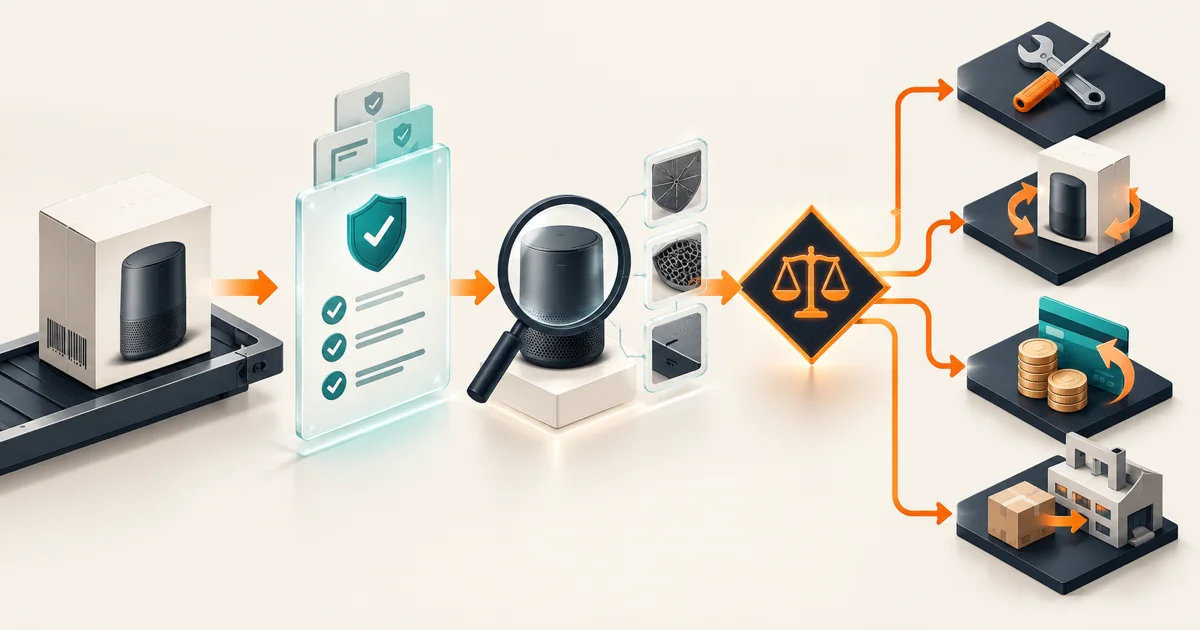
Define an explainable warranty decision before choosing software
A useful warranty management software requirements checklist defines how the system identifies the exact product, selects the warranty terms that applied to its sale or activation, collects failure evidence, checks eligibility, records a decision, authorizes a remedy, and reconciles the physical and financial outcome. It also defines who owns exceptions, supplier recovery, safety signals, and failed integrations.
Start with one difficult claim. Follow it from customer or dealer intake through coverage, triage, diagnosis, approval, repair or replacement, parts, logistics, payment, supplier recovery, closure, and reopening. A feature list is useful only when it can preserve the evidence and obligations across that complete decision.
Write a warranty decision contract for one claim
Select a claim with enough friction to expose the real system: an item bought through a dealer, registered late, repaired once, missing part of its proof of purchase, covered by a policy that changed after sale, and eligible for supplier recovery only if the diagnosis and replaced part are documented. Record the product, unit, claimant, transaction, activation, policy, symptom, dates, location, usage where relevant, evidence, diagnostic work, requested outcome, and current owner.
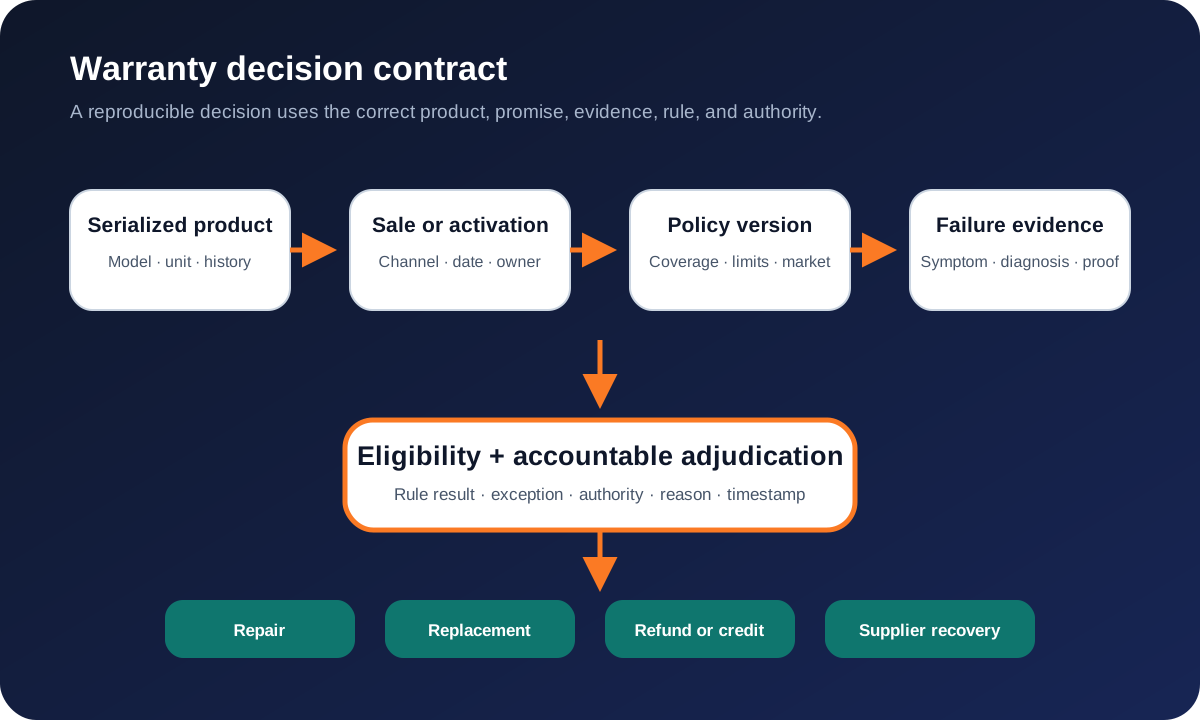
Keep the customer report, diagnostic finding, policy check, and adjudication separate. “Does not power on” is a reported symptom; a failed component is a diagnosis; coverage depends on the applicable promise and evidence; the remedy is a controlled business decision. Collapsing those records into one status or editable note makes later review and quality analysis unreliable.
Version the warranty terms. A claim opened today may depend on the product, market, transaction date, activation rule, plan, campaign, or extension that applied months or years earlier. Preserve the evaluated rule set and inputs so a later policy edit does not silently rewrite the basis of a closed decision.
Cover the requirement lanes that complete the claim lifecycle
Product and entitlement
Models, serials, lots where relevant, sales and activation, owners, dealers, warranty products, versioned terms, duration or usage limits, extensions, transfers, campaigns, and prior claims.
Intake and communication
Customer, dealer, service, API, and staff intake; identity checks; proof; symptoms; attachments; consent; acknowledgement; status; missing-information requests; and accessible communication.
Triage and adjudication
Completeness, duplicates, coverage, dates, usage, exclusions, abuse signals, severity, safety escalation, diagnosis, estimates, rules, approvals, goodwill, denials, appeals, and reopening.
Remedy and execution
Repair authorization, labor, parts, depot or field work, replacement, advance replacement, refund or credit, return authorization, shipping, inspection, scrap, and customer acceptance.
Recovery and finance
Supplier responsibility, claim split, evidence packages, debit or credit, payment, taxes, reserves where applicable, rejected recovery, accounting references, settlement, and reconciliation.
Platform and operations
Roles, segregation, delegation, audit history, notifications, search, queues, service levels, reporting, integrations, bulk work, migration, exports, retention, privacy, backup, monitoring, and support.
Add product-specific dimensions only when they affect a real decision: operating hours, mileage, installation record, maintenance evidence, consumables, calibration, connected-device telemetry, environment, or service campaigns. Define the source, reliability, permitted use, and dispute path for every signal.
Do not treat warranty, return, repair, replacement, and recall as synonyms. A warranty claim may not require a return; a return may be outside warranty; a repair can create a new parts or labor obligation; and a safety or campaign process may override the ordinary commercial route. The system should connect these processes without erasing their separate authority.
Automate stable checks and expose consequential exceptions
Use deterministic automation for reliable checks such as identifier format, required evidence, duplicate detection, coverage dates, configured limits, and straightforward routing. Keep a named human checkpoint for ambiguous identity, conflicting evidence, unusual cost, safety indicators, suspected abuse, policy exceptions, goodwill, disputed diagnosis, and failed supplier recovery.
SAP’s current warranty-claim processing documentation separates completeness and reimbursement eligibility, the claim decision, payment, and supplier reimbursement. That separation is a useful requirements principle even when you use another platform: one approved customer remedy does not prove that the supplier claim, parts movement, service payment, or accounting entry completed.
Define an exception register with type, severity, owner, due date, allowed actions, required evidence, escalation, customer promise, financial exposure, and closure proof. Measure queue age and unresolved obligations, not only average claim time. Fast closure can hide claims that were denied, duplicated, or moved to a spreadsheet without a reconciled outcome.
Map every physical and financial boundary
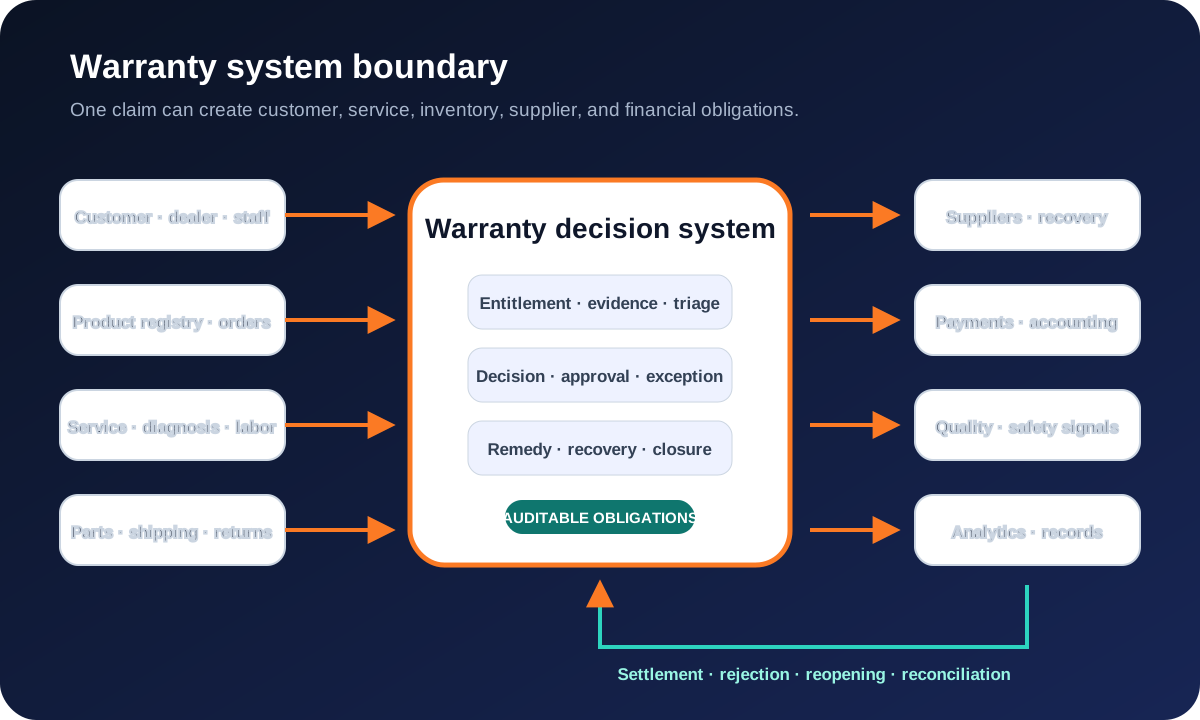
Assign authority for the product registry, customer or dealer, order, warranty terms, service order, diagnosis, parts, shipment, inventory state, payment, supplier recovery, accounting entry, quality signal, and communication. For each integration, define identifiers, timing, ordering, duplicate handling, correction, retry, reconciliation, monitoring, and the team that owns a mismatch.
The related returns-management requirements guide goes deeper on authorization, inbound logistics, inspection, disposition, and customer outcomes. Use both when warranty decisions regularly create RMAs, but keep entitlement and reverse-logistics state separate enough to explain each result.
Legal requirements vary. For U.S. consumer products, the Federal Trade Commission’s business guidance on federal warranty law explains that written warranty obligations and disclosures have specific legal meanings and that state-law rights can also apply. Do not encode a generic internet summary as policy. Have qualified counsel approve the exact terms, disclosures, eligibility logic, records, and customer communication for each jurisdiction and product.
Choose the smallest ownership boundary that closes the loop
Use an existing ERP, CRM, service, or warranty module when it can represent the real policy versions, claim paths, service work, supplier recovery, and reconciliation with acceptable operator and partner experience. Add a focused portal or integration layer when intake, evidence collection, dealer collaboration, or cross-system orchestration is the actual gap.
Choose a specialist product when warranty is a substantial, repeatable operation and the platform fits the product, territory, service network, remedy, and recovery model. Consider custom ownership only when distinctive decision rules, collaboration, or system boundaries produce durable value and the team can fund security, accessibility, operations, policy changes, support, and ongoing testing.
A focused web application or portal can connect customers, dealers, service partners, and internal reviewers without replacing every source system. Compare the options with the same claim scenarios and include configuration, integration, migration, operating effort, upgrade risk, observability, and exit access—not license price alone.
For a narrower worked example, see the warranty claim decision workflow concept study. It separates intake, evidence, eligibility, diagnosis, adjudication, remedy, and reconciliation for one proposed first release, without presenting the model as delivered client work.
Run a difficult-claim rehearsal before rollout
- Select the claims. Include valid, incomplete, ineligible, ambiguous, duplicate, late, goodwill, high-cost, and supplier-recoverable cases.
- Freeze the historical inputs. Capture product, transaction, activation, policy version, claimant, symptom, evidence, and prior service.
- Execute the decision. Test rules, human review, authority, estimates, approvals, denials, overrides, and customer communication.
- Complete the remedy. Exercise repair, parts, logistics, replacement, refund or credit, and customer acceptance where applicable.
- Recover the cost. Build and submit supplier evidence, handle a rejection, post the result, and reconcile open balances.
- Break the flow. Simulate duplicate events, a failed label, unavailable part, integration outage, payment failure, and withdrawn approval.
- Prove control. Reopen a claim, export its evidence, trace every decision, restore service, and show who owns every unresolved obligation.
The output is a decision brief: configure the current platform, improve policy and data first, buy specialist software, build a focused portal, add integrations, or own a custom claim system. Include exclusions, migration scope, acceptance scenarios, operating roles, and legal or safety review needs.
Warranty management software FAQ
What should warranty management software requirements include?
Include product and serial identity, sale or activation, versioned warranty terms, coverage and eligibility, claimant and channel intake, evidence, triage, adjudication, approvals, goodwill, repair, replacement, refund or credit, parts and logistics, supplier recovery, labor and cost rules, notifications, permissions, audit history, integrations, reporting, reconciliation, migration, and exception recovery.
What is the difference between warranty software and returns software?
Warranty software decides whether a product failure is covered and coordinates the authorized remedy and cost responsibility. Returns software authorizes and tracks reverse logistics and customer outcomes. The workflows can overlap, but a return is not automatically a warranty claim, and an approved warranty claim may be resolved without a product return.
Should warranty claims be fully automated?
Automate stable, low-consequence checks when the input evidence and rules are reliable. Route ambiguity, suspected abuse, safety signals, policy exceptions, costly remedies, unusual supplier liability, and failed integrations to named human owners. Preserve the rule version, inputs, decision, and override reason either way.
How should warranty management software be tested?
Rehearse valid, invalid, ambiguous, duplicate, late, goodwill, multi-item, repaired, replaced, refunded, supplier-recoverable, safety-related, and integration-failure claims. Verify historical policy selection, evidence, permissions, notifications, inventory movements, payments, supplier claims, accounting, reopening, audit history, and reconciliation.