Answer first
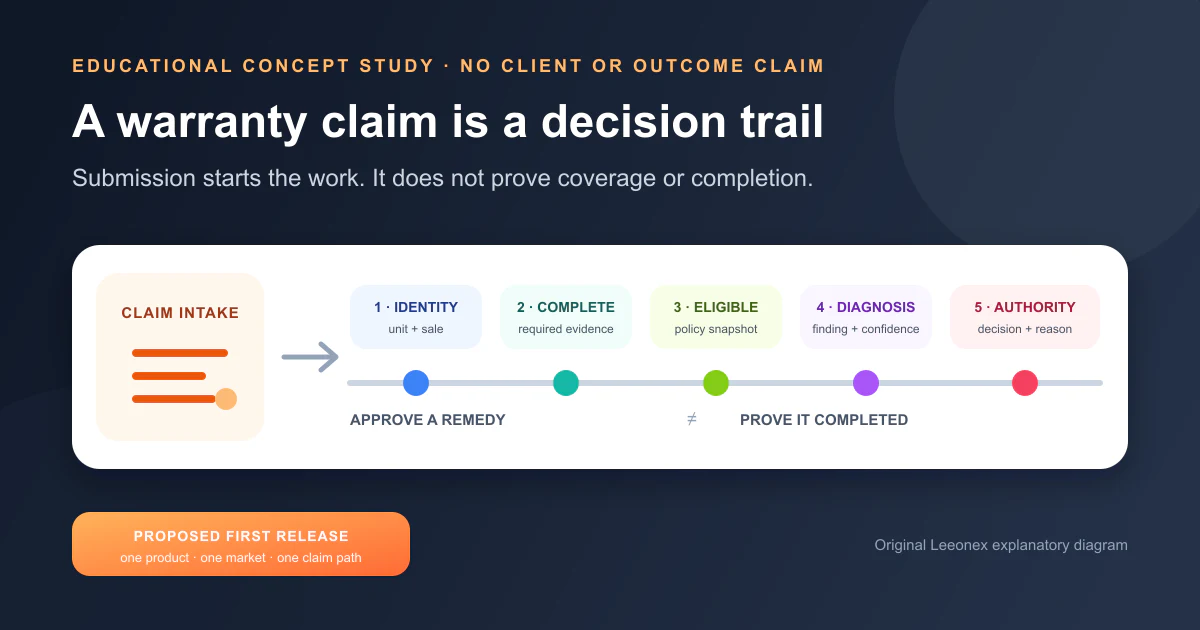
Treat a warranty claim as an evidence-backed decision, not a form that becomes approved when it is submitted.
The smallest useful warranty claim workflow identifies the exact product and transaction, freezes the promise that applied, checks whether the submission is complete, separates reported symptoms from diagnosis, records who may decide, and reconciles the approved remedy after execution. Every ambiguous or failed step stays owned instead of disappearing behind a single “in progress” status.
This is an educational concept study for a team considering a focused web application or extension to an existing warranty platform. Leeonex did not build or test this workflow for a client. No product, claimant, policy decision, repair, replacement, refund, supplier recovery, time saving, or business result here is real. The counts in the hero describe the model, not performance.
Illustrative discovery conversation — not a client quotation
“The customer uploaded the receipt. Can we approve the claim now?”
Illustrative warranty lead: “The serial exists, but registration was late, the policy changed after sale, and the service partner has not confirmed the failure.”
Illustrative Leeonex response: “Then receipt is only the first state. Which evidence establishes identity, eligibility, diagnosis, decision authority, and completed remedy?”
Both voices are invented teaching examples. They are not a customer conversation, testimonial, quotation, or description of delivered work.
Starting situation and intended buyer
Imagine a manufacturer or distributor receiving warranty claims through email, dealer portals, phone calls, and spreadsheets. One system knows the serial number, another knows the sale, a PDF stores the warranty wording, and a service partner sends its diagnosis later. Operations can see that a claim exists, but not always which promise applied, whether the evidence is sufficient, who approved an exception, or whether the remedy finished.
The intended buyer is a warranty operations leader or service manager working with product, quality, finance, legal, and engineering owners. Constraints may include dealer sales, delayed registration, multiple policy versions, serial or lot identity, proof of purchase, parts availability, safety escalation, goodwill, supplier recovery, and disconnected service systems. This concept cannot decide those rules; it makes them visible.
Give every role a bounded decision
- Claimant or dealer: reports the product, transaction, symptom, requested help, and available evidence.
- Intake owner: resolves identity, duplicates, consent, and missing information without deciding coverage.
- Technical reviewer: records inspection, diagnostic findings, tests, parts, and uncertainty separately from the original report.
- Adjudicator: applies the correct policy version, records eligibility and exclusions, and routes exceptions to an authorized owner.
- Remedy owner: coordinates repair, replacement, refund, credit, or another approved action and proves completion.
- System worker: sends controlled commands to connected systems and records responses; it does not invent a diagnosis or policy exception.
Keep the claimant's statement, inspection finding, coverage check, decision, and remedy as separate records. “Will not start” is a symptom. “Failed component” is a diagnostic finding. “Covered under policy version 4” is an eligibility conclusion. “Replace” is an authorized remedy. Combining them in one editable note makes review, correction, and reporting unreliable.
The core flow: identify, complete, assess, decide, reconcile
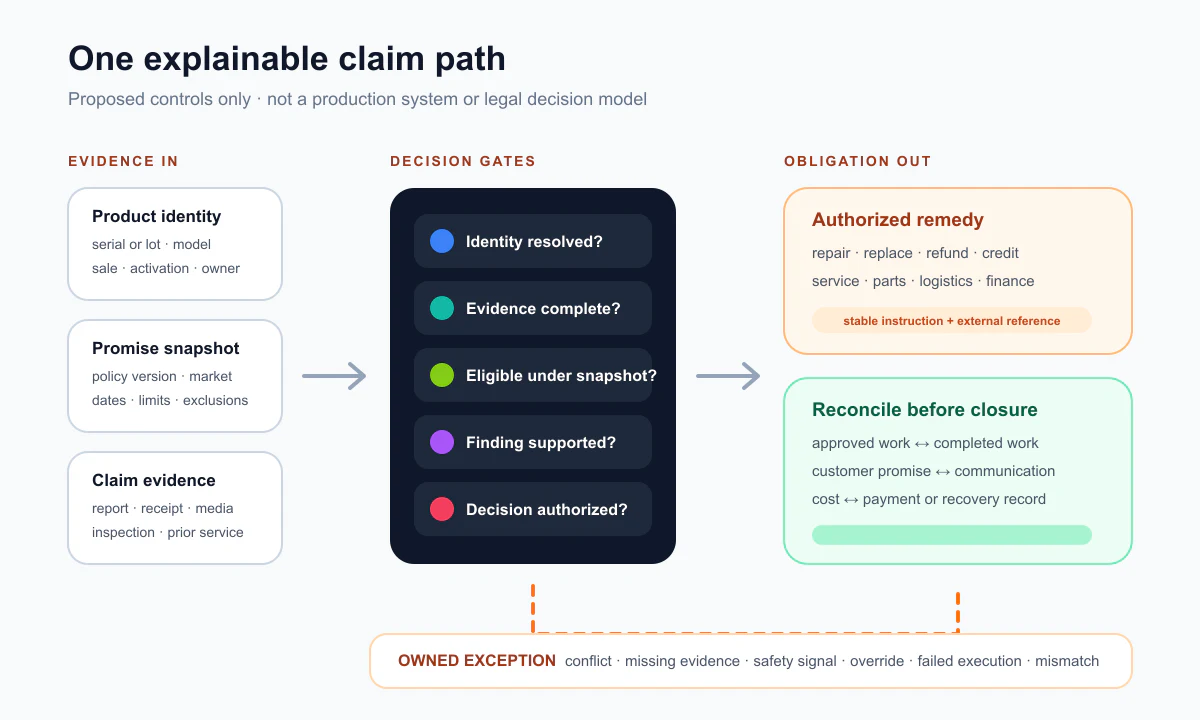
Start by assigning one stable claim identity while preserving the source and any suspected duplicates. Resolve the exact product, unit or lot where relevant, claimant, sale or activation, channel, prior service, and the historical policy snapshot. If those facts conflict, place the claim in an explicit identity exception; do not silently choose the most convenient record.
A completeness gate asks whether the required information exists. Eligibility asks whether the known facts satisfy the applicable promise. Diagnosis asks what failed and with what confidence. Adjudication records the rule or human authority, reason, evidence, and any override. The approved remedy then creates controlled work for service, parts, logistics, payment, or supplier recovery. The claim closes only when required outcomes reconcile or an accountable exception remains visible.
Build one explainable claim path first
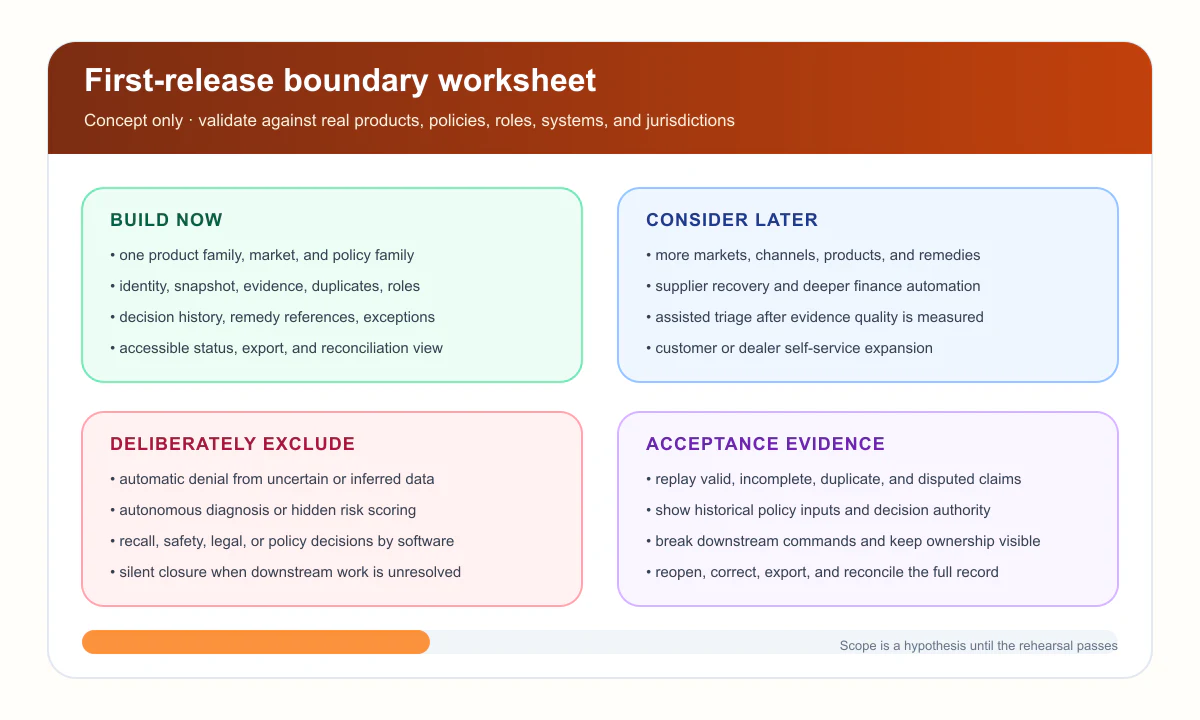
A responsible first release can cover one product family, one market, one policy family, one intake channel, and a limited remedy set. Build product and transaction matching, policy snapshotting, required-evidence requests, duplicate review, role-aware decisions, history, customer-safe status messages, remedy references, and an unresolved-obligation queue. Include accessible forms and exports that a reviewer can inspect without developer help.
Keep advanced fraud scoring, autonomous diagnosis, predictive failure models, multi-party supplier recovery, recall management, complex reserves, and every international policy variation for later. Exclude automatic denial from uncertain data. If policy and product identity are still inconsistent, repair those foundations before building a larger workflow.
The warranty management software requirements guide covers the broader platform, integrations, buy-versus-build choice, and operating model. This study goes deeper on one claim decision. Leeonex's custom web application service is relevant when that path cannot be handled responsibly through process repair or configured software.
Architecture and implementation decisions
- Store stable claim, product, transaction, policy-version, and remedy identities. Preserve the exact inputs evaluated by each decision rather than recalculating history from current data.
- Use explicit states and allowed transitions for intake, completeness, technical review, adjudication, remedy, exception, reconciliation, closure, and reopening.
- Validate decision authority on the server. Record actor, role, delegated authority, reason, evidence, timestamp, and the decision that an override superseded.
- Keep attachments access-controlled, malware-scanned where appropriate, size-limited, and governed by retention and deletion rules. Avoid placing personal or product-sensitive data in broad logs.
- Give each downstream instruction a stable idempotency key and status. A successful request is not proof that a part shipped, repair completed, payment settled, or supplier credit posted.
- Maintain a reconciliation view that compares authorized remedies with service, inventory, logistics, finance, and recovery records. Assign every mismatch to a named owner.
Risks and guardrails belong in the scope
Product-safety signals need a separate escalation path that cannot be closed as an ordinary commercial denial. Suspected abuse needs restricted handling, documented evidence, and appeal or review policy; a score alone should not become a hidden adverse decision. Customer-facing messages should explain what information is missing or what decision was made without exposing internal risk rules or unsupported certainty.
Permissions must distinguish viewing evidence, changing identity, recording diagnosis, deciding coverage, approving cost, executing a remedy, and reopening a claim. Corrections should supersede prior decisions visibly. Retention, deletion, export, localization, accessibility, security, and incident response are first-release requirements when they affect the real operation.
What would count as acceptance evidence?
A real pilot should replay a valid claim, missing evidence, conflicting serial or transaction data, a duplicate, an expired or ambiguous policy, a disputed diagnosis, a goodwill exception, a safety signal, a denied decision, a reopened claim, and each supported remedy. It should also simulate a failed downstream command and prove that an unresolved obligation remains visible.
The team should demonstrate which historical policy and inputs produced each decision, who had authority, what changed after an override, whether customer communication matched the internal state, and whether authorized work reconciled with external systems. These are proposed acceptance checks, not tests Leeonex has run.
Any future claim about faster adjudication, lower claim cost, fewer errors, reduced abuse, improved recovery, or customer satisfaction would require a dated baseline, metric definition, observation window, source records, exclusions, attribution limits, verifier, approved visuals, and publication permission.
Limitations and lessons
This concept is not legal, safety, quality, tax, accounting, insurance, security, or compliance advice. It does not determine consumer rights, warranty coverage, product liability, recall handling, diagnosis, remedy, goodwill, suspected abuse, supplier responsibility, evidence retention, or record admissibility. Those decisions require accountable specialists and the actual contract, product, market, and jurisdiction.
The central lesson is that “claim approved” is not one piece of truth. A trustworthy workflow can explain the product, applicable promise, evidence, diagnostic basis, decision authority, and completed obligation independently. If the team cannot do that on paper for one disputed claim, a larger software build will mainly digitize ambiguity.
What to bring to a first consultation
Bring a redacted difficult claim, product and serial model, sale or activation evidence, the exact policy version, required documents, roles and approval limits, one exception, the remedy and recovery paths, customer communications, and the systems that must agree. Leeonex can use those inputs to decide whether the right first move is process repair, configuration, integration, or a focused custom web app.
Explore the case-study hub for more clearly labeled educational studies, or discuss your warranty workflow with Leeonex.