Answer first
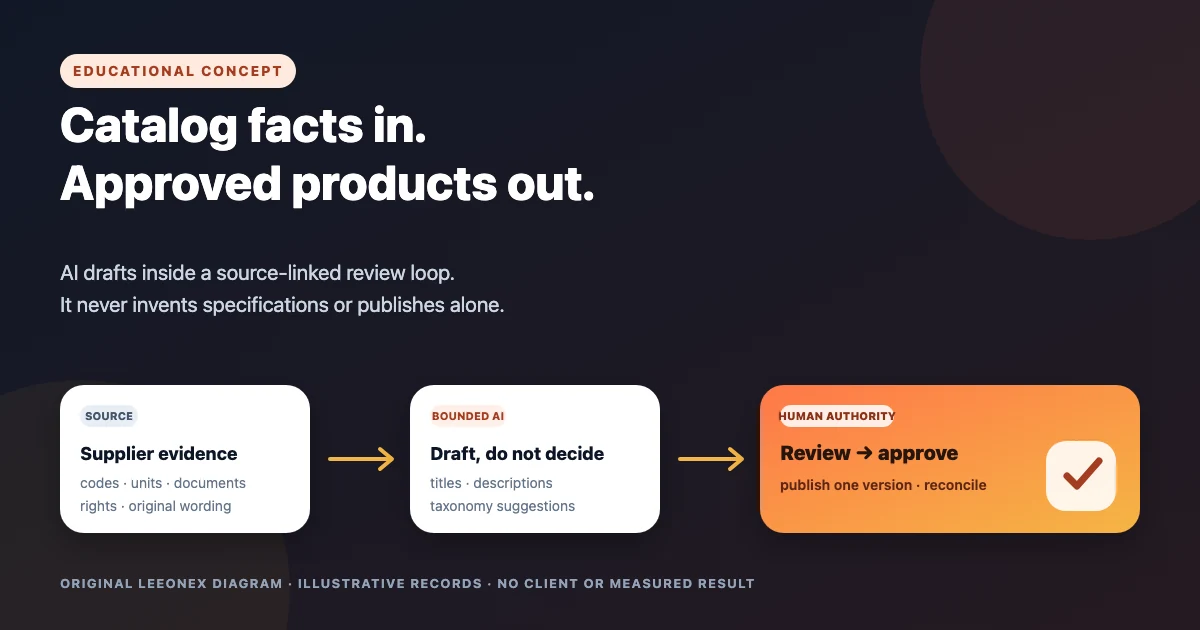
Preserve source facts, let AI draft around them, and make a person approve the product record.
The smallest useful AI catalog-enrichment workflow starts with one product family and one target schema. It keeps supplier evidence beside every factual field, validates identifiers and allowed values with rules, uses AI only for bounded drafts or suggestions, and sends uncertainty and commercial claims to a named reviewer. Nothing reaches a storefront, marketplace, or feed until an authorized person approves the complete record.
This is an educational concept study, not a client story or delivered system. No supplier file, product specification, catalog record, accuracy result, publishing event, time saving, or commercial outcome here is real. The counts above describe the proposed workflow, not observed performance.
Illustrative discovery conversation — not a client quotation
“Can AI finish the supplier spreadsheet and publish the products?”
Illustrative catalog lead: “Some rows have a manufacturer code and dimensions. Others have a paragraph, three photos, and no category. The team rewrites everything before a launch.”
Illustrative Leeonex response: “Which values are source facts, which can be derived by rule, which are editorial drafts, and who is allowed to approve a claim or publish the record?”
Both voices are invented teaching examples. They are not a client conversation, customer quotation, or description of delivered work.
Starting situation and intended buyer
Imagine an ecommerce or distribution team onboarding products from several suppliers. Files arrive as spreadsheets, PDFs, image folders, and email notes. Column names differ, units are mixed, required attributes are missing, and product descriptions use supplier language that does not match the store. Catalog operators copy data into a template, search for gaps, choose a taxonomy, rewrite copy, and ask a merchandiser or compliance owner to check sensitive claims.
The intended buyer is a catalog, ecommerce, or operations leader who owns onboarding throughput and data quality, with product-data and technical owners available to define the system boundary. Important constraints may include variant relationships, regional units, regulated claims, image rights, pricing ownership, inventory availability, localization, channel-specific fields, and an existing product information management system. This concept cannot infer those rules.
Separate roles before choosing a model
- Supplier-data owner: provides the source files, confirms permitted use, and answers factual questions.
- Catalog operator: matches records, resolves missing evidence, and corrects proposed values.
- Merchandising or domain reviewer: approves taxonomy, customer-facing copy, and claims under the real policy.
- Publishing owner: authorizes the complete record for a named channel and can stop or reverse a release.
- System worker: imports, validates, drafts, and records events; it cannot invent facts or grant itself approval.
One person may hold several roles in a small team, but the decisions must remain distinct. Correcting a source dimension is not the same as approving marketing copy, and approving a record is not the same as confirming that a downstream channel accepted it.
Core flow: ingest, prove, draft, review, publish, reconcile
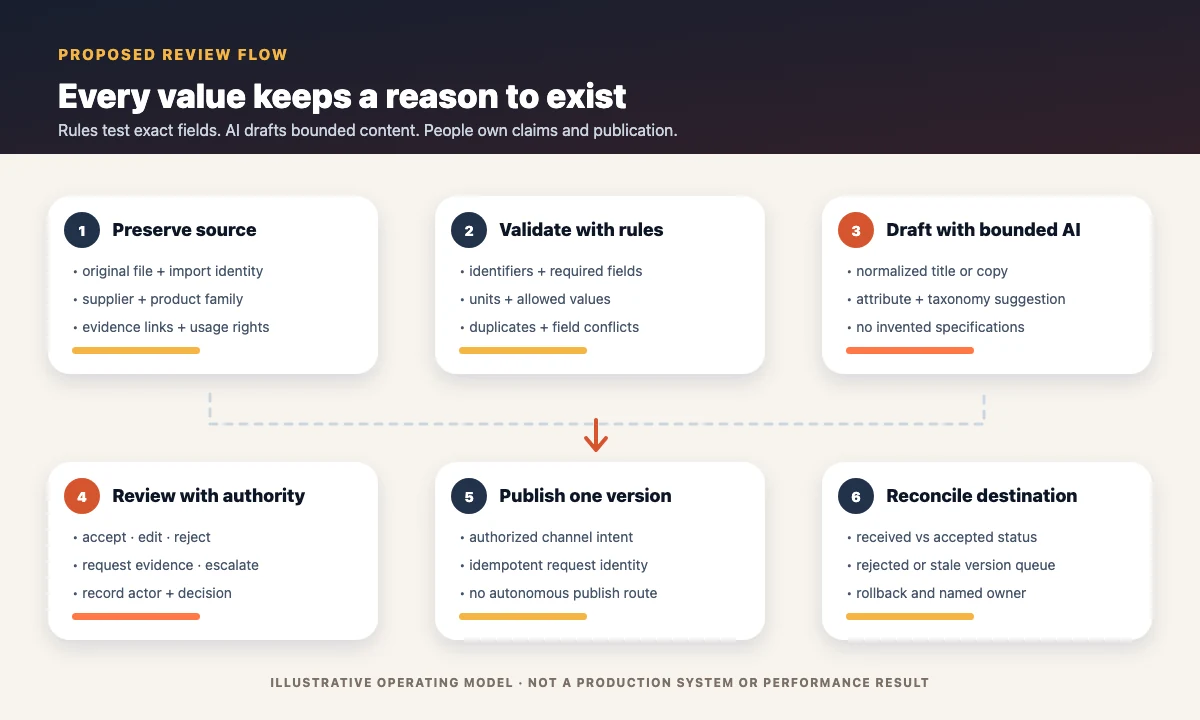
Start by preserving the original file and assigning the import a stable identity. Match each row to a supplier and product family, then map known columns into a canonical draft without overwriting the source. Deterministic checks should handle required fields, data types, units, duplicate identifiers, allowed values, and cross-field rules. A failure becomes visible work; it does not become a guessed value.
AI may then propose a normalized title, short description, attribute mapping, or taxonomy candidate using only the permitted evidence. Every proposal should remain distinguishable from source data and carry its source references, model or configuration version, and review state. Low confidence is not the only reason for review: material claims, ambiguous units, prohibited language, and fields with costly consequences should always follow policy.
An authorized reviewer accepts, edits, rejects, or requests evidence. Approval creates a versioned product record and a channel-specific publishing intent. The workflow records whether the destination received and accepted that version, then exposes rejected or mismatched records for reconciliation. A successful API response alone is not proof that the right product is live.
Build the smallest evidence-producing scope
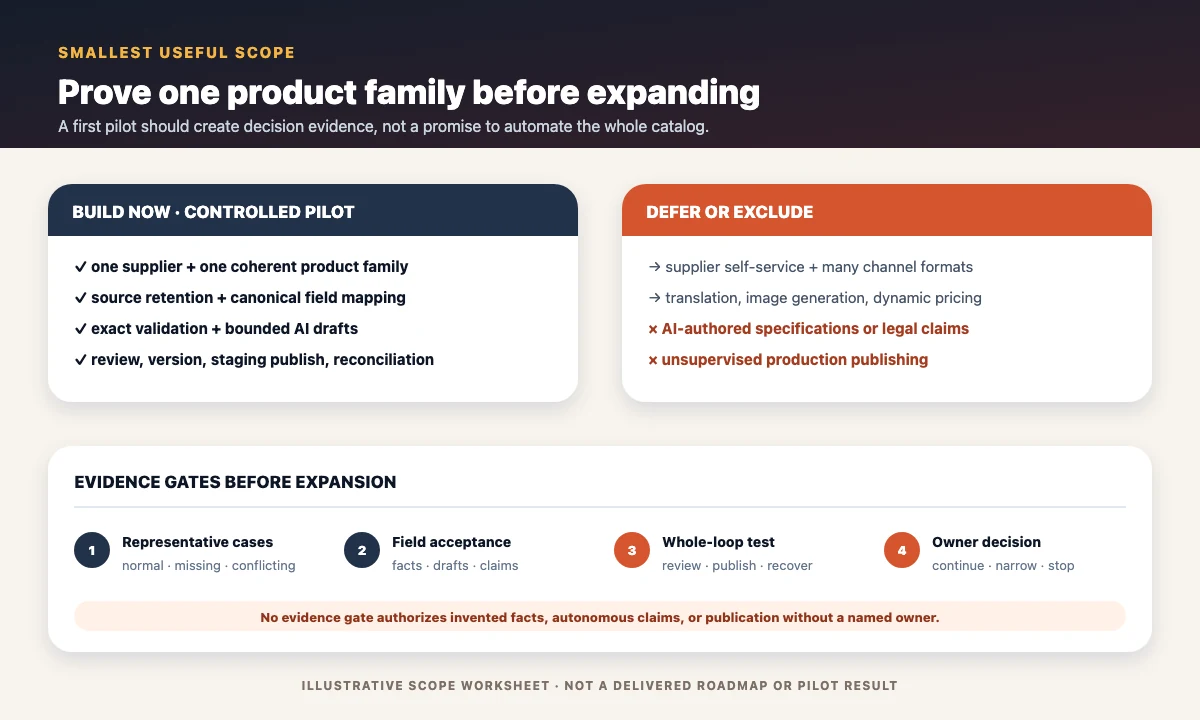
A responsible first pilot can cover one supplier, one coherent product family, one language, one target schema, and a staging destination. Build now: source-file retention, field mapping, deterministic validation, one or two bounded AI drafts, evidence links, reviewer decisions, version history, controlled publishing, and a reconciliation view. Keep production publishing behind a separate approval until the pilot has passed representative cases.
Defer multi-supplier self-service, automatic translation, image generation, dynamic pricing, inventory promises, broad marketplace syndication, autonomous claim writing, and continuous model adaptation. Explicitly exclude AI-authored specifications and unsupervised publishing. If consistent supplier templates and import rules solve most of the bottleneck, that simpler system is the better first release.
Use the AI workflow automation readiness checklist to test whether volume, repeatability, inputs, ownership, and failure containment justify a maintained workflow. Leeonex's AI workflow automation service is relevant when the review loop and connected systems need a tailored implementation.
Architecture decisions and guardrails
- Store the immutable source, normalized source fields, derived values, AI proposals, human edits, approvals, and published versions as distinguishable records.
- Define field ownership. Supplier evidence may own dimensions; merchandising may own customer-facing copy; commerce systems may own price and availability.
- Keep identifiers, units, required fields, permissions, and prohibited actions deterministic. Do not ask a model to enforce rules that code can test exactly.
- Constrain prompts and tools to the current product record. Treat supplier text and uploaded files as untrusted input, not system instructions.
- Validate reviewer and publisher authority on the server. Record actor, time, prior version, decision, and destination response.
- Give every publish intent a stable key and a status lookup. Retries must not create duplicate products or silently publish an obsolete version.
- Monitor missing evidence, rule failures, correction patterns, destination rejections, model changes, and queue age. Name the owner who can pause the automation.
What would a pilot need to prove?
Freeze a representative set containing complete rows, missing attributes, inconsistent units, duplicate codes, variants, conflicting documents, prohibited claims, category ambiguity, destination rejection, and an interrupted publish. Domain owners should define field-level correctness, acceptable editorial changes, mandatory review cases, and the exact evidence required before a record may advance.
Evaluate the complete operation: source coverage, deterministic rule results, unsupported additions, reviewer corrections, exception routing, approval integrity, destination reconciliation, queue age, and cost per approved record. Those are proposed measures, not results Leeonex has observed. Any future claim about accuracy, speed, cost, publication volume, or sales would need a dated baseline, defined calculation, observation window, source records, exclusions, attribution limits, verifier, and permission.
Risks, limitations, and lessons
The most obvious risk is fabricated or unsupported product data, but quieter failures matter too: wrong unit conversion, lost variant relationships, stale pricing, duplicate identifiers, copied claims without rights, exposure of confidential supplier material, biased taxonomy suggestions, and an approved record that never reaches the destination. Human review does not repair a bad interface, unclear authority, or an unmanageable queue.
This concept does not determine legal or regulated claims, product safety, pricing, tax, inventory, image licensing, accessibility, localization, marketplace policy, privacy, security certification, or the correct PIM, commerce platform, model, host, or service level. It is not an evaluation of any model or vendor.
The central lesson is that enrichment is a provenance and approval workflow before it is a generation feature. AI can help with variable language and classification only after the team knows which facts must survive unchanged, which transformations are exact, which claims need authority, and how a bad release is stopped or reversed.
What to bring to a first consultation
Bring representative supplier files, a target schema, one product family, field definitions, unit rules, taxonomy, claim and rights policy, reviewer and publisher roles, publishing API or platform constraints, recent corrections, and examples of records the team would never allow through. Leeonex can use them to separate rules from AI assistance, identify missing ownership, and design a small pilot with observable acceptance and stop conditions.
Browse the case-study hub for more clearly labeled studies, or discuss your catalog workflow with Leeonex.