Answer first
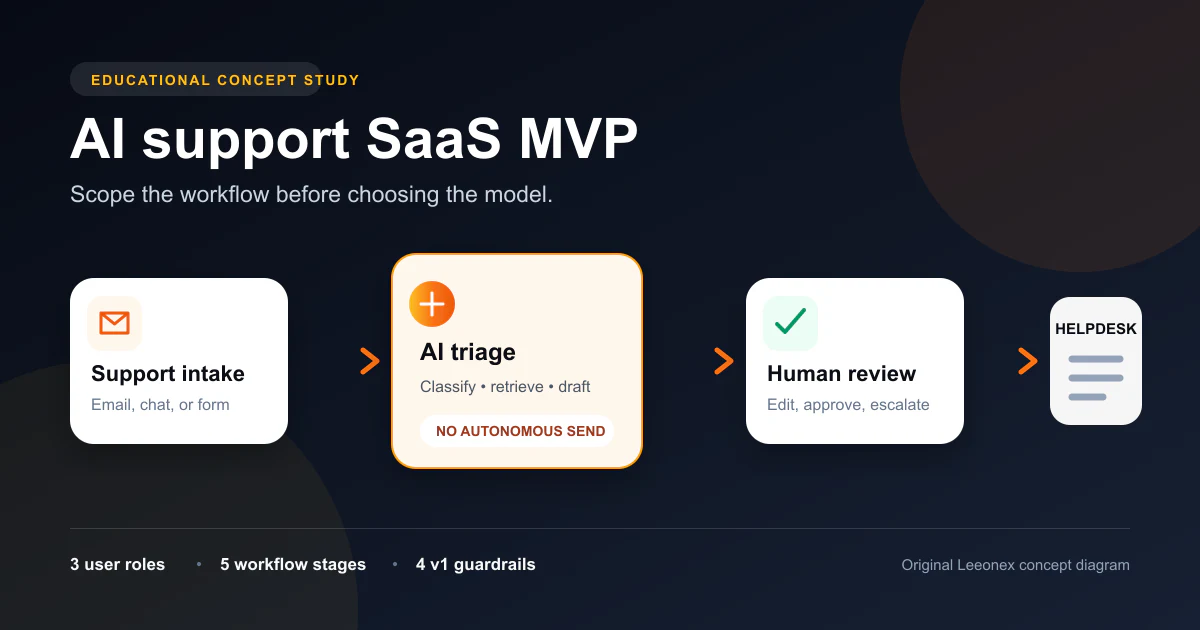
The useful first product is an accountable workflow, not an autonomous chatbot.
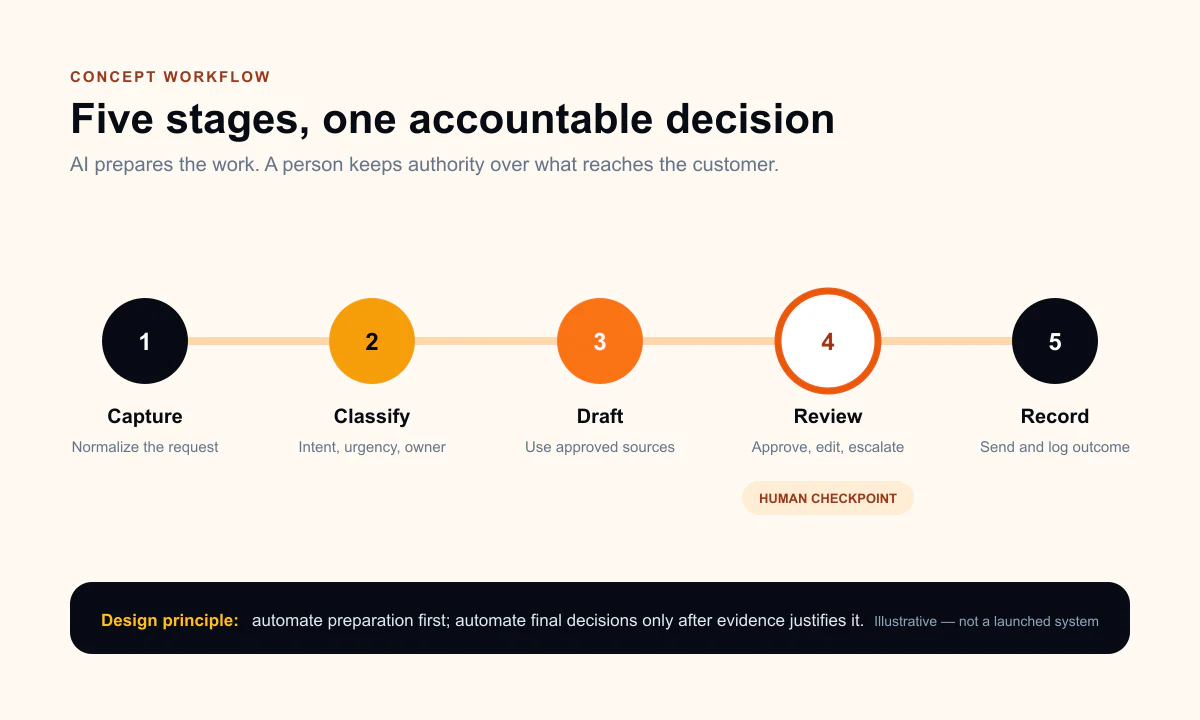
This concept starts with a common product request: use AI to answer repetitive support questions. A safer and more testable first version captures each request, classifies it, retrieves approved information, prepares a draft, and places that draft in front of a person who can approve, edit, or escalate it.
That scope creates a real SaaS learning loop without pretending the model is ready to own billing, account access, refunds, or other decisions where a confident-looking mistake can be costly.
Illustrative discovery conversation — not a client quotation
A founder may arrive with a model idea. Product scope begins with the decisions around it.
Founder
“We answer the same support questions all day. Can we add AI and let it reply?”
Leeonex
“Before choosing a model, which requests are repetitive, which sources are trusted, and which mistakes would be costly?”
Founder
“Billing and account issues need a person, but product questions could start with a draft.”
Leeonex
“Then v1 should prepare and route responses, keep a reviewer in control, and record every decision before autonomy is considered.”
These lines are written to demonstrate a productive scoping exchange. They do not represent a real customer or completed engagement.
Start with people
Three roles are enough to expose the important product boundaries.
Requester
Submits a support question and receives the approved response through the channel the team already uses.
Support specialist
Reviews the classification and draft, edits the answer, approves it, or escalates the request.
Product or ops admin
Controls sources, routing rules, access, integrations, and the audit view used to improve the workflow.
Scope the learning loop
V1 should answer three product questions before the feature list grows.
Can the system classify requests well enough to save useful preparation work? Can it draft from approved sources without hiding where the answer came from? Can a support specialist tell quickly when to approve, edit, or escalate?
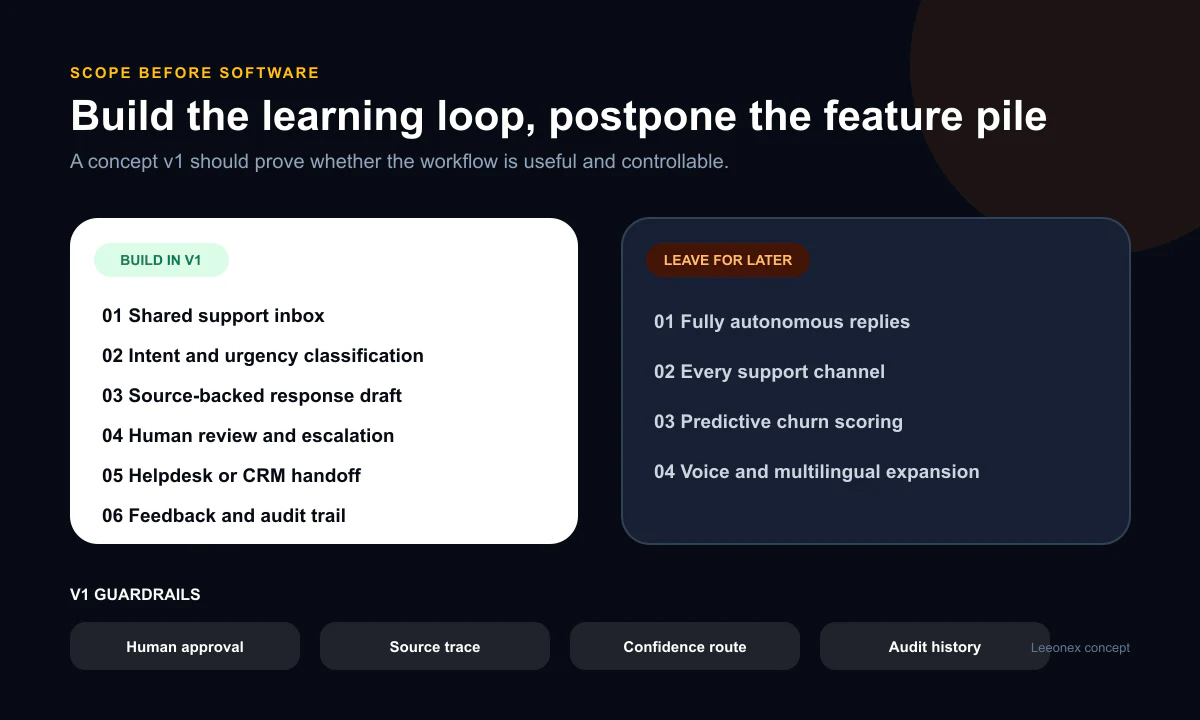
A shared inbox, classification, source-backed drafting, review, helpdesk or CRM handoff, and an audit trail are enough to test those questions. Fully autonomous replies, every possible channel, predictive churn scoring, voice, and multilingual expansion can wait for evidence from the smaller workflow.
What the concept does not prove
No launch, accuracy, time-saving, adoption, or support-cost result is being claimed.
This is a proposed product and workflow model, not a finished Leeonex build or client story. Model quality, latency, security, operating cost, and the right confidence thresholds depend on real requests, approved knowledge, integration constraints, and an evaluation plan. A pilot would need to measure those conditions before stronger automation is justified.
Prepare the first conversation
Bring workflow evidence, not a polished product brief.
Leeonex can start from rough material. These four inputs make an AI workflow or MVP discussion concrete:
- Ten to twenty representative requests, including difficult exceptions
- The policies, help content, or product data a response may rely on
- The inbox, helpdesk, CRM, or collaboration tools already in the workflow
- The decisions that must stay human and the failures the team cannot accept
If the workflow is not ready for AI, Leeonex can recommend a simpler rule-based automation. If it needs a product shell, roles, saved history, and operator controls, it may be a focused SaaS MVP. Review the AI workflow readiness checklist before the call if you want to assess the process first.
Recognize your workflow?