Answer first
A runway dashboard should explain a decision under assumptions, not publish one confident-looking date.
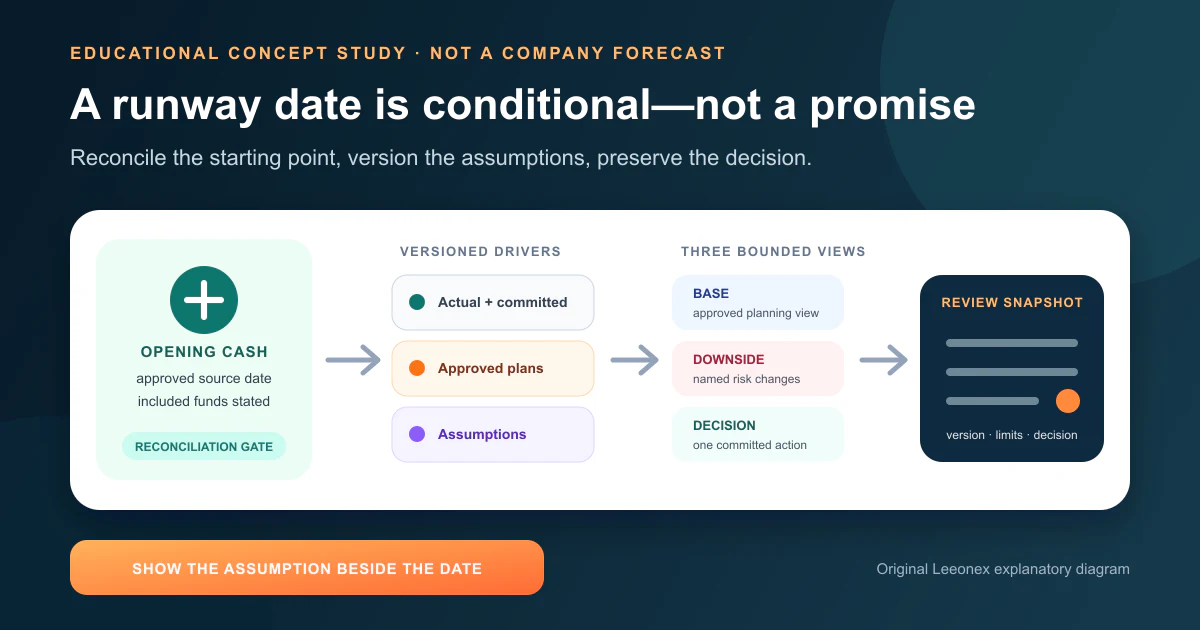
Start by reconciling an approved opening cash position. Then classify every driver as a source-backed actual, committed obligation, approved plan, or adjustable assumption; give it an owner, effective period, evidence reference, and review date. Only after those boundaries are explicit should a dashboard calculate and compare scenarios.
The smallest useful release shows a base case, a downside case, and one committed-decision case over a bounded monthly window. Each published snapshot preserves its inputs, formulas, reviewer, limitations, and decision note. The result can help a team discuss hiring, spending, timing, or financing, but it cannot make uncertain cash movements predictable.
Evidence boundary
This is a Level E educational concept study. Leeonex has not implemented, operated, audited, or measured this system for a client or company. The conversation, roles, data classes, scenarios, calculations, counts, diagrams, technology labels, and decisions are illustrative planning material—not a financial statement, dashboard screenshot, forecast, testimonial, professional opinion, or performance claim.
Starting situation and intended buyer
The spreadsheet works until copied tabs become competing versions of the company’s future.
This concept is for a founder, finance lead, operations leader, or product team that uses a runway model to discuss a cash-sensitive decision but cannot reproduce why the displayed date changed. The balance may come from one day, receivables from another, hiring from a private plan, and sales from an optimistic tab. The arithmetic can be correct while the decision boundary is not.
A dashboard is useful when it makes that boundary inspectable: which money is available, which receipts or payments are committed, which assumptions belong only to a scenario, which source is stale, and what action the team is actually evaluating. It is dangerous when presentation polish turns a conditional model into a promise.
If the team still needs to choose between a BI tool, custom interface, and embedded approach, start with the BI tool versus custom dashboard guide. This study begins after the recurring decision and ownership boundary justify a focused scenario view.
Illustrative discovery conversation — not a client quotation
The disputed date is usually a disputed input and governance problem.
Founder
“Our runway is twelve months in the board sheet, nine in the finance model, and six if the next hires start on time. Can one dashboard give us the real date?”
Leeonex
“Which opening balance is approved, which payments are committed, which revenue is contracted, and which entries are still assumptions?”
Founder
“Those categories are mixed. People copy the latest tab and change what they need for the meeting.”
Leeonex
“Then the first release should govern inputs and preserve scenarios. It can show how a date follows from stated assumptions, but it cannot turn those assumptions into a forecasted fact.”
This exchange is Leeonex-authored teaching material. It describes no real founder, company, quotation, financial position, model, engagement, decision, or result.
User roles and decision ownership
Keep source approval, business assumptions, model governance, and the final decision separate.
Finance owner
Approves the opening cash position, accounting treatment, timing rules, reconciliation evidence, and formula changes.
Commercial owner
Owns contracted receipts, pipeline assumptions, collection timing, churn or renewal inputs, and the evidence attached to each commercial driver.
People and operations owner
Owns payroll, hiring dates, contractors, facilities, subscriptions, tax timing, and other operating commitments within their remit.
Decision owner
Names the decision, accepts the scenario boundary and uncertainty, records the chosen action, and schedules the next review.
One person may hold several roles in a small business, but the approvals remain distinct. A dashboard developer should not decide how restricted cash is treated, and a sales owner should not convert pipeline confidence into an accounting fact.
Core planning flow
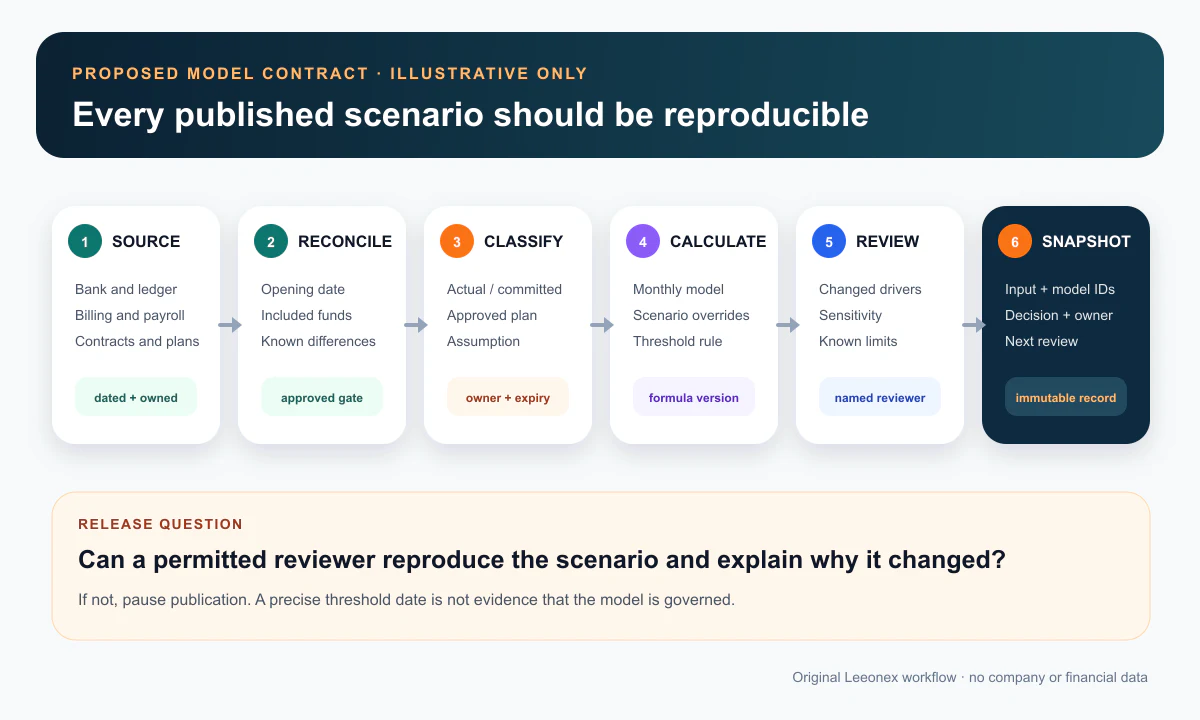
Reconcile, classify, calculate, compare, review, and preserve.
First, establish the opening position for a named date. Document the included accounts, currencies, legal entities, restricted funds, usable credit, outstanding transfers, and reconciliation method. If that position is uncertain, the interface should say so instead of offering a precise downstream date.
Next, normalize drivers by period and evidence class. Posted transactions and reconciled balances are not the same as contracted payments, approved hiring plans, expected collections, optional purchases, or speculative financing. Preserve those distinctions through calculation and display.
Then calculate bounded scenarios from a shared model contract. A base case expresses the currently approved planning view; a downside case changes a short, named set of risk assumptions; and the committed-decision case isolates the action under review. Avoid dozens of unnamed tabs that differ in ways no reviewer can explain.
Finally, publish a versioned snapshot. Show the threshold rule, affected months, largest drivers, changed assumptions, source freshness, limitations, and sensitivity. Record the decision, owner, and review date without labeling the scenario as a guaranteed outcome.
Smallest useful scope
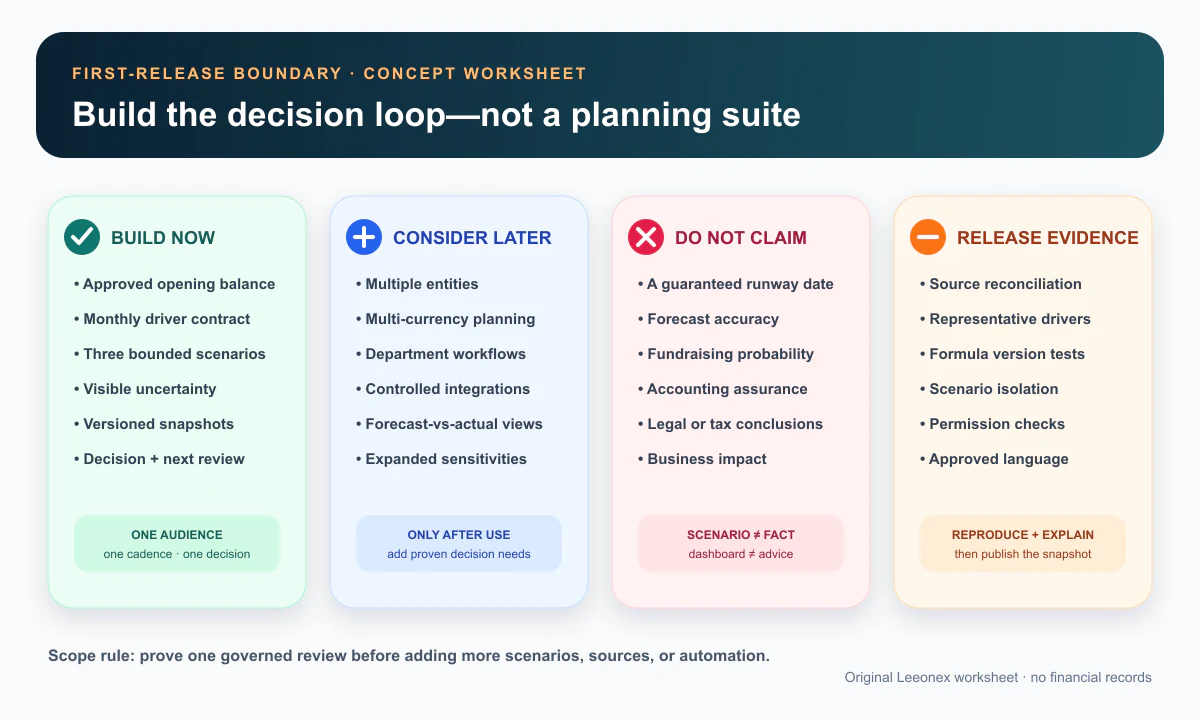
Build one repeatable decision loop before building a finance planning suite.
The first version should support one audience, one review cadence, one approved monthly model, and one live decision. That can be enough to prove whether the organization will maintain driver ownership, reconcile sources, review changes, and use the resulting snapshot responsibly.
Build now
- One approved opening cash position with source date, accounts included, restricted or unavailable funds separated, and reconciliation evidence
- A monthly planning window with named inflow and outflow drivers, units, timing rules, owner, evidence class, review date, and change history
- Three bounded views: a base case, a downside case, and one committed-decision case that isolates the action under review
- A calculation contract that shows how opening cash, receipts, payments, minimum-cash policy, and scenario overrides produce the displayed threshold date
- Versioned snapshots with input version, model version, reviewer, limitations, decision note, and a visible difference from the prior approved snapshot
Later or deliberately excluded
- Probability-weighted fundraising, sales, or financing outcomes presented as expected cash until the organization defines and approves a defensible method
- Machine-learning forecasts, autonomous recommendations, or automatic spending controls before descriptive inputs and review behavior are trustworthy
- Every legal entity, currency, bank, department, product line, contract, tax jurisdiction, and accounting scenario in the first release
- Real-time bank or ledger synchronization when an approved scheduled import meets the decision cadence with lower operational risk
- Valuation, investment return, insolvency, covenant, tax, or legal conclusions that require qualified professional judgment outside a dashboard build
Architecture and implementation decisions
Design for traceability before designing the scenario chart.
Separate facts from assumptions
Store source-backed actuals, committed obligations, approved plans, and adjustable assumptions as different classes. A user should never mistake a changed assumption for a posted transaction.
Version inputs and formulas
A published date needs the exact driver set and calculation version that produced it. Editing the current model must not silently rewrite an earlier board or operating decision.
Snapshot decisions, not only charts
Preserve who reviewed the scenario, the limitations they saw, the action they chose, and the next review date. The decision record is part of the product.
Keep the model inspectable
Let permitted users trace a monthly total to driver groups and representative source evidence. A polished line without a review path is fragile.
A practical data path
Approved bank, ledger, payroll, billing, contract, and planning inputs enter a controlled staging layer. Validation checks schema, duplication, dates, currencies, classes, ownership, and freshness. The calculation service applies a versioned monthly model and scenario overrides. The interface reads immutable review snapshots and permitted drill-downs; it does not edit source accounting records or silently recalculate history.
Risks and guardrails
The largest risk is false confidence, not an unattractive chart.
Restrict bank, payroll, compensation, contract, customer, debt, and financing details by role; define export, retention, audit, residency, and deletion rules for the real jurisdictions.
Require source dates and owners for actuals, commitments, plans, and assumptions. Mark missing, stale, disputed, manually overridden, or unreconciled inputs beside the affected scenario.
Do not label a scenario date as certain. Show the planning window, minimum-cash rule, assumption set, sensitivity, and events that can invalidate the view.
Use controlled imports, schema checks, duplicate detection, currency and time-period rules, and representative reconciliation before calculation.
Treat formula, driver, timing, and classification changes as releases with review evidence, impact comparison, communication, and a rollback or prior-version path.
Keep professional judgments outside the interface where appropriate. The dashboard may organize approved inputs; it does not replace finance, accounting, tax, legal, or investment advice.
Release evidence
Accept the first release with representative records and reproducible snapshots.
A scenario that renders is not automatically decision-ready. Finance and business owners should approve representative cases, failure behavior, permissions, traceability, and the exact language used around uncertainty.
- Check 1
The opening cash figure ties to the approved source set for the stated date, with excluded or restricted balances visible.
- Check 2
Representative recurring and one-off receipts and payments land in the correct month, class, owner, and scenario.
- Check 3
Changing one assumption affects only the intended scenario and produces an inspectable difference from the prior snapshot.
- Check 4
Formula and input versions reproduce a previously approved snapshot instead of recalculating history with current logic.
- Check 5
Stale, missing, disputed, duplicate, negative, foreign-currency, and out-of-window records produce reviewed behavior.
- Check 6
Role checks prevent unauthorized drill-downs and exports while summary users still see enough context to interpret the scenario.
- Check 7
A reviewer can record a decision, limitation, owner, and next review date without implying the scenario became a promise.
Limitations
This concept cannot validate a company’s cash position or predict its future.
No financial records, assumptions, formulas, source integrations, accounting policies, user research, security controls, or decision workflows were tested. The proposed scenarios and counts are structural examples, not benchmarks or recommendations.
The model does not define treatment for restricted cash, credit, debt, covenants, taxes, payroll, foreign exchange, deferred revenue, financing probability, insolvency, or jurisdiction-specific obligations. It is not accounting, tax, legal, investment, fundraising, treasury, or financial-planning advice.
Stronger public claims would require an approved real project, implementation evidence, model and reconciliation records, forecast-versus-actual definitions, a measurement window, exclusions, attribution limits, verification, approved visuals, and publication permission. Even then, a prior model’s accuracy would not guarantee a future result.
Lessons for a similar team
The useful product is a governed conversation about choices.
Reconcile before extrapolating
A precise scenario built on an unresolved opening position is precise in the wrong place.
Name the evidence class
Actual, committed, approved, expected, optional, and speculative inputs should not share one visual status.
Preserve the decision context
A snapshot needs the assumptions, limitations, reviewer, action, and review date that gave it meaning.
What to bring to a first consultation
Bring the disputed model and one pending decision—not polished requirements.
- The decision to support, who decides, the review cadence, the minimum-cash or other threshold policy, and examples of actions taken when the date changes
- A redacted current model, its formulas and tabs, the reports people compare, known disagreements, and the latest approved planning snapshot
- Opening-balance sources, bank and ledger timing, restricted cash, credit availability, currencies, legal entities, and the approved reconciliation method
- Revenue, collections, payroll, hiring, contractor, vendor, tax, debt, financing, and other driver examples with owners and evidence classes
- Committed, approved, expected, optional, and speculative definitions—including who may change each class and when it expires
- Access, export, audit, privacy, security, retention, accounting, tax, legal, tooling, budget, support, and change-management constraints
The right next step may be governance, not software.
Leeonex can help define the model contract, reconcile a representative period, prototype the decision view, or scope a focused analytics dashboard. If a controlled spreadsheet already supports the decision safely, the recommendation may be to improve ownership and review rather than build an application.