The short answer: make the pilot answer a budget decision
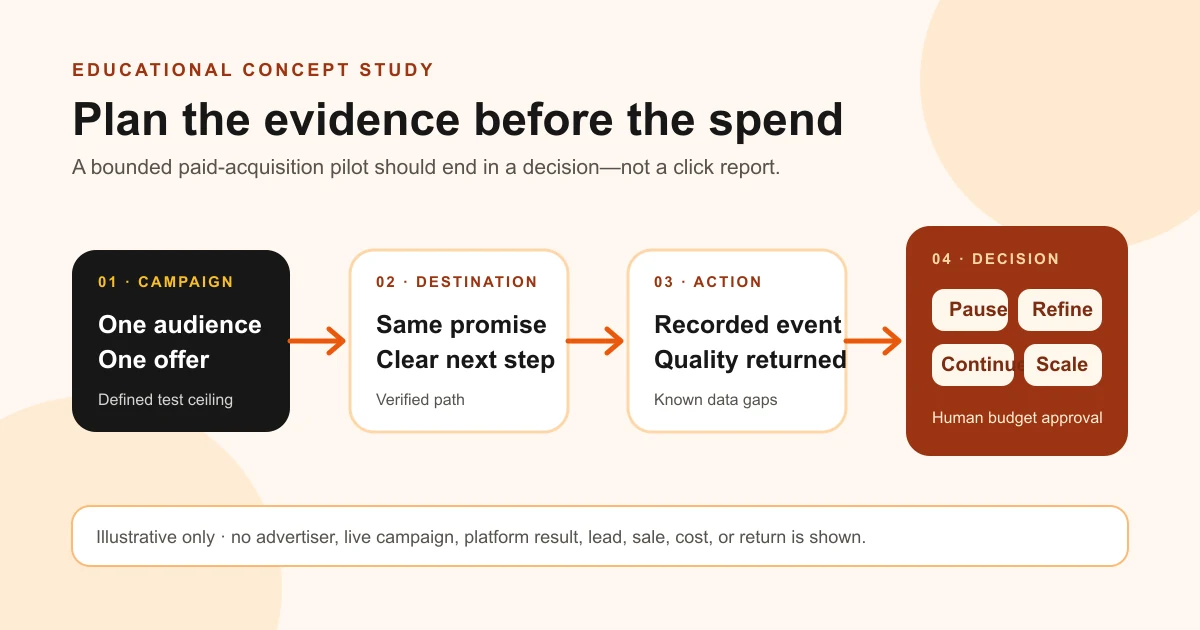
A useful ChatGPT Ads pilot is not “buy clicks and see what happens.” It is a bounded test with one audience, one coherent offer, a destination that continues the promise, one primary business action, and a way to reconcile campaign delivery with website behavior and lead or order quality. Before launch, decide what evidence would justify pausing, refining, continuing, or cautiously scaling.
That framing matters because a click confirms only that someone chose to visit. It does not prove the offer was understood, the visitor was qualified, the form was valid, a sale occurred, or the channel caused the outcome. The pilot should make those boundaries visible instead of compressing them into one attractive metric.
Evidence notice
This is a Level E educational concept study. No advertiser, client campaign, media delivery, conversion, lead, sale, cost, or return was measured. The counts describe a proposed pilot structure, not performance.
The buyer situation: channel enthusiasm arrives before measurement readiness
This concept is for a software business seeking demos, a service company seeking enquiries, or an ecommerce team seeking purchases from a new paid channel. The offer already exists, but the team has not yet proved that its destination, event tracking, business records, and review habits can support a fair channel decision.
The constraint is rarely just ad creative. Marketing sees platform activity. A website owner sees sessions and forms. Sales sees qualified and rejected opportunities. Finance sees paid orders, cancellations, or refunds. If those views cannot be joined at a useful level, the loudest dashboard wins the meeting.
Illustrative conversation — not a client quotation
Growth lead
“We want to test ChatGPT Ads. Can we set a budget, reuse our best campaign, and decide from the click-through rate?”
Leeonex
“What business action should a useful visitor complete, and can your team tell us whether that action became a qualified opportunity or sale?”
Growth lead
“The website records forms, but the CRM reason for rejection is inconsistent. Some buyers also call or book through another tool.”
Leeonex
“Then campaign setup is only part of the pilot. We need one coherent offer, a traceable destination path, a primary action, a lead-quality feedback loop, and decision rules before spend begins.”
The roles that need to be explicit
- Budget owner: approves the test ceiling and any increase.
- Campaign owner: manages settings, creative, pacing, and the change log.
- Website owner: owns the destination experience and conversion-event implementation.
- Business feedback owner: returns qualification or order-quality evidence on an agreed cadence.
- Privacy or compliance owner: confirms consent, data handling, claims, and policy obligations for the real business.
The core flow: from a useful context to a business decision
- Define the job. Name the audience, offer, destination, primary action, test budget, timing, and question the pilot must answer.
- Map the promise. Creative and destination should describe the same offer, eligibility, next step, and evidence appropriate to the business.
- Verify the action. Test the form, booking, trial, checkout, tags, event names, identifiers, consent behavior, and failure paths before spending.
- Launch within the ceiling. Record settings, dates, approvals, creative, destinations, and material changes.
- Return quality. Sales or operations labels the agreed outcomes consistently enough to interpret website actions.
- Make the decision. Review the three evidence layers and select pause, refine, continue, or scale without rewriting the rules after the result.
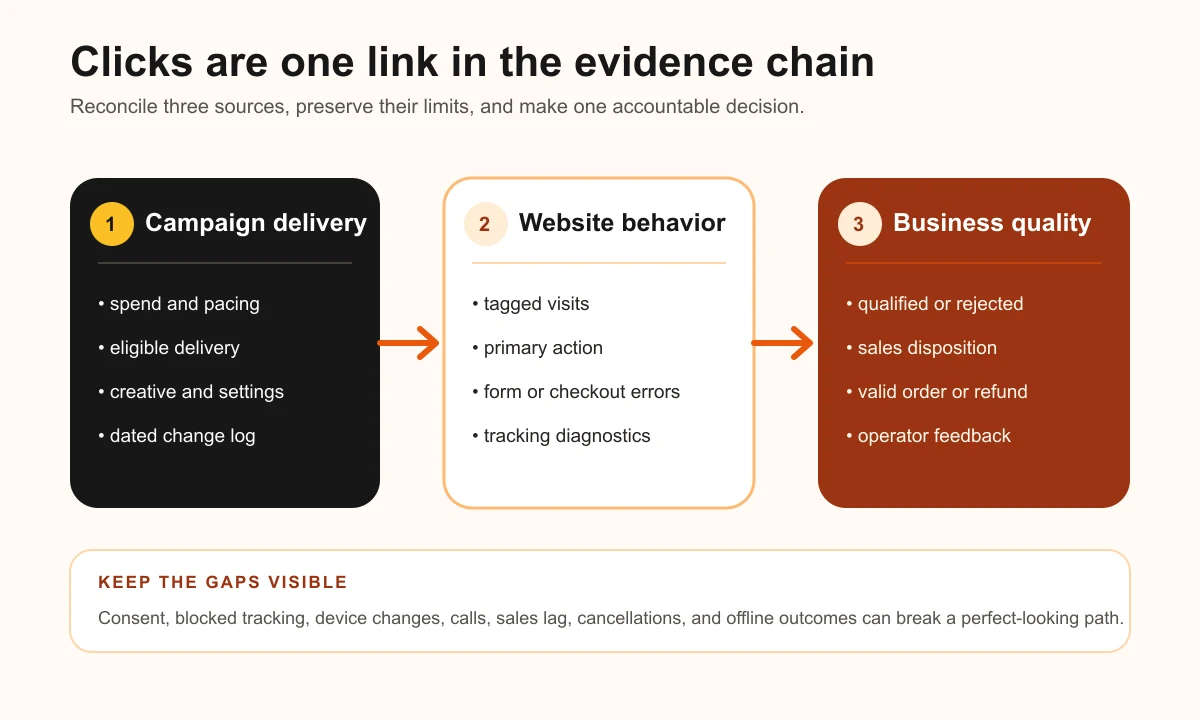
Campaign delivery
Spend, eligible delivery, pacing, placement context available in the account, and creative changes explain what the media system actually did.
Website behavior
Tagged visits, destination engagement, form or checkout events, and tracking diagnostics explain what happened after the visit began.
Business quality
Qualification, sales disposition, order validity, refunds, and useful operator notes explain whether the recorded action mattered to the business.
The layers will not match perfectly. A person can block tracking, change devices, call instead of submitting a form, or convert after the review window. The useful practice is to document the gaps and use a consistent decision method—not to manufacture certainty through forced precision.
The smallest useful pilot is narrow enough to explain
Start with one commercially meaningful offer and one destination path. Use a small creative set that tests a real difference in message, not dozens of tiny variations. Choose one primary action and a few diagnostics that help explain failure, such as form start, form error, booking completion, or checkout failure.
| Include now | Why it belongs | Deliberately exclude |
|---|---|---|
| One offer and audience | Keeps message and qualification interpretable. | Every product, region, and persona. |
| One primary action | Makes the pilot’s job and event contract explicit. | A blended score built from unrelated micro-events. |
| Quality feedback | Separates recorded actions from useful business outcomes. | A new CRM if a disciplined field or export is enough. |
| Decision cadence | Prevents daily noise from becoming strategy. | Automatic budget expansion. |
If the current page cannot carry one coherent promise and action, scope a focused destination before or alongside the campaign. Leeonex’s landing page development service covers that build path. The landing page or MVP guide helps when the deeper question is which evidence instrument the business needs first.
Build now versus later: buy clarity before sophistication
Build or configure now
- A written event contract with event name, trigger, owner, destination, validation step, and known failure modes.
- Campaign URL conventions and a test record proving the destination retains the identifiers the team needs.
- A lead or order disposition field with a small controlled set of reasons and a named completion owner.
- A change log connecting creative, destination, budget, bid, or audience changes to dates and rationale.
- A review worksheet that shows delivery, website action, business quality, data gaps, and the next decision together.
Delay until the pilot earns it
- Custom multi-touch attribution that the available identifiers and sales process cannot support.
- A bespoke reporting platform when a controlled export and review sheet can answer the first question.
- Large creative libraries before the team knows which promise and objections matter.
- Automated budget increases without a human approval boundary and fresh business-quality evidence.
- More markets, products, or conversion paths before the original scope is explainable.
The implementation boundary should keep the advertiser’s account, campaign assets, website, analytics, and business records identifiable and handover-ready. Leeonex’s ChatGPT Ads management service combines campaign planning, creative, destination review, conversion tracking, and ongoing review within an agreed scope.
Risks and guardrails that belong in the pilot
False attribution
Show platform, website, CRM, call, and order evidence with their source and window. Record gaps rather than assigning every outcome to the campaign.
Low-quality conversion optimization
Do not optimize around the easiest event if it attracts irrelevant forms, invalid orders, or actions the business cannot serve. Return quality feedback.
Budget drift
Use a test ceiling, named approver, review cadence, and explicit rule for changes. Scaling is a new decision, not the default state after activity appears.
Policy, privacy, and consent gaps
Confirm the real advertiser, destination, claims, data collection, consent behavior, retention, and access obligations with accountable owners before launch.
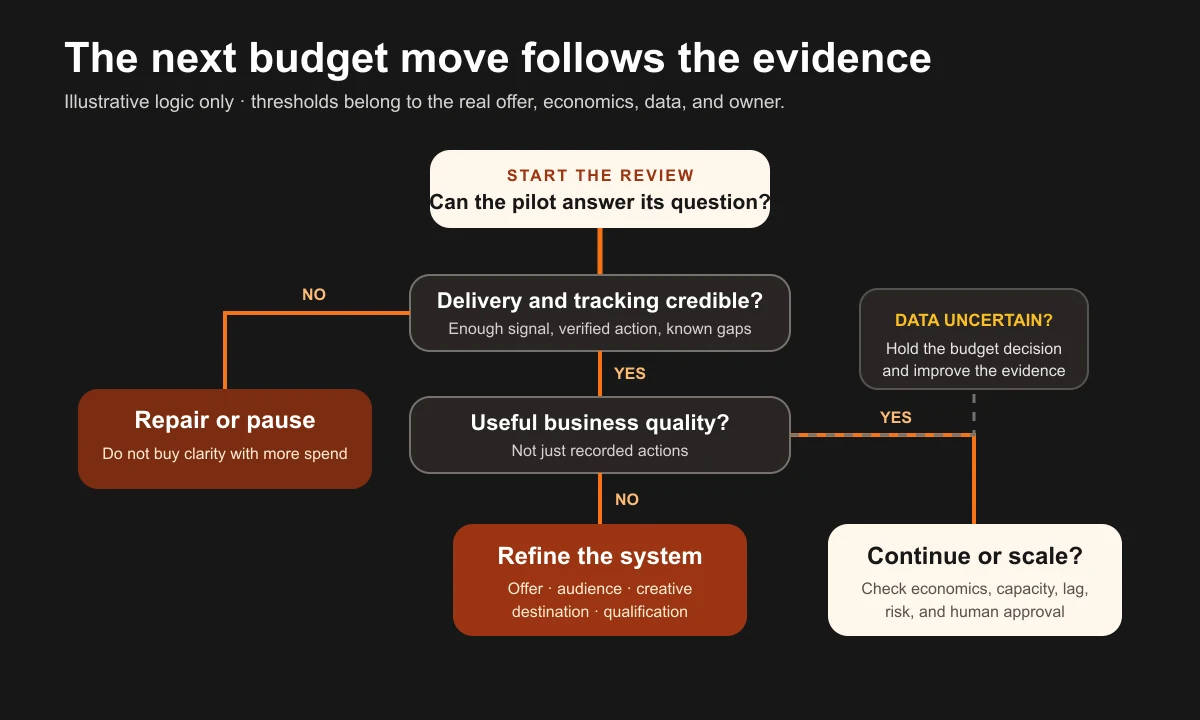
Useful decision rules combine signal and data quality. Weak delivery may mean the campaign cannot yet answer the demand question. Healthy delivery with broken tracking calls for measurement repair. Recorded actions with poor qualification call for message, targeting, offer, or destination refinement. Only a credible chain from delivery to useful business outcomes supports considering more spend.
Limitations and evidence needed before stronger claims
- No advertiser, website, account, campaign, approval, audience, creative, tracking implementation, or business outcome was assessed.
- The framework is Leeonex-authored planning guidance, not an OpenAI requirement, attribution standard, forecast, legal review, privacy review, or guarantee of access or delivery.
- OpenAI controls advertiser eligibility, ad review, platform features, delivery, and policy enforcement; a management plan cannot guarantee any of them.
- Sponsored advertising is separate from ChatGPT’s answers. Paying for ads does not buy organic recommendations, rankings, citations, endorsement, or trust.
- The counts describe proposed scope only. They do not forecast clicks, conversions, leads, sales, cost, return, or statistical confidence.
A publishable performance case study would need approved advertiser identity or anonymization, campaign settings and change history, verified event tests, delivery and spend records, website and business-system outcomes for a defined window, attribution limits, an accountable verifier, and permission for every screenshot and claim. Until then, this page can teach the method but cannot claim the result.
What to bring to a first consultation
The first useful output is a go/no-go boundary: what can be launched now, what must be repaired first, which evidence will be available, and who owns the next decision. That protects both the media budget and the quality of the learning.
Plan one explainable paid-acquisition test
Leeonex can map the offer, destination, measurement contract, campaign scope, quality feedback, and review rules—or tell you which prerequisite should come first.
Return to the Leeonex case-study hub for more evidence-labeled build blueprints and owned work.