
The short answer: build for the evidence you need
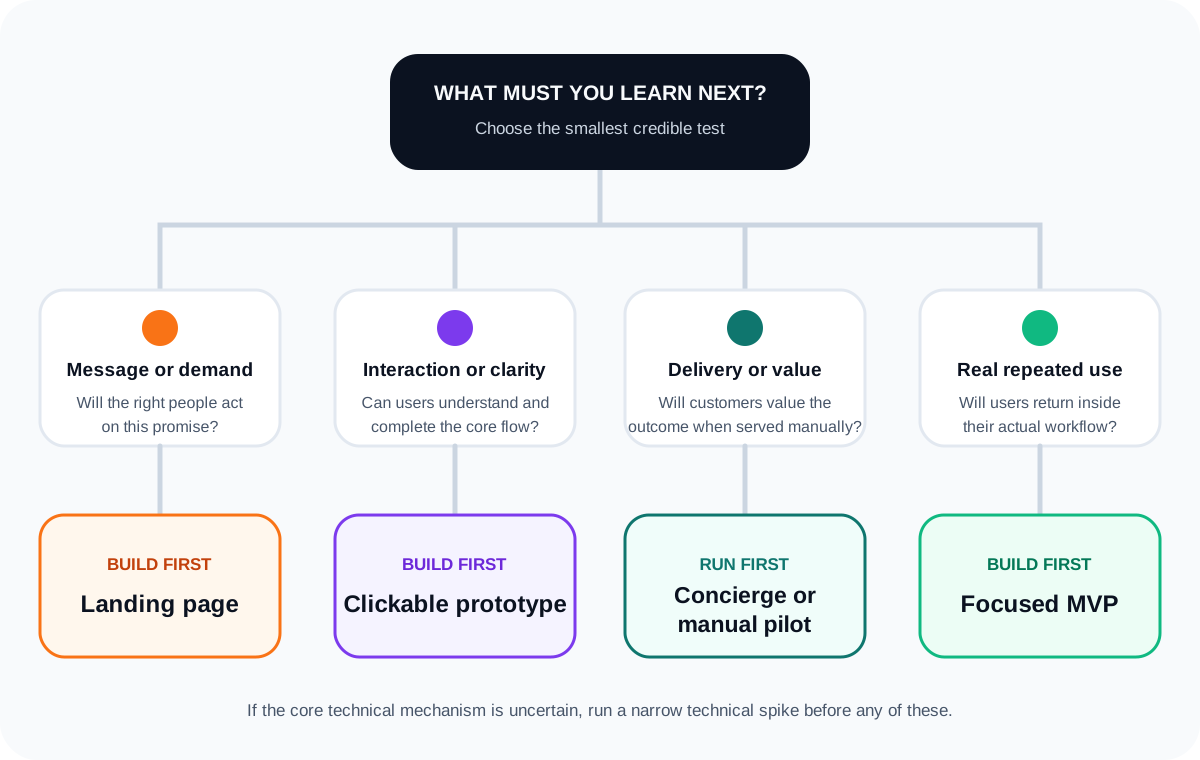
Build the smallest credible thing that can answer your riskiest unanswered question. Use a landing page to test whether a specific audience understands and acts on a promise. Use a clickable prototype to test comprehension and interaction. Use a manual pilot to test whether the delivered outcome creates value. Build a focused MVP when you need evidence from real product behavior and repeated use.
The common mistake is treating these as levels in a compulsory sequence: landing page, then prototype, then MVP. They are different research instruments. The correct one depends on what must become less uncertain before you invest again.
| Uncertainty | Build or run first | Useful evidence | It does not prove |
|---|---|---|---|
| Message and demand | Landing page | Qualified visitors take a meaningful action | That they will use the product repeatedly |
| Flow and comprehension | Clickable prototype | Target users understand and complete the core flow | That the system is feasible or valuable in practice |
| Delivery and outcome | Concierge pilot | Customers engage with and value the manually delivered result | That software will make delivery economical |
| Real behavior and retention | Focused MVP | Users complete the job and return in a real workflow | That broader features or scale are needed |
Why “interest” and “product value” are different evidence
A waitlist signup may show that the framing is relevant. A booked call is stronger because it costs the prospect time. A deposit, paid pilot, or committed data integration is stronger again because the action has real weight. But none of these automatically proves that people can use the finished product or will return to it.
This is why the strength of the call to action matters. “Join our newsletter” tests content interest. “Send your current spreadsheet for a workflow audit” tests willingness to expose the actual problem. “Book a pilot” tests a more serious buying action. Your page should ask for the strongest action that is ethical and realistic at the current stage.
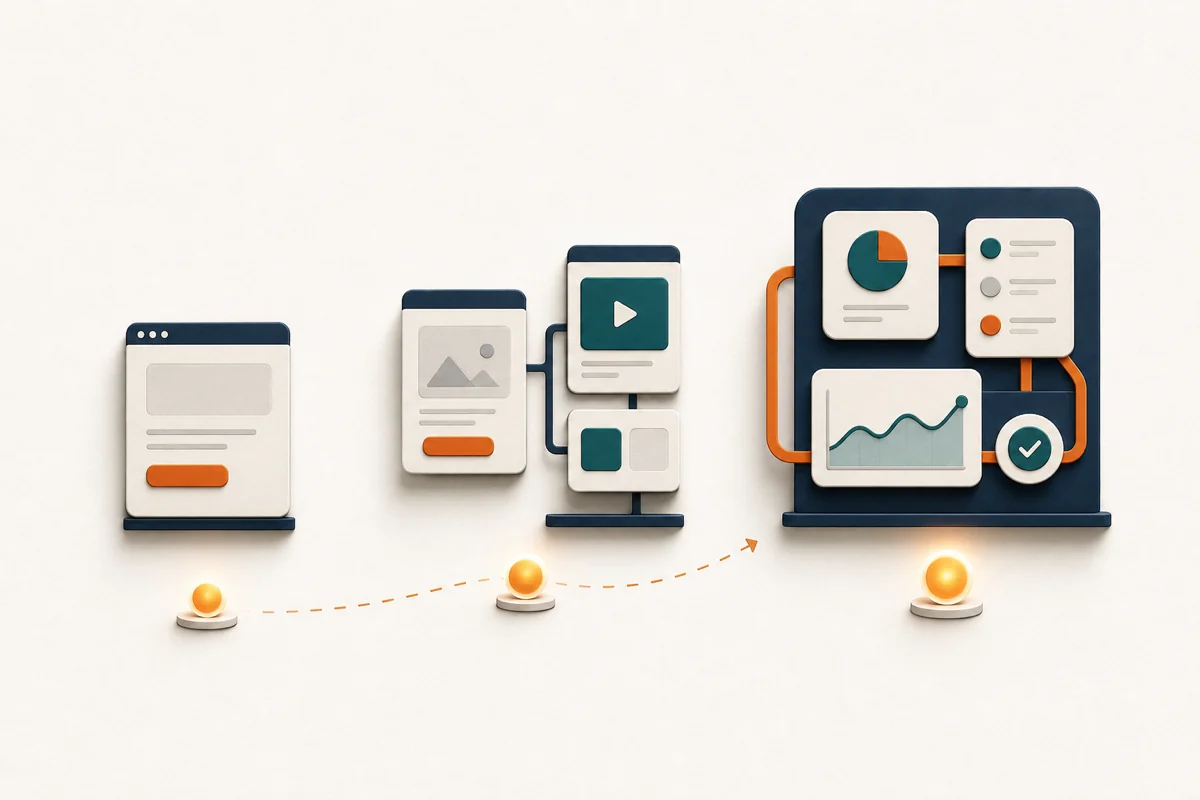
The original minimum viable product idea is also frequently flattened into “the cheapest version of the app.” Eric Ries instead describes an MVP as the version that enables the greatest amount of validated learning with the least effort. That makes the learning goal—not a generic feature count—the organizing principle. See the Lean Startup definition of an MVP.
Strategyzer’s experiment guidance makes the same discipline concrete: state the hypothesis, define the test, specify what will be measured, and decide the success threshold before results arrive. Its Test Card is a useful one-page structure for that work.
A four-question process for choosing the first version
1. What must be true for the business to work?
Write the assumptions underneath the idea, not the features inside it. Examples: operations managers have this problem weekly; they can recognize the value without a long explanation; the outcome is important enough to change an existing workflow; the data required is available; or the core automation can produce an acceptable result.
Rank those assumptions by consequence and uncertainty. The assumption that is both uncertain and fatal if false is the one your first version should address.
2. What observable action would change your confidence?
Avoid evidence such as compliments, survey enthusiasm, or “I would use this.” Define behavior you can observe: completing a booking, sharing a workflow, connecting a data source, paying for a pilot, finishing a core task, inviting a teammate, or returning without a reminder.
3. How will the right people encounter the test?
A page with no qualified distribution tests almost nothing. Name the channel and audience before design begins: founder-led outreach to 30 operations leads, a partner newsletter, a narrow paid-search campaign, or calls with existing customers. If you do not know how the first users will arrive, solve that problem alongside the artifact.
4. What decision will the result trigger?
Pre-commit to the next move. A strong result might justify a prototype or pilot. A mixed result might trigger new interviews and revised positioning. A weak result might end the concept. Without a decision rule, teams tend to explain away bad signals and continue building.
Five valid starting paths—and when to use each
Start with a landing page when the promise is uncertain
Choose a landing page when you need to learn whether a defined audience recognizes the problem, understands the proposed outcome, and will take a meaningful next step. It works well before software exists because the test can focus on positioning, demand, and acquisition.
A credible test page needs one audience, one problem, one outcome, enough explanation to make the offer understandable, trust appropriate to your stage, and one measurable call to action. It also needs analytics and a real traffic plan. Strategyzer’s landing-page experiment explicitly connects the page to a value-proposition hypothesis rather than treating it as decoration.
Leeonex’s landing page development path is designed for this kind of focused message and conversion problem.
When a live offer will be tested with paid acquisition, the page is only one part of the evidence system. Our ChatGPT Ads pilot concept study shows how to connect campaign delivery, destination behavior, lead quality, and a pre-agreed budget decision without treating clicks as proof of demand.
If the offer already has a live business site, the decision may be about changing that system rather than validating a net-new idea. Use the website redesign or rebuild guide to separate message and interface problems from content-model, CMS, integration, and migration constraints.
Start with a clickable prototype when the flow is uncertain
Choose a prototype when prospects already care about the outcome but you do not know whether the proposed interaction makes sense. Put realistic tasks and data in front of target users. Ask them to complete the core job without coaching, then observe where their mental model and the interface diverge.
A prototype is intentionally disposable. It can validate labels, sequence, information hierarchy, and comprehension. It cannot validate backend feasibility, performance, security, or genuine retention.
Start with a concierge pilot when delivery is uncertain
If the promised outcome can be produced manually, deliver it to a small number of customers before automating it. A reporting product might begin as a weekly analyst-built report. An AI workflow might begin with human review at every step. A marketplace might be matched manually.
The purpose is not to pretend the manual operation scales. It is to learn what inputs are actually available, which steps create value, where exceptions appear, and whether customers care about the finished outcome enough to continue.
Start with a technical spike when feasibility is uncertain
Some ideas have one technical mechanism that carries most of the risk: extracting reliable data from inconsistent documents, meeting a latency constraint, syncing with a legacy system, or achieving an acceptable model output. Build a narrow, non-production experiment around that mechanism. Do not surround it with accounts, billing, dashboards, or design polish.
For a mobile product, use the same spike discipline to test the hardest device or operating-system path before choosing the full architecture. If you have not yet decided whether the first product surface should be browser-based or installed, start with the web app or mobile app first guide. Once mobile is justified, our native vs cross-platform decision guide provides a platform-pressure matrix and spike worksheet.
If the first version is an operational AI system, apply the same discipline at workflow level with our AI workflow automation readiness checklist.
Start with a focused MVP when real usage is the unanswered question
Build an MVP when earlier evidence has made the audience, problem, and promise credible—and the next uncertainty can only be reduced by a working product. The MVP should let the user complete one valuable end-to-end job in a realistic environment, while capturing the behavior needed for the next decision.
This is a product system, not a feature sampler. A single reliable workflow is more informative than six incomplete modules. If this is your stage, review Leeonex’s MVP development and MVP scoping services.
How to scope the first version without making it trivial
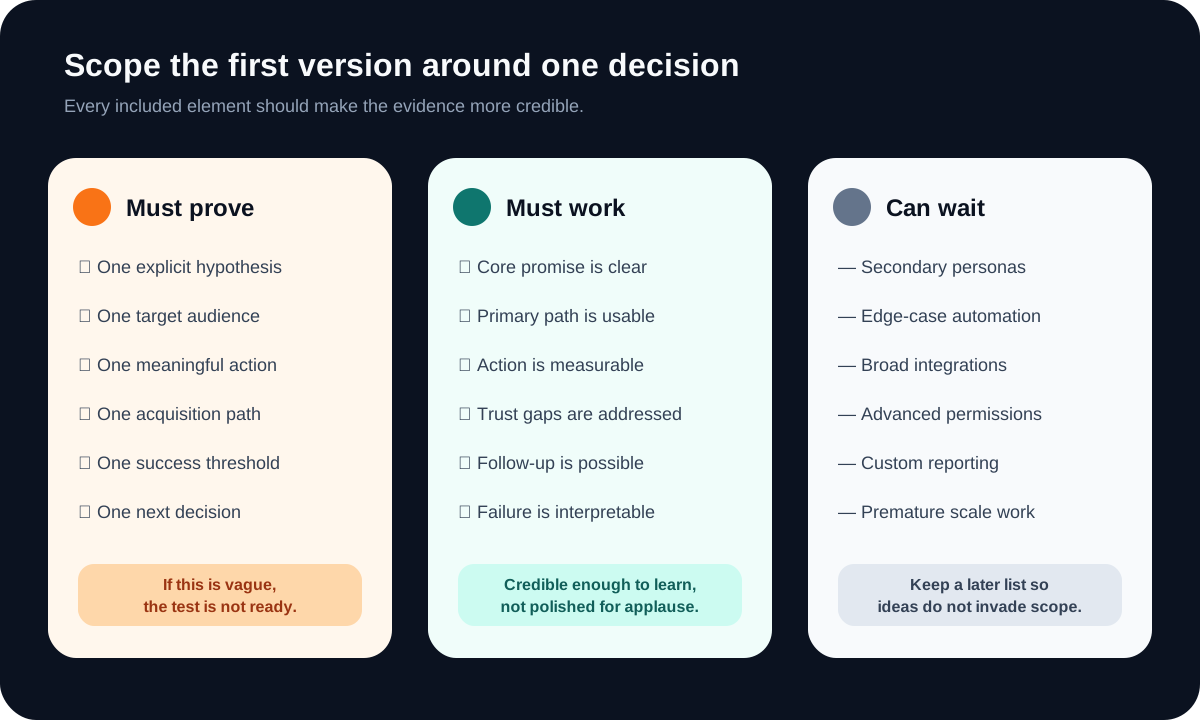
“Minimum” does not mean low quality, fake, or too weak to produce trustworthy evidence. It means removing everything that does not help prove the chosen hypothesis or make the test credible. The version still has to work well enough that failure can be interpreted.
Write the experiment contract
Before implementation, write one sentence for each item: target user, hypothesis, artifact, acquisition channel, primary action, metric, threshold, test window, and next decision. For example: “We believe finance leads at 20–100-person agencies will book a workflow review after seeing a page that promises to reduce monthly reporting assembly. We will send 80 qualified prospects to the page over two weeks. Ten booked reviews will justify a concierge pilot.”
The numbers are not universal benchmarks; they are a sample decision rule. Set your own threshold based on channel quality, price, sales motion, and opportunity cost. What matters is choosing it before seeing the outcome.
For a landing page, include only what supports belief and action
- A headline that names the outcome in the audience’s language.
- A precise problem and the situation in which it occurs.
- A simple explanation of the proposed approach—not invented features.
- Honest trust signals: relevant expertise, process transparency, a demo, or founder access. Never fabricate customer logos or results.
- One primary action whose completion can be measured and followed up.
- Analytics that distinguish traffic sources and completed actions.
For an MVP, include one complete value loop
- The minimum input required to start the core job.
- The central processing or collaboration step that creates the outcome.
- A usable output the customer can evaluate in their real context.
- Basic reliability, privacy, and error handling appropriate to the data involved.
- Instrumentation for activation, completion, failure points, and return behavior.
- A practical feedback route that reaches the product team.
Put multi-role permissions, broad integrations, custom reporting, edge-case automation, and scale optimization on a later list unless the core test genuinely depends on them. A visible later list reassures stakeholders that an idea has not been lost while keeping it out of the active scope.
When the MVP path is chosen, use the first-release MVP scope checklist to test core value, trust, operations, learning, exclusions, and acceptance before asking for an implementation estimate.
Common mistakes that make either path inconclusive
Building the MVP because it feels more real
Code creates momentum, but momentum is not evidence. If the unknown is whether anyone wants the outcome, a larger build only increases the cost of learning the same answer.
Using a weak call to action
Email signups are easy to collect and hard to interpret. Ask for an action close to the eventual buying or usage behavior. Strategyzer’s guidance on value-proposition A/B tests emphasizes connecting clicks to a deeper call to action so teams do not confuse a surface preference with genuine intent.
Testing several audiences or promises together
A page for “startups and enterprises” with three unrelated outcomes may produce traffic, but the result cannot tell you which segment or promise worked. Begin narrowly. Expansion is easier after one combination is understood.
Counting traffic without examining its quality
A hundred well-matched visitors from direct outreach can be more useful than thousands of curiosity clicks. Record the source, job role, context, action, and follow-up response. The experiment is about qualified behavior, not a large dashboard number.
Changing the success rule after the result
If every outcome becomes “promising,” the test cannot protect the company from a weak idea. Document what would count as strong, ambiguous, and weak—and what each result means—before launch.
A seven-day plan to choose your first version
- Day 1: Write the business assumptions and rank them by uncertainty and consequence.
- Day 2: Talk to three to five target users about the current workflow, triggers, cost of the problem, and attempted alternatives.
- Day 3: Choose one hypothesis and the observable behavior that would change your confidence.
- Day 4: Select the artifact: landing page, prototype, concierge pilot, technical spike, or focused MVP.
- Day 5: Write the experiment contract, including audience, channel, metric, threshold, and next decision.
- Day 6: Scope only the elements required for a credible result, then place everything else on the later list.
- Day 7: Review the test with someone outside the project. Ask: “If this fails, will we know what failed?” Then start production.
If you reach day seven and still cannot name the decision the artifact will unlock, pause the build. More features will not repair an unclear experiment.
Frequently asked questions
Is a landing page an MVP?
Usually, no. A landing page can be a minimum viable test of positioning or demand, but it is not a functional version of the product. Call it an MVP only when the product itself is the page-based experience being delivered.
Can a startup build a landing page and MVP at the same time?
It can, but parallel work is sensible only when the team already has strong evidence for the problem and audience, the landing page supports active acquisition, and MVP scope is independently justified. Otherwise, simultaneous work can make the landing page a marketing exercise instead of a decision tool.
How much validation is enough before building an MVP?
There is no universal number. Move forward when evidence is strong enough to justify the next investment: the target user and problem are specific, real prospects take a meaningful action, and you know which product behavior must be observed next. Define that threshold before running the test.
What if the idea cannot be validated without working software?
Build the narrowest technical spike or focused MVP that exposes the uncertain mechanism. Do not add onboarding, dashboards, permissions, integrations, or scale work unless they are necessary for a credible test of that mechanism.
Sources and further reading
- The Lean Startup: What is an MVP?
- Strategyzer: Validate Your Ideas with the Test Card
- Strategyzer: Design an Experiment Connected to Your Value Proposition Canvas
This guide provides a decision framework, not a universal conversion benchmark. Test thresholds should reflect your audience, channel, business model, and cost of the next investment.