
The short answer: scope one complete learning loop
Scope an MVP around one specific user completing one valuable job end to end. Add only the trust, access, failure handling, operator support, and measurement needed to run that job responsibly and learn from real behavior. Write everything else into an explicit exclusion list with a reason and a condition for reconsidering it.
This is stricter than ranking a backlog into “must,” “should,” and “could.” Teams label too many features as must-haves because the category has no test. A useful boundary asks what observable failure occurs if a feature is absent from the first release. If the core outcome still works safely and the team can still learn, the feature can usually wait.
Include in v1
Work that completes the job, protects the user, keeps the service operable, or makes the learning signal readable.
Defer deliberately
Breadth, convenience, automation, customization, polish, and scale that the first evidence does not require.
Use four scope tests, not one feature list
A narrow feature list can still be an unusable product. It may show the happy path but omit permissions, recovery, support, or the instrumentation needed to interpret a pilot. Review each candidate against four independent tests.
1. Core value
Does this item let the chosen user reach the promised outcome? Describe the job as a sequence with a trigger and an end state, not as a category such as “dashboard” or “marketplace.” “An operations lead imports unresolved orders, assigns exceptions, and confirms a reconciled queue” is a boundary the team can test.
2. Trust baseline
What is the minimum responsible treatment of identity, access, privacy, accuracy, consent, accessibility, and recovery for the real pilot? Trust is not synonymous with enterprise complexity. Invitation-only access may replace self-serve registration, but it does not justify exposing one customer’s records to another.
3. Operability
How will the team see stuck work, correct a bad record, support a user, and recover from a dependency failure? The answer may be a tiny review queue and a documented manual procedure rather than a complete admin suite. Hidden manual work is acceptable in a pilot only when it is named, owned, and realistically supportable.
4. Learning
What behavior will change the next decision? Record the few events and outcomes that answer the release hypothesis. A large analytics implementation does not compensate for a vague question. Define success, warning, and stop signals before the first users arrive.
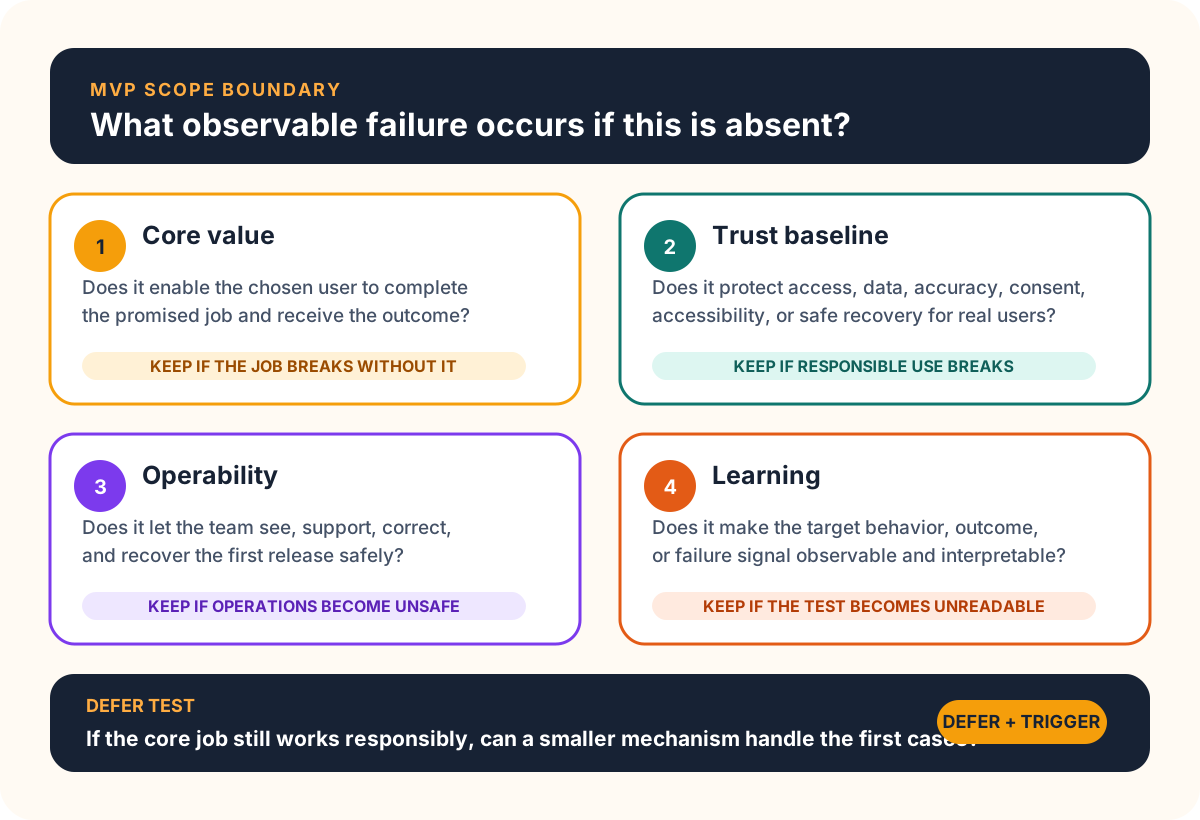
The original MVP principle is about learning rather than cheap imitation of a finished product. The Lean Startup explanation of an MVP frames it as the version that enables the most validated learning with the least effort. That does not mean cutting work that makes the experiment unsafe or impossible to interpret.
Map one complete flow before naming features
Start with the moment a user recognizes the problem. Trace how they enter, provide or retrieve the required information, complete the primary action, receive the result, recover from a common failure, and know what happens next. Then trace the same case from the operator’s side.
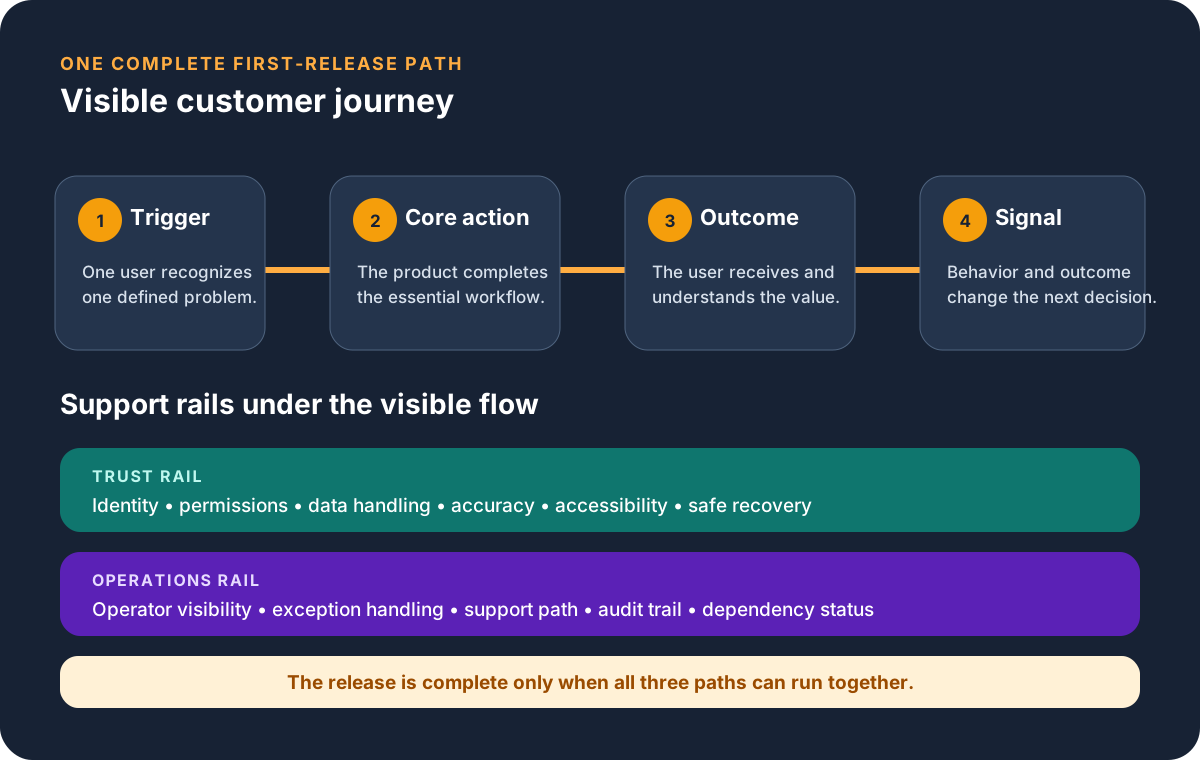
Features emerge from this map. Authentication appears only if the path requires persistent identity or protected data. Notifications appear where a user must return after asynchronous work. An admin view appears when an operator needs to resolve exceptions. Reporting appears when a metric changes a decision. The flow explains why each element exists.
If the team has not observed the workflow closely enough to justify a software release, the B2B SaaS concierge-pilot concept study shows an earlier evidence step: deliver one narrow outcome manually, disclose the human service, record exceptions and effort, and define continue, change, or stop rules before features become commitments. It is an educational concept, not a client pilot or validated-demand claim.
A two-sided product makes this discipline especially useful. The managed service marketplace MVP concept shows how a buyer request, operator shortlist, provider response, and confirmed outcome can form one testable loop before the team builds public search, automated matching, payments, or two full participant dashboards.
A trust-sensitive workflow needs the same boundary discipline. The compliance evidence SaaS MVP concept study narrows a suite-sized idea to one versioned request, source-linked submission, human review, expiry path, and honestly labeled export. It deliberately excludes framework interpretation, automated assurance, and certification claims.
Once the first product outcome is clear, use the SaaS user onboarding requirements checklist to turn signup, setup, team participation, saved progress, recovery, and measurement into one testable path to first value.
When the exchange is ready to become a build brief, use the marketplace MVP requirements checklist to define both participant sides, operating work, payments, trust, exceptions, and release evidence without expanding the general MVP boundary.
Name the first audience precisely
“Small businesses” is not a usable audience. A first release may serve an operations manager at a service company who already receives orders in a particular format and owns the weekly reconciliation. A second user type can multiply permissions, onboarding, workflows, content, and acceptance cases. Add it only when the value loop cannot work without that role.
Keep discovery and delivery connected
The official 2020 Scrum Guide makes the Product Owner accountable for a transparent, ordered backlog and explicitly allows scope to be clarified as more is learned. Whether or not a team uses Scrum, the useful principle is the same: one owner must connect the product goal, the order of work, and the evidence that changes the plan.
Apply the feature inclusion test
For every proposed feature, write a one-sentence user or operator outcome, then answer these questions in order:
- Which version-one user and job does it serve?If the answer introduces another audience or job, split it.
- What fails without it? Name an observable blocked outcome, trust breach, operational overload, or lost learning signal.
- Can a smaller mechanism handle the first cases?Consider invitation access, a manual review, one export, one template, or a limited integration.
- What complexity does it introduce? Count new roles, states, permissions, data entities, dependencies, failure modes, and support paths—not screens alone.
- What evidence would justify adding it later?Give the excluded item a trigger instead of an emotional promise.
| Candidate | Possible v1 mechanism | Trigger for expansion |
|---|---|---|
| Self-serve signup | Invite approved pilot users | Acquisition is ready to scale |
| Automated billing | Invoice pilot accounts manually | Repeated plans and volume justify automation |
| Advanced admin | Exception queue plus audited support procedure | Case volume exceeds safe manual capacity |
| Many integrations | One source or structured import | Usage proves another system blocks adoption |
Smaller does not mean careless. The WCAG 2.2 Recommendation provides testable accessibility criteria, and the OWASP Application Security Verification Standard is a useful requirements reference for application security. Apply the relevant baseline to the actual product and risk; do not postpone every quality obligation under the MVP label.
Make the scope estimable without pretending certainty
A feature name is not an estimate input. “User management” could mean invitation-only access for one role or self-serve signup, social login, organizations, granular permissions, account recovery, audit history, and offboarding. Write acceptance examples for the happy path, a permission boundary, invalid input, dependency failure, and operator recovery.
Record constraints that change implementation: supported devices, browser or app surfaces, data sensitivity, tenant model, integrations, migration, content ownership, expected concurrency, environments, observability, and launch process. Unknowns should become discovery tasks or technical spikes, not optimistic assumptions hidden inside a fixed number.
When the problem, users, or viable solution path is still open, use the software discovery phase checklist before treating the backlog as approved scope. It separates the evidence needed for a build decision from the requirements that follow once a direction is justified.
If you are still deciding whether real product behavior is needed, use the landing page or MVP decision guide first. Once the evidence requires software, Leeonex’s MVP scoping service can turn the boundary into a reviewable brief, while the focused MVP build service is the next step when the scope is ready to implement.
For a B2B SaaS release, define the customer and account boundary early enough to test it without turning infrastructure into the whole MVP. The SaaS tenancy model guide helps decide what should be pooled, selectively isolated, or dedicated as evidence and customer tiers develop.
Complete the MVP scope brief
Keep the brief short enough to challenge. It should name the first user, triggering problem, promised outcome, complete flow, trust baseline, operator path, learning signal, constraints, explicit exclusions, acceptance cases, and the owner who can change the boundary.
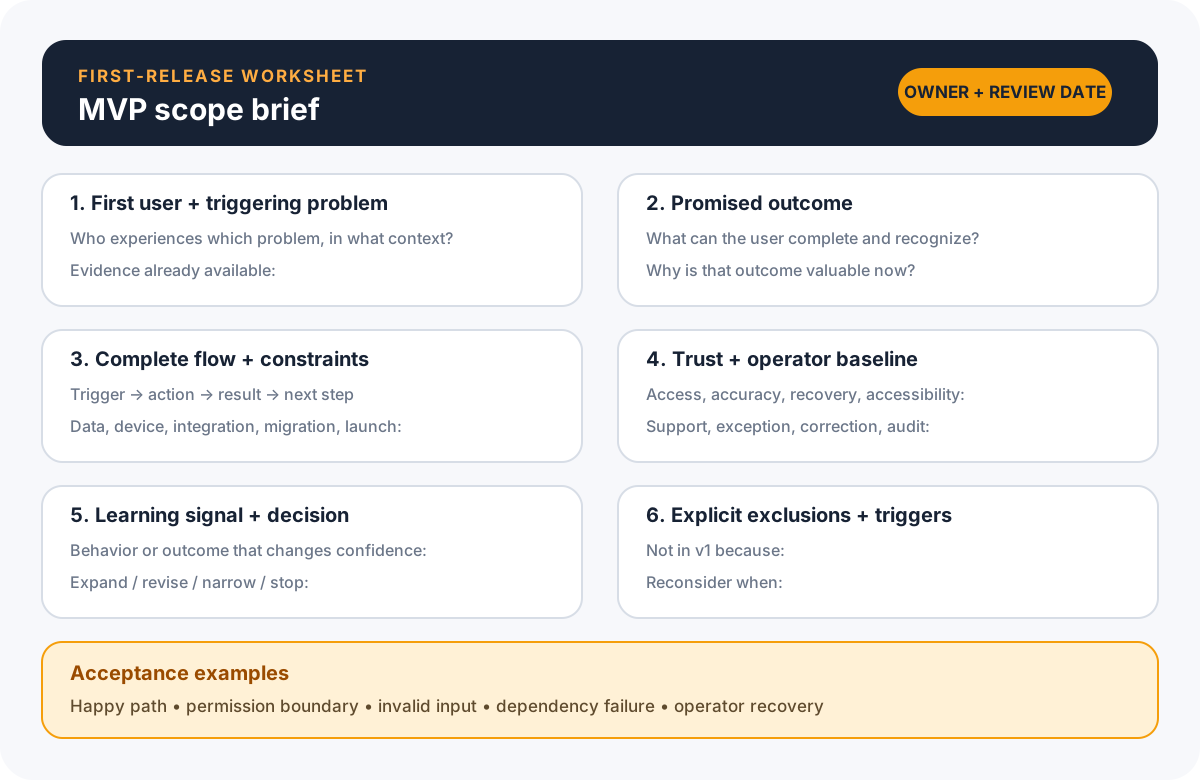
End with the decision after launch: expand, change the workflow, narrow the audience, run another test, or stop. An MVP is useful when it creates a credible next decision—not when it merely checks boxes in a smaller backlog.
Frequently asked questions
What should be included in an MVP?
An MVP should include the smallest complete path that lets one specific user achieve one valuable outcome, plus the trust, access, failure handling, operator visibility, and measurement required to run that path responsibly. Include a feature when removing it breaks the core job, makes the release unsafe or unmanageable, or prevents the team from learning what it set out to test.
How do you decide which MVP features to cut?
Ask what observable failure occurs if the feature is absent in the first release. Defer it when the answer is mainly reduced convenience, polish, audience breadth, automation, configuration, or future scale. Keep it when its absence blocks the primary outcome, violates a real trust requirement, overwhelms operations, or makes the learning signal unreadable.
Does an MVP need login, billing, and an admin panel?
Only when the product and pilot require them. A controlled pilot may use invitation access, manual invoicing, and a small operator queue. A multi-tenant or self-serve release may need stronger identity, permissions, billing, and support tooling. Scope the minimum responsible mechanism for the actual users, data, and operating model rather than copying a generic SaaS checklist.
How long should MVP scoping take?
There is no honest universal duration. It depends on uncertainty, stakeholder access, workflow complexity, integrations, data, security, and the quality of existing evidence. Scoping is ready when the team can name the user, job, complete flow, constraints, exclusions, acceptance cases, learning signal, and owner well enough to compare implementation options and estimates.
What is the difference between an MVP scope and a roadmap?
MVP scope is the committed boundary for the first evidence-producing release. A roadmap is a set of possible later outcomes and decisions that should change as evidence arrives. Features excluded from the MVP may remain roadmap candidates, but they are not promises until the first release shows which problem deserves the next investment.