Answer first
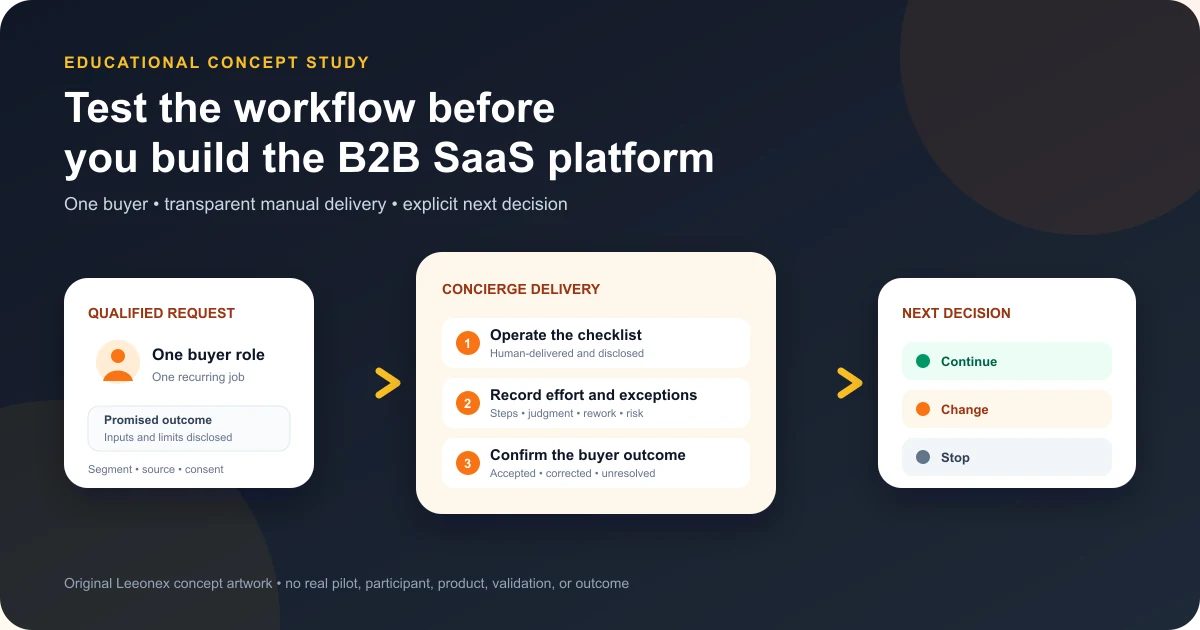
Before building a B2B SaaS platform, deliver one valuable workflow manually and learn where the product boundary actually belongs.
Choose one reachable buyer, one recurring job, and one outcome the buyer can confirm. Use a simple, truthful intake to collect the case, operate the service behind the scenes, return the result, and record every step, exception, judgment, delay, and correction.
The goal is not to make manual work look like software. It is to test whether the problem repeats, whether buyers supply the inputs, whether the promised outcome matters, whether delivery can become repeatable, and which risks must stay controlled. Build only after the evidence supports a specific next decision; change or stop when it does not.
Illustrative discovery conversation — not a client quotation
“What should we build?” becomes “what must we learn before a build is defensible?”
Founder
“We know the platform we want to build. Should we start with accounts, dashboards, integrations, and billing?”
Leeonex
“What recurring outcome will the first buyer ask for, and can your team deliver that outcome manually for a small controlled cohort?”
Founder
“We can do the work, but several steps depend on our domain judgment and the customer data is inconsistent.”
Leeonex
“Then the pilot should expose those judgments and data failures before code freezes them into a self-serve flow.”
This is Leeonex-authored teaching material. It represents no real founder, buyer, prospect, client, participant, interview, pilot, product, payment, quotation, launch, validation, demand, conversion, revenue, retention, time saving, or business outcome.
Starting situation and buyer
This concept is for a B2B founder who understands the domain but does not yet know which parts deserve software.
The founder may have interviews, a deck, a waiting list, or a long feature backlog. Prospective buyers agree that the problem sounds familiar, but the team has not observed enough real cases to know which inputs arrive, which exceptions dominate, who performs the work, or what outcome earns another use.
The intended first buyer is deliberately narrow: for example, a compliance operations lead at a mid-sized supplier who must turn a recurring evidence request into an approved response. The concept does not assume that example is attractive; a real team must choose its segment from its own access, expertise, risk, and research.
A concierge pilot is useful when the service can be delivered safely with people and simple tools before a full platform exists. It is a poor fit when the value depends on real-time scale, network effects, hardware behavior, regulated automation, or a risk that cannot be responsibly simulated.
Product owner
Owns the target buyer, hypothesis, exclusions, decision thresholds, pilot changes, and the final continue, change, or stop call.
Buyer participant
Brings a real recurring case, supplies required inputs, evaluates the promised outcome, and explains what would make the service worth repeating.
Concierge operator
Delivers the service through documented steps, records effort and exceptions, avoids invisible heroics, and escalates unsafe or unsupported cases.
Technical observer
Maps data, tools, handoffs, repeatable rules, security constraints, and automation candidates without prematurely turning observations into features.
User roles and core flow
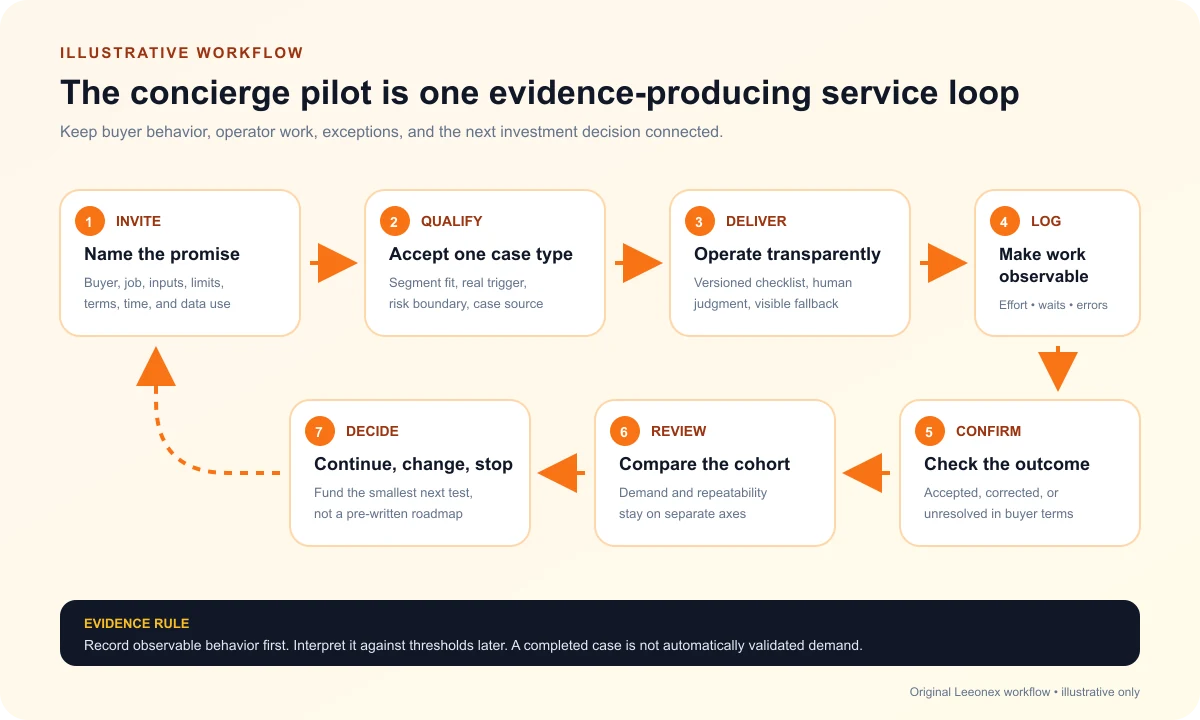
The workflow moves from a qualified request to a manually delivered outcome, buyer confirmation, and a recorded product decision.
A prospective participant sees a precise invitation that names the supported job, required inputs, expected output, response window, data treatment, price or free-test status, and what the pilot does not provide. The product owner qualifies the request against the segment and risk boundary instead of accepting every interesting edge case.
The operator checks the intake, requests missing information, and works through a versioned delivery checklist. Each transformation, external lookup, judgment, wait, correction, and exception is recorded. When a case falls outside the agreed boundary, the participant sees a clear refusal or escalation rather than a founder quietly inventing a new service.
The participant receives the result with its assumptions and limitations, then confirms whether the promised job was completed. A short debrief asks what they would do next, what they still had to fix, whether the job recurs, who would approve a repeat, and what alternative they would otherwise use.
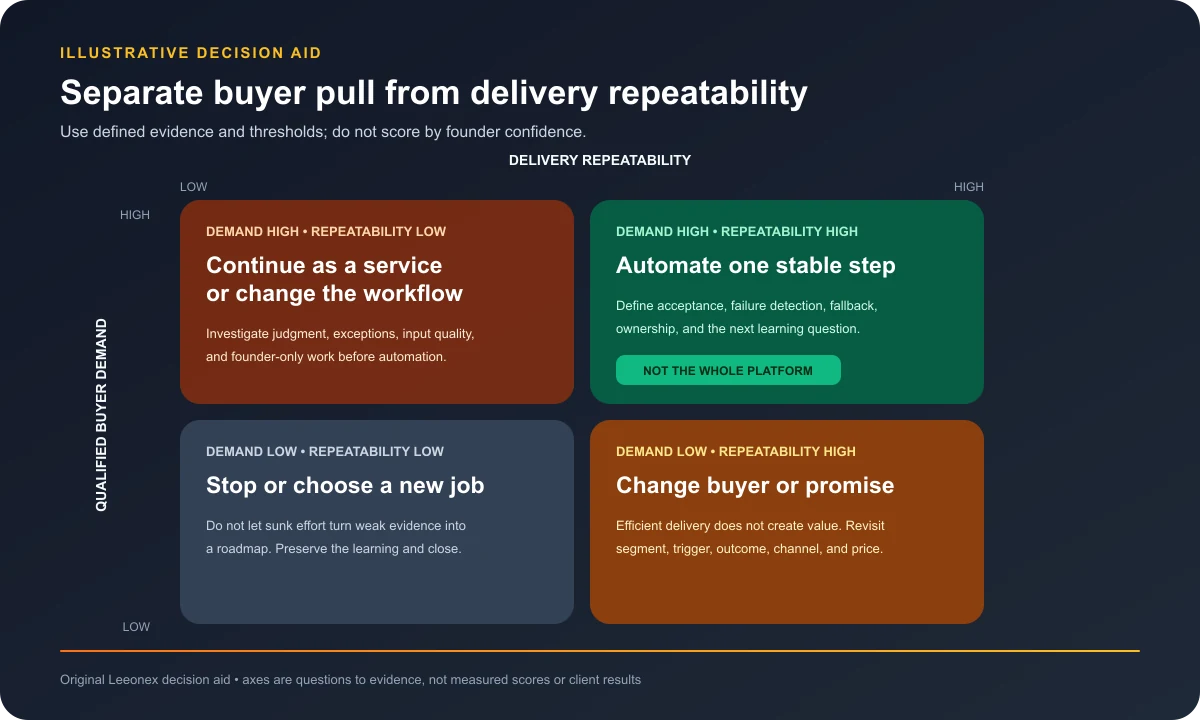
The team reviews cases as a cohort. Repeated demand and repeatable delivery are separate axes. A popular request that needs founder judgment every time may remain a service; a stable workflow with weak buyer pull may deserve no product at all.
Smallest useful scope
Build only enough infrastructure to run the experiment safely and preserve what the team learns.
A first pilot may use a focused landing page or direct invitation, a structured form, secure file collection when needed, a controlled operator queue, a versioned checklist, a response template, and a decision ledger. The buyer should know people are delivering the service; “concierge” is not permission to stage fake automation.
Limit the cohort, case type, input format, geography, turnaround, support channel, and number of iterations. Define which cases are rejected, refunded, or escalated. Manual work is acceptable only when its volume, owner, cost, and risk are visible.
Before recruitment, write the hypothesis and the decision it serves. The related MVP scoping checklist helps turn a supported workflow into one complete first-release loop. This study covers the earlier question: whether observed service evidence supports funding that release at all.
| Operate now | Build after evidence | Deliberately exclude |
|---|---|---|
| One qualified buyer segment | Self-serve onboarding | “Anyone with this problem” |
| Human-run delivery checklist | Stable step automation | Hidden fake automation |
| Outcome and exception ledger | Customer and operator workspace | Full platform feature parity |
Architecture and operating decisions
Treat the manual service as an observable system, not an improvisation that disappears into inboxes.
The intake record should identify the participant, organization, consent, case type, source, required inputs, promised output, service terms, and qualification decision. Sensitive material belongs in approved storage with explicit access, retention, and deletion rules—not copied through personal accounts for speed.
A case record tracks status, owner, timestamps, checklist version, actions, input gaps, external dependencies, judgment points, exceptions, rework, output version, and final disposition. The system may begin as carefully governed simple tools, provided the records can be exported and audited.
Participant feedback stays linked to the specific case and promised outcome. The evidence ledger distinguishes observed behavior from interpretation: “sent the required file after one reminder” is an observation; “onboarding is easy” is a conclusion that needs more support.
Product requirements emerge from repeated constraints. If every case needs the same missing-field request, the future product may need validation at intake. If exceptions vary by buyer policy, configurable rules or a permanent human review lane may matter more than a polished dashboard.
Evidence and decision rules
Decide what would make the team continue, change, or stop before the first participant enters.
Demand evidence may include qualified acceptance, completed intake, willingness to provide sensitive or inconvenient inputs, a defined budget owner, payment where appropriate, repeat use, and a buyer-introduced colleague with the same job. Each signal needs a definition, source, cohort, and observation window.
Delivery evidence may include cases completed within the promised boundary, operator steps, elapsed and active effort, missing-input loops, corrections, exceptions, escalations, quality review, and the buyer's outcome confirmation. Average effort must not hide a consequential failure or founder-only rescue.
Continue when the target buyer repeatedly completes the test and delivery is becoming understandable. Change the segment, promise, input, workflow, price, or operating model when the problem is real but the current path is not. Stop when the job is infrequent, the outcome is not valuable, acquisition is implausible, delivery is unsafe, or the evidence does not justify another round.
A pilot does not prove product-market fit. Its value is a smaller, auditable decision. Leeonex's product ideation and MVP scoping service can help define that decision before design or engineering spend expands.
Research and service boundary
A paid or manually delivered pilot is not automatically ethical, safe, representative, or valid research.
Participants need truthful terms, appropriate consent, privacy, accessible participation, secure handling, and a real support or complaint path. Regulated, clinical, legal, financial, safety, employment, or other consequential work may require qualified specialists and controls beyond a startup experiment. The team must not expose participants to a risk it cannot monitor and remedy merely to learn faster.
Risks and guardrails
The guardrails protect participants, keep manual work visible, and prevent hopeful interpretation from becoming a product claim.
Recruit from one defined buyer segment and record the source of every participant. Friendly interest, cold demand, partner referrals, and paid participation are different signals.
State the promised outcome, participation terms, manual service boundary, response time, data use, confidentiality, price or free-test status, and exit conditions before accepting a case.
Keep source inputs, operator actions, judgment calls, exceptions, outputs, participant feedback, and final outcomes as separate records so the team can see what actually happened.
Use a checklist for repeatable work and a visible exception path for cases that require improvisation. A founder rescuing every case is evidence of hidden complexity, not smooth delivery.
Confirm the outcome with the buyer in their language. Email replies, meetings, usage, and polite enthusiasm are not substitutes for a predefined completion or acceptance signal.
Protect access and sensitive data even when the interface is simple. A manual pilot still needs least privilege, approved storage, deletion rules, consent, and an incident route.
Set continue, change, and stop thresholds before results arrive. Do not reinterpret weak evidence as success because time has already been spent.
Automate only a repeated, understood, bounded step whose failure can be detected and recovered. Keep consequential judgment human until evidence supports a narrower rule.
Deliberate exclusions
The pilot should refuse the broad market, the finished-platform performance, and the metrics that cannot change a decision.
Do not build public registration, broad permissions, configurable workflows, integrations, subscriptions, multi-tenant reporting, mobile apps, AI automation, or enterprise administration merely because a future platform may need them. Add a technical spike only where feasibility is part of the current hypothesis.
Do not recruit everyone, accept every case, or count waitlist emails, page views, social reactions, meeting attendance, survey enthusiasm, or free participation as equivalent to recurring demand. Do not present pilot revenue without delivery cost, participant source, refunds, time window, and limitations.
Do not conceal manual work behind a simulated interface. Do not automate consequential judgments to make the demo feel complete. Do not retain participant inputs for future model training or marketing without a separate explicit, lawful, informed decision.
Limitations
This concept proves no buyer demand, delivery feasibility, price, product scope, or commercial outcome.
Leeonex has not run this concept for a client. No real founder, participant, segment, workflow, case, service, prototype, acquisition channel, price, payment, operator, security control, or observation window supports the page. The diagrams are explanatory artwork, not screenshots, research findings, or analytics.
Results would depend on participant access, selection bias, urgency, switching cost, trust, data quality, service skill, founder involvement, price, alternatives, legal duties, and the difference between what buyers say and what they repeatedly do. A concierge pilot can still produce ambiguous or misleading evidence.
Claims about validation, willingness to pay, product-market fit, conversion, revenue, retention, effort, cost, time saved, risk reduction, or build efficiency would require an approved protocol, transparent recruitment, contemporaneous records, defined measures, negative cases, comparable periods, attribution limits, and publication permission.
Lessons
The first product artifact can be a decision system, not a customer-facing application.
Early B2B ideas often contain three unknowns: whether the buyer wants the outcome, whether the team can deliver it repeatedly, and whether software is the right way to deliver it. A feature backlog mixes those questions together and makes confident estimates look more informative than they are.
A carefully operated service loop separates the unknowns. It shows which information buyers actually provide, which steps follow stable rules, where judgment remains essential, and which failure states a future product must make visible. That evidence can shape a smaller build—or an honest decision to remain a service.
The best next step is the smallest one that changes the investment decision. It might be a buyer interview round, a concierge pilot, a landing-page test, a data or integration spike, or a scoped MVP. Browse the Leeonex case-study hub for other educational product, workflow, and implementation blueprints.
Bring this to a first consultation
The fastest useful conversation starts with a reachable buyer and a decision—not a preferred stack or finished feature list.
- The narrowest buyer you can reach, the recurring trigger that creates the job, today’s workaround, the cost or consequence of leaving it unresolved, and who owns the buying decision
- Three to ten representative cases if available, including incomplete inputs, exceptions, urgent cases, failed attempts, and examples that should be refused or escalated
- The outcome you can promise honestly, how the buyer will confirm it, expected turnaround, manual effort you can sustain, pricing assumptions, and the decision the pilot must unlock
- Sensitive-data categories, access constraints, regulatory or contractual duties, allowed tools, retention and deletion needs, participant consent, and any qualified review that cannot be replaced
Leeonex can use those inputs to map the pilot boundary, participant journey, operating checklist, evidence ledger, risk controls, and continue-change-stop rules. The result may support a focused build, another research round, a service model, or no product investment yet.