Answer first
Build the request-to-outcome record first; operate the uncertain middle deliberately.
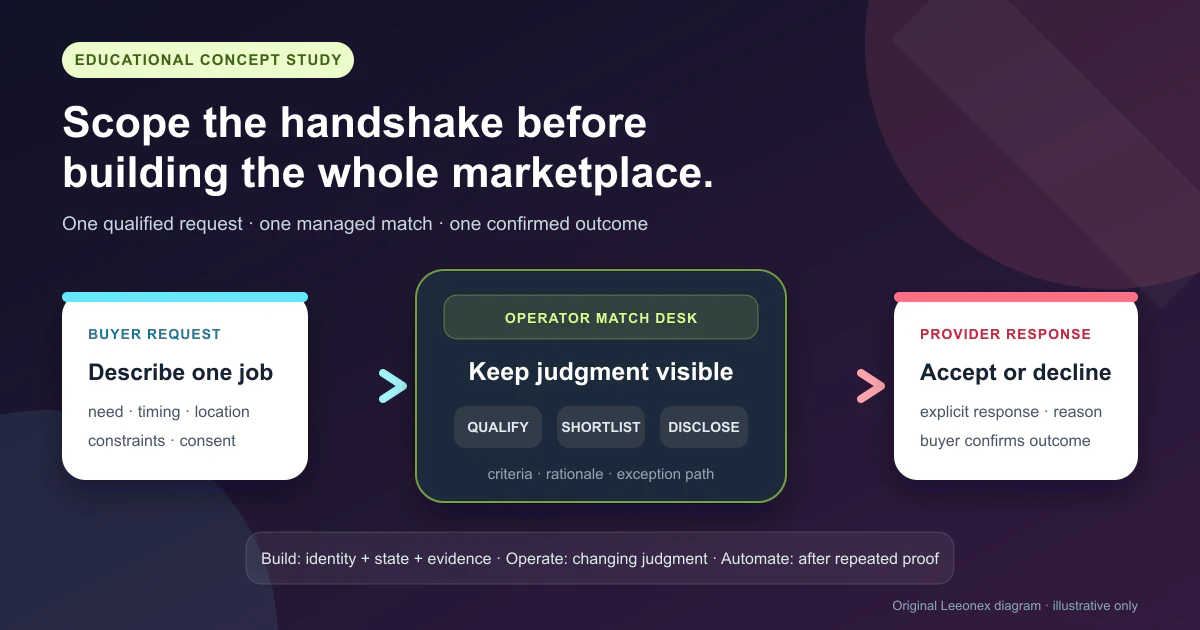
A two-sided service marketplace MVP should not begin as two complete self-serve products plus a matching engine. Begin with one bounded buyer segment, one service category, an approved provider pool, and one complete learning loop: capture a usable request, qualify it, create a shortlist, receive an explicit provider response, confirm what happened, and close the record.
Build the parts that preserve identity, state, permission, disclosure, communication, and evidence. Keep the judgment that is still changing—qualification, shortlist selection, exception handling, and sometimes pricing or settlement—with a named operator. Automate only after repeated cases show which rules are stable and which manual work is actually the bottleneck.
Evidence boundary
This is a Level E educational concept study. Leeonex has not built or operated this marketplace, recruited its participants, processed a transaction, or measured demand, matching speed, completion, retention, revenue, or marketplace liquidity. The roles, states, diagrams, scope choices, and dialogue are illustrative planning material—not client evidence or a product result.
Starting situation and intended buyer
The founder sees a platform; the riskiest assumption may be one human handoff.
This concept is for a founder, service operator, or product team that can reach a narrow buyer group and a small set of potential providers, but does not yet know whether requests will arrive in a matchable form, whether providers will respond, or whether a recommendation will become a completed service engagement.
The common brief sounds larger: searchable profiles, maps, availability calendars, chat, proposals, booking, escrow, ratings, referrals, subscriptions, provider onboarding, dispute workflows, and an algorithm that finds the best match. Each item can be reasonable later. Together, they create multiple products before the team has observed the operating loop they are meant to support.
The useful constraint is not “make it cheap.” It is “make the next decision readable.” A pilot may be invitation-only, cover one location, accept one request type, and rely on a small operator queue. It still needs truthful consent, permissions, recovery, accessibility, auditability, and support appropriate to the people and data involved.
Illustrative discovery conversation
Replace a category wishlist with the uncertainty the MVP must resolve.
The following exchange is fictional and is not a client quotation, transcript, testimonial, or account of delivered work. It shows how a first conversation can narrow the product boundary.
Founder
We need a marketplace where customers browse providers, compare profiles, book, pay, message, review, and come back.
Leeonex
Which uncertain behavior must the first release prove: that buyers submit usable demand, that qualified providers respond, or that both sides complete a service through your operating model?
Founder
We already know a small provider group. The uncertainty is whether buyers will submit enough detail and accept a recommended match.
Leeonex
Then provider discovery is not the first product. Start with a qualified request, an operator-owned shortlist, a lightweight provider response, and a confirmed outcome. Record the judgment before trying to automate it.
The decision is not that manual matching is universally better. It is that the first product should capture the facts and state transitions around a judgment before encoding a rule the team cannot yet defend.
User roles and accountability
Three roles are enough only when their boundaries are explicit.
Buyer
Owns: Describes one service need, constraints, location or delivery mode, timing, and contact preference; confirms whether the proposed match is useful.
Boundary: Cannot browse private provider data, see internal scoring, or treat a recommendation as a guarantee of quality, availability, or outcome.
Approved provider
Owns: Maintains a verified service profile, receives a bounded opportunity, accepts or declines with a reason, and reports the service status.
Boundary: Cannot see competing providers, unrelated buyer requests, or buyer details before the marketplace has a defined disclosure basis.
Marketplace operator
Owns: Qualifies requests, applies documented matching criteria, protects sensitive data, resolves exceptions, and closes the learning record.
Boundary: Cannot improvise undisclosed commercial, safety, compliance, or fairness rules without an accountable policy owner.
Core workflow
Use one lifecycle that both the product and the operator can explain.
The request begins when a buyer describes the job. The product checks required fields and records consent, but it does not claim the request is suitable. An operator either asks for missing detail, closes an out-of-scope request with a reason, or marks it ready to match.
The operator applies hard constraints before preferences, records a small shortlist, and invites one or more approved providers according to a defined disclosure policy. A provider accepts, declines, or lets the invitation expire. Acceptance does not silently mean a completed booking: the buyer still confirms the proposal or next step, and both sides can report what happened.
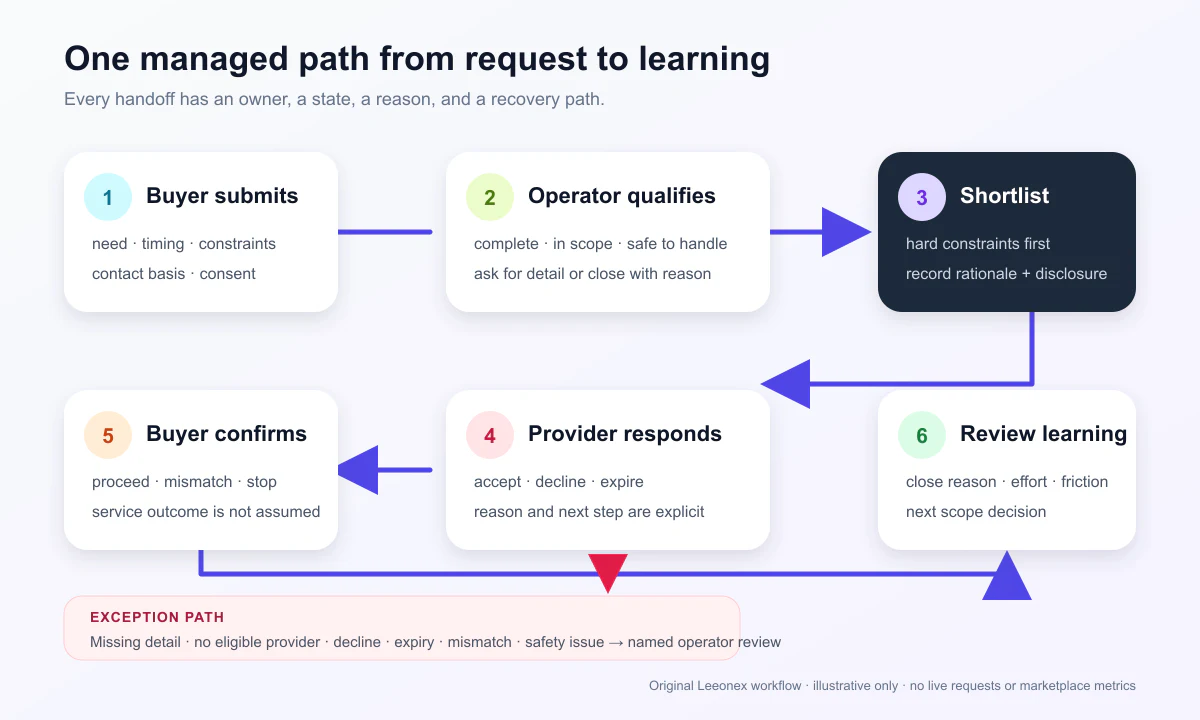
| Request state | Allowed owner | Evidence kept | Honest next step |
|---|---|---|---|
| Submitted | Buyer | Request version and consent | Qualification review |
| Needs detail | Buyer + operator | Question, response, timestamp | Ready or close with reason |
| Ready to match | Operator | Criteria and shortlist rationale | Provider invitation |
| Provider invited | Provider | Disclosure, expiry, response | Accept, decline, or retry |
| Accepted | Buyer + provider | Terms or next-step confirmation | Complete or flag issue |
| Completed / closed | Operator | Outcome reason and learning note | Review the next product decision |
Smallest useful scope
Build stable state; run changing judgment as an explicit service.
A concierge layer is not permission to hide chaos. The operator work needs criteria, capacity, ownership, timestamps, and a recovery path. The product should make that work observable enough to improve while avoiding automation that pretends the rules are settled.
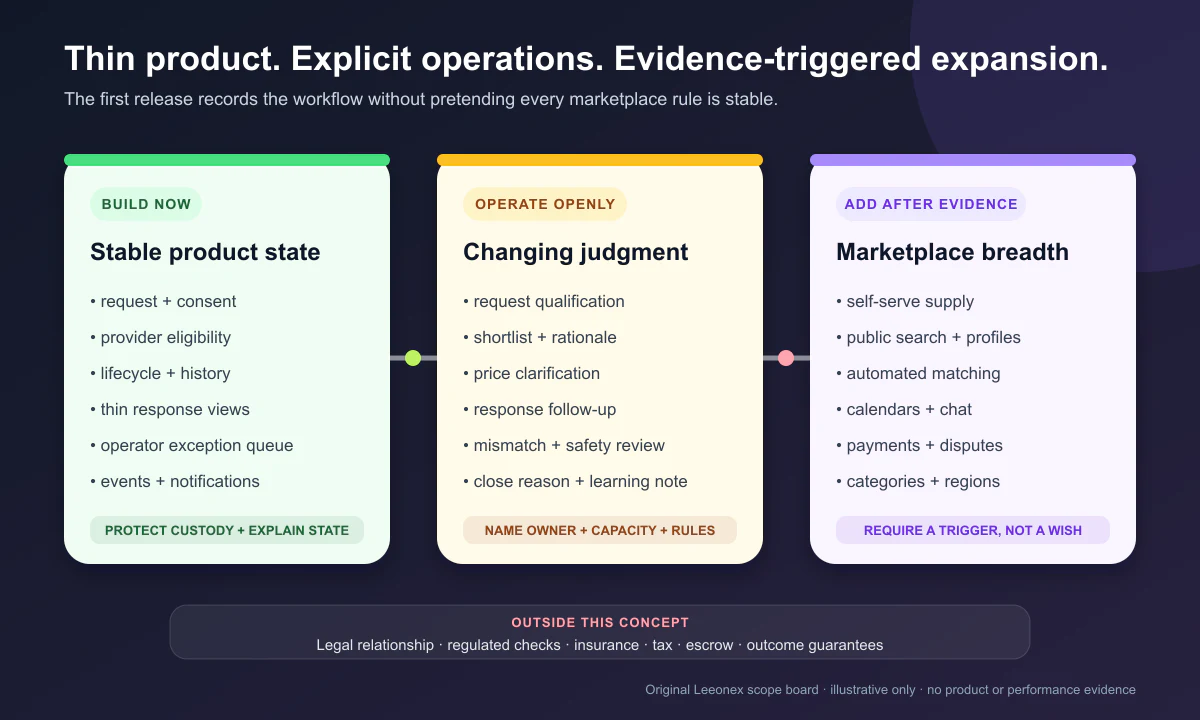
Build now
- Bounded request intake and consent
- Provider eligibility records
- State transitions and history
- Thin participant response views
- Operator queue and exception reasons
- Lifecycle notifications and learning events
Operate deliberately
- Request qualification
- Shortlist selection and rationale
- Price clarification where needed
- Response follow-up
- Mismatch and safety review
- Manual invoice or off-platform settlement if lawful
Add after evidence
- Self-serve provider onboarding
- Public search and profile comparison
- Automated ranking or routing
- Calendars, chat, payments, and disputes
- Ratings, referrals, and subscriptions
- Multiple categories, regions, and pricing models
Deliberately excluded from the concept
No claim is made that the marketplace should hold funds, employ or classify providers, verify professional licenses, insure the service, guarantee results, determine a fair price, arbitrate disputes, or comply with every sector and geography. Those are commercial, legal, safety, and operational decisions that may materially change the product. They must be resolved with the appropriate owners before the relevant capability enters scope.
Architecture and implementation decisions
Design around custody and transitions, not a catalogue of screens.
- Model a request as a lifecycle with allowed transitions, actor, reason, and timestamp—not as a mutable status label anyone can overwrite.
- Keep provider eligibility separate from match suitability. A provider can be approved for the network without fitting a particular request.
- Expose thin, task-specific views: a buyer request and status page, a provider invitation and response page, and an operator queue. Avoid three premature full dashboards.
- Store the shortlist rationale and disclosure state without publishing a mysterious universal score. Matching criteria should be inspectable and change-controlled.
- Use expiring, least-privilege links or authenticated access according to data sensitivity. Log who viewed, disclosed, changed, and closed a request.
- Send notifications from recorded state transitions. Email or messaging delivery is a prompt to return, not the source of truth for marketplace status.
A practical first data model may contain buyer accounts, provider profiles, approval records, requests, request versions, criteria, shortlists, invitations, responses, disclosures, lifecycle events, and issue records. Exact technology follows the constraints. The important implementation fact is that history and authority remain explicit enough to reproduce why a request moved—or did not move.
Risks and guardrails
A narrow pilot still needs a responsible operating boundary.
- 1
Define which service categories, locations, price bands, urgency levels, and request types the pilot will accept; route everything else to a clear decline or manual review.
- 2
Collect only information needed to qualify and match the request. Decide when provider identity and buyer contact details may be disclosed, and record consent where required.
- 3
Separate product matching from regulated advice, employment classification, licensing, insurance, safeguarding, tax, payments, disputes, and sector-specific obligations. Qualified legal and compliance review remains outside this concept.
- 4
Give providers a reason-coded decline path and operators an exception queue. Silence must not be interpreted as acceptance, availability, or completion.
- 5
Let both sides report a mismatch or unsafe interaction, and define who can pause a provider or request while the issue is reviewed.
- 6
Instrument lifecycle events and manual effort, but do not infer marketplace liquidity, unit economics, quality, or product-market fit from activity counts alone.
Limitations and evidence needed
The blueprint explains a build boundary; it does not prove a marketplace will work.
No buyer or provider research was supplied for this concept. No category, geography, price model, legal relationship, safety process, operator capacity, acquisition channel, or service standard has been validated. The diagrams are explanatory artifacts, not screens from a live product. The proposed stack is illustrative and would change with identity, privacy, payments, notification, localization, and sector constraints.
Stronger implementation claims would require a delivered system, repository and release evidence, acceptance tests, permission checks, security review, state-transition tests, audit history, operational procedures, incident records, and approved visuals. Stronger performance claims would additionally require defined cohorts, baselines, measurement windows, event sources, completion definitions, manual-effort records, exclusions, attribution limits, a verifier, and publication approval.
Useful pilot questions could include whether target buyers submit complete requests, why requests are rejected, which criteria eliminate providers, why providers decline, where operator effort accumulates, and whether both sides confirm the same outcome. These are measurement candidates—not reported results or promises of faster matching, lower cost, more bookings, better quality, retention, revenue, or liquidity.
Lessons and first consultation
Bring the operating truth that sits between request and outcome.
A marketplace brief becomes buildable when the team can explain who asks, who qualifies, who may see what, how a shortlist is made, what acceptance means, how the service relationship begins, and how exceptions end. Bring these inputs to a first conversation:
- The first buyer segment, the triggering situation, and the single service outcome the marketplace will coordinate
- The current provider list, approval criteria, coverage limits, availability signals, and who owns provider quality
- A real or representative request form, including which details are required before anyone can make a responsible shortlist
- The matching judgment used today: hard exclusions, useful preferences, conflicts, ties, and reasons a provider may decline
- The commercial boundary: who contracts with whom, when pricing is known, whether payment belongs in v1, and who handles refunds or disputes
- Privacy, consent, safety, licensing, accessibility, geography, notification, retention, and support constraints
- The pilot cohort, operator capacity, learning questions, stop conditions, and evidence that would justify more automation
Leeonex’s focused MVP development service fits teams ready to turn one validated workflow into a usable first release. If the boundary is still broad, use the MVP scoping checklist to define one complete learning loop. If software behavior is not yet required, the landing page or MVP decision guide can help choose a lighter demand test.
Explore the Leeonex case-study hub to compare other evidence types and product decisions. Case-study structure, metadata, sitemaps, and AI-readable discovery can make the work easier to find and interpret, but none guarantees rankings, indexing, traffic, citations, trust, leads, conversions, or marketplace success.
A problem-aligned next step
Map one request all the way to a confirmed outcome.
Bring one representative buyer request, the provider criteria, and the judgment used to make a match. Leeonex can turn them into a focused marketplace MVP scope—or show where a manual pilot should answer the next question first.