Answer first
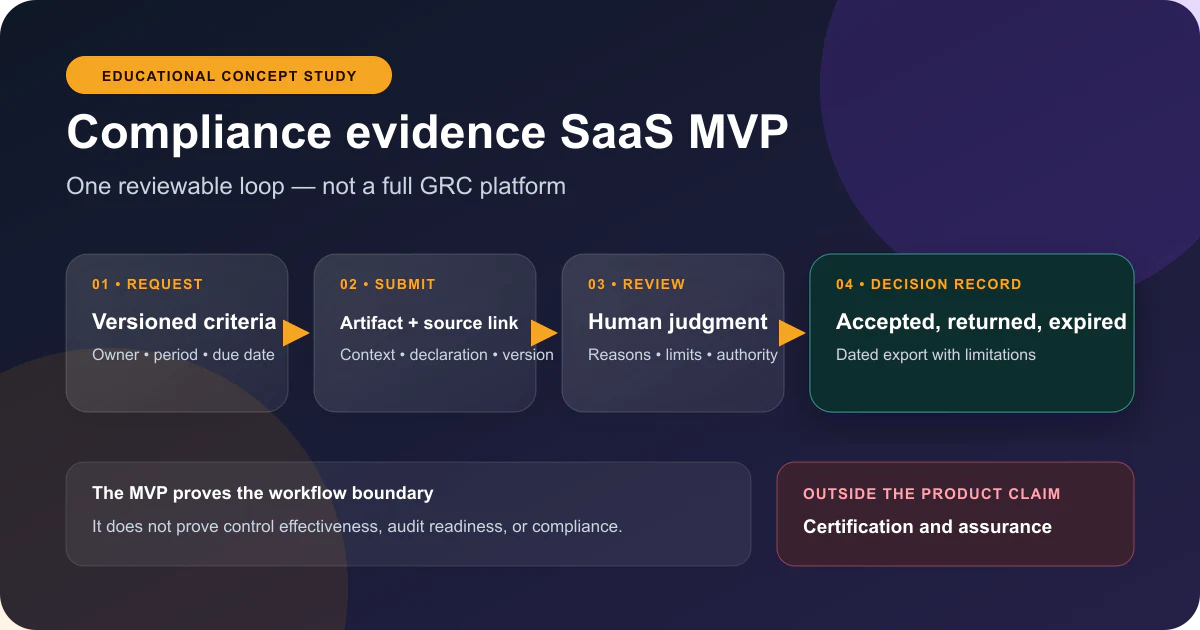
A useful compliance evidence MVP should prove one request-to-review loop, not imitate an entire GRC suite.
Start with one recurring evidence request family and four explicit authorities: who asks, who submits, who reviews, and who controls access. Preserve the request version, source context, artifact, contributor declaration, reviewer decision, reasons, expiry, and export history as separate facts.
The first release should help a team know what was requested, which version was supplied, who judged it, what remains unresolved, and when the decision becomes stale. It should not score compliance, certify a company, interpret a framework, or turn an uploaded file into proof that a control operates effectively.
Illustrative discovery conversation — not a client quotation
“Build a compliance platform” becomes “preserve one reviewable evidence decision.”
Founder
“We want a platform for policies, controls, risks, audits, vendors, frameworks, evidence, and automated compliance. What should the MVP include?”
Leeonex
“Which one recurring evidence request is painful enough to test, and who is allowed to request, submit, judge, and export it?”
Founder
“Today the program owner chases files in email, contributors upload different versions, and reviewers cannot tell what was accepted last time.”
Leeonex
“Then the first product should preserve that chain of custody and decision. It should not pretend to determine compliance or replace the reviewer.”
This is Leeonex-authored teaching material. It represents no real founder, company, compliance program, framework, request, reviewer, auditor, client, prospect, product, pilot, certification, audit, launch, adoption, time saving, risk reduction, or business outcome.
Starting situation and buyer
The buyer has an evidence coordination problem before they have a platform problem.
This concept is for a compliance software founder, security or operations leader, or B2B product team that sees evidence requests moving through email, spreadsheets, ticket comments, shared drives, and meetings. The team can usually locate some files, but it cannot quickly explain which request version they answer, what period they cover, who reviewed them, why they were accepted, or whether the decision is still current.
The visible frustration is chasing. The product risk is deeper: unlike items are called evidence, request wording changes without history, old files are reused silently, reviewers leave decisions in chat, broad folders expose sensitive material, and exports flatten uncertainty into a reassuring status table.
A custom MVP is worth considering only when the team has a distinctive, repeated workflow that existing tools cannot support through configuration. If the main need is a standard control library, policy register, vendor questionnaire, or certification workflow, buying and configuring a mature product may be the more responsible first move.
Program owner
Defines the evidence request, due date, scope, owner, review route, recurrence, expiry rule, and what an export may honestly represent.
Contributor
Responds to an assigned request, links the source, supplies the artifact and context, declares the covered period, and corrects returned submissions.
Reviewer
Checks the submission against stated criteria, records an acceptance or return decision with reasons, and never lets software imply assurance it did not perform.
Tenant administrator
Controls membership, role assignment, access boundaries, retention settings, integrations, and support escalation without deciding whether evidence is sufficient.
Core workflow
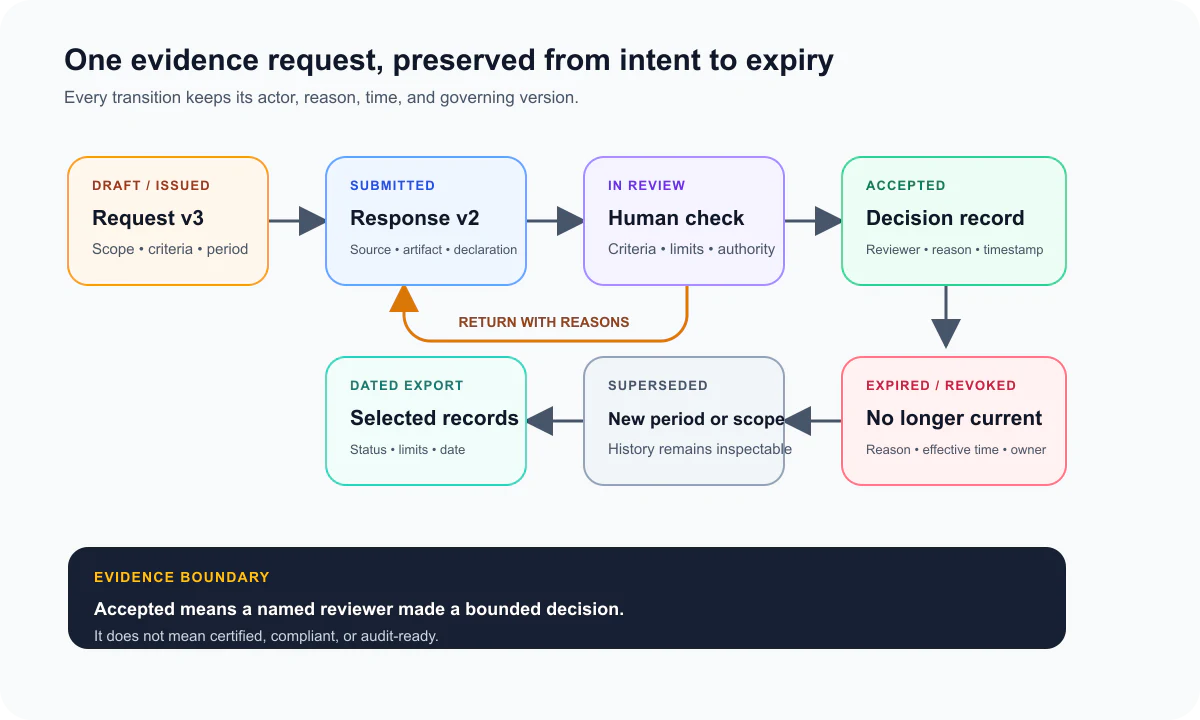
The product moves a versioned request to an explainable decision, then keeps time and change visible.
The program owner creates a request from an approved template or a bounded ad hoc need. The request names the subject, expected source, covered period, acceptance criteria, permitted formats, owner, reviewer, due date, recurrence, sensitivity, and expiry rule. A published request version becomes immutable; material changes create a new version rather than rewriting history.
The contributor opens only assigned requests, sees the required context, and either submits, asks for clarification, or declares why the item is not applicable or unavailable. A submission links its source and period, records a declaration, and preserves its own version. Replacing a file does not silently erase the earlier response.
The reviewer compares the submission with the stated criteria and accepts it, returns it with reasons, or escalates it to the accountable owner. Acceptance records who decided, when, against which request and submission versions, with what limits. The system can show a review status; it cannot infer that the underlying control was properly designed or operated.
Time then becomes part of the model. An accepted item can approach expiry, expire, be superseded by a new period, or be revoked when its source becomes unreliable. An export is a dated view of selected records and their known limitations—not a certificate or a permanent truth snapshot.
Smallest useful scope
Build one tenant, one evidence family, and one complete decision trail.
V1 needs invitation-based tenant access; the four roles; one request template family; request versioning; assignment; due dates; clarification; source-linked file or URL submission; versioned responses; return, accept, expire, supersede, and revoke paths; a reviewer queue; scoped search; notifications; and a dated export.
Add a small operator view for failed notifications, inaccessible files, malware or file-processing failures, orphaned assignments, overdue requests, and support access. Define deletion, retention, restoration, and incident paths before sensitive evidence enters the product. A polished contributor screen without these controls is not an operable release.
Keep framework catalogs, cross-framework mappings, continuous control monitoring, automated evidence collection, risk registers, policy authoring, vendor management, remediation projects, audit sampling, assessor workspaces, executive scoring, and certification workflows outside V1. They are separate products or later decisions, not setup fields.
Architecture decisions
Model provenance, authority, and history before dashboards.
Use stable tenant, person, request, submission, artifact, review, and export identities. Request and submission versions should be append-oriented records linked to a stable parent. Consequential decisions should reference the exact versions they judged rather than whichever file happens to be current when a page loads.
Store artifacts in private object storage with tenant-scoped keys, server-authorized access, short-lived downloads, file type and size rules, malware scanning where required, encryption, backup and restore evidence, and an explicit retention policy. Avoid putting sensitive filenames, document text, signed URLs, or reviewer notes into broad analytics and application logs.
Enforce authorization on the server for every query and mutation. A contributor's assignment is not permission to browse a control library; a reviewer's request access is not permission to export a tenant; and a support role should require bounded, approved, time-limited access with a reason and record.
Notifications should point people back to the authoritative product state instead of carrying attachments. Use idempotent commands for submission and review, optimistic concurrency or an equivalent check for competing updates, and an outbox or similarly recoverable path for email delivery. Reconciliation should surface a decision saved without its expected notification or file-processing result.
Risks and guardrails
The dangerous failure is confident status without inspectable evidence or authority.
- Version the request separately from the response. When wording, scope, criteria, due date, or recurrence changes, keep the historical request that governed each decision.
- Store the source reference, covered period, contributor declaration, artifact checksum or stable identity, submission version, and timestamp. A filename alone is weak provenance.
- Make reviewer authority explicit. Acceptance means a named reviewer accepted a named submission against stated criteria; it does not mean a control passed an audit.
- Treat returned, expired, superseded, revoked, inaccessible, and deleted evidence as first-class states. Never turn absence or staleness into a green status by default.
- Separate tenant administration from evidence judgment, and use least privilege for requests, sensitive artifacts, reviewer notes, exports, support access, and deletion.
- Do not calculate a universal compliance percentage from unlike controls, missing scope, or unreviewed artifacts. Status labels need precise definitions and visible denominators.
- Log consequential actions, but do not call an application log tamper-proof or audit-ready without an implemented integrity model, retention controls, access review, and testing.
- Put framework interpretation, legal advice, certification, independent assurance, and final audit judgment outside the software claim. Qualified owners remain accountable.
Build now versus later
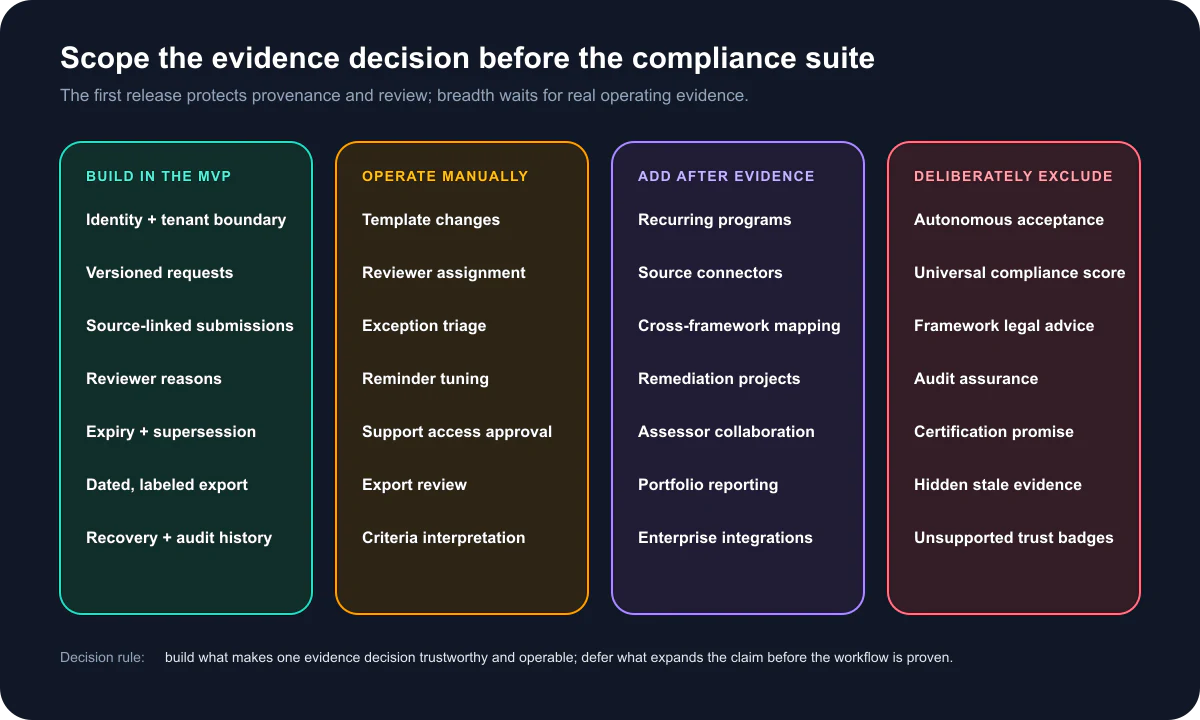
Build decision integrity now; earn breadth with evidence.
Build identity, tenant isolation, role enforcement, request and response versioning, source context, reviewer reasons, expiry, supersession, action history, private storage, recoverable notifications, export labeling, retention controls, and representative acceptance tests now. These make the narrow loop trustworthy enough to test.
Operate template changes, reviewer assignment, reminder tuning, exception triage, support access approval, export review, and framework interpretation manually during the first controlled cohort. Manual work is acceptable when it is disclosed, bounded, recorded, and used to learn rather than hidden as fake automation.
Add connectors, recurring request programs, reusable mappings, dashboards, remediation links, APIs, assessor collaboration, and multi-region or enterprise controls only after real cases show a repeated need and the organization can own the resulting security, support, governance, and change burden.
Deliberately excluded
Do not let product language outrun the evidence.
V1 does not determine applicability, interpret frameworks, design controls, prove operating effectiveness, sample populations, validate source authenticity, perform penetration testing, assess risk, issue legal advice, act as an independent auditor, or grant a certification. It does not promise “audit readiness” as a product state.
It also excludes public trust badges, universal compliance scores, autonomous acceptance, evidence generated from screenshots without source context, broad support impersonation, irreversible deletion, exports that omit unresolved or expired items, and AI summaries that hide the underlying request, artifact, or reviewer decision.
Limitations and evidence boundary
This concept proves no product fit, security, reliability, compliance, audit readiness, certification, time saving, or business outcome.
No client, compliance program, framework, control, evidence set, reviewer, auditor, assessor, product, codebase, tenant, storage system, integration, incident, export, or production environment was inspected. The four roles, seven states, workflow, scope boundary, architecture, and guardrails are proposed planning material.
Stronger delivery claims would require an approved scope and data model, applicable criteria, representative artifacts and exceptions, implemented identity and authorization evidence, tenant-isolation tests, integrity and retention controls, review records, export checks, accessibility and usability findings, security assessment, runbooks, incidents, recovery tests, and publication permission.
Performance claims would additionally need predefined units, baselines, dated measurement windows, source systems, calculations, exclusions, confounding changes, attribution limits, verifier approval, and permitted wording. Possible measures include time to first response, review cycle time, return reasons, stale-item rate, overdue volume, inaccessible artifacts, reopened decisions, and support load; none was measured here.
Lessons and first consultation
Bring one real evidence journey, not a framework feature list.
The best first conversation follows a single request from creation to expiry and names every point where authority, source, access, meaning, or time can become ambiguous. Bring these inputs:
- One evidence request family, why it recurs, the decision it supports, the applicable scope and criteria, who owns it, who contributes, who reviews, and who may see the result
- Representative artifacts and exceptions: missing periods, partial exports, screenshots without source context, changed policies, revoked access, duplicates, sensitive data, and evidence that should be refused
- Current tools and handoffs, request volume, recurrence, due-date logic, review turnaround, escalation rules, retention and deletion needs, export audience, and support ownership
- Tenant and identity model, data classifications, hosting and integration constraints, legal or contractual duties, qualified reviewers, security requirements, and the decision the first release must unlock
Leeonex's MVP development service fits teams that need to turn one validated workflow into a focused, operable first release. The MVP scope checklist helps test every feature against the core job, trust baseline, operations, and learning signal. The SaaS audit log requirements guide explains why operational history must be scoped as evidence rather than generic telemetry.
Explore the Leeonex case-study hub for other product and workflow decisions. Metadata, structured data, sitemaps, and AI-readable discovery files can improve eligibility and understanding, but they do not guarantee ranking, indexing, traffic, citations, trust, leads, conversions, or product success.
A problem-aligned next step
Map one request-to-review loop before the backlog becomes a GRC platform.
Bring the request, roles, artifacts, criteria, access boundary, exceptions, expiry rule, and decision the MVP must unlock. Leeonex can turn them into a focused first-release brief.