Answer first
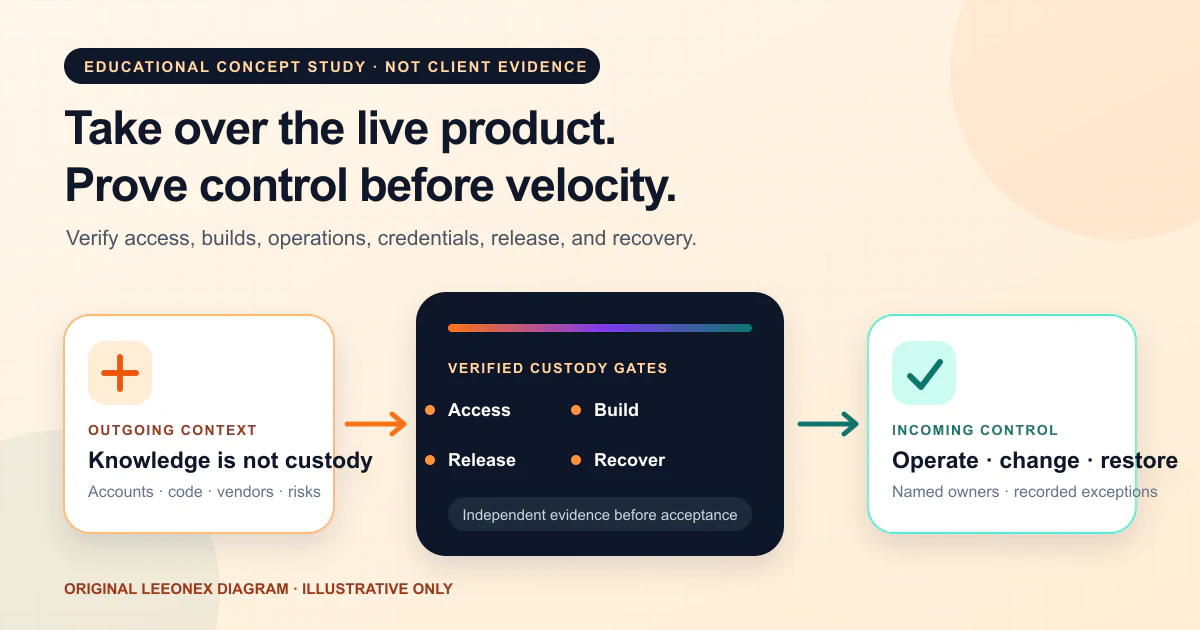
A live product handover is complete only when the incoming team can operate, release, and recover it without hidden dependence.
Start by freezing the assumption that a repository and a call count as a handover. Build a complete custody inventory across product decisions, source code, infrastructure, data, vendors, observability, and support. Move control into organization-owned accounts, verify access from the incoming team, and record every exception before removing the outgoing team.
Next, reproduce the product from a clean environment, observe the live system, verify the critical journeys and backups, and run one narrow release with approval, monitoring, and rollback. New feature delivery comes after that control loop—not as a shortcut for discovering whether the incoming team can safely change the product.
Illustrative discovery conversation — not a client quotation
“Take over the code” becomes buildable only after custody and release authority are mapped.
Founder
“Our development partner is leaving next month. Can your team take over and keep shipping?”
Leeonex
“Who controls the repository, cloud account, domains, build pipeline, production secrets, billing vendors, and incident alerts today?”
Founder
“We own the Git organization and cloud billing, but releases happen from one developer’s laptop and several vendor accounts use their email.”
Leeonex
“Then the first scope is operational custody: verify access, reproduce the build, map critical journeys, rotate credentials, and prove one reversible release before promising roadmap velocity.”
This is Leeonex-authored teaching material. It represents no real founder, quotation, agency, engagement, repository, cloud account, incident, release, handover, or product result.
Starting situation and buyer
This concept is for teams whose software must stay live while technical ownership changes.
The intended buyer is a SaaS founder, product leader, engineering owner, or business operator inheriting a live product from an agency, contractor, departing internal team, acquisition, or previous vendor. Customers still sign in, payments still run, support still receives tickets, and contractual or roadmap work may continue while the people who know the system prepare to leave.
The constraints are operational. Access may live in personal accounts. Production configuration may exist only in a dashboard or laptop. Builds may depend on undeclared packages. Database migrations, scheduled jobs, manual data repairs, vendor limits, certificate renewal, and incident escalation may be understood by one person. The incoming team cannot responsibly estimate feature velocity until those dependencies are visible and testable.
Product owner
Defines the critical journeys, current commitments, acceptable interruption, priority decisions, and evidence required to accept the handover.
Outgoing technical lead
Explains the real build, release, data, vendor, incident, and support paths; transfers known exceptions instead of producing only a stack summary.
Incoming rescue lead
Verifies artifacts independently, records gaps, owns the controlled first change, and refuses custody where a critical path remains untestable.
Security or operations owner
Approves access, credential rotation, backups, monitoring, incident escalation, vendor ownership, and the final operational acceptance boundary.
Smallest useful scope
Close one custody loop before accepting the roadmap.
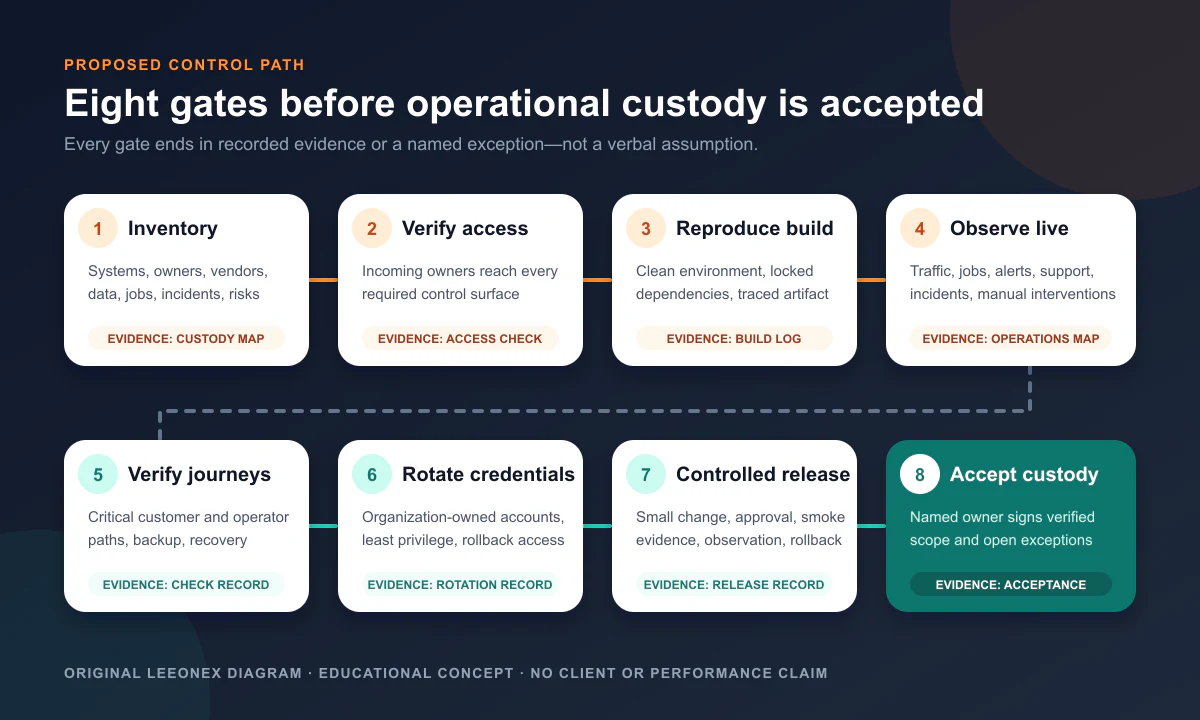
The first scope inventories the product and its operating surface, verifies that the incoming team can reach each required system, reproduces a build from reviewed source, and maps the path from approved change to deployed artifact. It identifies the critical customer and operator journeys, the data they touch, how failures become visible, who responds, and how service is restored.
The custody proof is one deliberately small change—such as a reversible content, configuration, or low-risk interface update— that moves through review, tests, staging, approval, production observation, and rollback readiness. Success here means the evidence bundle is complete enough for an accountable owner to accept control. It does not mean the codebase is healthy or the full roadmap is ready to accelerate.
Architecture and implementation decisions
Make product custody traceable from source change to production recovery.
Keep source repositories, issues, build definitions, infrastructure configuration, artifacts, documentation, and decision records in organization-controlled systems. A clean build should declare the runtime, dependency lock, required configuration names, test commands, artifact identity, and deployment target. Environment-specific secrets belong in an approved secret store, never in handover documents or chat.
Map domains and DNS, certificates, cloud resources, databases, object storage, queues, background workers, scheduled jobs, identity, payments, email, analytics, feature flags, monitoring, support, and mobile-store accounts as one operating graph. For each node, record the organization owner, technical owner, access route, billing owner, renewal risk, data sensitivity, alert path, backup expectation, and exit procedure.
The release path should connect an approved commit to an immutable artifact, target environment, migration plan, smoke evidence, monitoring window, and rollback decision. If the current process cannot do that, the handover scope should stabilize delivery before it adds features or proposes a rewrite.
Risks and guardrails
Removing the old team too early and trusting access without testing it are opposite versions of the same handover risk.
- Inventory repositories, domains, cloud resources, data stores, queues, scheduled jobs, vendors, mobile-store accounts, analytics, and support channels before revoking access.
- Move shared control into organization-owned accounts, grant least privilege, require multi-factor authentication, and rotate credentials through a written sequence with rollback access.
- Reproduce the build from a clean environment and trace each artifact to reviewed source, declared dependencies, configuration, and a named release approver.
- Protect production with a release freeze or narrow change policy until critical journeys, backups, monitoring, deployment, and rollback have been verified.
- Record open incidents, manual interventions, data repairs, vendor limits, undocumented jobs, and known failure modes; a polished handover document is not proof that the system is controlled.
- Accept custody by explicit exceptions: name what is verified, what remains dependent on the outgoing team, the risk owner, and the deadline for each unresolved gap.
Build now, validate later
Operational control belongs now; modernization belongs behind evidence.
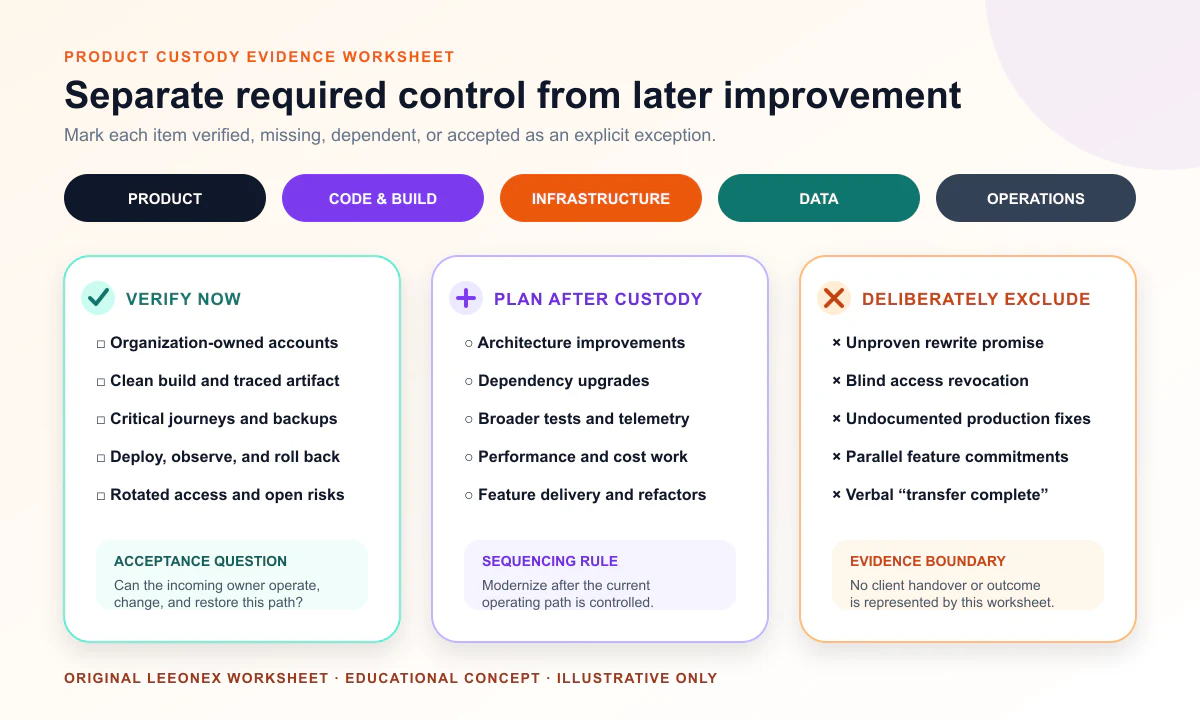
Verify inventory, organization ownership, least-privilege access, clean builds, critical journeys, backups, monitoring, incident escalation, deployment, database migration, rollback, credential rotation, open risks, and acceptance now. Preserve current behaviour where it is required for continuity, even when the new team would design it differently.
Validate architecture changes, dependency upgrades, broader test coverage, observability improvements, performance work, vendor replacement, feature delivery, and refactoring after custody is stable. Deliberately exclude a framework rewrite, mass credential revocation without an access map, undocumented production fixes, parallel feature promises, and “knowledge transfer complete” as an acceptance criterion without independent verification.
Limitations and evidence boundary
This concept proves no successful handover, safer release, reduced downtime, faster delivery, or software rescue outcome.
No product, repository, infrastructure, customer data, agency, development team, build, credential, backup, incident, release, or rollback was inspected or transferred for this study. The four roles, eight gates, five evidence bundles, technical controls, and diagrams are proposed planning choices only. They are not a security audit, legal checklist, service-level commitment, or guarantee that an inherited product can continue without interruption.
Stronger delivery claims would require an approved project record, named or approved-anonymous parties, completed access and asset inventory, source and build verification, recorded exceptions, credential rotation, backup and recovery evidence, critical-flow tests, release and rollback records, acceptance sign-off, approved visuals, and publication permission. Performance claims would additionally need a baseline, stable metric definition, measurement window, source, calculation, exclusions, attribution limits, and an approved verifier.
Lessons and first consultation
Bring the operating reality, not only the codebase.
The main lesson is that handover scope lives in control, reproducibility, observability, recovery, and named acceptance. These inputs make a first consultation concrete:
- Repository and issue-tracker locations, product roadmap, release history, current incidents, known fragile areas, and the date or event driving the transition
- An owner map for cloud, domains, DNS, certificates, app stores, databases, email, payments, identity, analytics, monitoring, support, and every other production vendor
- The critical customer and operator journeys, representative test accounts, data sensitivities, backup expectations, compliance owners, and acceptable release or service interruption
- Current build and deployment instructions, environment list, access process, secret locations, migration steps, scheduled work, rollback method, support runbooks, and named acceptance owner
Explore Leeonex software project rescue for the closest service path. Use the staff augmentation versus project delivery guide to clarify ownership after the transition, and the refactor-or-rewrite rescue guide when the inherited system also needs a modernization decision. You can also return to the case-study hub to compare other evidence types and product decisions.
Is product ownership changing hands?