Answer first
The smallest useful offline field app completes one inspection without treating connectivity as a save button.
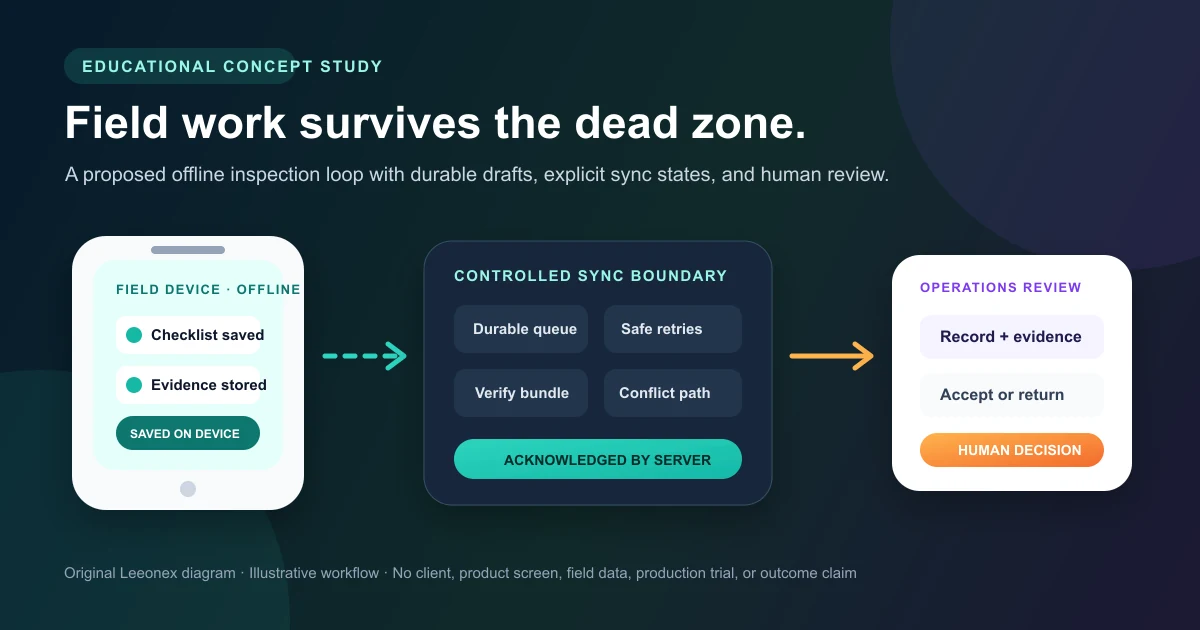
Preload one assigned inspection and its versioned checklist. Let the inspector record required answers, notes, photos, and an acknowledgement while disconnected. Persist every change on the device, validate it locally, and place the completed record in a visible upload queue.
When a connection returns, upload through an idempotent API, verify every evidence item, and move the record to review only after the server acknowledges it. Anything incompatible, incomplete, or disputed should enter a named human path rather than disappear behind a spinner.
Illustrative discovery conversation — not a client quotation
“Works offline” becomes buildable only after save, submission, and review are separate states.
Field operations lead
“Our inspectors complete paper forms at remote sites and enter them again later. Can we replace that with an app?”
Leeonex
“What must still work with no signal, what evidence is required, and when is an inspection officially submitted?”
Field operations lead
“The checklist, notes, photos, and signatures must survive offline. A reviewer accepts the record after it reaches the office system.”
Leeonex
“Then v1 needs durable local drafts, visible sync states, safe retries, a conflict path, and one review handoff before it needs more form types.”
This is Leeonex-authored teaching material. It represents no real customer, quotation, engagement, app, inspection, or field data.
Starting situation and buyer
This concept is for teams that cannot prove what happened between the site and the office.
The intended buyer is a field operations leader, safety or compliance owner, service business, or mobile product team whose inspectors work in basements, plants, construction sites, rural areas, or other unreliable network conditions. Paper, shared files, or online-only forms lead to later re-entry and unclear submission status.
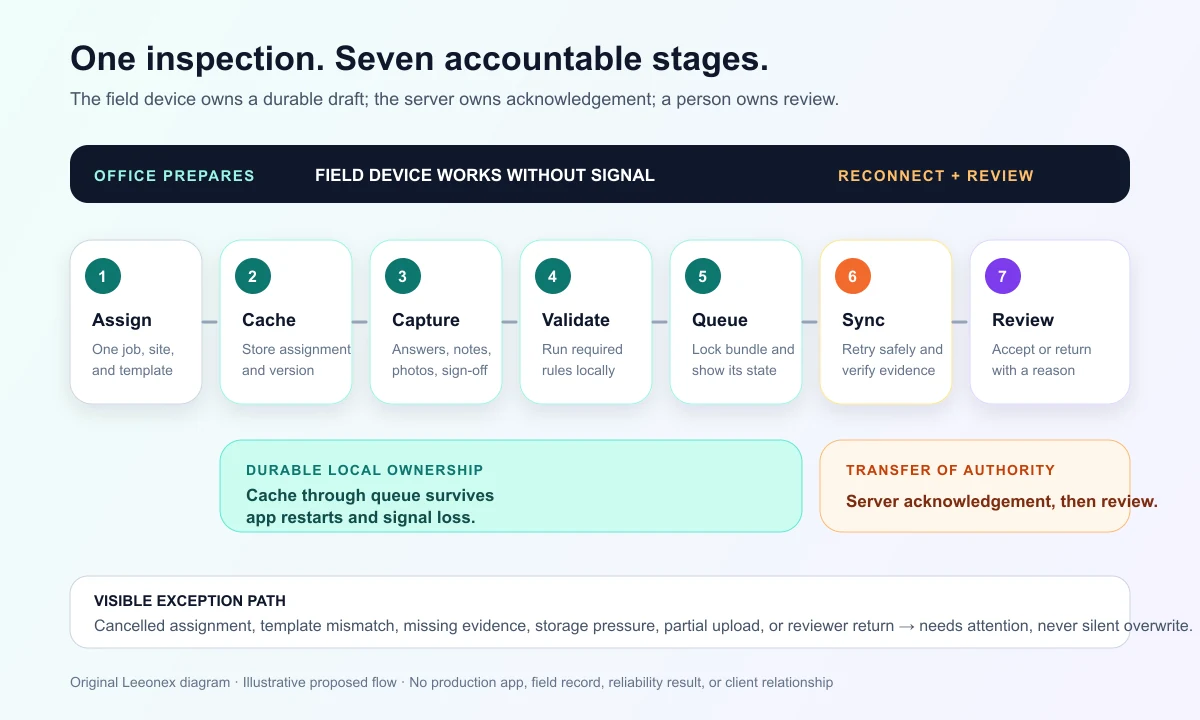
The hard constraints are operational: form versions can change; photos are large; devices may be shared or lost; clocks can be wrong; uploads can partly succeed; assignments can be cancelled; and a reviewer may reject a completed record. Offline mode is therefore a data lifecycle, not a visual banner.
Field inspector
Downloads assigned work, records findings and evidence offline, fixes validation issues, and can see whether each inspection is safely submitted.
Operations reviewer
Checks the completed record, returns incomplete work with a reason, and resolves business questions without editing away the original evidence.
System owner
Owns templates, access, device policy, sync monitoring, retention, support, and the runbook used when uploads or versions conflict.
Smallest useful scope
Choose one inspection type, one evidence bundle, and one review handoff.
Version one can cover assigned work for one site or asset type. A signed-in inspector downloads the assignment and a versioned template, captures structured answers, notes, photos, location only when justified, and a final acknowledgement. Required rules run on the device before the record can enter the queue.
The release also needs draft recovery, storage limits, upload progress, evidence checksums, retry controls, server acknowledgement, reviewer accept-or-return, operator monitoring, and a support runbook. A form builder, live collaboration, predictive risk scoring, route optimization, and every legacy inspection type are not required to prove the first loop.
Architecture decisions
Design a local source of work and a controlled synchronization boundary.
The mobile client needs an encrypted local database for assignments, template versions, drafts, evidence metadata, and queue state. Photos can use managed local files with checksums and explicit cleanup rules. A state machine should allow only valid transitions, while background work attempts uploads without hiding failures from the inspector.
The backend issues stable identifiers, accepts idempotent submissions, verifies the record and every evidence item, and acknowledges the accepted version. Conflict rules must distinguish a cancelled assignment, a replaced template, a returned inspection, and a harmless duplicate retry. Native or cross-platform remains a separate decision: test storage, camera, background transfer, device policy, and recovery on representative hardware before committing.
Risks and guardrails
Lost evidence, duplicate submissions, and silent overwrites are product failures—not rare connectivity edge cases.
- Save every meaningful change to durable local storage; an in-memory form is not an offline workflow.
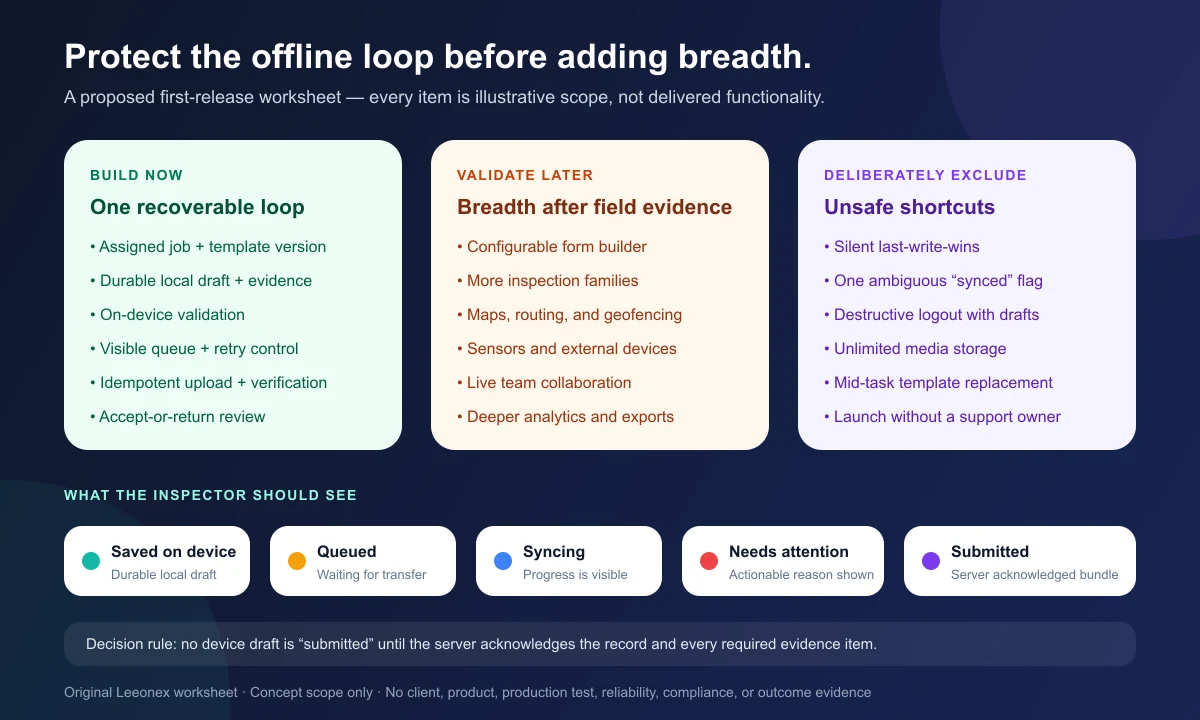
- Show human-readable states such as saved on device, queued, syncing, needs attention, and submitted.
- Use stable inspection and evidence identifiers so reconnects and retries cannot create duplicate submissions.
- Version templates and route incompatible server changes to review instead of silently overwriting field work.
- Encrypt sensitive local data, minimize what is cached, and define logout, device-loss, and retention behaviour before rollout.
Build now, validate later
Reliability belongs in v1; workflow breadth does not.
Build assignment download, one versioned template, durable local drafts, evidence capture, on-device validation, explicit queue states, idempotent upload, verification, review, monitoring, and recovery instructions now. Validate more inspection types, configurable forms, maps, routing, external sensors, team collaboration, and deeper analytics against observed field work.
Deliberately exclude silent last-write-wins, a single “synced” boolean, destructive logout with pending work, unlimited photo caching, automatic template replacement mid-inspection, and a launch with no named support owner. If offline work is rare and low risk, a responsive web form with draft recovery may be the lighter answer.
Limitations and evidence boundary
This concept proves no field reliability, compliance, or operating outcome.
No app was implemented, installed, or trialled for this study. No client, offline completion rate, sync success, data-loss rate, inspection speed, re-entry reduction, accuracy, adoption, compliance, safety, cost, revenue, or business improvement is claimed. The roles, stages, technology labels, and guardrails are proposed scope decisions only.
Stronger claims would require an implemented app, approved identity or anonymization, representative devices and sites, versioned forms, offline and reconnect test cases, local and server logs, conflict records, security and retention review, launch and measurement windows, metric definitions, exclusions, a verifier, approved visuals, and publication permission.
Lessons and first consultation
Bring one real inspection journey, including the reconnect.
The main lesson is that offline mobile scope lives in states, evidence, and recovery—not in a list of screens. These inputs make a first conversation concrete:
- One current inspection form and examples of normal, incomplete, disputed, and cancelled work
- The target devices, operating systems, connectivity conditions, camera or signature needs, and device-ownership policy
- The assignment source, receiving system, API or export options, review owner, and the moment a record becomes official
- Required evidence, retention rules, sensitive data, expected volume, acceptable sync delay, and support responsibilities
Explore Leeonex mobile app development for the closest service path. Use the native-versus-cross-platform decision guide to test the implementation boundary after the workflow is clear. You can also return to the case-study hub to compare other evidence types and product decisions.
Have one field workflow that cannot depend on signal?