Answer first
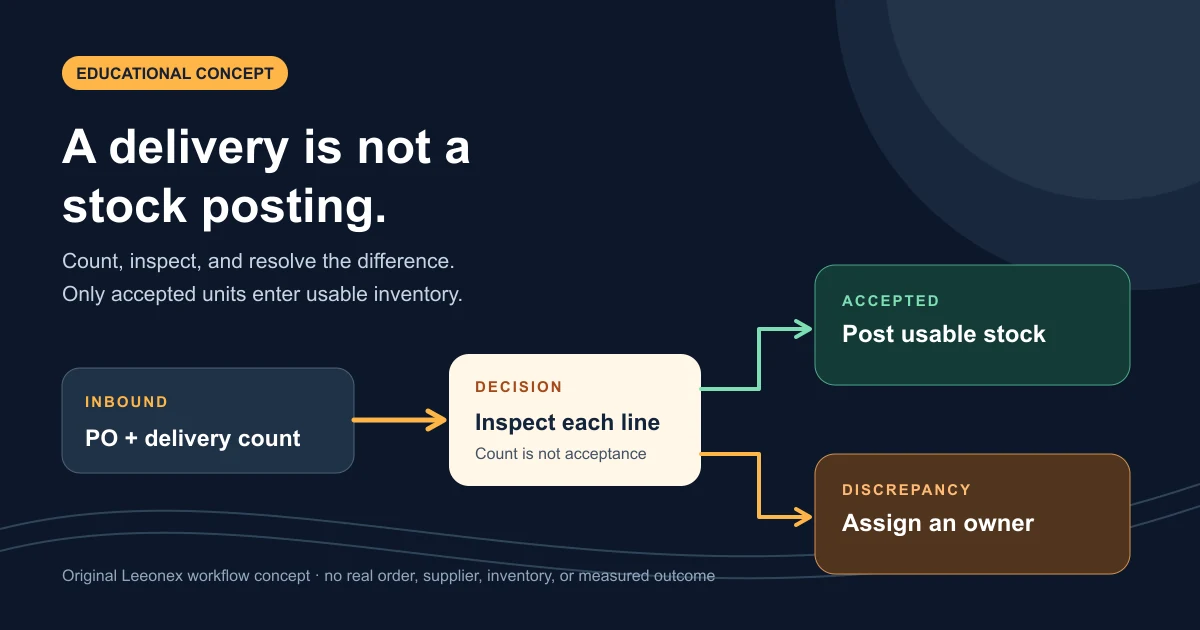
Count the delivery, decide what is usable, then change stock.
The smallest useful partial receiving workflow does not mark an entire purchase order as received when only some goods arrived. It records each receipt against stable order lines, separates counted from accepted and disputed quantities, preserves evidence for damage or shortage, and posts only the accepted amount to usable inventory. Every unresolved difference needs an owner and a next action.
This is an educational concept study for a team considering a focused web application or extension to existing inventory software. The proposed flow was not built or tested for a client. No delivery, supplier, stock record, time saving, loss reduction, or business result here is real. The counts in the hero describe the suggested model, not observed performance.
Illustrative discovery conversation — not a client quotation
“Can we just mark the order partially received?”
Illustrative warehouse lead: “The driver leaves before we finish counting. One carton is damaged, and purchasing needs to ask the supplier for the missing units.”
Illustrative Leeonex response: “Let us separate physical arrival, inspection, stock acceptance, and the supplier claim. Which system owns each quantity, and who can close the difference?”
Both voices are invented teaching examples. They are not a client conversation, customer quotation, or description of delivered work.
Starting situation and the buyer
Imagine a warehouse receiving goods against a purchase order while procurement manages suppliers in another system. A delivery note says the order is complete. The physical count is short on one line, and some units on another line are damaged. A spreadsheet records the difference, but inventory software shows a single received flag. Fulfillment could promise stock that is not usable, while procurement cannot tell whether the balance is still due, credited, or deliberately cancelled.
The intended buyer is a warehouse or operations leader who owns receiving accuracy, with a procurement owner and product team available to define system boundaries. Real constraints may include supplier lead times, multiple delivery notes per order, units of measure, lot or serial tracking, barcode availability, damaged-goods handling, returns, and the current inventory product. Those rules cannot be inferred from this example.
Name the roles and the quantity truth
- Receiver: identifies the purchase order and delivery, counts physical units, and attaches condition notes.
- Inspector or lead: accepts usable units and quarantines questionable ones under an explicit policy.
- Procurement owner: follows up shortages, credits, replacements, or cancellations with the supplier.
- Inventory owner: reconciles accepted postings against the stock system and resolves failed or duplicate writes.
- System worker: sends a validated posting command and records the response; it does not decide if damaged goods are sellable.
Keep ordered, physically counted, accepted, and disputed quantities separate per order line and receipt. A later delivery adds another receipt; it does not rewrite the first count. A shortage is not automatically a stock adjustment, and quarantined units should not quietly become available. The exact accounting treatment of goods received but not accepted belongs to the organization's inventory and finance policy.
The core flow: identify, count, decide, post, resolve
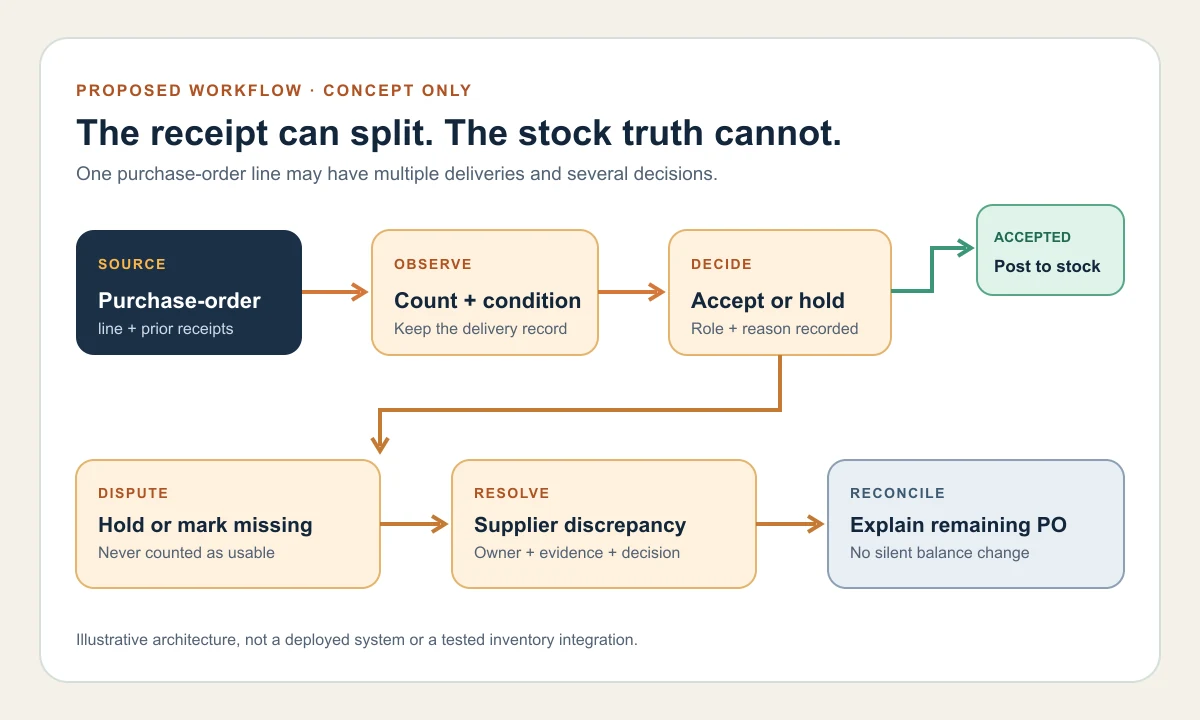
Start with a purchase order snapshot and stable line identifiers. A receiver opens a receipt using a delivery reference, checks the item, unit, and destination location, and enters the physical count. The screen shows prior receipts and the remaining expected quantity, but it does not silently cap or overwrite a real over-delivery. The receiver records damage, mismatch, or missing paperwork as a discrepancy with a reason and supporting evidence.
A lead then classifies counted units as accepted or quarantined. Acceptance produces an immutable posting intent for the inventory system. A confirmed posting links back to the receipt line; timeout or rejection remains visibly unresolved until status is checked. Procurement gets a separate shortage or damage case for the supplier decision. Closing that case requires a recorded resolution, such as replacement due, credit expected, accepted variance, or order balance cancelled. It never changes physical stock merely by changing the case label.
Build the narrow receiving loop first
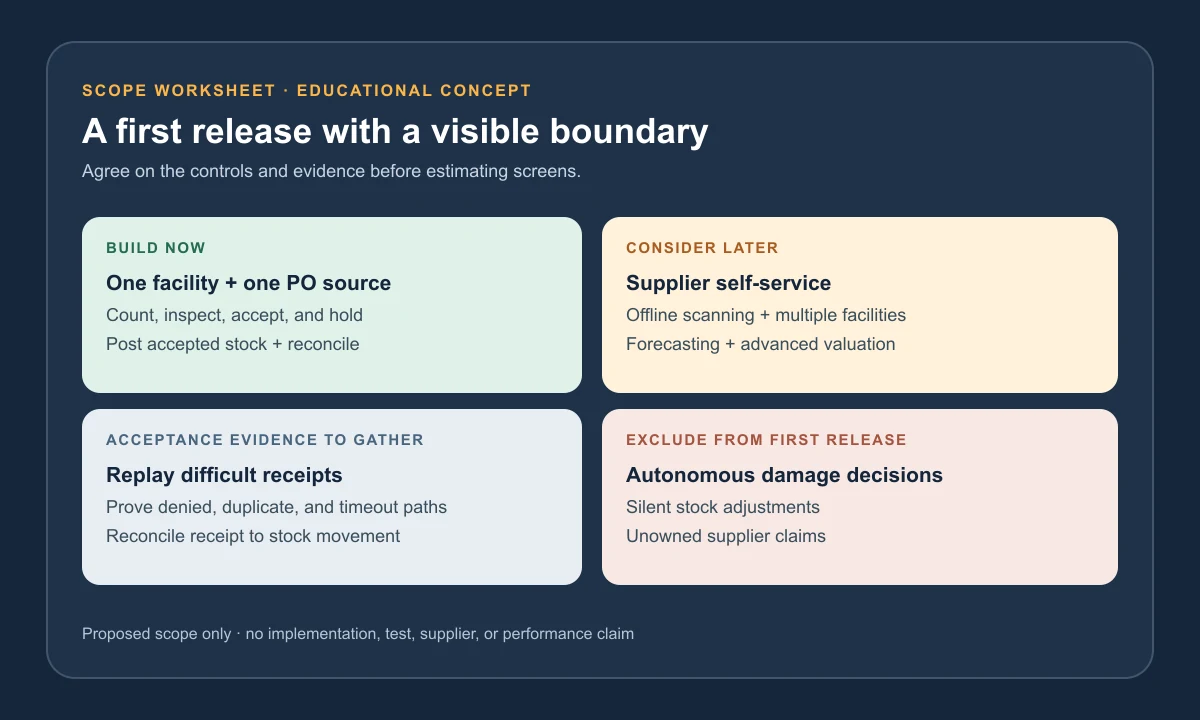
A responsible first release can cover one facility, one purchase order source, one inventory posting target, and a small set of receipt reasons. It needs order and line matching, multiple receipts per order, count and condition capture, role-aware acceptance, discrepancy ownership, a posting status with a stable reference, event history, and a reconciliation view. The interface should work with a keyboard and make units and status labels unambiguous at the receiving desk.
Defer supplier self-service, automated claims, forecasting, complex cross-warehouse transfer, offline scanning, and advanced lot valuation until the real operation proves those needs. Exclude autonomous damage classification and silent inventory adjustment from the first version. If a standard inventory product already handles this flow well, configuration may be a better first move than a new app.
The inventory software requirements guide covers the broader stock model and buy-versus-build choice. This concept focuses on one difficult inbound receipt. Leeonex's custom web application service is relevant when the receiving rules genuinely require a tailored workflow.
Architecture decisions and guardrails
- Store receipt lines and append count, inspection, decision, and posting events. Preserve actor, time, unit, location, reason, evidence reference, and the purchase-order version seen.
- Define the source of truth per field. Purchasing owns ordered quantity and supplier terms; receiving owns physical observation; the inventory system owns posted stock balance.
- Validate acceptance authority on the server. A disabled button alone cannot stop an unauthorized stock-changing action.
- Give each posting intent a stable identity. Verify duplicate, timeout, replay, and reversal behavior against the actual inventory API before promising exactly-once effects.
- Keep discrepancy photos or documents access-controlled, sized appropriately, and subject to a retention policy. Do not copy sensitive supplier data into unrestricted logs.
- Reconcile accepted receipt quantities with confirmed inventory movements. Flag unmatched records for a named owner instead of calling a successful API response a balanced stock ledger.
The receiving app should not become a second inventory ledger by accident. If the existing platform cannot support partial postings or reliable status lookup, discovery must change the architecture or narrow the scope. The diagram is a hypothesis to test against real product contracts and operations, not evidence of a working integration.
What would count as acceptance evidence?
A real pilot should replay a redacted complete receipt, a short delivery, damaged units, a second delivery against the same order, an over-delivery, a denied acceptance, a duplicate posting request, a timeout, and a supplier credit or replacement. The team should demonstrate that accepted quantities match confirmed stock movements, quarantined quantities are unavailable, unresolved discrepancies remain owned, and the purchase-order balance can be explained line by line.
Those are proposed acceptance checks, not tests Leeonex has run. Any future claim about reduced stock error, faster receiving, or fewer supplier disputes would require a dated baseline, metric definition, observation window, source records, exclusions, attribution limits, verifier, approved visuals, and publication permission.
Limitations and lessons
This concept does not determine legal title, financial accrual, supplier claim terms, customs, regulated traceability, tax, valuation, warehouse safety, or security certification. It does not select a barcode system, database, host, or service-level target. Those choices depend on actual contracts, inventory platforms, item types, and operating policy.
The lesson is that “partially received” is a summary, not a full workflow. A receiving tool is useful when every quantity has a meaning, every stock change has a controlled boundary, and every difference has an owner. If those rules are still unsettled, a short process and data-model exercise should precede development.
What to bring to a first consultation
Bring a redacted purchase order and delivery note, one difficult count, item and unit definitions, damage policy, receiver and approver roles, current supplier follow-up, inventory API or product constraints, and a stock reconciliation example. Leeonex can use those inputs to decide whether configuration, integration, or a focused custom app is the right first step and to write observable acceptance cases.
Explore the case-study hub for more clearly labeled studies, or discuss your receiving workflow with Leeonex.