Answer first
Promote a known partner application into production; do not hand a shared key to an unknown integration and hope the sandbox was representative.
The smallest useful partner API onboarding path gives every application a stable consumer identity, records its declared business purpose and owner, issues environment-specific scoped credentials, collects conformance and failure-path evidence, and requires an accountable production decision. Live access then remains observable, supportable, rotatable, and revocable.
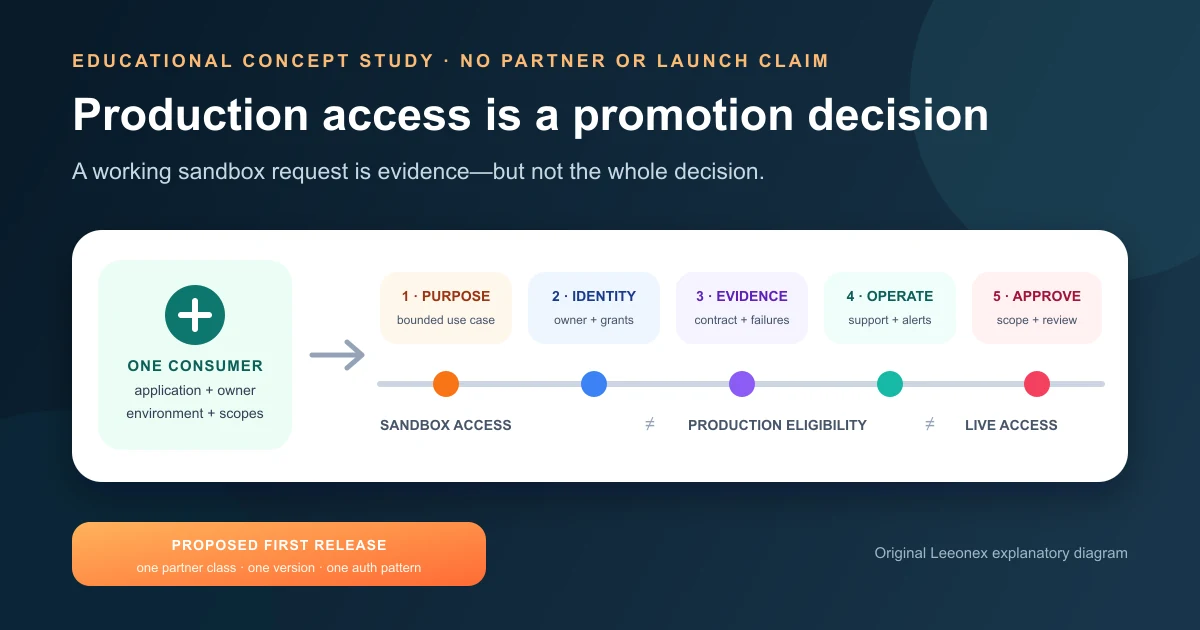
Sandbox access, production eligibility, and live production access are three different states. A partner may be able to call test endpoints without being ready to handle real records, production limits, schema changes, retries, incidents, or credential rotation. The promotion process should make those gaps visible before customer or business data carries the risk.
This is an educational concept study for a B2B SaaS or platform team planning partner-facing API access. Leeonex did not build, secure, test, certify, or operate this model for a client. There is no real partner, API, credential, security approval, production launch, adoption figure, reliability result, or measured outcome. The counts describe the teaching model only.
Illustrative discovery conversation — not a client quotation
“The partner finished the sandbox demo. Can we email them a production key?”
Illustrative platform lead: “Their engineer can create a test order, but we do not know which customer accounts they should reach, who will respond to failed calls, or what happens when their secret expires.”
Illustrative Leeonex response: “Then the demo proved one request, not production readiness. Which identity, scopes, tests, owners, and review decision should authorize live access?”
Both voices are invented teaching examples. They are not a customer conversation, testimonial, quotation, partner record, or description of delivered work.
Starting situation, intended buyer, and constraints
Imagine a SaaS product with several integration requests. One partner needs account and transaction data, another needs to create records, and an internal commercial team wants both live quickly. Documentation exists, but onboarding happens in email: a developer shares a test credential, answers questions in chat, and later creates a production secret by hand. The company cannot reliably say which application owns a key, what it may do, which tests it passed, or who should be contacted during an incident.
The intended buyer is a platform or product leader working with engineering, security, partner operations, support, legal, and commercial owners. Constraints can include a legacy API, incomplete documentation, several customer tenancy models, personal or commercially sensitive data, rate limits, regional rules, partner-specific contracts, manual approvals, and a small team that cannot run a full developer-platform program on day one.
The objective is not to remove judgment. It is to make the judgment inspectable: who is requesting access, which application and customer context are involved, what evidence supports promotion, what remains limited, and who owns the live relationship. If those answers are still ambiguous, automation would only move the ambiguity faster.
Give every role a bounded decision
- Partner business owner: explains the business purpose, customer context, expected volume, data use, and accountable contact.
- Partner developer: registers the application, uses the sandbox, implements the contract, and supplies test evidence and operational contacts.
- Partner operations owner: checks that the use case matches the commercial relationship and that support and escalation paths exist.
- Platform engineer: owns API behavior, versions, environment parity notes, rate limits, observability, and technical review.
- Security or privacy reviewer: evaluates identity, scopes, data handling, retention, secrets, and required risk controls without becoming a generic rubber stamp.
- Production access approver: records the final promotion decision, limitations, expiry or review date, and evidence considered.
- Support or incident owner: receives live alerts, knows how to identify the consumer, and can limit, rotate, suspend, or revoke access through an authorized path.
A small team may assign several roles to one person, but the record should still show which authority was exercised. “Alex approved it” is not enough when Alex might have been acting as the commercial owner, technical reviewer, or production access approver.
The core flow: declare, identify, prove, promote, operate
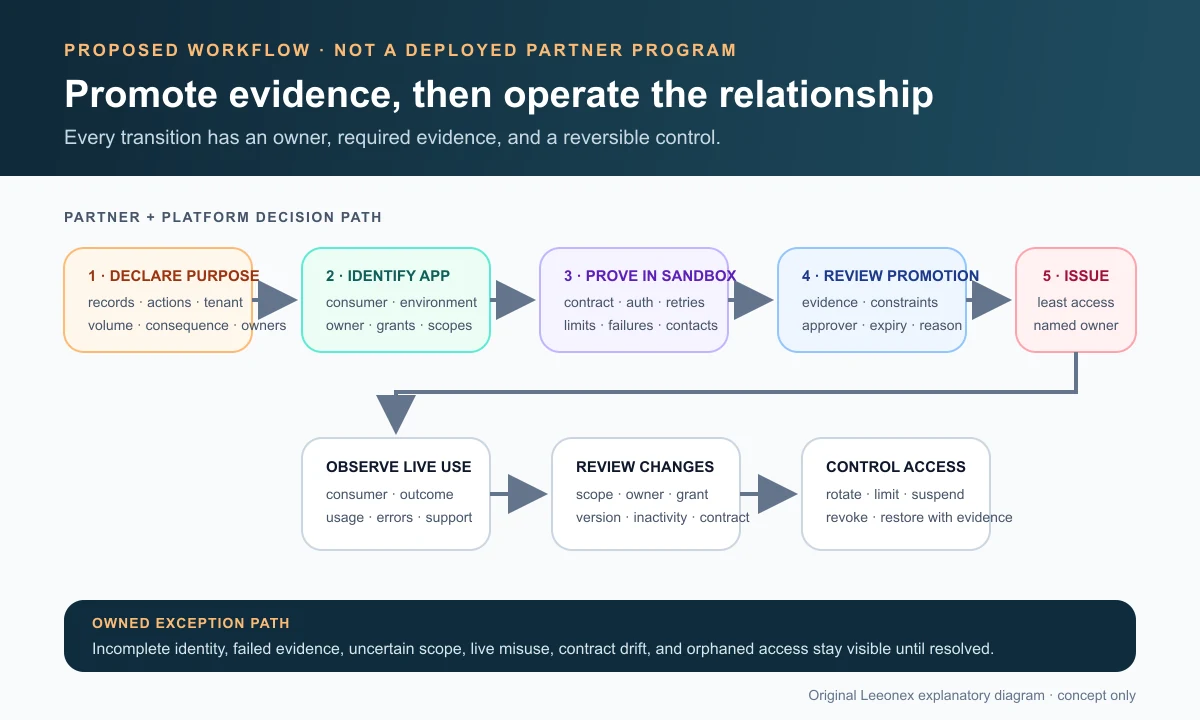
Start with the partner's declared purpose, not a credential request. Record the customer or tenant context, records and actions required, expected frequency and volume, data use, consequence of failure, and named business and technical owners. Reject or revise uses that the current API, agreement, or support model cannot responsibly sustain.
Create one consumer identity for the application and keep it distinct from a human user or partner company. Link the identity to its environment, owners, customer grants, scopes, credential versions, approval status, review date, and history. Issue a sandbox credential only after basic identity checks; never copy a production secret into test tooling.
In the sandbox, the partner exercises representative happy paths and named failure paths against the supported contract. Evidence can include contract-test results, authorization failures, duplicate and retry behavior, pagination, rate-limit handling, malformed inputs, version headers, and support contacts. The platform team records where sandbox behavior does not reproduce production limits, data, latency, or downstream dependencies.
Promotion then combines five gates: the purpose is approved; the consumer identity and scopes are correct; conformance evidence is sufficient; monitoring, support, and incident ownership exist; and an authorized person records the production decision. The production credential is created through a controlled path and starts with the smallest scopes, tenants, limits, or endpoint family the use case actually needs.
Onboarding does not end at issuance. Live requests must be attributable to the consumer; alerts and support views should distinguish provider faults, partner faults, policy blocks, and uncertain outcomes. Rotation, scope changes, customer revocation, version migration, inactivity review, suspension, and permanent offboarding are part of the same lifecycle.
Build the smallest useful production-promotion path
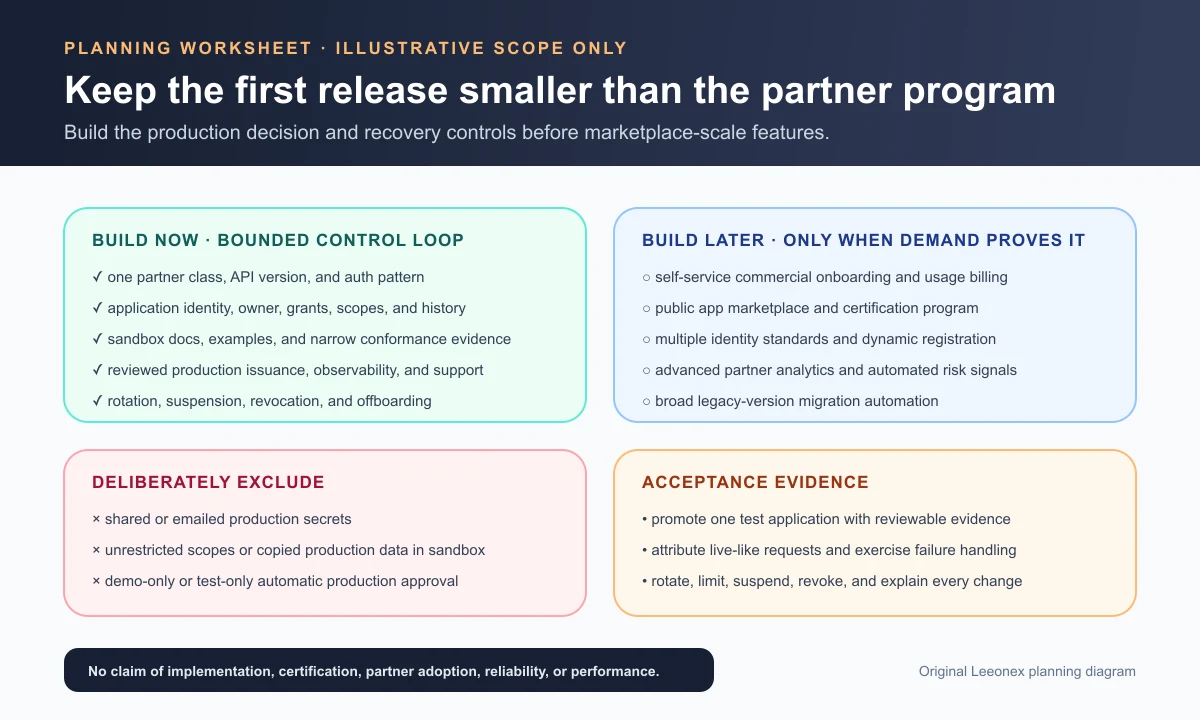
A responsible first release can support one partner class, one API version, one authentication pattern, one bounded endpoint family, and one customer-grant model. Build application registration, named owners, sandbox credentials, documentation and examples, a small conformance suite, evidence upload or references, review states, scoped production issuance, audit history, usage and error visibility, rotation, suspension, and revocation.
Keep self-service commercial onboarding, usage billing, a public app marketplace, dynamic client registration, several identity standards, automated risk scoring, broad analytics, certification badges, and every legacy API version for later. A spreadsheet and documented review may remain acceptable for low onboarding volume if credentials and production controls are not performed through ad hoc messages.
Deliberately exclude shared production keys, secrets in tickets or email, production customer data copied into sandbox, an unrestricted “read/write everything” scope, promotion based only on a demo, indefinite credentials with no owner, and automatic production approval from test output. Those shortcuts remove the evidence the team needs when the relationship changes or an incident occurs.
The API integration requirements checklist covers the broader business boundary, contract, failure, security, and release questions for an integration. This concept goes deeper on one provider-side decision: whether a particular partner application should receive and retain production API access. Leeonex's API and integration development service is the closest build path when documentation, gateway configuration, onboarding workflow, or custom platform work is required.
Architecture and implementation decisions
- Model partner organization, application consumer, human owner, customer or tenant grant, environment, credential version, scope set, approval, and access event as related but separate records.
- Treat credentials as references to secrets managed through an appropriate vault or gateway. Store only what the onboarding and support views need; never make a secret recoverable from the ordinary application database or audit log.
- Enforce scopes and customer boundaries at the API, not only in documentation or the partner's interface. Authorization should use the current grant even when a cached credential remains syntactically valid.
- Version the contract deliberately. Define additive and breaking changes, deprecation notice, migration evidence, supported overlap, and the condition that permits retirement of an old version.
- Keep the conformance suite narrow and deterministic. It should prove supported behaviors and important failure handling, not imply that every partner implementation or security property has been certified.
- Rate limits should reflect consequence and capacity. Return documented signals, expose relevant usage to the partner, and distinguish deliberate throttling from platform failure.
- Make live requests attributable without logging secrets or excessive sensitive payloads. Connect request IDs, consumer IDs, version, endpoint, outcome class, latency, and support context under defined retention and access rules.
- Design suspension and revocation as safe product actions. Name who may use them, what customer impact they create, how the partner is notified, and what evidence allows restoration.
Risks and guardrails belong in the first scope
Least privilege is not a one-time scope checkbox. Customer grants, partner purpose, employee ownership, contract status, and product capabilities can change after a credential is issued. Review those relationships on meaningful events and on a defined cadence. An inactive application with no current owner should not remain trusted by default.
Sandbox data should be synthetic or appropriately governed, and environment differences should be explicit. A test endpoint rarely reproduces production volume, downstream latency, regional configuration, abuse controls, or historical records. Promotion evidence must therefore say what was tested and what remains untested instead of turning “sandbox passed” into a blanket assurance.
Security, privacy, legal, commercial, and support obligations differ by data, action, jurisdiction, customer agreement, and sector. The onboarding workflow can collect decisions and enforce technical boundaries, but it cannot invent those policies. High- consequence write actions may require stronger authentication, narrower grants, secondary approval, notification, reconciliation, or a separate integration design.
Define acceptance evidence before building the portal
The first release is acceptable when a reviewer can take one fictional or authorized test application from request to sandbox, collect the required evidence, approve a bounded production grant, identify its live requests, rotate its credential, change or remove a customer grant, suspend it, and explain every state transition without reading private messages or editing the database.
Test rejected and incomplete requests, duplicate applications, expired owners, invalid scopes, cross-tenant attempts, malformed inputs, pagination, rate limits, timeouts, retries, old API versions, credential rotation, revocation, incident lookup, and offboarding. Record which behaviors use synthetic data and which production-only risks still need a controlled launch check.
Operational acceptance also needs owners and response paths. An alert without a consumer identity, partner contact, affected customer context, severity rule, or safe mitigation is only a signal. The team should rehearse how it will limit or revoke access and how it will distinguish partner misuse, partner bugs, platform faults, and contract drift.
Limitations, lessons, and evidence needed for stronger claims
This study is not legal advice, a threat model, a privacy impact assessment, a partner agreement, a security architecture, a penetration test, a compliance mapping, a service-level promise, or proof that any API is safe or reliable. The proposed states and gates are a discovery tool. They must be adapted to the actual data, actions, tenancy, identity provider, gateway, jurisdictions, contracts, incident duties, and team capacity.
The main lesson is that partner onboarding is a product and operating lifecycle, not credential issuance. Documentation helps a developer call an endpoint. Production access additionally needs a known consumer, bounded authority, representative evidence, an accountable decision, and a reversible operating relationship.
A future delivery claim would require approved implementation and test records. A reliability, onboarding-time, support-load, adoption, or commercial claim would additionally require a defined baseline, measurement window, source system, calculation, exclusions, attribution limits, verifier, and publication permission. None of that evidence exists for this concept.
Browse the Leeonex case-study hub for other studies labeled by evidence type. Discovery and structured data can improve eligibility and understanding, but neither this page nor the proposed workflow guarantees rankings, indexing, AI citations, trust, leads, adoption, or conversions.
Bring this to a first consultation
One real use case is more useful than a portal wish list
- One intended partner application, its business purpose, customer context, records, actions, volume, timing, and failure consequence.
- Current API specifications, example payloads, versions, environments, authentication options, scopes, rate limits, and known production-only differences.
- The partner, customer, tenant, application, and human-owner identities that already exist—and where they disagree.
- Security, privacy, legal, commercial, support, incident, retention, data residency, and offboarding constraints that are already known.
- Examples of a successful request, a denied request, a retry, a limit breach, a credential change, a customer revocation, and a production incident the team must be able to explain.
If those inputs reveal that documentation, ownership, or gateway configuration is the real gap, fix that first. If a focused onboarding workflow or partner-facing API layer is justified, discuss the partner API with Leeonex.