Answer first
Add automation capacity around one trusted release decision—not a target number of tests.
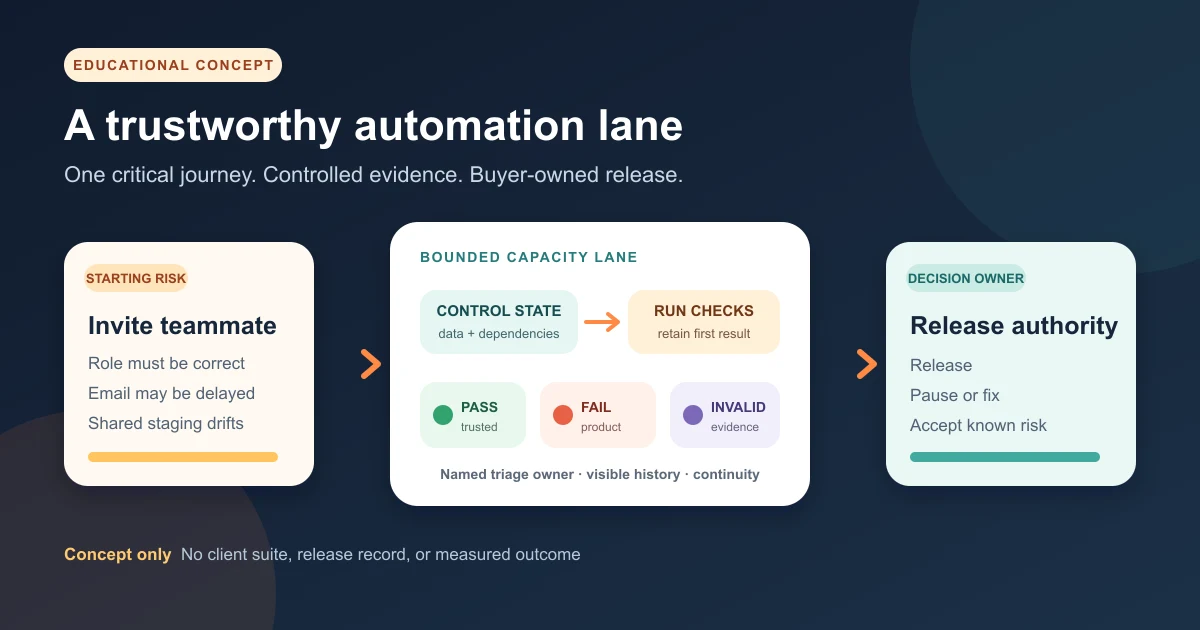
A useful first QA automation lane begins with one journey whose failure matters, makes its starting state reproducible, runs at the narrowest credible test layers, and keeps product failures separate from broken tests or environments. The specialist works inside the buyer’s repositories and release process; the buyer keeps product risk and release authority.
That boundary matters because a large unreliable suite can add noise without adding confidence. If failed checks are routinely rerun, ignored, or diagnosed by only one person, making them a hard release gate merely moves the bottleneck. First prove that the team can reproduce, classify, triage, and maintain one decision-relevant path.
This is a Level E educational concept. No client supplied this situation, and the dialogue, workflow, counts, and diagrams are illustrative. They are not customer quotations, implementation records, test results, release metrics, or evidence of a Leeonex engagement.
Starting situation and intended buyer
The real constraint is usually trusted feedback, not the absence of a testing tool.
Imagine a product team that still checks its critical journeys manually before release. The checklist has grown, the person who understands the awkward setup is overloaded, staging state drifts, and a late defect can restart the review. The team wants a QA automation specialist, but it has not yet agreed which risks deserve automation or what evidence should block a release.
This blueprint is for product leaders, engineering managers, quality owners, and agencies that already own a product and delivery process but need focused specialist capacity. It is not a substitute for product ownership, engineering fixes, exploratory testing, security review, accessibility evaluation, performance work, user acceptance, or operational readiness.
Common constraints include a shared environment, limited test data control, asynchronous integrations, third-party sandboxes, older code with weak test seams, several supported browsers or devices, and a release calendar that cannot pause while a broad automation rewrite is attempted. Those constraints should shape the first slice rather than appear later as excuses for flaky evidence.
Illustrative conversation — not a client quotation
Move the conversation from “automate everything” to “what evidence changes the decision?”
Product lead
Regression takes two days, so we want an automation engineer to automate the whole checklist and block releases when anything fails.
Leeonex
Which customer journey would make a release unacceptable if it broke, and what currently makes its result hard to trust?
Product lead
Account owners must invite a teammate, assign the right role, and let that person sign in. Our staging data changes, email can be delayed, and retries sometimes turn a red run green.
Leeonex
Then the first job is not maximum test count. It is one controlled journey with owned fixtures, observable dependencies, explicit invalid-result handling, and a release decision the team can explain.
User and decision roles
Keep automation authorship, product risk, and release authority distinct.
Product or risk owner
Names the journey that matters, its business rules, unacceptable failures, representative conditions, and who may accept a known release risk.
Embedded QA automation specialist
Designs maintainable checks, fixtures, diagnostics, and triage rules inside the buyer’s repositories, tools, standards, and review process.
Feature engineer
Improves testability, reviews automation beside product code, fixes genuine regressions, and keeps interfaces and selectors intentional.
Release owner
Reads the evidence, separates product risk from invalid test evidence, and records the release, pause, rollback, or conditional-acceptance decision.
One person may cover several roles in a small team, but the decisions must remain visible. A specialist can design and interpret test evidence; that does not silently grant authority to redefine the product rule or accept commercial, security, or operational risk on the buyer’s behalf.
Core evidence flow
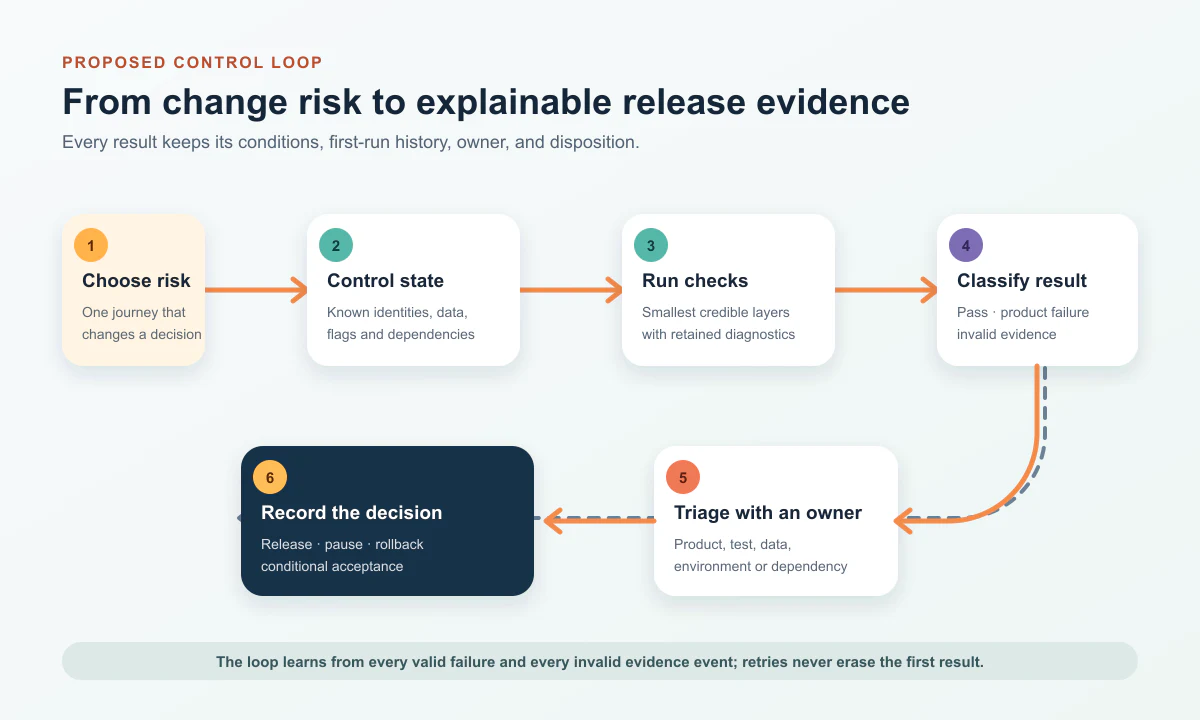
A test run is useful only when the team can explain the state, result, and next decision.
Step 1
Choose a release-relevant risk
Start from a customer or operator journey whose failure changes a release decision, not from the easiest screen to automate.
Step 2
Make the starting state reproducible
Create or reset known accounts, roles, records, feature flags, clocks, and dependency states without relying on a shared mystery dataset.
Step 3
Run the smallest useful check set
Exercise the critical happy path and the few failure boundaries that protect the real rule; retain identifiers, timestamps, and useful diagnostics.
Step 4
Classify the result
Keep a trusted pass, a product failure, and an invalid test or environment result distinct. A retry may gather evidence, but it must not rewrite history.
Step 5
Triage with an owner
Confirm whether the product, automation, data, environment, or external dependency failed, then assign the corrective action and retest condition.
Step 6
Make and record the release decision
An authorized owner uses the evidence with other release gates, records the decision, and feeds recurring failure patterns back into product and test design.
This loop complements Leeonex’s software acceptance criteria checklist. That guide defines observable acceptance evidence across a delivery. This concept focuses on how a specialist capacity lane turns one repeated regression risk into maintainable automated evidence without pretending the suite owns the release decision.
Smallest useful scope
Prove one risk-to-decision path before expanding the matrix.
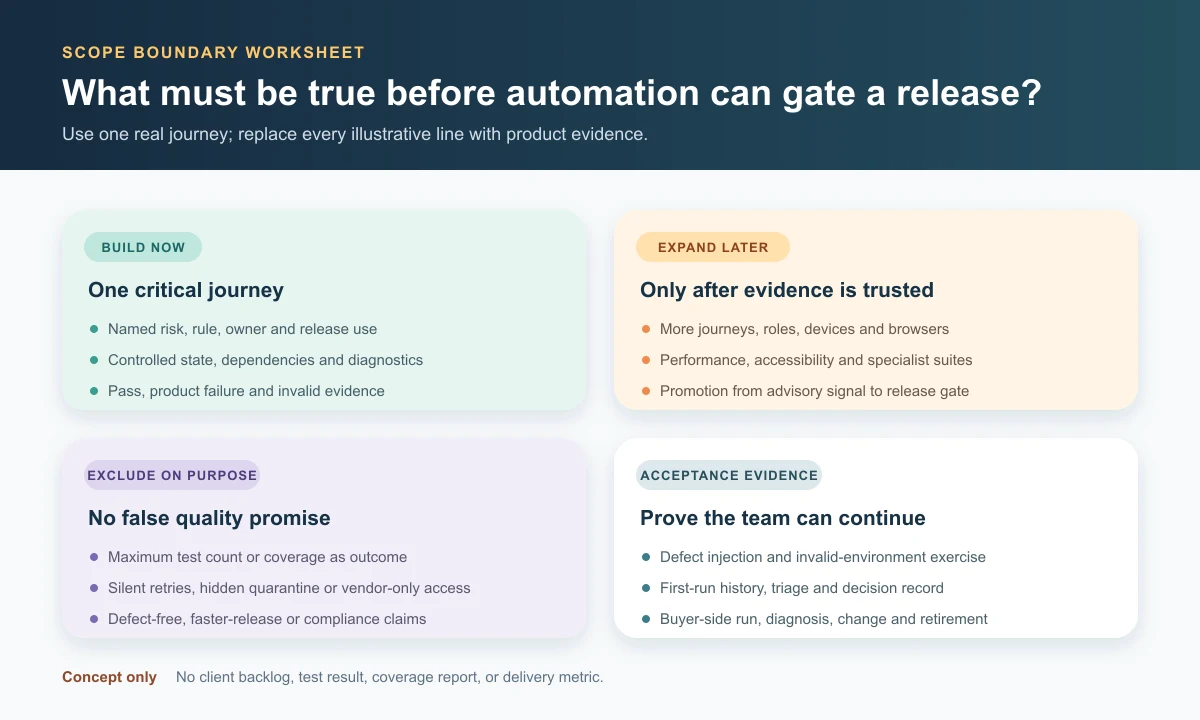
Build now
- One critical web or API journey with an explicit business rule, starting state, expected result, and meaningful failure boundaries
- Buyer-owned source, review, execution, credentials, fixtures, reports, and run instructions inside the existing delivery system
- Deterministic setup and cleanup for representative identities, permissions, records, feature configuration, and dependency substitutes where appropriate
- Pass, product failure, and invalid-evidence states with retained diagnostics, first-run history, accountable triage, and a visible quarantine policy
- A documented place in the release process, plus a handover exercise proving another team member can run, diagnose, change, and retire the checks
Later or deliberately excluded
- Automating the whole manual regression pack, every browser and device, every historical defect, or every feature before the first slice is trusted
- Using UI automation where a smaller unit, contract, integration, accessibility, security, performance, or manual exploratory check provides better evidence
- Silently retrying failures until green, measuring quality by test count, or treating line coverage as proof that customer risk is controlled
- Letting an external specialist own production credentials, the only runnable environment, the only fixture knowledge, or the final release decision
- Promises that automation guarantees defect-free releases, faster delivery, lower cost, compliance, coverage completeness, or a particular quality outcome
Architecture and implementation decisions
Design for stable evidence, not loyalty to a test framework.
Test at the narrowest credible layer
Keep business rules close to unit or component checks, service contracts at integration boundaries, and a small end-to-end path for cross-system confidence. The visible browser is not automatically the best evidence layer.
Own state instead of hoping for it
Prefer APIs, fixtures, builders, seeded snapshots, controlled clocks, and named test identities over long UI setup chains or shared mutable staging records.
Expose asynchronous progress
Poll a meaningful state with a bounded timeout and diagnostics. Fixed sleeps hide whether queues, email, jobs, caches, and external sandboxes completed or stalled.
Keep evidence with the change
Record build and commit identity, environment, configuration, first-run result, retry history, failure category, logs, traces, screenshots where useful, and the final disposition.
Framework choice follows the application stack, supported surfaces, team skills, execution environment, diagnostics, accessibility needs, and existing test architecture. A browser-level check may be justified for the complete invite journey, while role calculation belongs closer to the service or domain layer and the email contract may be verified without waiting for a public inbox.
The specialist should contribute through the same review and release controls as the product team. Test source, pipeline definitions, fixtures, secrets references, reports, ownership, and runbooks stay in buyer-controlled systems. If the proposed engagement needs a broader onboarding baseline, use the external development team onboarding checklist.
Risks and guardrails
Flakiness is an evidence problem and an ownership problem.
A failed check must not block indefinitely without a named triage owner, diagnostic path, and policy for product failures versus invalid evidence.
Quarantine is a visible debt state with an owner and review date. Quarantined checks do not count as passing evidence and cannot disappear from reporting.
Retries preserve the first result and reason. A later pass may reveal instability; it does not retroactively prove the first failure was harmless.
Test credentials and data follow least-privilege, retention, privacy, and environment-separation rules. Production customer data is not copied into tests by convenience.
Selectors and test interfaces express stable product intent where possible. Automation should not depend on incidental styling, generated text, or layout position.
The capacity lane includes review, documentation, pairing, and an exit exercise so the specialist adds team capability instead of becoming the only maintainer.
A release gate earns authority gradually. Begin as an advisory signal while the team observes false alarms, missed defects, runtime, environment stability, and triage effort. Promote only the checks whose risk, conditions, failure meaning, and owner are understood. A hard gate without a fast diagnosis path can reduce delivery control instead of increasing it.
Acceptance evidence
Accept the lane when the team can trust, diagnose, and continue it—not when a demo turns green.
Risk traceability
The automated path maps to an agreed customer or operator risk and observable acceptance criteria, including important denied, duplicate, empty, or timeout behavior.
Reproducible setup
A clean execution creates or resets its required state, identifies the environment and dependencies, and does not need a specialist to repair hidden staging data first.
Diagnostic failure
A deliberately introduced product defect produces a failed result with enough evidence to locate the affected step, while a broken fixture or environment produces an invalid result instead.
Continuity and release use
Another team member can run, inspect, update, and disable the checks under review, and the release owner can explain exactly how the result informs—but does not replace—the decision.
The first slice can produce implementation facts: which journey is checked, where it runs, what state it creates, how results are classified, and whether another team member can maintain it. Those facts do not establish fewer defects, faster releases, lower cost, improved productivity, broader coverage, or customer impact.
Limitations and evidence needed
This concept cannot select the tools, estimate the suite, or predict delivery impact.
No product, architecture, source repository, current tests, environments, CI configuration, supported-device matrix, customer data policy, defect history, release calendar, or team capacity record was supplied. The illustrative invite journey is not a recommendation for every product and cannot establish the correct layer, framework, coverage, runtime, staffing level, or commercial model.
Stronger public claims would require an approved engagement record, implemented and reviewable automation, first-run and retry history, triage records, release decisions, and defined baseline and follow-up windows. Any statement about defects, escaped regressions, release frequency, manual effort, runtime, cost, productivity, availability, or customer impact would need a unit, source, exclusions, verifier, and attribution limits.
Automation also does not certify security, privacy, accessibility, performance, compliance, or operational safety. Those areas need appropriate specialists and evidence. This study is product and delivery scoping guidance, not a quality guarantee or an assurance report.
Lessons for a similar buyer
Buy a maintainable evidence lane, not a detached pile of scripts.
Start with risk. A short stable check around a release-critical rule can be more useful than broad automation that duplicates a manual checklist without controlling data, dependencies, or failure meaning. The first slice should reveal whether the product is testable and whether the delivery system can support reliable feedback.
Treat invalid evidence as a first-class outcome. Mixing product failures with broken fixtures and unstable environments teaches teams to ignore red results. Separating them supports faster ownership decisions and makes the cost of unreliable test infrastructure visible.
Finally, continuity is part of the deliverable. The embedded specialist should leave reviewed source, understood interfaces, diagnostic habits, and more than one person able to maintain the lane. That is the practical fit for Leeonex’s staff augmentation service: focused capacity inside a client-owned product and delivery system.
What to bring to a first consultation
Bring one risky journey and the current evidence gaps.
- One customer or operator journey that has delayed a release, escaped as a regression, or consumes disproportionate manual checking
- The current repository, CI, environment, deployment, and test ownership map, including where access or knowledge sits with one person
- Representative roles, data, feature configuration, browsers or devices, and external dependencies for that journey
- Recent failed, flaky, rerun, quarantined, or manually waived checks and what evidence the team had when it decided to ship
- The buyer-side product, engineering, quality, security, and release owners who can define risk and accept the first automation slice
Map one critical journey from change risk to release evidence.
Leeonex can help define the first automation slice, embedded ownership model, result policy, acceptance evidence, and continuity path before a broad regression target is assumed.
Continue browsing the Leeonex case-study hub for other clearly labeled build, research, and concept evidence.