Answer first
Approving a refund and confirming money moved are different events.
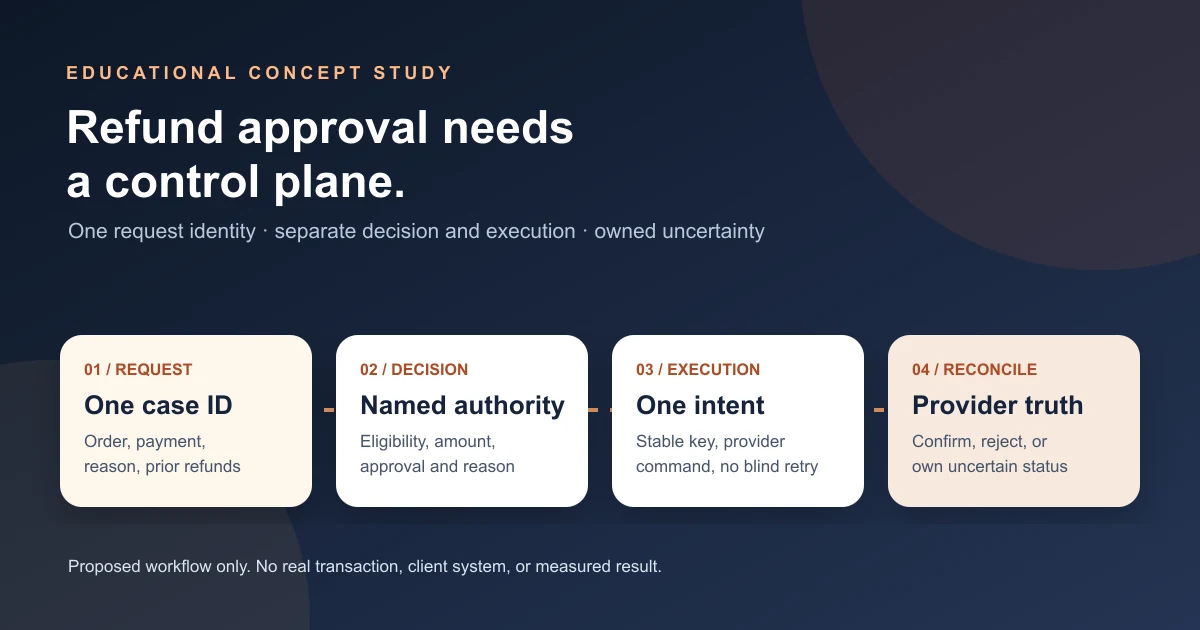
The smallest useful refund admin panel gives each request one stable identity, shows the operator the order and policy context, records an accountable decision, sends at most one authorized payment command for that decision, and reconciles the provider result. If the provider answer is uncertain, the request moves to an owned exception queue. An operator should never have to guess whether clicking again will pay twice.
This is an educational concept study for a commerce or service team that handles refunds across support, operations, finance, and a payment provider. It is a proposed design, not a Leeonex client project, deployed product, tested integration, or measured reduction in errors. The counts in this page describe the suggested model, not observed performance.
Illustrative discovery conversation — not a client quotation
“Can we just add an approve button?”
Illustrative operations lead: “Support gets the request, finance approves large amounts, and sometimes the payment provider times out. We cannot tell if the refund happened.”
Illustrative Leeonex response: “Before the button, let us define one request ID, who can decide, what provider response counts as final, and who resolves an uncertain result.”
Both voices are invented teaching examples. They represent no client, customer conversation, quotation, transaction, or delivered work.
The starting situation and the buyer
Imagine a support team taking refund requests in email, a manager approving exceptions in chat, and a finance operator entering refunds in a payment dashboard. An order may have a partial refund, a prior credit, or multiple tickets. A timeout can leave the team unsure whether money moved. The problem is not simply the absence of a screen; it is the absence of a shared decision record and recovery rule.
The intended buyer is an operations leader, support manager, or product owner who can bring policy owners and payment-system access to discovery. Constraints may include existing support and order tools, multiple currencies, partial refunds, approval thresholds, privacy obligations, provider rate limits, and a finance reconciliation process. The precise rules must come from that organization, not this illustration.
Name the roles before drawing the queue
- Support intake: links the customer request to an order and gathers a reason and evidence; cannot execute payment.
- Operations reviewer: checks eligibility and proposes an amount within a defined policy.
- Approver: accepts or rejects a decision when a threshold or exception requires a second person.
- Finance reconciler: resolves uncertain provider states and compares the refund ledger with settlement data.
- System worker: sends authorized provider commands and records responses; it does not invent policy decisions.
One person may hold more than one role in a small team, but the system should still record which authority they exercised. A second approval is meaningful only if the organization truly has a distinct reviewer and a clear rule for when they are needed.
The core flow: request, decide, execute, reconcile
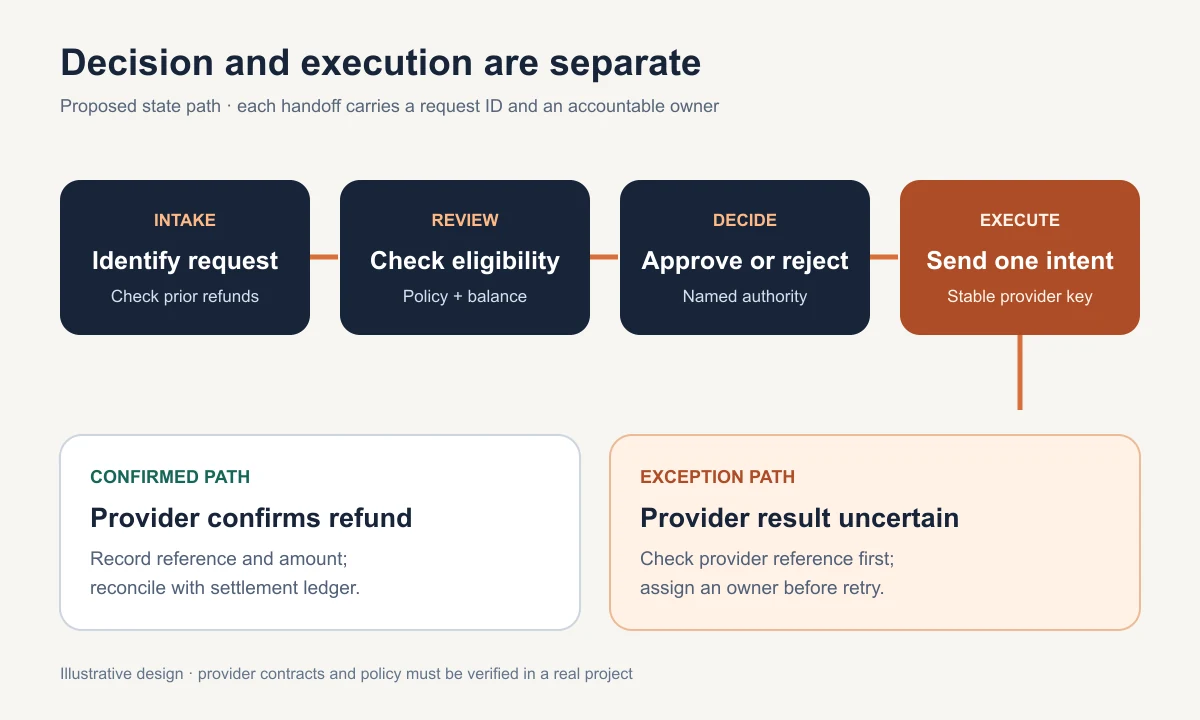
Intake creates a canonical request tied to the order, payment, currency, requested amount, reason, and source ticket. Before a new request is accepted, the panel surfaces prior and pending refunds against the same payment. The reviewer sees the remaining refundable amount and the policy version that governs the decision. They can approve, reject, or ask for evidence, with a recorded reason.
Approval creates an immutable execution intent with a stable idempotency key. A worker sends that intent to the payment provider. A confirmed provider refund closes the execution step; a rejection records why it failed; an ambiguous timeout remains pending investigation. The system checks provider status using the same reference before any retry. Finance then reconciles provider records with the internal request, including partial refunds and delayed settlement. “Approved” must never be shown as “paid” merely because a command was sent.
Build the narrow control loop first
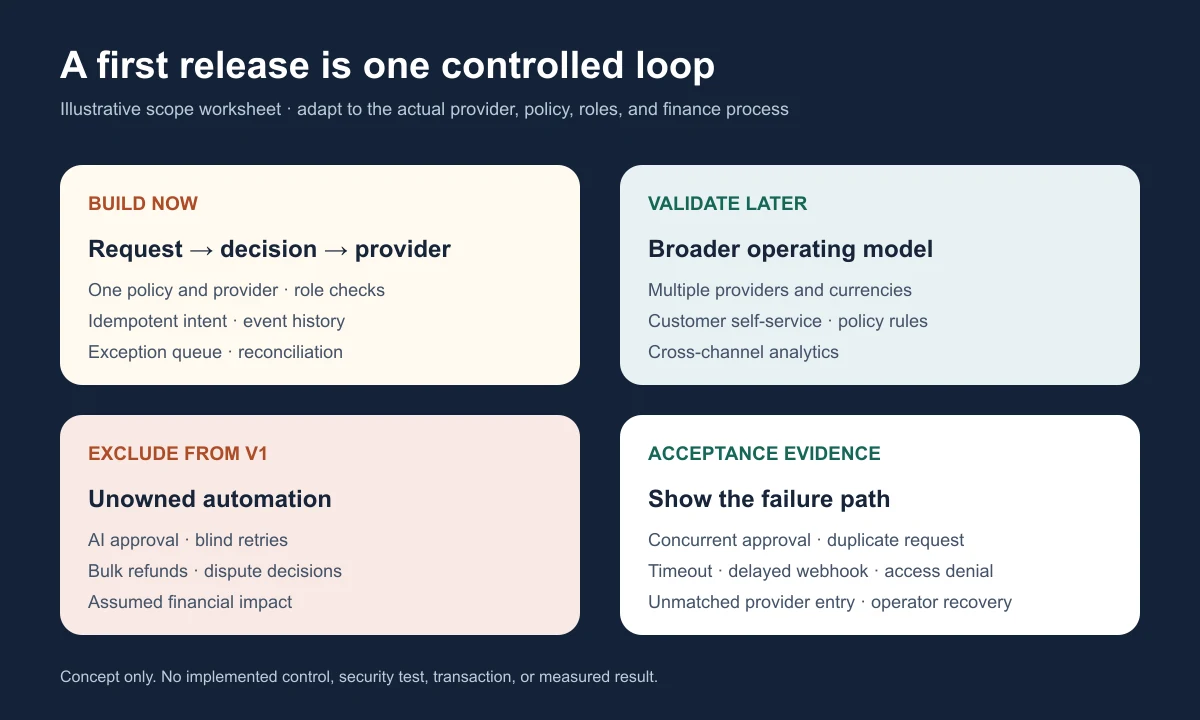
A useful first release handles one payment provider and one refund policy for one business unit. It supports request intake, duplicate detection, eligibility context, role-aware review, approval where required, an idempotent provider command, status polling or webhook ingestion, an event history, an exception queue, and a reconciliation export. It needs accessible keyboard operation and clear status language because operators will use it under time pressure.
Later work can add multiple providers, complex promotional-credit allocation, customer self-service, automated policy suggestions, and analytics across channels. Deliberately exclude AI approval, automatic dispute handling, chargeback decisions, and arbitrary bulk refunds from this first scope. Those would add separate evidence, policy, security, and recovery burdens.
The admin-panel requirements guide provides the broader privileged-action checklist. This study narrows that framework to one money-moving decision. Leeonex's portal and admin panel development service is the relevant build path if the workflow calls for a custom panel.
Architecture decisions and guardrails
- Use one request record and append decision and execution events, preserving actor, timestamp, reason, amount, policy version, and provider references.
- Enforce authorization on the server for each record and action. A hidden button is not a permission boundary.
- Validate the refundable balance against provider truth and existing pending intents immediately before execution, not only when the page loads.
- Put a unique constraint around the execution intent and use the provider's supported idempotency mechanism. Verify its retention and retry semantics in a sandbox.
- Keep provider credentials out of the browser. Verify webhook signatures, handle repeats and out-of-order events, and preserve a manual reconciliation path.
- Show an explicit “status uncertain” state after a timeout. Lock blind retries until the provider reference is checked and an owner records the resolution.
- Minimize customer and payment data in logs and exports; define retention and access with the organization's privacy and finance owners.
A provider may not support every idempotency or lookup behavior assumed here. Discovery must read its current contract and test duplicate, timeout, delayed webhook, partial-refund, and reversal cases. A design diagram alone proves none of those controls.
What would count as acceptance evidence?
A real build would need test records and provider sandbox results showing that duplicate requests are surfaced, unauthorized users cannot approve or execute, concurrent approvals produce one execution intent, a timeout does not trigger a second refund, delayed webhooks update the correct request, and reconciliation identifies unmatched entries. Operators should demonstrate the exception path with a keyboard and explain what each status means.
That is an acceptance plan, not evidence that Leeonex has built or passed it. A future claim about fewer double refunds, faster handling, or reduced losses would need an approved baseline, metric definition, observation window, provider and ledger data, exclusions, attribution limits, independent verification, and publication permission.
Limitations and lessons
This concept does not settle refund law, card-network rules, chargebacks, tax treatment, provider-specific guarantees, fraud policy, accounting close, data retention, or the authority of an actual employee. It does not select a payment provider, database, cloud host, or service-level target. Those decisions depend on the organization's contracts, risk, volume, and system landscape.
The main lesson is to model money movement as a decision plus an externally observed result. A polished queue cannot compensate for ambiguous ownership or an unsafe retry path. The best first design may use an existing support tool and a narrow integration rather than a new admin application.
What to bring to a first consultation
Bring a redacted refund request and a troublesome exception; current policy and thresholds; roles and sign-off owners; order, support, and payment-system boundaries; provider API and webhook behavior; a sample reconciliation report; and the mistakes the team most needs to prevent. Leeonex can use those inputs to map one controlled flow, choose buy/configure/build boundaries, and define acceptance evidence before implementation.
Explore the case-study hub for more clearly labeled studies, or discuss your refund workflow with Leeonex.