The answer first
Rescue one user journey with correlated evidence before buying more capacity or rewriting the stack
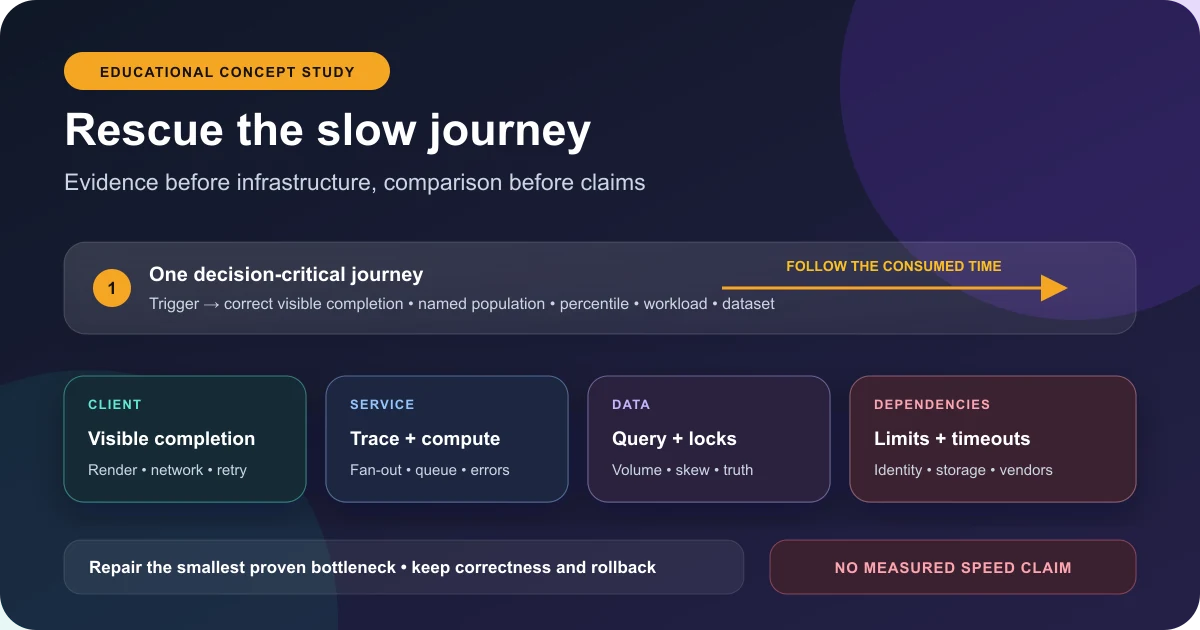
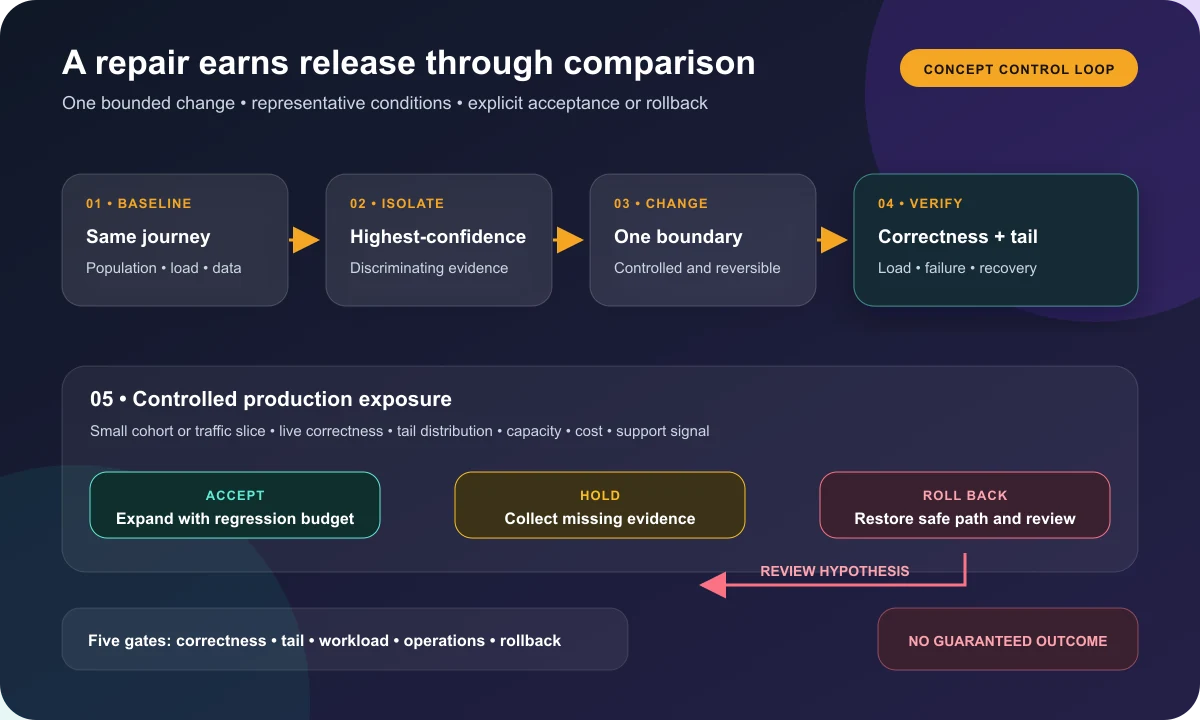
Define one decision-critical journey from trigger to useful, correct completion. Baseline its slower users under named data and workload conditions. Correlate evidence across the client, service, data, and dependency layers. Then repair the smallest proven bottleneck and release it through five gates: correctness, tail performance, representative workload, operations, and rollback.
Define the journey
Replace “the app is slow” with one user outcome, population, percentile, workload, dataset, and source.
Locate consumed time
Join client, service, data, and dependency signals instead of blaming the nearest visible component.
Compare one repair
Preserve correctness, stage exposure, observe the tail, and keep a usable rollback before expanding scope.
Evidence disclosure
This is a Level E educational concept study, not a client story, production assessment, or completed Leeonex rescue. The situation, dialogue, roles, counts, scope, diagrams, architecture, signals, repair choices, and gates are illustrative. No real application, user, dataset, trace, benchmark, infrastructure, response time, capacity, release, cost, reliability change, or business outcome was inspected or measured.
Starting situation
Everyone can feel the delay, but the current evidence cannot support a repair decision
Imagine an authenticated B2B application used to search customer records, review a case, and produce an operational report. Larger accounts complain that screens hang at busy times. Support sees duplicate clicks and abandoned work. Sales worries about renewals. Engineering sees acceptable average API latency, while operations sees jobs that finish long after the browser request.
Suggestions arrive quickly: increase instance size, add caching, rewrite the frontend, replace the database, or move reports to a queue. Each might be useful, but none is yet tied to a complete journey, the slow population, the real data shape, or a test that preserves correctness. The rescue problem is not merely speed. It is restoring a defensible decision loop.
Illustrative conversation — not a client quotation
Illustrative product owner
Customers say the app is slow, support blames the database, and the team wants larger servers before the next renewal cycle.
Illustrative Leeonex response
Which user journey is losing trust, what does complete mean, and can we reproduce the slow cases with the same data, workload, and dependency conditions?
Illustrative product owner
Search and reporting feel worst, but our dashboard shows an average API time and no one agrees which accounts or records it represents.
Illustrative Leeonex response
Then the rescue starts with one journey contract and correlated evidence. A bigger server is only a candidate change; it is not proof that the user outcome improved or stayed correct.
Both voices are invented teaching examples. They are not a client conversation, testimonial, or description of delivered work.
Intended buyer and constraints
This is for the owner who needs a safe performance decision, not another generic optimization backlog
The intended buyer is a product leader, operations owner, engineering manager, or business sponsor responsible for a slow revenue, service, or operational application. The pressure may be a renewal, seasonal peak, backlog, support escalation, rising infrastructure cost, delayed release, or inherited codebase whose performance work no longer has an owner.
Constraints can include uneven tenant sizes, sensitive records, missing field telemetry, sampled traces, shared databases, background work, third-party limits, brittle releases, fixed maintenance windows, and no production-like dataset. These are part of the scope, not inconveniences to hide behind a benchmark.
Business or product owner
Names the costly journey, user promise, business deadline, acceptable degradation, and authority to release or stop.
Representative operator
Explains completion, wait behavior, data shapes, workarounds, peak conditions, and mistakes caused by delay or stale state.
Technical recovery lead
Owns instrumentation, reproduction, hypothesis quality, change isolation, test evidence, staged release, and rollback.
Data owner
Defines representative volume, skew, query correctness, freshness, permissions, retention, and safe test fixtures.
Support or operations owner
Connects complaints and incidents to telemetry, prepares runbooks, and watches the journey after release.
Core flow
Follow one journey across four evidence layers
Start when the user triggers the action and stop only when the useful result is visible and correct. Give the journey a privacy-safe identifier that can join client timing, service traces, data work, and dependencies. Record gaps explicitly; do not manufacture a complete trace from incompatible clocks or samples.
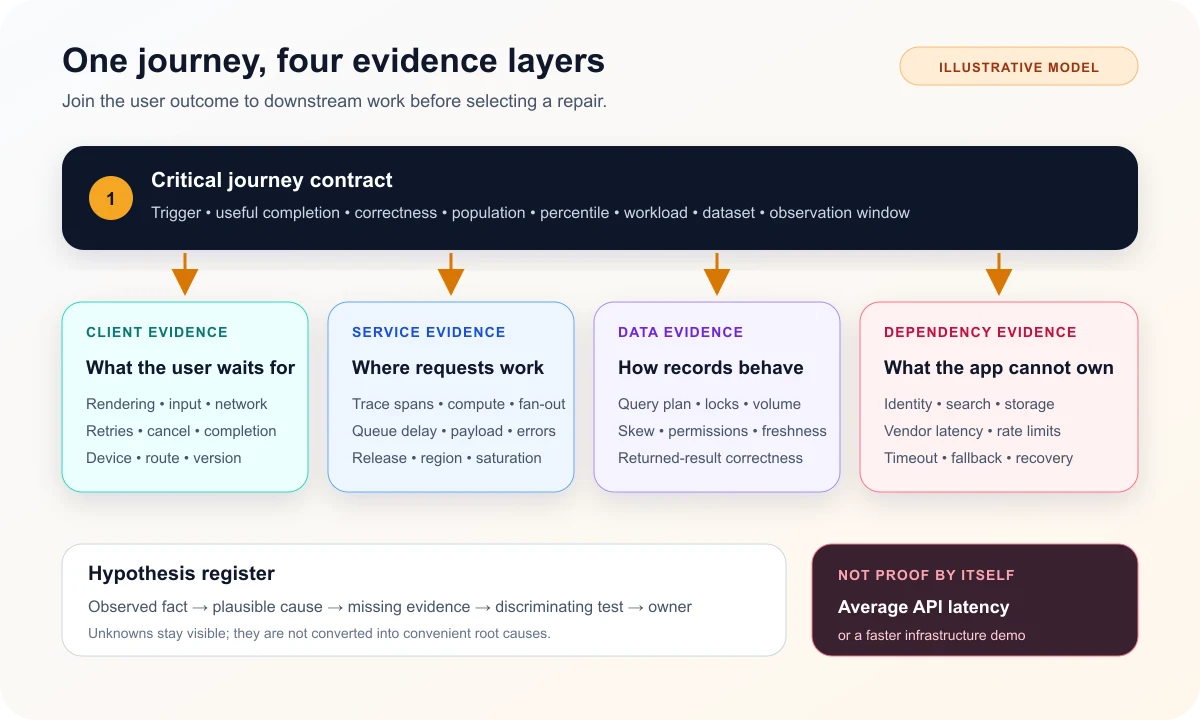
Client
Input, rendering, device, network, retries, cancellation, and useful visible completion.
Service
Request path, fan-out, serialization, compute, queues, errors, and trace context.
Data
Query shape, plan, locks, volume, skew, permissions, freshness, and returned-result correctness.
Dependencies
Identity, storage, search, payments, messaging, vendor APIs, limits, timeouts, and recovery.
The companion guide on web application performance requirements explains how to define the journey, percentile, workload, and evidence contract before engineering commits to a target.
Smallest useful scope
Build the measurement and release loop now; defer the platform programme
Build now
- One critical journey from user trigger to useful visible completion, including correctness, cancellation, timeout, and stale or partial states
- A baseline with population, percentile, workload, dataset, device and network assumptions, environment, observation window, and confidence
- Correlation across client, service, data, and dependency evidence using privacy-safe journey and trace context
- A repeatable reproduction or a clear statement that the issue is currently observable only in production
- A ranked hypothesis register that separates observed facts, plausible causes, missing evidence, and the next discriminating test
- One bounded repair at the highest-confidence bottleneck, with correctness, tail latency, workload, operations, and rollback gates
- A staged release, comparison window, owner decision, regression budget, and record of what remains unresolved
Later or excluded
- A whole-product speed programme, visual redesign, framework rewrite, cloud migration, database replacement, or universal observability platform
- Every page, endpoint, tenant, report, import, background job, integration, geography, browser, device, and historical edge case
- A blanket server upgrade, cache layer, index set, queue, CDN, read replica, or autoscaling change without journey evidence
- A public response-time promise, capacity claim, or service-level objective inferred from one lab run
- Uncontrolled load tests against production, sensitive customer records, or third-party services without approval and stop conditions
- Removing old code or infrastructure before dependency, rollback, cost, and observation evidence supports retirement
Architecture and release decisions
Make the repair reversible and the comparison legible
A practical rescue path separates measurement from mutation. Add only the instrumentation needed to answer the bottleneck question, establish a repeatable baseline, and rank hypotheses by evidence. Apply one bounded change behind a release control where possible. Compare the same completion definition, population, workload, and data conditions before expanding exposure.
| Observed signal | Smallest useful move | Evidence before release |
|---|---|---|
| Client work dominates | Reduce shipped work, split expensive rendering, virtualize large views, or make progress and cancellation honest. | User timing, browser profiles, representative devices, visual correctness, accessibility, and field comparison. |
| Service path dominates | Remove serial calls, reduce payloads, bound fan-out, move non-critical work, or fix a hot code path. | Correlated traces, endpoint distributions, error behavior, CPU or memory evidence, and journey completion. |
| Data access dominates | Repair one query shape, index for the verified access pattern, page results, precompute carefully, or narrow a report. | Query plan, representative volume and skew, lock behavior, freshness, authorization, and result reconciliation. |
| Dependency dominates | Set a time budget, cache approved data, defer optional work, add a circuit boundary, or renegotiate the contract. | Dependency timing, failure and recovery tests, stale-data rules, retries, rate limits, and user-visible fallback. |
Risks and guardrails
Faster is acceptable only when the journey stays correct and operable
Correctness
The journey returns the right records and state, preserves permissions, and handles timeout, retry, cancellation, and concurrency safely.
Tail performance
The agreed percentile improves or stays within budget for the named population; an average alone cannot accept the change.
Workload
Evidence uses the representative data, traffic mix, cache state, background work, dependency behavior, and duration that matter.
Operations
Telemetry, alerts, support context, capacity signals, cost visibility, and accountable response exist before exposure grows.
Rollback
The team can disable or reverse the repair without corrupting state, losing queued work, or hiding the original failure.
- Measure the full user outcome. A fast HTTP response is not a success if the browser keeps working, a job is unfinished, or the data is wrong.
- Keep timestamps and correlation context trustworthy. A trace assembled from unsynchronized or sampled-away events can point to the wrong layer.
- Segment without exposing people. Use the least sensitive account, tenant, route, device, region, or data-shape context that answers the question.
- Preserve correctness checks during profiling and load tests. Faster stale, duplicated, unauthorized, or incomplete results are regressions.
- Change one important boundary at a time when practical. Bundling infrastructure, query, frontend, and caching changes destroys attribution and rollback clarity.
- Test cold, warm, ordinary, peak, burst, and recovery conditions where relevant. A warmed demonstration is not representative evidence.
- Track cost and capacity with speed. A repair that shifts unbounded spend or instability to another service is not automatically acceptable.
- Stop the rollout on unexplained divergence, rising errors, queue growth, saturation, permission failures, support confusion, or missing rollback evidence.
Limitations and stronger evidence
This concept cannot diagnose a real application or promise a speed improvement
The framework does not establish which layer is slow, whether the application needs tuning or modernization, what target users need, or which change is safe. It does not specify infrastructure, database, caching, queueing, frontend, observability, testing, budget, or timeline choices. A real diagnosis may show that the perceived delay is incorrect state, missing progress, an external dependency, a capacity limit, or a workflow problem rather than raw execution time.
Evidence required before stronger claims
- An approved journey, population, completion definition, baseline, target or decision threshold, percentile, workload, dataset, environment, source, and observation window
- Correlated client, service, data, dependency, correctness, resource, cost, error, saturation, failure, recovery, and operator-support evidence
- A repeatable comparison of the bounded repair against the baseline, plus staged production observation, regression controls, and rehearsed rollback
- Approved project identity or anonymization, factual architecture and screenshots, metric definitions and attribution limits, verifier, visual rights, and publication permission
Lessons for a qualified buyer
The first deliverable is a better decision, not an impressive benchmark
A useful rescue converts frustration into a journey contract. That contract says who is slow, what complete means, under which conditions, how the tail is measured, and who decides when the evidence is good enough.
Instrumentation should be purchased by question. More telemetry is not automatically more truth, especially when it cannot join the user outcome to downstream work or when labels create privacy and cost problems.
A server upgrade is legitimate when evidence shows capacity is the constraint and the comparison passes every gate. It remains a hypothesis—not a result—until the same user journey improves under representative conditions without moving failure, incorrectness, or cost elsewhere.
Broader modernization may still be the right next move. Earn it from repeated structural evidence across critical journeys, rather than using a rewrite to escape a diagnosis the team has not completed.
What to bring to a first consultation
Bring the slow journey, the evidence you trust, and the gaps you do not
- The one journey users or operators say is slow, who performs it, what complete means, why the delay matters, and any fixed business deadline
- Support tickets, recordings or timings where permitted, incident history, analytics, monitoring, traces, logs, profiles, and recent change history
- Representative data volumes and skew, tenant or account patterns, ordinary and peak workload, cache conditions, and background jobs
- Current architecture and ownership across browser or client, APIs, services, databases, queues, storage, identity, and external dependencies
- Known correctness, permission, freshness, timeout, retry, concurrency, cancellation, recovery, and accessibility requirements
- Release pipeline, test environments, feature controls, rollback path, operational access, alerts, support process, and change constraints
- The people authorized to accept the journey definition, test population, performance budget, operational risk, release, rollback, and remaining uncertainty
Leeonex's Software Project Rescue service can help turn that material into a bounded diagnosis and repair plan. If you want to compare this problem with other transparent implementation blueprints, browse the Leeonex case-study hub.