The answer first
Rescue the migration by shrinking the next decision, not by defending the old plan
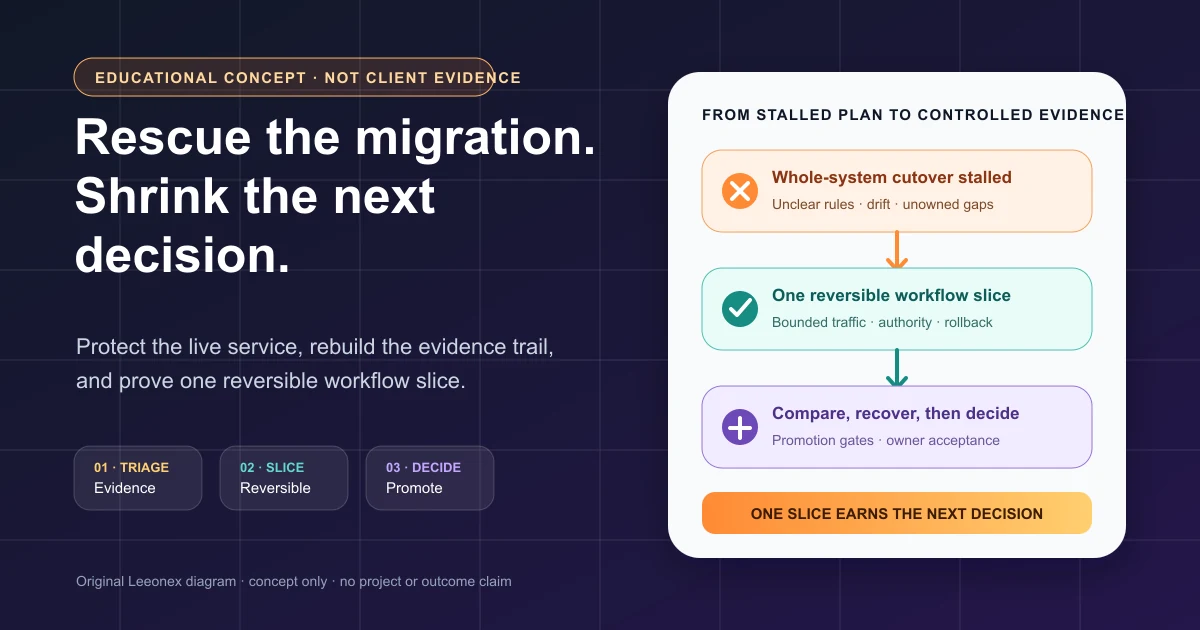
Protect the live service first. Rebuild one evidence trail across workflow behavior, data, delivery, and operations. Classify the unfinished work as keep, rework, retire, or still unknown. Then route one bounded workflow through a reversible new path, compare the business result, and promote it only after named owners accept six gates: acceptance, comparison, operations, recovery, ownership, and retirement.
Protect the service
Stabilize releases, incidents, access, recovery, and ownership before migration pressure creates another outage.
Rebuild evidence
Connect promised behavior, observed behavior, open decisions, tests, defects, and owners in one recovery record.
Prove one slice
Move bounded traffic, compare outcomes, and rehearse recovery before the next capability enters scope.
Evidence disclosure
This is a Level E educational concept study, not a client story, project audit, or completed Leeonex rescue. The situation, dialogue, roles, counts, scope, diagrams, gates, and architecture are illustrative. No real application, repository, migration, cutover, schedule, budget, incident, reliability result, risk reduction, or business outcome was inspected or measured.
Starting situation
The replacement looks nearly finished, but nobody can prove a safe cutover
Imagine a business-critical application that has been scheduled for replacement for more than a year. The new interface demos well, most headline modules exist, and a migration spreadsheet says the programme is close to complete. Yet rehearsals expose missing rules, unmatched records, reports that depend on hidden fields, and operators who still need the old system to finish the day.
Meanwhile the live application keeps changing. Urgent fixes land in one codebase but not the other. Data mappings are corrected in private spreadsheets. The vendor, internal team, and business owners use different meanings for “done.” Another all-at-once date feels decisive, but it concentrates the same uncertainty that stalled the project.
Illustrative conversation — not a client quotation
Illustrative product sponsor
The replacement is mostly built, but every rehearsal finds another rule. The old system is still changing, and the team wants one final push to cut everything over.
Illustrative Leeonex response
Which workflow can the new system complete today, which evidence proves the same business result, and how would operations return that workflow safely if the comparison fails?
Illustrative product sponsor
We have demo scripts and migration spreadsheets, but no shared definition of an acceptable mismatch or who approves the data.
Illustrative Leeonex response
Then the rescue starts by protecting the live service, rebuilding that decision contract, and proving one reversible slice—not by scheduling another whole-system date.
Both voices are invented teaching examples. They are not a client conversation, testimonial, or description of delivered work.
Intended buyer and constraints
This is for the owner who must decide what to save, not merely how to finish more tickets
The intended buyer is a product leader, operations owner, business sponsor, or engineering team inheriting a migration that is late, fragile, disputed, or unable to pass a cutover rehearsal. The pressure may come from unsupported technology, a vendor exit, rising incidents, licensing deadlines, regulatory change, or a workflow the legacy design can no longer support.
Constraints can include limited overlap between teams, incomplete documentation, contractual boundaries, sensitive records, fixed reporting dates, shared databases, batch jobs, user retraining, audit retention, and a live roadmap that cannot simply stop. A rescue has to separate urgent service safety from migration scope while keeping the decision trail visible.
Business sponsor
Owns the outcome, funding boundary, and decision to continue, narrow, pause, or stop the migration.
Workflow owner
Explains real rules and exceptions, accepts changed operating behavior, and names what cannot be interrupted.
Technical recovery lead
Owns diagnosis, compatibility boundaries, delivery controls, test evidence, observability, and rollback design.
Data owner
Defines record authority, mapping and reconciliation rules, tolerated differences, retention, and correction decisions.
Support or operations owner
Needs visible states, runbooks, alerts, permissions, and a safe response when the new path becomes uncertain.
Recovery sequence
Triage evidence before deciding whether the unfinished system is an asset or another source of risk
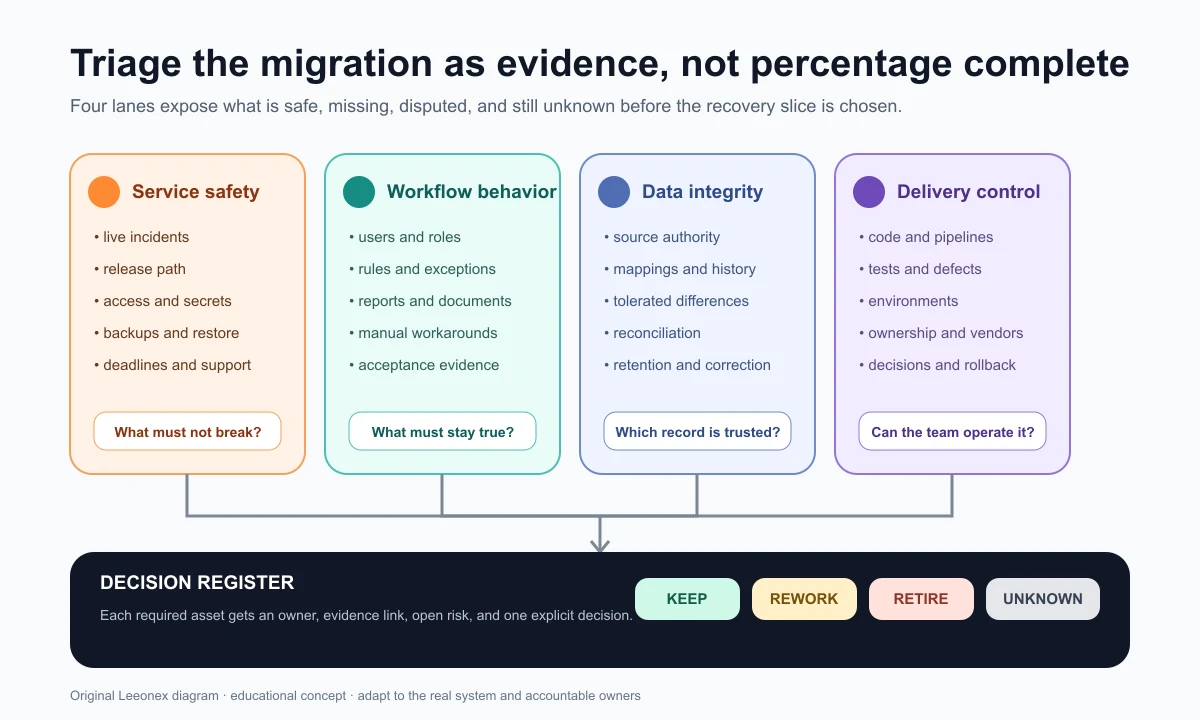
First establish service safety: how the live system releases, fails, recovers, and receives urgent change. Then trace one workflow across users, rules, permissions, data, integrations, reports, support, and downstream effects. Compare that observed behavior with the target design, tests, defects, and migration logic. Gaps become named decisions rather than another vague percentage-complete estimate.
Classify assets at the level where evidence differs. A user interface may be reusable while its data writes are unsafe. A mapping may work for common records but need redesign for historical exceptions. A module can be technically complete yet operationally unowned. Use keep only when the required evidence exists, rework when the boundary is valuable but incomplete, retirewhen it no longer serves the chosen path, and unknown when more investigation is cheaper than a confident guess.
Smallest useful scope
Build the recovery controls around one meaningful workflow
Choose a slice that matters enough to reveal the real delivery path, but is bounded enough to compare and return safely. Define its users, trigger, completion state, data authority, integrations, permissions, exception states, support owner, and rollback boundary. Avoid the most coupled workflow first unless its risk is the reason the rescue exists.
Build now
- A current-state service-safety baseline: critical workflows, incidents, release path, support ownership, backups, recovery, and known deadlines
- One evidence register linking promised behavior, observed legacy behavior, target behavior, open decisions, tests, defects, and accountable owners
- A keep, rework, retire, or unknown decision for migration assets needed by the first slice
- One bounded workflow with explicit entry, exit, user, data, integration, permission, and failure boundaries
- A compatibility route or adapter that allows old and new paths to coexist without granting both systems silent authority
- Representative comparison fixtures, operator acceptance, observable promotion gates, pause control, and a rehearsed rollback
- A decision record for expanding, repeating, redesigning, pausing, or ending the migration after the slice
Later or deliberately excluded
- A whole-application rewrite, full data clean-up, cloud migration, organization redesign, or universal integration platform
- Every workflow, report, batch job, user group, market, region, tenant, vendor, and historical edge case
- Automatic deletion of legacy records or retirement of the old system before dependency and retention evidence exists
- New feature scope added only to make the recovery programme feel more valuable
- Parallel writes without an explicit authority, conflict, replay, reconciliation, and recovery design
- A new final cutover date based only on percentage-complete estimates or a successful demonstration
The broader legacy application modernization roadmap helps teams assess capabilities and choose a first slice before a programme begins. This concept applies when work is already underway and the immediate job is to recover evidence, ownership, and a safe delivery decision.
Architecture and promotion decisions
Coexistence needs one authority, observable comparison, and a real way back
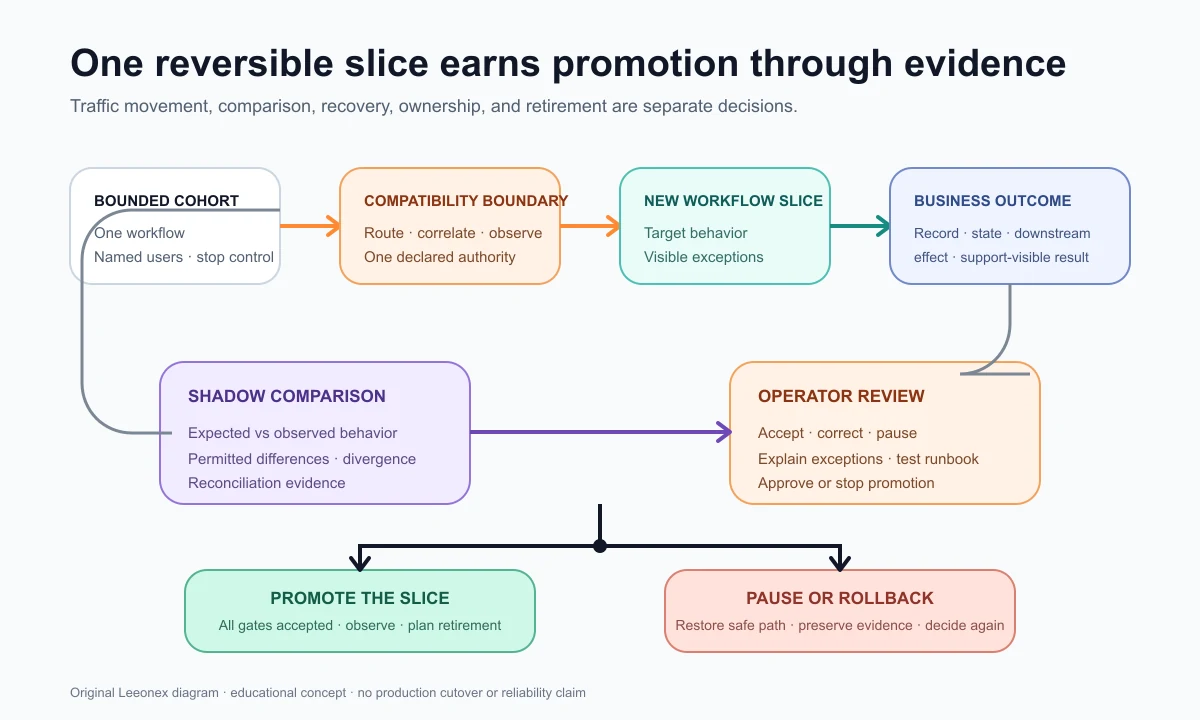
Route only the chosen cohort or workflow to the new path. Keep a stable correlation identifier across legacy and target records. Where safe, shadow reads or calculations can compare results without creating duplicate side effects. Where both paths must change data, declare which system is authoritative and how conflicts, delay, replay, and reconciliation work. An adapter may be temporary, but it still needs tests, ownership, monitoring, and a removal condition.
Acceptance
Representative users can complete the slice and named workflow owners accept changed behavior and exceptions.
Comparison
Old and new outcomes reconcile under agreed rules; unexplained mismatches are visible and owned.
Operations
Monitoring, support states, alerts, runbooks, access, and escalation work for the people carrying the service.
Recovery
The team has rehearsed pause, retry, correction, restore, and rollback for the slice rather than assuming failure is clean.
Ownership
Business, workflow, technical, data, and support decisions have accountable owners who can approve or stop promotion.
Retirement
The old path has a removal condition covering traffic, dependencies, records, access, support, retention, and rollback expiry.
Risks and guardrails
The quiet failures live between the old and new systems
- Freeze avoidable change in the recovery slice, but keep urgent live-service fixes moving through a controlled branch and decision log.
- Treat undocumented legacy behavior as evidence to investigate, not automatically as a defect to copy or a rule to delete.
- Give each record and business action one declared authority during coexistence. Dual-read or dual-write patterns need explicit conflict handling.
- Use production-like, rights-cleared fixtures with known expected outcomes; mask or synthesize sensitive data without erasing important edge cases.
- Compare business outcomes, not only row counts or API status. Include totals, state transitions, permissions, generated documents, downstream effects, and operator-visible exceptions.
- Separate a reversible traffic switch from destructive data or infrastructure retirement. Rollback is not real if the old path cannot still serve safely.
- Make stop conditions visible: unexplained divergence, unowned exceptions, failed recovery, rising support load, or missing evidence pauses promotion.
- Keep the decision trail in buyer-controlled systems so a vendor or team change does not recreate the same knowledge gap.
A rescue can fail by copying accidental legacy behavior, losing a necessary exception, running both systems as masters, masking data-quality problems, or treating a rollback switch as proof that data can be restored. It can also fail commercially when teams keep building to protect sunk cost rather than the current business need.
Evidence and measurement plan
Measure whether the slice is operable, comparable, and recoverable—not whether the project looks busy
Before implementation, define the fixtures, expected business outcomes, permitted differences, comparison method, exception owner, observation window, and stop conditions. Useful measures may include unexplained divergence, exception age, manual corrections, recovery completion, operator task success, support contacts, and the share of the slice still dependent on the old path. These are proposed measures, not results.
Any future claim about faster delivery, fewer incidents, improved accuracy, lower cost, reduced risk, successful cutover, or business impact would require a dated baseline, exact definition, source records, end state, measurement window, exclusions, attribution limits, verifier, approved project identity or anonymization, and publication permission.
Limitations
This concept cannot decide what a real migration should keep
No real codebase, architecture, contract, data set, workflow, incident history, user group, vendor relationship, security control, recovery target, budget, or deadline was reviewed. The four evidence lanes and six promotion gates are teaching devices, not universal standards. A small application may need a simpler cutover; a regulated or safety-critical system may require a much deeper assurance process.
The concept deliberately excludes legal conclusions, vendor or employment disputes, complete portfolio planning, full data governance, procurement, organization design, and a guaranteed rescue timeline. SEO, structured data, sitemaps, and AI-readable discovery improve eligibility and interpretation; they do not guarantee rankings, indexing, citations, traffic, leads, trust, or conversions.
Evidence needed before stronger claims
- An implemented and approved recovery scope, current and target system boundaries, named owners, delivery controls, and an auditable decision record
- Representative acceptance, comparison, permission, integration, concurrency, failure, recovery, rollback, and operator-support tests
- Reconciled migration data, rehearsal evidence, production telemetry, incidents, support records, and retirement proof over a defined observation window
- Approved project identity or anonymization, factual architecture and screenshots, visual rights, metric definitions, attribution limits, verifier, and publication permission
Lessons for a similar buyer
A stalled migration is a decision-system problem before it is a capacity problem
Adding developers can accelerate whichever direction already exists; it cannot create a shared meaning of complete, resolve data authority, or decide which behavior the business accepts. Diagnosis has to reconnect technical work to workflow evidence and accountable decisions.
Sunk work is not automatically reusable work, but neither is it automatically waste. Classify assets by the evidence required for the chosen slice. This preserves useful investment without letting historical effort dictate the next architecture.
A successful slice is not proof that the whole migration will succeed. It is evidence that the team can operate one recovery loop: define, implement, compare, recover, decide, and retire. The next slice should earn its scope under the same discipline.
What to bring to a first consultation
Bring the failed decision trail, not a polished rescue brief
- The original business case, promised scope, current plan, target dates, budget constraints, and the decision now required
- Access to the current and target repositories, build and release paths, environments, observability, incident history, and dependency inventory
- One critical workflow with real owners, rules, exceptions, volumes, deadlines, support steps, and examples of acceptable and unacceptable outcomes
- Migration code, mappings, sample records, reconciliation reports, failed rehearsal notes, defect patterns, and known data-quality issues
- System and vendor contracts, integration ownership, credentials, licensing, security, privacy, audit, retention, and recovery constraints
- A list of assets the current team believes are complete, reusable, unsafe, blocked, obsolete, or not understood
- The people authorized to accept workflow changes, data differences, operational risk, promotion, rollback, and retirement
Those inputs are enough to identify whether the next step is live service stabilization, a bounded assessment, selective salvage, handover, a reversible migration slice, or a pause. Explore Leeonex's software project rescue service or browse other evidence-labelled blueprints in the case-study hub.
Problem-aligned next step
Ask for a rescue review before promising another cutover
Leeonex can help inspect the current delivery path, rebuild the evidence around one workflow, and propose a stabilization or recovery boundary. The honest outcome may be to salvage less, sequence differently, hand the work back cleanly, or stop until a missing owner or contract is resolved.
Discuss a migration rescue