Answer first
Treat onboarding as an evidence-backed decision, not a long form
The smallest useful supplier onboarding portal should prove one complete lane: invite the correct organization, collect a versioned evidence pack, let named reviewers request changes or record a decision, represent current eligibility separately, and confirm the handoff to the system that owns supplier master data.
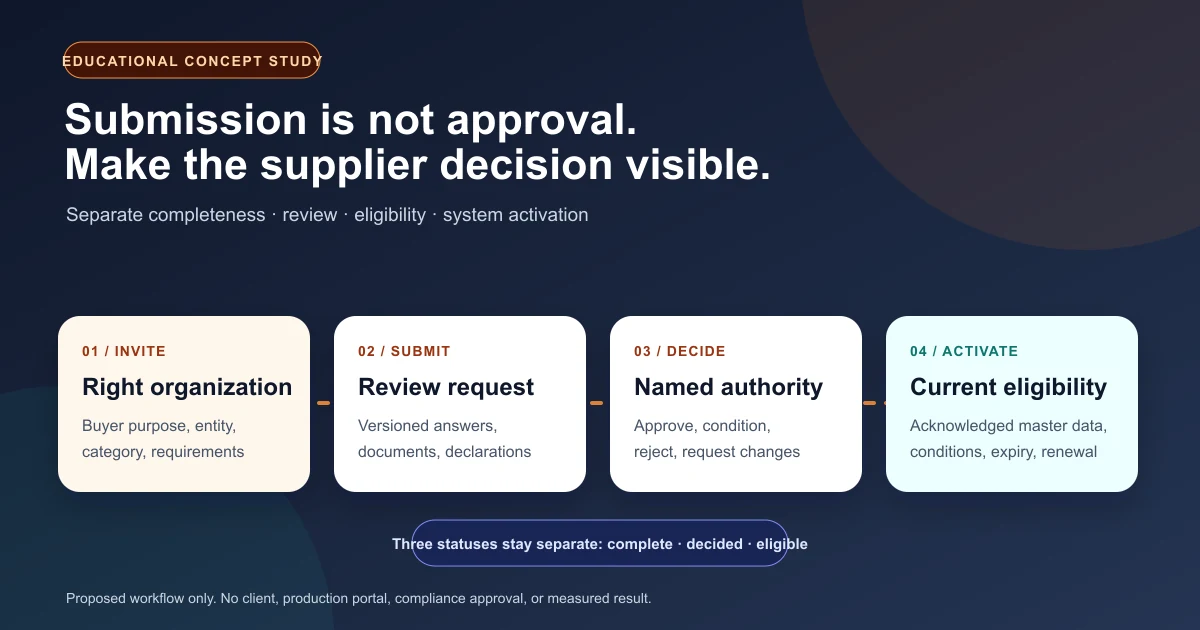
The central rule is simple: submitted means the supplier asked for review. It does not mean the pack is complete, the evidence is valid, the reviewer approved it, the downstream record exists, or the supplier may transact.
What this study is—and what it is not
This is a Level E educational concept study, authored by Leeonex to show how a focused supplier onboarding portal could be scoped. It is not a client story, a live product, a procurement policy, a security review, a legal or compliance assessment, or evidence that any onboarding result improved.
The figures on this page count design choices in the proposed blueprint. They are not performance metrics. Stronger claims would require an implemented system, approved policy, test and operational records, defined baselines and measurement windows, attribution limits, verified results, and publication permission.
The starting situation: onboarding looks digital, but approval still lives in inboxes
This pattern appears when procurement or supplier operations already has an online form, a shared mailbox, a document folder, and an ERP or procurement platform—but nobody can answer one operational question from a single record: why is this supplier currently allowed to transact?
A supplier may have submitted every visible field while a tax identifier conflicts with master data. Procurement may have accepted the category while finance has not activated the record. A time-bound document may expire after approval. A buyer sponsor may leave. A reviewer may approve one legal entity while the supplier assumes that every subsidiary is covered.
The intended buyer is a procurement leader, supplier operations owner, finance or master-data team, or product team that needs a controlled interaction layer around an existing system of record. They are not looking for a generic vendor directory. They need a reviewable first release with explicit authority, exceptions, and renewal.
Business constraint
The portal must reduce coordination ambiguity without inventing policy or becoming a second ERP.
Supplier constraint
External users need clear requests, progress, and recovery without seeing restricted internal reasoning.
Control constraint
Reviewers need bounded authority, versioned evidence, reasons, and time-limited decisions.
Delivery constraint
The first release must close one real onboarding lane before adding the whole supplier lifecycle.
An illustrative discovery conversation
Illustrative conversation—not a client quotation. This composite exchange shows the decision that changes the scope from “build a supplier form” to “control an onboarding decision.” It does not describe a real customer or engagement.
Procurement lead
We want suppliers to upload their details and documents themselves so the team can stop chasing forms by email.
Leeonex
When the supplier presses submit, what has actually happened: is the pack complete, has a reviewer accepted it, or may the supplier already receive orders?
Procurement lead
Those are different. Finance checks some fields, procurement approves categories, and expired documents can later stop new work. Today the status lives across inboxes and the ERP.
Leeonex
Then the first release needs separate completeness, decision, and eligibility states—with named owners and a controlled handoff to the supplier master. The portal should not compress them into one Approved badge.
Start with the people who carry authority and recovery
Portal roles should come from real decisions, not a generic admin-versus-user split. A small first release can still fail if it models the supplier screen but omits the buyer sponsor, reviewer, master-data operator, and support owner who complete the work.
Supplier administrator
Accepts an invitation for the correct organization, adds authorized colleagues, completes the requested profile, uploads evidence, answers change requests, and sees what remains outstanding.
Buyer sponsor
Confirms why this supplier is being onboarded, which buying entity and category apply, and who inside the business owns the relationship.
Procurement or compliance reviewer
Reviews only the evidence and policy decisions within an explicit authority, requests changes, records reasons, applies conditions, and escalates exceptions.
Finance or master-data operator
Verifies controlled fields, resolves duplicates, creates or updates the authoritative supplier record, and reports whether the downstream handoff succeeded.
Support and audit owner
Can reconstruct invitations, organization membership, evidence versions, decisions, expiry events, overrides, notifications, and system acknowledgements without editing history.
The core flow: submission opens review; it does not close it
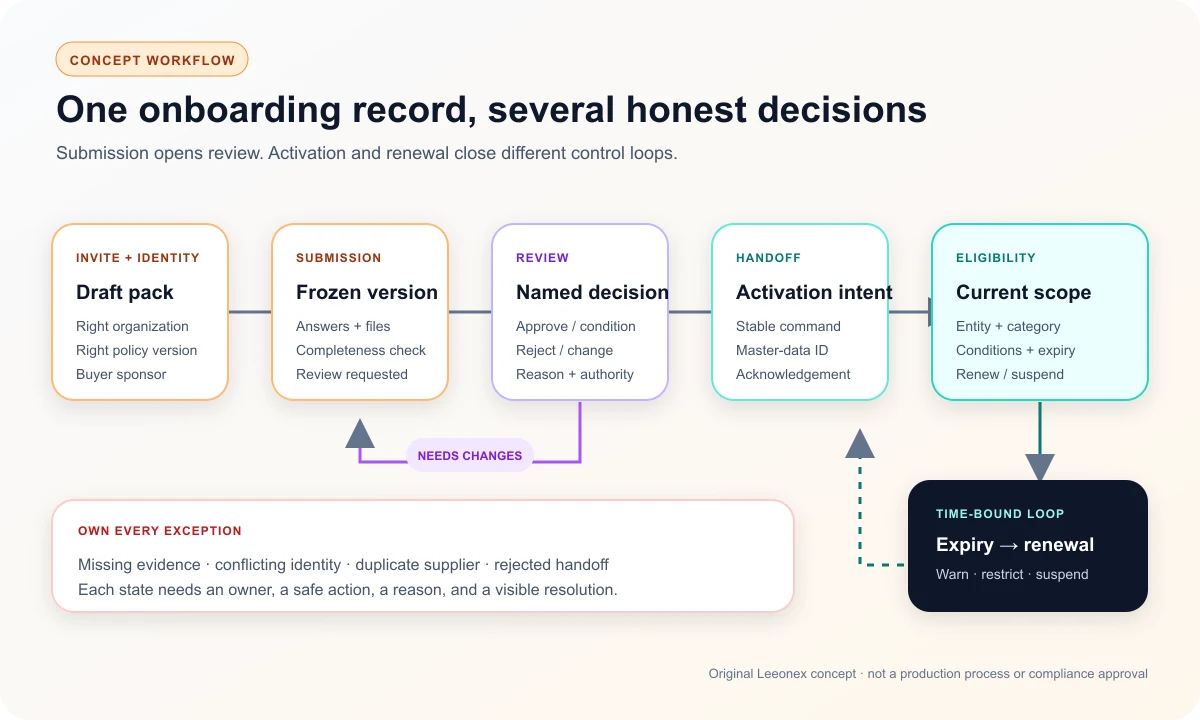
The proposed flow begins with a buyer-owned reason to invite one supplier organization. The supplier accepts the invitation, verifies organization context, completes the requirements pack, and submits one version. Automated completeness checks can stop an obviously incomplete pack, but consequential decisions remain assigned to accountable roles.
- Invite. A buyer sponsor names the supplier type, buying entity, category, requirements version, and purpose of the relationship.
- Establish organization context. The supplier accepts for the correct legal organization; possible duplicates or conflicting identifiers pause creation.
- Prepare and submit. The supplier completes structured fields, declarations, and documents, then submits an immutable review version.
- Check and review. Completeness rules route the pack; named reviewers approve within authority, reject with a reason, request changes, apply conditions, or escalate.
- Activate deliberately. An approved decision creates one observable intent for the authoritative supplier record. Eligibility becomes active only after the required acknowledgement and conditions are satisfied.
- Renew or suspend. Expiring evidence and time-bound decisions create future work. Missing renewal does not quietly leave an old approval looking current.
The smallest useful scope closes one onboarding lane
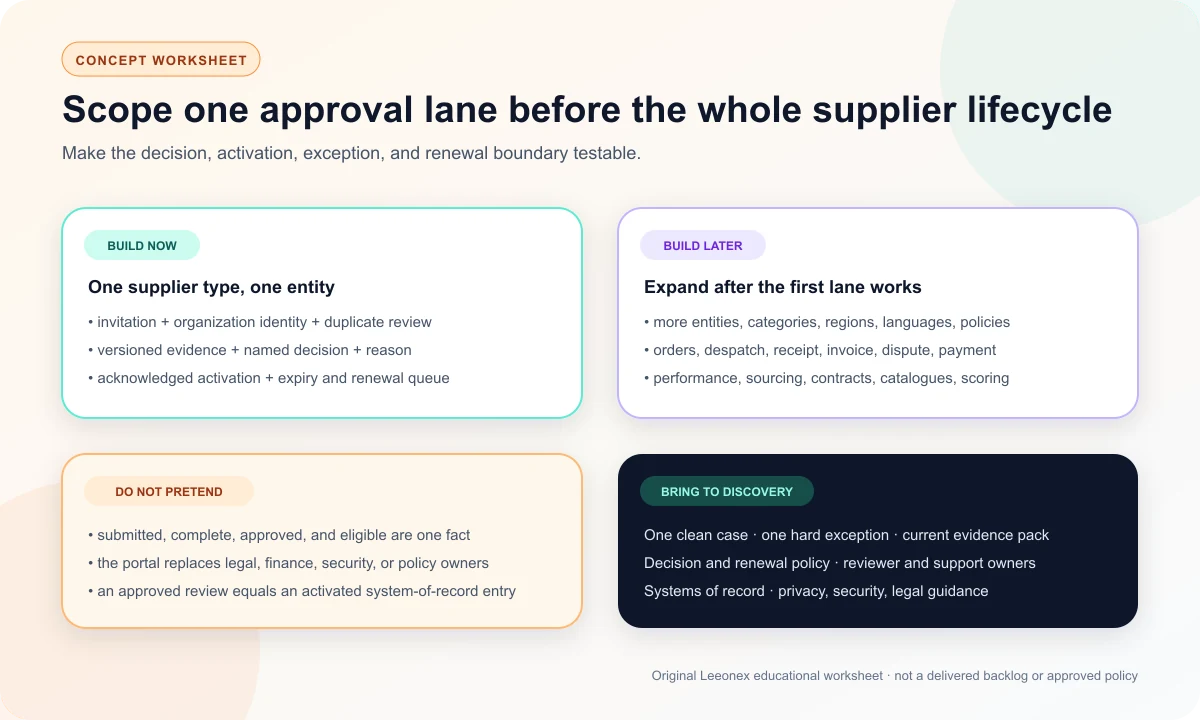
A first release should not promise a complete supplier relationship. It should prove that one supplier type can move from justified invitation to current eligibility—and that the team can recover when the normal path breaks.
Build now
- One supplier type, one buying entity, one category path, and one approved evidence pack
- Invitation acceptance, organization identity, authorized membership, and duplicate-candidate review
- Versioned profile fields and documents with clear required, optional, rejected, and expired states
- Supplier submit, completeness validation, reviewer assignment, change request, decision, and reason
- Separate profile-complete, review-decision, and eligibility-to-transact status
- Controlled creation or update of the authoritative supplier record with visible acknowledgement
- Expiry and renewal queue for time-bound evidence, conditions, and approval decisions
- Restricted event history, notifications, support tools, and exception ownership
Build later, if evidence supports it
- Purchase orders, order acknowledgement, despatch, receipt, invoice, dispute, and payment-status workflows
- Every supplier category, legal entity, geography, tax regime, currency, language, and evidence policy
- Automated external checks that approve or reject a supplier without accountable human policy ownership
- Complex parent-child supplier hierarchies, delegated administration, and shared service centers
- Dynamic risk scoring, supplier performance management, sourcing, contracts, tenders, and catalogue management
- Self-service bank-detail changes until independent verification and payment-risk controls are approved
What is deliberately excluded
- A single Approved label that hides which entity, category, scope, conditions, and expiry date the decision covers
- A portal-created supplier record silently overriding the ERP, procurement platform, identity provider, or other named source of truth
- Automatic sanctions, tax, legal, security, privacy, financial, or payment eligibility decisions without approved specialists, policy, and providers
- Sensitive documents or bank data exposed to broad internal roles merely because they participate in onboarding
- Deleting or overwriting rejected evidence, prior answers, decisions, conditions, or approval history when a supplier resubmits
Architecture decisions that keep the approval explainable
The important architecture is not a fashionable stack. It is the ownership and state model that keeps organization identity, evidence, reviewer authority, eligibility, and downstream activation from collapsing into one mutable supplier row.
Organization identity comes before the form
A supplier user belongs to a proposed or known legal organization. Invitation, domain, registration identifiers, buyer sponsor, and duplicate review help prevent a polished form from creating the wrong supplier twice.
The requirements pack is versioned
Required fields, documents, declarations, reviewers, and expiry rules change by supplier type and policy version. Each submission records the version it answered so later review remains explainable.
Completeness is not approval
Machine checks can identify missing fields, file types, and obvious contradictions. They cannot silently stand in for an accountable procurement, finance, security, legal, or compliance decision.
Decision and eligibility are separate
A review may be approved, rejected, conditionally approved, or returned for changes. Current eligibility additionally depends on entity, category, conditions, expiry, suspension, and successful downstream activation.
The system-of-record handoff is observable
The portal emits one stable activation intent, records identifiers and acknowledgements, and sends rejected, duplicated, or uncertain handoffs to an owner. A successful review is not yet a created supplier master record.
Evidence changes append history
A corrected answer or replacement document creates a new version linked to the prior one. Reviewer decisions, waivers, conditions, expiry, suspension, and reinstatement remain attributable and time-bound.
A typical implementation may use a responsive web portal, a server-side authorization layer, relational workflow records, encrypted object storage, queued notifications, an integration worker with stable commands, and an append-only event history. Those are implementation hypotheses—not a prescribed stack. Existing procurement and identity platforms should remain when they already own the relevant facts reliably.
Acceptance evidence should reconstruct normal work and failure
A successful demo is not enough. Acceptance should use representative, synthetic or safely redacted scenarios and prove what each role sees, what each state means, what history is retained, and how operators recover.
| Scenario | Expected control | Reviewable evidence |
|---|---|---|
| Complete, policy-aligned pack | Authorized reviewers decide; activation waits for the authoritative handoff. | Submission version, decisions, reasons, conditions, command, acknowledgement, and current eligibility. |
| Missing or rejected document | Supplier receives an actionable change request without a false rejection or approval. | Requirement, rejected version, reviewer reason, notification, replacement version, and resubmission. |
| Possible duplicate organization | Creation pauses for an authorized merge, link, or distinct-entity decision. | Matched identifiers, restricted review, decision, preserved references, and no duplicate activation. |
| Downstream timeout | The portal shows approval pending activation and retries safely without creating a second supplier. | Stable intent ID, attempts, response state, reconciliation result, and operator action. |
| Evidence expires after approval | Eligibility follows approved policy: warn, restrict, suspend, or escalate with a named owner. | Expiry rule, notifications, grace period, renewal version, decision, and status transition. |
Risks and guardrails
Supplier onboarding touches identity, commercial relationships, private records, system access, and sometimes payment data. The portal can coordinate approved controls; it cannot invent the organization's legal, procurement, finance, privacy, security, tax, records, sanctions, or sector policy.
- Define what approved means for each buying entity, supplier type, category, region, and transaction—not just the color of a badge.
- Use least-privilege access for supplier users, sponsors, reviewers, finance, support, security, and auditors; enforce authorization on the server and on every file operation.
- Separate ordinary profile edits from consequential identity, ownership, tax, bank, and payment changes; route higher-risk changes through approved verification.
- Encrypt sensitive data in transit and at rest, define retention and deletion, log access where appropriate, and avoid collecting evidence without an owner and purpose.
- Make draft, submitted, incomplete, in review, needs changes, conditionally approved, approved, rejected, expired, suspended, and handoff-failed states unambiguous.
- Protect against duplicate invitations, duplicate organizations, repeated submits, stale browser tabs, concurrent reviewers, retries, and downstream timeouts.
- Let suppliers see actionable status without exposing internal risk notes, other suppliers, restricted checks, reviewer identities, or security-sensitive reasoning.
- Test accessibility, mobile document capture, file size and malware handling, slow networks, translated instructions, notification failure, and support recovery.
Consequential checks need accountable specialists
This study does not define who is legally eligible to supply, what evidence proves that fact, how sanctions or tax checks should run, whether a bank change is genuine, or how long a record must be kept. Those decisions require the relevant accountable owners and jurisdiction-specific advice.
Limitations and what would be needed for stronger claims
- No supplier, buyer, reviewer, or specialist was interviewed for this concept, so the proposed roles and states are hypotheses.
- No procurement, ERP, identity, document, security, screening, tax, banking, or notification system was integrated or tested.
- The diagrams are explanatory artwork, not screenshots, delivered interfaces, approved process maps, or production architecture.
- No accessibility, usability, performance, security, privacy, recovery, legal, compliance, or operational assessment has been completed.
- No onboarding time, completion, error, fraud, approval, supplier satisfaction, support, cost, or adoption result is claimed.
Stronger wording would require approved policy and scope, representative users and records, an implemented system, test and operational evidence, exact metric definitions, baselines, measurement windows, exclusions, attribution limits, a named verifier, and publication permission.
Lessons a buyer can use before commissioning the portal
Name the approval object
Decide whether approval covers a legal organization, site, category, buying entity, contract, or transaction capability—and for how long.
Keep three statuses
Profile completeness, reviewer decision, and current eligibility answer different questions and should not share one badge.
Design renewal with onboarding
Expiry is future work created by today's approval. Give it an owner, notice window, state, and recovery path from the start.
Prove the handoff
An approved portal record is not an active supplier until the authoritative system accepts and can reconcile the same identity.
Protect consequential changes
Identity, ownership, tax, bank, and payment changes deserve stronger verification than ordinary contact edits.
Buy before building broadly
Use an existing procurement platform when the organization can adopt its model; custom scope should earn its place at a distinct operating boundary.
What to bring to a first consultation
The useful starting point is not a list of dashboard tabs. Bring one supplier lane, its current evidence and decisions, the hardest exception, and the owners who can define approval, activation, renewal, privacy, security, and recovery.
- One supplier type and the buying entity, category, or relationship the first release should support
- The current invitation, forms, spreadsheets, email templates, document checklist, declarations, and reviewer instructions
- One clean onboarding and one difficult case involving missing, conflicting, duplicate, expired, or sensitive information
- The exact people who sponsor, review, approve, activate, suspend, support, renew, and audit the supplier
- Policy definitions for complete, approved, eligible, conditionally approved, rejected, expired, suspended, and reinstated
- Systems that own identity, supplier master data, procurement, documents, payments, notifications, tickets, and reporting
- Expected volumes, seasonal peaks, evidence sizes, languages, accessibility needs, retention rules, and service expectations
- Known legal, privacy, security, finance, tax, sanctions, records, and sector constraints from accountable specialists
Leave with an approval boundary, not a portal wish list
A focused discovery should identify the approval object, requirements version, roles, state meanings, system owners, exception queues, renewal rules, acceptance scenarios, exclusions, and the smallest supplier lane worth proving. Explore Leeonex portal and admin panel development, use the broader supplier portal requirements checklist, review other educational work in the case-study hub, or bring your onboarding workflow to a consultation.