The short answer: define the supplier transaction, not a login page
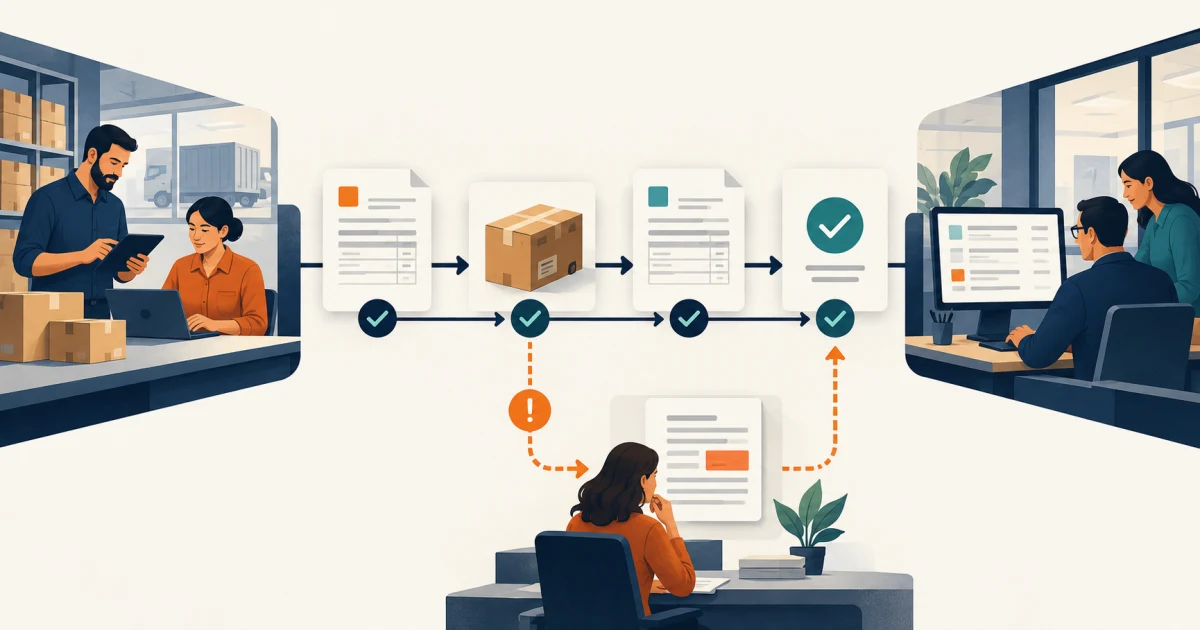
Supplier portal requirements should explain how a supplier is invited, qualified, permitted to act, sent a purchase order, allowed to accept or propose a change, linked to delivery or service evidence, matched to an invoice, and returned to a named owner when something disagrees. The portal is useful only when supplier action and buyer control resolve into the same trusted transaction.
Start with one representative order or service engagement and one expensive exception: a changed quantity, rejected delivery, missing receipt, disputed invoice, expired document, or bank detail change. Follow the records, people, messages, approvals, and recovery actions on both sides. That journey reveals more than a list headed “dashboard, documents, orders, invoices.”
This guide is deliberately narrower than the general customer portal requirements checklist. A supplier portal is shaped by procurement authority, reciprocal business documents, financial controls, and exceptions between organizations.
If the external organization markets, refers, resells, implements, or supports work with you, use the partner portal requirements checklist instead. It focuses on program access, deal registration, approved enablement, channel attribution, and CRM authority rather than procurement transactions.
Write a supplier transaction and exception contract
Model each business document as a versioned statement, not a downloadable file with a vague status. An order says what the buyer is requesting. A response says what the supplier can fulfil. Despatch or service evidence says what happened. A receipt says what the buyer accepted. An invoice asks for settlement against those facts.
For every transition, record the triggering document or event, stable identifiers, allowed actor, required fields, validation, deadline, downstream effects, notifications, retained evidence, and available correction. OpenPeppol's current Ordering specification makes the same distinction concrete: an order response refers to an order and can accept, reject, or accept with changes at defined levels. Your portal may not use Peppol, but it still needs equally unambiguous business states.
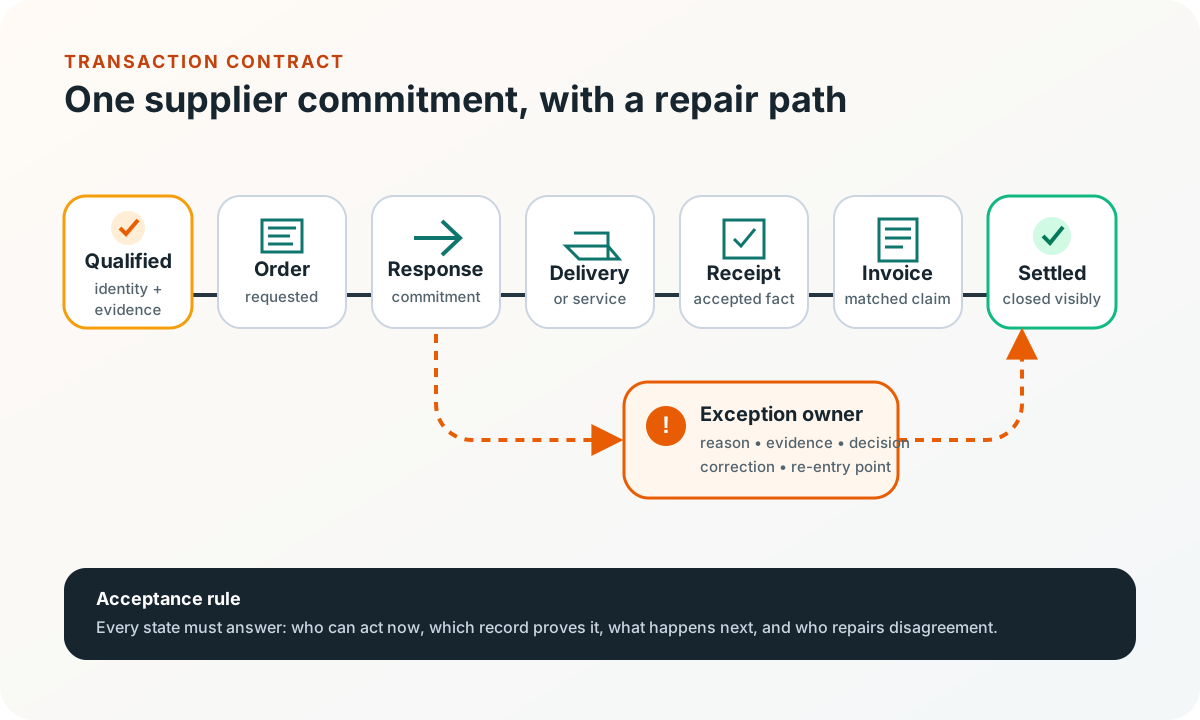
Do not collapse “submitted,” “received,” “validated,” and “approved.” They answer different questions. A supplier can submit an invoice successfully while the buyer later rejects a line because the receipt is missing. Preserve document versions and reasons so neither side has to reconstruct the decision from email.
Define eight requirement lanes around the work
Use recent supplier setup forms, purchase orders, changes, delivery records, invoices, disputes, support tickets, and renewal chases as source material. Write observable behavior and acceptance evidence in each lane.
| Lane | Decision to specify | Acceptance evidence |
|---|---|---|
| Supplier identity | Legal entity, trading locations, contacts, identifiers, duplicates | One organization is matched without merging unrelated parties |
| Invitation and access | Sponsor, roles, delegation, federation, recovery, revocation | The right person can act only for the right supplier |
| Qualification | Data by risk tier, documents, reviewers, expiry, remediation | Activation explains what passed, failed, or remains conditional |
| Orders and responses | Lines, dates, quantities, substitutions, rejection, change authority | Both sides can reconstruct the accepted commitment |
| Delivery or service | Despatch, milestones, receipt, shortage, damage, evidence | The outcome is linked to the correct order and line |
| Invoice and dispute | References, validation, duplicate rule, mismatch, correction | Every invoice resolves to approval, dispute, or rejection |
| Profile and renewal | Controlled changes, expiry, reminders, suspension, offboarding | Consequential changes have review and effective dates |
| Operations and evidence | Queues, support, audit events, exports, reconciliation, metrics | An owner can find, repair, and prove each exception |
Show suppliers the state they can act on
A home view should answer what needs attention now, why, by when, and what a valid next action looks like. Do not expose internal workflow noise or an unexplained colour. Translate a state into a supplier-facing meaning while preserving the internal reason and owner behind it.
Make buyer operations part of the scope
Name who can resend an invitation, associate a user with the correct supplier, request missing evidence, approve a changed order line, correct a receipt, hold an invoice, reverse an erroneous decision, and communicate the result. Use the approval workflow requirements guide when authority, delegation, escalation, and evidence need their own model.
Apply stronger controls to consequential changes
A supplier user, supplier organization, buyer sponsor, role, and bank account are separate concepts. Specify invitations, organization membership, supplier switching, delegated administration, dormant accounts, leavers, recovery, and reauthentication. NIST's current Digital Identity Guidelines provide a risk-based model for identity proofing, authentication, and federation; select controls from the consequence of a false or compromised identity.
Bank-detail changes deserve a distinct workflow. Business email compromise specifically targets organizations that work with suppliers and make wire payments, as described in the FBI's business email compromise guidance. A portal should not turn that risk into a convenient self-service edit. Separate request and approval, use an independently controlled verification channel, notify the relevant owners, preserve prior values securely, and define the effect on pending payments.
Apply the same consequence-led thinking to legal name changes, tax identifiers, beneficial ownership where relevant, insurance, certificates, sanctions or compliance information, and administrator changes. The responsible business and legal owners must set the policy; software should make that policy visible, testable, and reviewable.
Keep system ownership visible across the portal
Map the supplier master, identity provider, procurement or ERP, contracts, document storage, receiving, accounts payable, payment status, messaging, support, and analytics. For every boundary, record the owning system, stable identifiers, direction, freshness, duplicate behavior, validation, retry, reconciliation, and repair owner.
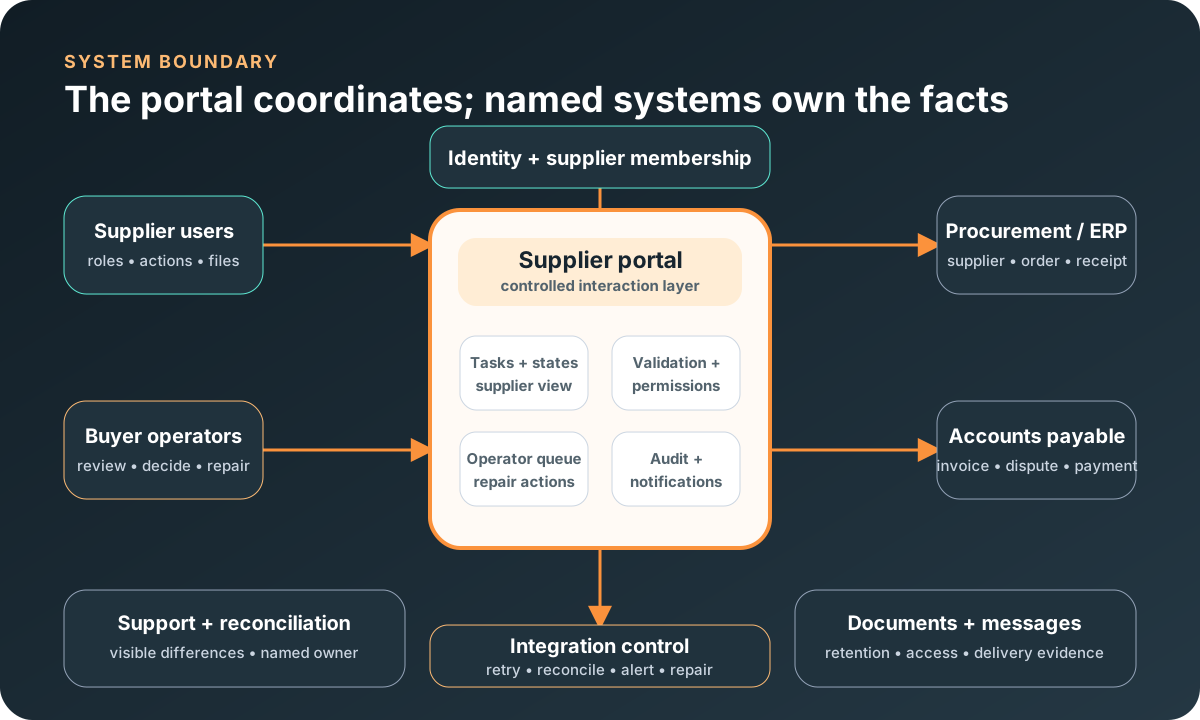
OpenPeppol's Billing specification treats invoice verification as a relationship to an authentic transaction, including purchase orders, contracts, receipts, and despatch advice. That is the useful design principle even when your exchange format differs: keep references intact so finance can match, explain, and dispute at document and line level.
If several systems must stay synchronized, pair this brief with the API integration requirements checklist. Do not let the portal quietly become a second ERP because integrations were left as a later technical detail.
If the decision extends beyond the supplier-facing experience, use the procure-to-pay software requirements checklist to connect requisition, approval, commitment, receipt, invoice matching, payment release, and reconciliation across the full operating path.
Choose buy, extend, or build by the operating boundary
Buy and configure
The organization can adopt a product's supplier model, document chain, approvals, and integrations.
Extend
A stable procurement core exists, but one focused supplier experience or orchestration gap matters.
Build
Distinct transaction rules, legacy boundaries, permissions, or exception handling are central to the operation.
Compare options with the same transaction scenarios, data, users, integrations, and evidence. A polished supplier profile screen proves little if the product cannot represent a partial acceptance, repeated message, missing receipt, disputed line, expired document, or controlled account change.
Prefer a simpler product and process change when it can safely remove the problem. Use custom web application development when the operating boundary itself is the differentiator and a maintainable portal must coordinate it.
Use a one-transaction pilot worksheet
Choose one supplier type and a recent transaction with enough variation to expose real work. Complete this worksheet before estimating a broad portal roadmap.
- Outcome: what can the supplier and buyer complete without email or shadow spreadsheets?
- Parties: which organizations, users, roles, sponsors, reviewers, and support operators participate?
- Documents: which order, response, delivery, receipt, invoice, profile, and evidence records are involved?
- Authority: who may submit, propose, approve, reject, correct, suspend, or reverse each consequential step?
- Boundaries: which system owns each fact, and how are identifiers, retries, and reconciliation handled?
- Exceptions: test a changed order, partial delivery, missing receipt, duplicate invoice, expired evidence, and sensitive profile change.
- Acceptance: define the visible state, audit evidence, notifications, operator repair, and matched totals expected after every scenario.
The smallest responsible release may cover qualification and controlled profile changes, or one order-to-invoice path—not both. Narrow scope is healthy when the chosen workflow reaches a real outcome and includes its support and repair path.
For a worked example of that narrower qualification boundary, review the educational concept for a supplier onboarding portal that keeps submission separate from approval. It focuses on evidence versions, reviewer authority, eligibility, activation, and renewal rather than the full transaction lifecycle covered here.
Supplier portal requirements FAQ
What should a supplier portal include?
Include supplier and organization identity, invitations and roles, qualification data and documents, controlled profile changes, purchase orders, order responses, despatch or service evidence, receipts, invoices and disputes, payment-status visibility where appropriate, renewals, messages, audit history, integrations, internal support tools, and acceptance scenarios. Only include workflows that have a named owner and source of truth.
Is a supplier portal the same as supplier onboarding?
No. Onboarding is one lifecycle stage that establishes whether a supplier may transact and which evidence is required. A supplier portal may also coordinate order acknowledgement, changes, delivery evidence, invoices, disputes, profile updates, renewals, and offboarding. Scope the first release around one complete transaction rather than trying to expose the entire relationship at once.
Should a business buy or build a supplier portal?
Buy or configure a procurement platform when the organization can adopt its supplier lifecycle, document model, approval rules, and supported integrations. Extend an existing platform when a small differentiating workflow sits around a stable core. Consider custom software when supplier interactions, exception rules, legacy-system coordination, or branded partner experience are central and packaged workarounds recreate manual risk.
How should supplier bank-detail changes be handled?
Treat a bank-detail change as a high-consequence request, not an ordinary profile edit. Separate request from approval, require suitable reauthentication, record old and new values securely, notify relevant owners, verify through an independently controlled channel, delay or flag affected payments when policy requires it, and preserve an audit trail. The exact controls should be set by finance, security, legal, and compliance owners.