
The short answer: specify the decision, not the inbox
Approval workflow software requirements should define who may request and decide, what information is required, how routing and thresholds work, what completes each stage, how exceptions recover, which systems exchange data, and what evidence proves the right decision happened. “Send it to a manager for approval” is not testable enough.
Take a purchase request. A useful requirement identifies the amount and cost-center boundaries, approvers at each threshold, whether all or one reviewer must respond, what happens when the approver is absent, who may change the request, and which record proves the final authorization. The same structure works for refunds, access requests, content reviews, supplier onboarding, discounts, and policy exceptions.
This guide focuses on one controlled decision flow. If the workflow sits inside a broader operator product, pair it with the admin panel requirements checklist. If the current process lives mostly in a workbook, first use the spreadsheet-to-internal-tool framework to decide whether custom software is warranted.
Configure a platform when the workflow fits; build when the boundary matters
Begin with the real policy and a representative exception—not a product feature list. Standard platforms are usually a good fit for structured intake, predictable sequential or parallel review, ordinary reminders, and common business integrations. Microsoft's current approval documentation, for example, distinguishes first-to-respond, everyone-must-approve, custom responses, and sequential approval behavior. Those labels are useful only after the team chooses the completion rule it needs.
Microsoft documents the behavior of those approval types, including when later flow actions run. Use comparable vendor documentation to verify your required behavior rather than assuming “multi-step approvals” means the same thing everywhere.
Consider an extension or custom application when approval is embedded in a customer or operator experience, routing depends on a domain-specific data model, several systems must agree on state, permission boundaries are unusual, or the workflow itself is operationally differentiating. A hybrid is common: keep a platform's workflow engine but build a focused intake, status, integration, or reporting layer. The deciding question is whether configuration can express the policy without hidden spreadsheets, copied data, or administrator improvisation.
Write each important rule as trigger, result, evidence, and owner
Feature names hide ambiguity. “Supports delegation” does not say who may delegate, for how long, whether prior decisions remain valid, or what the audit record shows. Use a four-part contract for every material rule:
- Trigger. Name the submitted field, threshold, role, event, deadline, failure, or state that invokes the rule.
- Expected result. State the route, restriction, notification, state change, or recovery behavior the system must produce.
- Evidence. Identify the record, timestamp, rule version, reason, comparison, or downstream acknowledgement that proves the behavior occurred.
- Owner. Name who maintains the policy, resolves ambiguity, reviews failures, and accepts a changed rule.
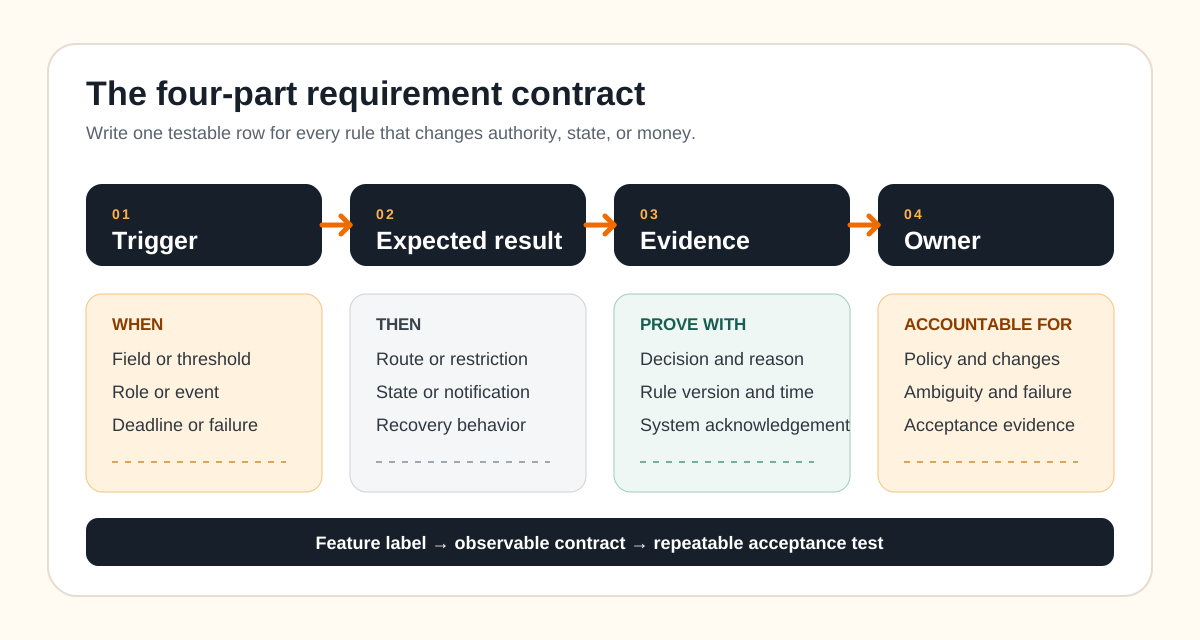
A concrete contract might read: when a request reaches the exact finance threshold, add the finance reviewer, prevent the requester from deciding, require both assigned reviewers, and retain their decisions with the rule version and evidence they saw. That statement can drive configuration, custom development, a vendor demonstration, and an acceptance test.
Model exceptions as states, not support tickets
Real approval work includes missing evidence, a request returned for changes, an unavailable reviewer, delegation, withdrawal, expiry, duplicate submission, downstream failure, and emergency override. Name the allowed transitions and the role that may cause each one. A request should never become “approved” merely because an integration timed out or an administrator edited a database row.
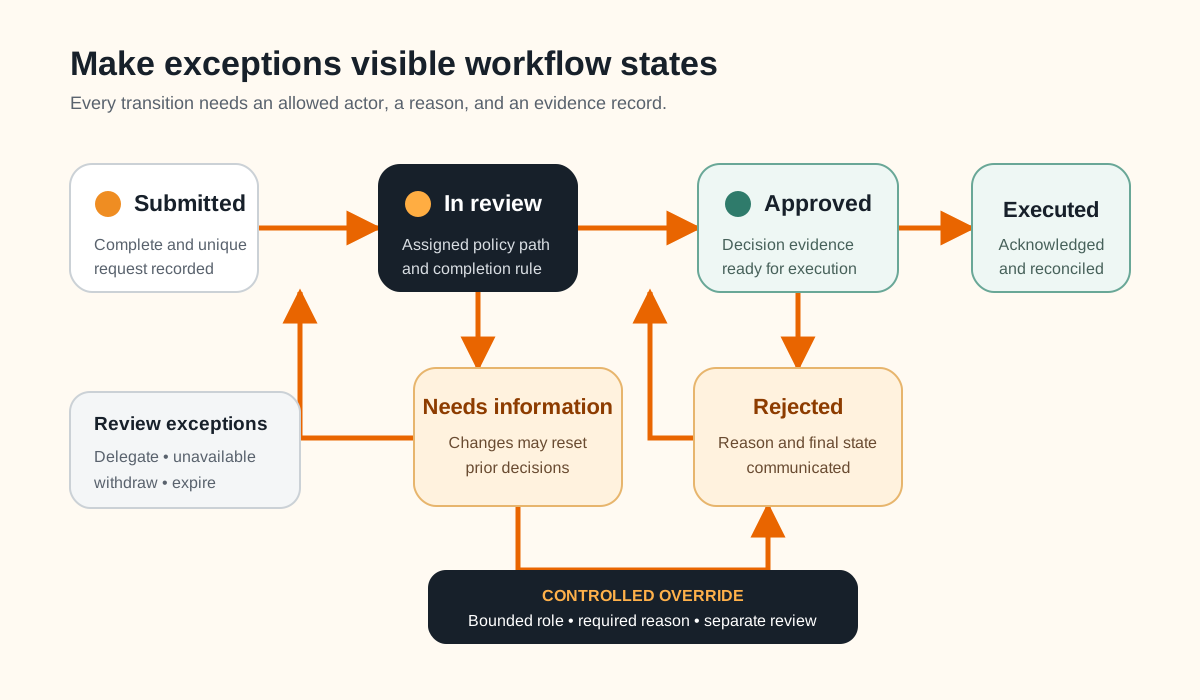
Decide what remains valid after a change. If the requester edits an amount, supplier, destination account, or attachment, prior approvals may need to reset. If an approver delegates a queue, define the start and end time and preserve both identities. If an override exists, require a reason, a bounded role, and a separate review path rather than hiding it in a generic admin permission.
Integrations need the same discipline. The API integration requirements checklist covers idempotency, retries, reconciliation, and ownership. Use those rules when an approved request creates a payment, account, access grant, order, or case in another system.
Separate authority, access, and audit evidence
Create a role-action matrix for requester, reviewer, policy owner, workflow administrator, auditor, and integration account. Decide who may view sensitive fields, change routing rules, reopen a request, delegate, override, export, and inspect the audit trail. Do not infer authority only from job titles; connect it to the business policy and data boundary.
NIST SP 800-53 AC-5 defines separation of duties as identifying duties that require separation and defining access authorizations to support it. Apply that principle where one person should not request, approve, execute, and conceal the same consequential action.
Authorization belongs on the server or trusted policy boundary, not only in a hidden button. The OWASP Authorization Cheat Sheet recommends least privilege, deny by default, and permission checks on every request. Log material state changes and rule changes, but avoid placing secrets or unnecessary personal data in an unrestricted history.
Prove the boundaries, failures, and reporting before launch
Build an acceptance pack from real examples. Test values just below, at, and above each threshold; incomplete and duplicate requests; conflicting simultaneous decisions; a withdrawn request; an unavailable approver; expired delegation; an unauthorized direct API call; a changed rule; a downstream timeout; a replayed event; and reconciliation after recovery.
For every case, save the input, expected state, actual state, notifications, integration outcome, and audit evidence. Then verify the reporting questions operators actually ask: what is waiting, who owns it, how long has it waited, which policy path applies, what failed, and what is safe to retry? A dashboard cannot repair an ambiguous state model.
Turn these examples into formal release evidence with the software acceptance criteria checklist. Measure cycle time, queue age, exception volume, and rework only after definitions are stable; do not adopt a universal target that ignores the risk and complexity of the decision.
A first-release approval workflow brief
Scope one request type end to end. Record its owner, business outcome, request fields, data classification, routing rules, authority matrix, stage completion rules, exceptions, deadlines, notifications, integrations, permission tests, audit events, reports, retention need, migration, training, acceptance pack, support owner, and excluded variants.
Run the brief against one ordinary request and the hardest recent exception. Mark each branch as required now, safely manual, or later. That produces a credible first release and exposes the real estimate drivers without pretending every department's policy can be automated at once.
If the workflow needs a tailored operator experience, domain data, and integration boundary, Leeonex's custom web application development service can help turn the brief into the smallest controlled system worth building.
Approval workflow software FAQ
What should an approval workflow requirements document include?
Include the request data, routing rules, authority matrix, completion policy, permissions, exceptions, notifications, integrations, audit evidence, reporting, recovery rules, acceptance tests, and owners. Write important behavior as a trigger, expected result, and proof rather than a feature label.
Should we buy, configure, or build approval workflow software?
Configure an existing platform when its data model, routing, permissions, and integrations fit without fragile workarounds. Build or extend when approval behavior is a differentiating operational system, needs unusual domain rules, or must live inside a customer or operator product. Prototype one real exception-heavy workflow before committing.
How do we test an approval workflow before launch?
Test the happy path and boundary cases: threshold values, missing data, duplicate submissions, unavailable approvers, delegation, rejection, withdrawal, stale requests, integration failure, unauthorized access, retries, and reporting. Keep the resulting event and record as acceptance evidence.