Define one controlled purchase from need to reconciliation
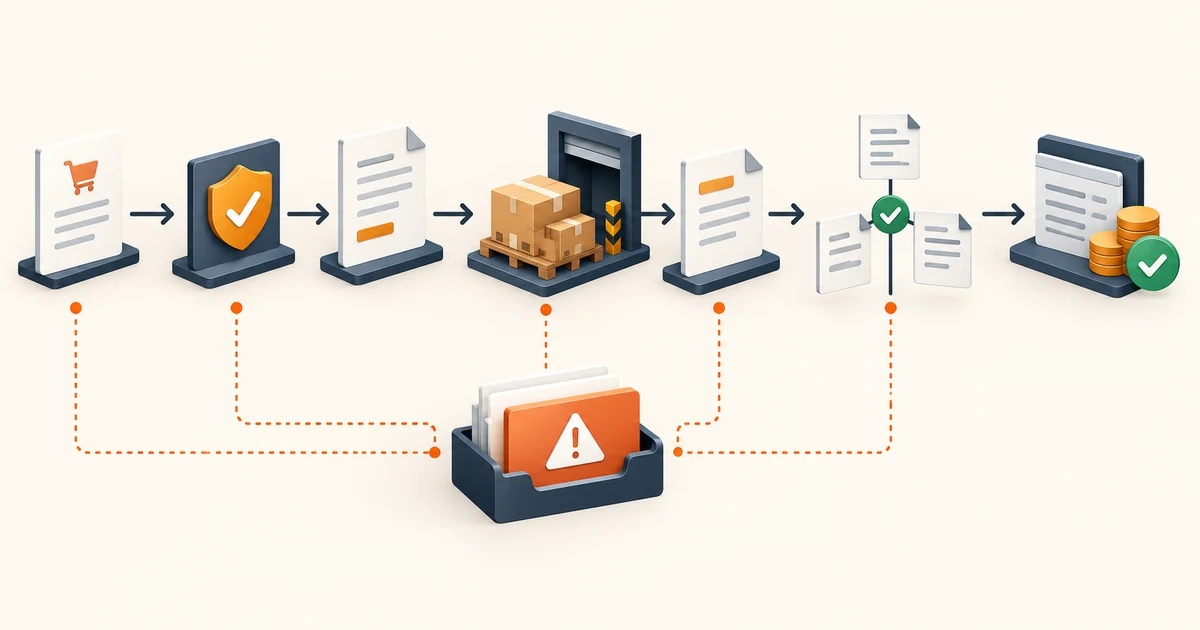
A useful procure-to-pay software requirements checklist connects the full transaction: need, requisition, policy and budget checks, approval, supplier, purchase order, acknowledgement, receipt of goods or services, invoice, matching, exception resolution, posting, payment release, and reconciliation. It names the record, authority, evidence, and system owner at every handoff.
Start with one recent purchase that exposed the real complexity: a partial delivery, service milestone, changed price, missing PO, duplicate invoice, disputed charge, credit, tax difference, or urgent exception. Model the normal path and that difficult path before comparing feature lists.
Write a transaction contract before designing screens
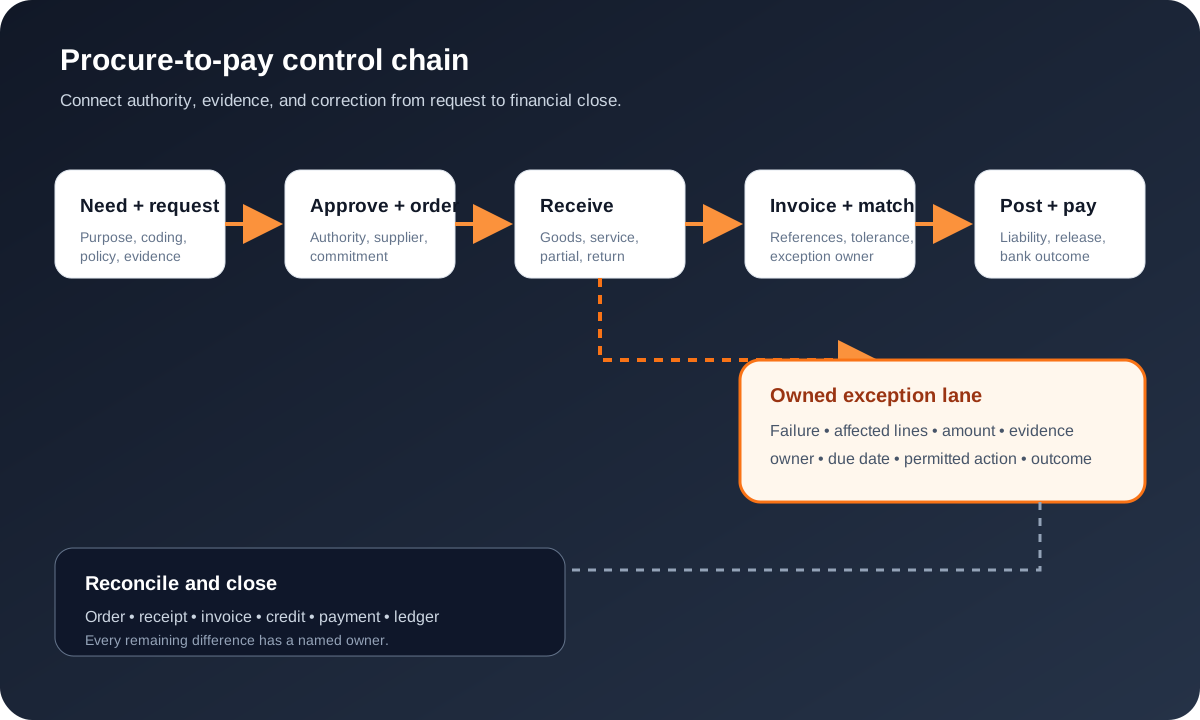
Give the transaction stable identifiers for requester, legal entity, cost center or project, supplier, contract, requisition, purchase order and line, acknowledgement, receipt, invoice and line, credit, payment instruction, and accounting entry. Record the effective policy and master-data versions used at each decision. A supplier-name string is not a reliable join key.
Define permitted states and transitions for every record: draft, submitted, approved, rejected, returned, ordered, acknowledged, partially received, disputed, matched, held, posted, scheduled, paid, reversed, and closed where relevant. Specify who may act, required evidence, notifications, timing, downstream effects, and correction behavior. Do not overwrite a confirmed order or posted receipt when a reversal, amendment, or superseding record is needed.
OpenPeppol's BIS Ordering specification models an order response that can accept, accept with agreed changes, or reject an order and notes that order information can support later invoice matching. Even if Peppol is outside your scope, the lesson is useful: supplier acknowledgement and order change are explicit business events, not email side notes.
Cover the lanes that make P2P operationally complete
Demand and policy
Request types, catalogs, free text, contracts, projects, accounting dimensions, budget checks, preferred suppliers, thresholds, conflicts, urgency, and supporting evidence.
Authority and commitment
Approval matrix, delegation, segregation, escalations, sourcing where needed, order creation, dispatch, acknowledgements, changes, cancellations, and commitments.
Supplier and delivery
Verified supplier records, contacts, locations, terms, catalogs, tax and payment details, shipment notices, goods receipts, service entry, inspection, returns, and disputes.
Invoice and matching
Channels, formats, capture, validation, duplicate rules, PO and non-PO invoices, two- and three-way matching, tolerances, charges, tax, credits, holds, and exception queues.
Posting and payment
Accounting distributions, accruals, posting rules, due dates, discounts, approvals, payment batches, bank handoff, remittance, rejection, fraud controls, and reconciliation.
Platform and lifecycle
Roles, identity, audit history, integrations, accessibility, localization, currencies, retention, privacy, performance, continuity, support, data export, migration, and exit.
Define scale in business units: active suppliers, legal entities, currencies, catalogs, requisitions and lines per day, orders, receipts, invoices and lines, attachments, concurrent approvers, matching jobs, exception backlog, integrations, retained years, close-period load, and acceptable processing and recovery times. “Enterprise scale” is not an acceptance criterion.
Make matching policy explainable—and exceptions first-class
Define which purchases use invoice-only approval, two-way match against the purchase order, or three-way match against order and receipt. Include quantity, unit price, line total, freight, charges, tax, currency, unit conversion, timing, and cumulative partials. Tolerances need a source, effective date, authority, reason, and override rule; they should not be hidden constants.
Microsoft's three-way matching documentation illustrates invoice price checks against purchase-order lines and quantity checks against product receipts. Its broader procurement overview also distinguishes physical receipt from service or nonphysical purchases that may follow another receipt or invoice path. Your requirements should model those differences explicitly.
An exception record should say what failed, affected lines and amounts, current owner, required evidence, permitted actions, due date, supplier communication, escalation, and downstream hold. Support split ownership: receiving may confirm quantity, procurement may resolve an order change, and finance may decide accounting treatment. The system should preserve each decision instead of bouncing an invoice through an opaque status.
The OpenPeppol BIS Billing specification treats invoice verification, accounting, auditing, and payment as distinct functions and identifies references such as the order, contract, buyer, and confirmed receipt. Use that as a prompt to preserve linkage at document and line level rather than relying on attachment search.
Map authority across procurement, operations, finance, and suppliers
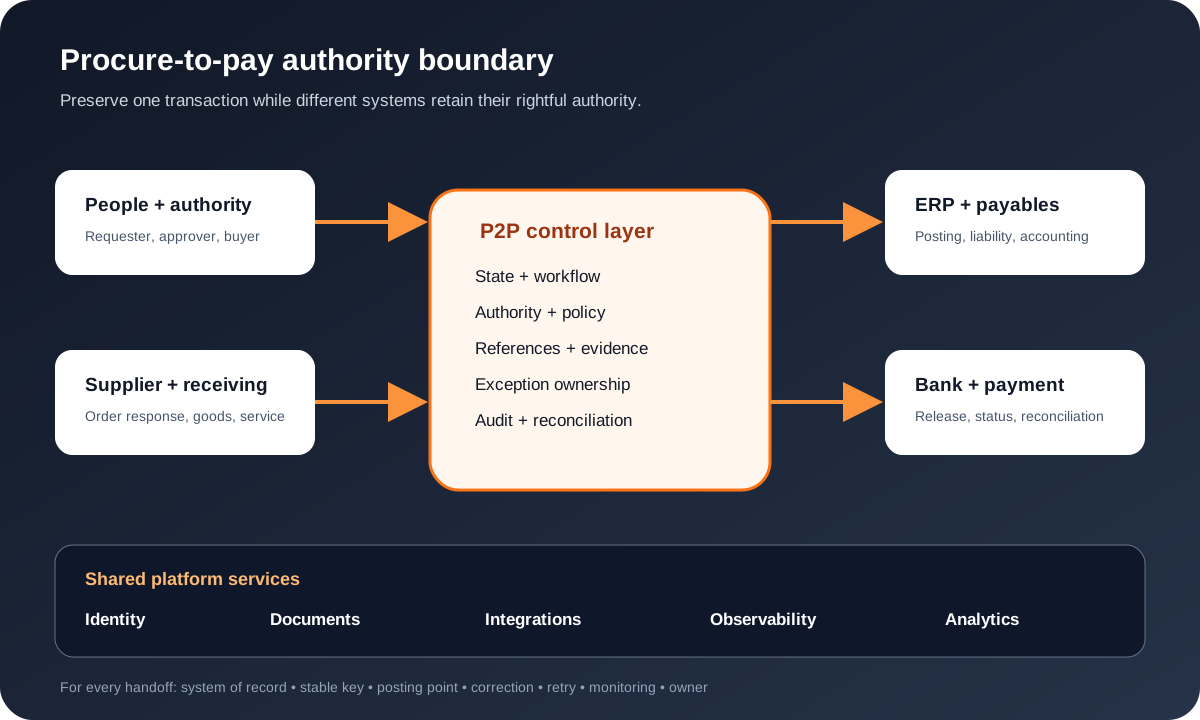
Name the authoritative source for employee and role, supplier, contract, catalog, budget, accounting dimensions, requisition, purchase order, receipt, inventory movement, invoice, tax result, liability, payment status, bank confirmation, and analytical copy. For every interface, define stable keys, payload meaning, direction, event and receipt time, ordering, duplicates, retries, correction, monitoring, reconciliation, and support owner.
A supplier portal may own supplier-facing acknowledgement and document exchange while ERP remains transactional authority. An approval workflow may handle unusual authority rules. Use the API integration checklist to specify reliable exchanges rather than making P2P a duplicate system of record.
Protect supplier master and payment-detail changes as high-consequence operations. Separate request, independent verification, approval, activation, notification, and audit. Apply least privilege and segregation to ordering, receipt, invoice override, posting, payment release, and configuration. Define continuity for unavailable ERP, portal, capture service, identity provider, or bank connection—and test reconciliation after recovery.
Choose the smallest ownership boundary that solves the gap
Configure
A proven platform represents the real transaction, jurisdictions, controls, integrations, exceptions, reporting, support, and upgrade path without fragile workarounds.
Extend
The transactional core is sound, but a bounded requester, supplier, service-receipt, exception, integration, document, or analytics experience is missing.
Build
A distinctive operating model creates durable value, packaged assumptions repeatedly break it, and the organization can own financial controls, security, support, compliance, and change.
Compare licenses, implementation, process change, supplier enablement, master-data repair, integrations, controls, training, support, upgrades, reporting, export, and exit. A focused custom web application may be appropriate for a differentiated intake, portal, or exception layer while established financial systems retain posting and payment authority.
Run one exception-heavy purchase pilot
- Freeze the transaction. Choose a representative purchase and record people, policies, supplier, contract, accounting, documents, systems, and expected evidence.
- Run the normal path. Submit, approve, order, acknowledge, receive, invoice, match, post, release, pay, notify, and reconcile.
- Break the path. Add a partial receipt, changed price, extra charge, duplicate invoice, missing reference, rejected item, service dispute, credit, and late document.
- Exercise authority. Verify thresholds, delegation, segregation, supplier-detail changes, override reasons, holds, and payment release.
- Correct without erasing. Amend an order, reverse a receipt, credit an invoice, reject a payment, and retain the original evidence.
- Interrupt integrations. Delay and repeat messages, restore each dependency, process events once, and reconcile records across systems.
- Write the decision brief. Record configure, extend, integrate, build, or process-repair decisions, exclusions, owners, acceptance cases, rollout, support, and rollback.
Procure-to-pay software FAQ
What should procure-to-pay software requirements include?
Include request intake, policy and budget checks, approval authority, supplier and catalog data, sourcing where applicable, purchase orders and changes, acknowledgements, goods and service receipts, invoice intake and validation, two- and three-way matching, tolerances, exceptions, credits, duplicate prevention, tax and accounting data, payment release, integrations, audit evidence, reporting, reconciliation, security, continuity, support, and acceptance tests.
What is the difference between procure-to-pay and accounts payable automation?
Accounts payable automation usually begins when an invoice arrives. Procure-to-pay starts earlier with the need, requisition, policy, approval, supplier, purchase order, and receipt, then continues through invoice verification, payment release, and reconciliation. AP automation can be one component of a wider P2P operating model.
Does every invoice need three-way matching?
No. Matching policy should reflect the purchase type and control objective. Some purchases use purchase order and invoice matching, some require receipt evidence as a third record, and non-PO or service invoices need different evidence and authority. Define tolerances, partials, charges, taxes, credits, substitutions, and an exception path instead of forcing one rule onto every purchase.
Should a business buy or build procure-to-pay software?
Buy or configure a proven platform when its supplier, approval, order, receipt, invoice, accounting, and payment model fits the organization and target jurisdictions. Extend or integrate when a stable core needs a bounded portal, approval, data, or exception layer. Consider custom software only where distinctive workflows justify long-term ownership and the organization can govern finance, security, compliance, support, and change.