Answer first
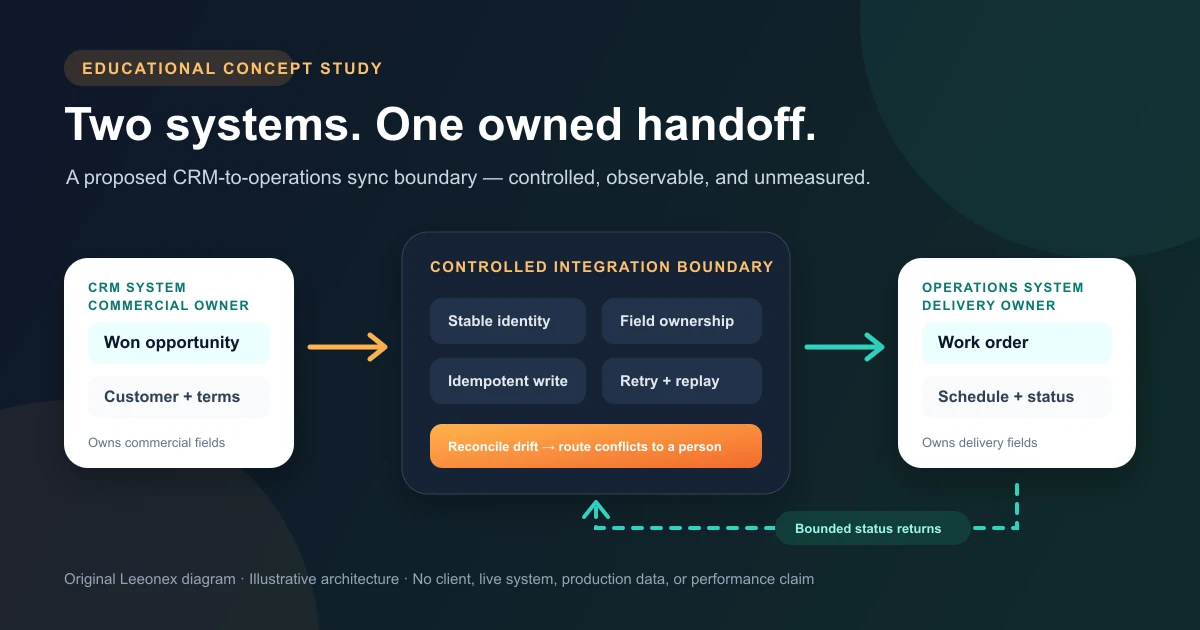
The smallest useful two-way integration is one owned handoff with a visible exception path.
Start when a CRM opportunity reaches one agreed state. Validate the payload, match it to a stable customer identity, and create or update one operations work order using an idempotent key. Return only the delivery status the sales team genuinely needs.
Every field should have one authoritative owner. Duplicate, missing, late, and conflicting records should enter a queue a person can investigate. That narrow loop is more useful than promising that two large systems will simply “stay in sync.”
Illustrative discovery conversation — not a client quotation
“Two-way sync” becomes buildable only after ownership and conflict decisions are named.
Revenue operations lead
“When an opportunity is won, our team copies it into the delivery system. Can we keep both tools in sync automatically?”
Leeonex
“Which record starts the handoff, which fields may change later, and what should happen when the systems disagree?”
Revenue operations lead
“Sales owns the customer and commercial details. Operations owns scheduling and delivery status, but people sometimes edit both.”
Leeonex
“Then the first release needs stable identity, field ownership, safe retries, one bounded return status, and a visible conflict queue before broad two-way sync.”
This is Leeonex-authored teaching material. It represents no real customer, quotation, engagement, system, or data flow.
Starting situation and buyer
This concept is for teams repairing the same sales-to-delivery handoff every week.
The intended buyer is a revenue operations leader, operations owner, business systems manager, or product team whose CRM and delivery system both contain part of the customer journey. People re-enter won work, chase missing fields, merge duplicates, and manually copy status back for account visibility.
The constraints are rarely just API access. Existing duplicate records, inconsistent identifiers, ambiguous field ownership, webhook delivery, vendor rate limits, historical edits, sensitive data, and unclear support ownership all shape whether the sync can be trusted.
Revenue operations owner
Defines the CRM trigger, owns customer and commercial fields, and resolves sales-side data questions.
Operations coordinator
Receives the work item, owns delivery fields, and handles records that cannot enter the normal operating path.
Integration owner
Maintains credentials, mappings, queues, monitoring, replay tools, and the runbook used when the systems drift.
Smallest useful scope
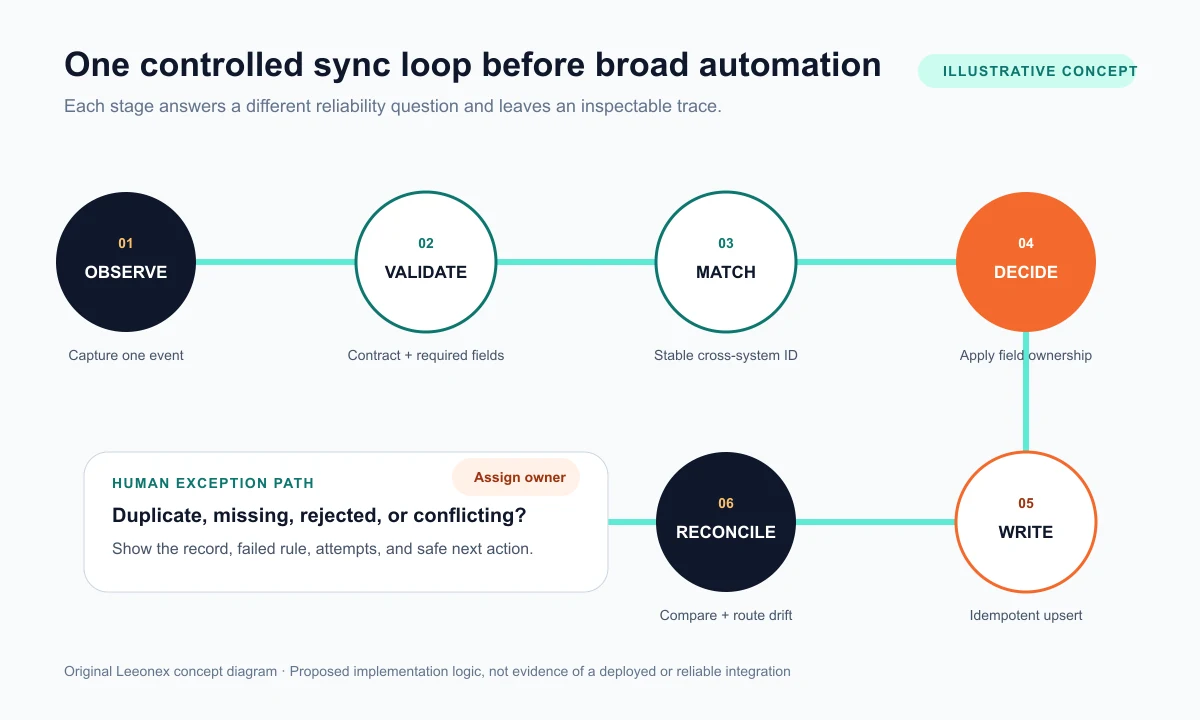
Choose one trigger, one record family, and one return status.
Version one can begin when an opportunity is marked ready for delivery. It validates required fields, resolves a stable customer and handoff identifier, and upserts one work order. Operations owns schedule and delivery state; the CRM receives a bounded, read-only status such as accepted, active, blocked, or complete.
The release also needs a dead-letter or exception queue, visible failure reasons, reconciliation, operator notes, replay controls, least-privilege credentials, and a runbook. Historical backfill, every CRM object, unrestricted notes, attachments, and arbitrary edits in both tools are not required to prove the first handoff.
Architecture decisions
Put a controlled integration boundary between the systems.
Webhooks can capture changes quickly, but they should enter a durable queue before external writes. A mapping and validation layer normalizes fields, an identity table stores cross-system keys, and an ownership policy decides which changes are allowed. The worker records every attempt and uses idempotency keys before it calls the destination API.
A scheduled reconciliation job compares the identifiers and owned fields that matter, rather than copying entire records back and forth. Monitoring should distinguish delayed, retrying, rejected, conflicted, and reconciled states. Secrets remain on the server, access stays least-privilege, and sensitive fields are excluded unless the handoff truly needs them.
Risks and guardrails
Duplicate delivery work and silent overwrites are product risks, not edge-case engineering details.
- Use immutable cross-system identifiers and explicit match rules; names and email addresses alone are not safe record keys.
- Assign one owner to every writable field and route true conflicts to a person instead of choosing the newest timestamp by default.
- Make each write idempotent so duplicate webhooks and retries do not create duplicate work orders or repeat side effects.
- Reconcile the systems on a schedule, expose failed and delayed states, and give an operator a controlled replay path.
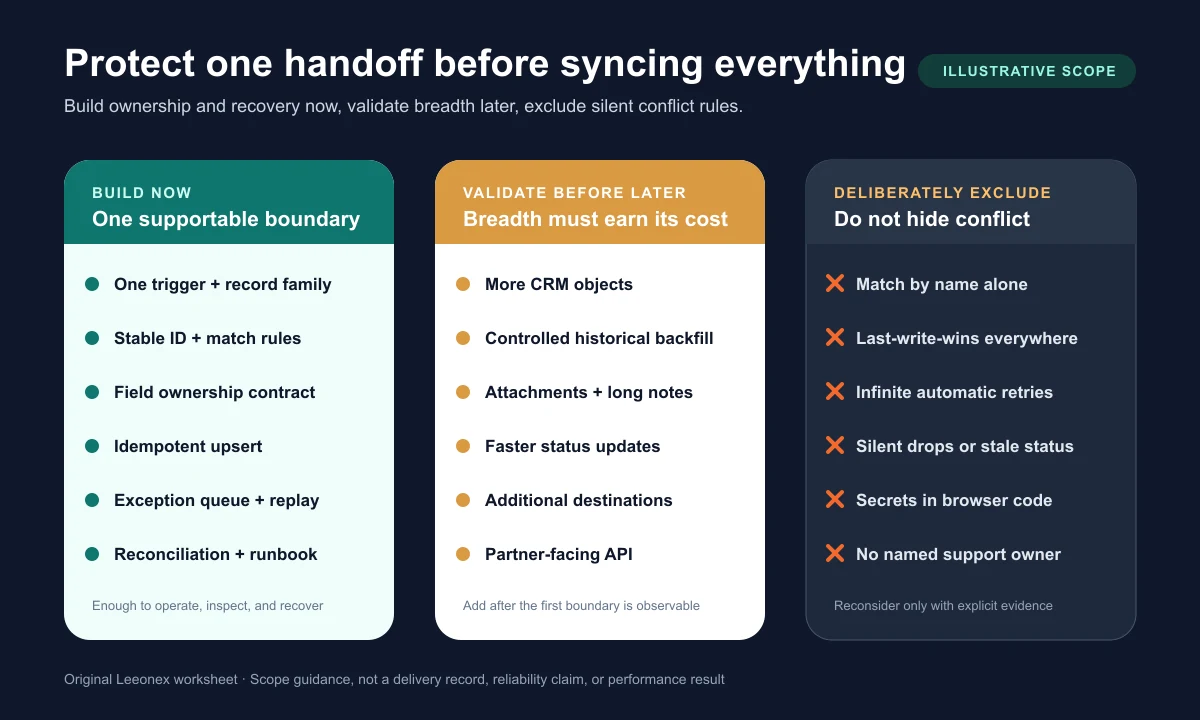
Build now, validate later
Add breadth only after the first boundary is supportable.
Build the trigger, contract validation, identity match, ownership rules, idempotent upsert, bounded status return, exception queue, reconciliation, monitoring, and runbook now. Validate more objects, faster status updates, controlled backfill, attachments, and additional downstream systems against real operating needs.
Deliberately exclude last-write-wins for every field, matching by name alone, infinite retries, silent drops, client-side secrets, and a launch with no named support owner. A one-way integration may be the better first release when ownership cannot yet be agreed.
Limitations and evidence boundary
This concept proves no integration reliability or operational outcome.
No connector was implemented or launched for this study. No client, sync accuracy, uptime, latency, throughput, time saving, duplicate reduction, adoption, revenue, or delivery improvement is claimed. The roles, stages, architecture, and guardrails are proposed scope decisions only.
Stronger claims would require an implemented integration, approved identity or anonymization, API contracts, test cases, field-ownership evidence, production logs, a reconciliation method, launch and operating windows, metric definitions, exclusions, a verifier, approved visuals, and publication permission.
Lessons and first consultation
Bring the broken handoff, not a list of endpoints.
The main lesson is that integration scope is a business ownership model expressed in software. These inputs make a first conversation concrete:
- The two systems, API documentation or sandbox access, and the business owner for each
- One handoff with representative normal, duplicate, late, changed, and cancelled records
- A field list showing which system creates, updates, or only reads each value
- Expected volume, acceptable delay, sensitive data, rate limits, and the failures that must alert a person
Explore Leeonex API and integration development for the closest service path. If this handoff is part of a larger spreadsheet replacement, start with the internal-tool decision guide. You can also return to the case-study hub to compare other evidence types and product decisions.
Have one fragile system handoff?