Answer first
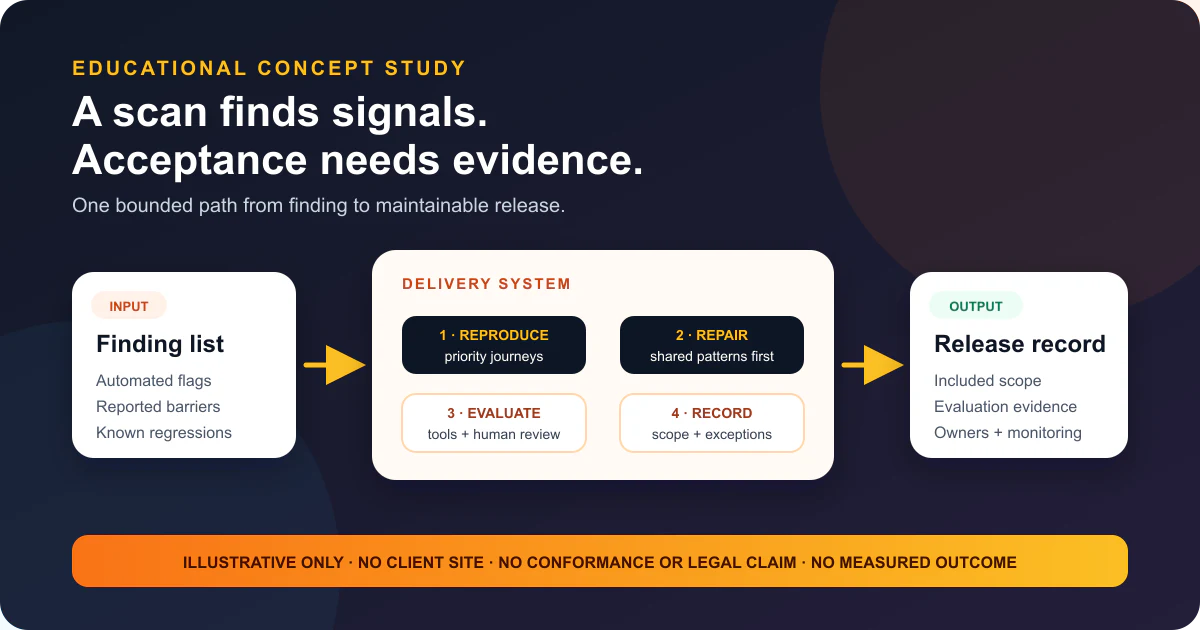
Scope accessibility remediation as a bounded release with several kinds of evidence—not as a race to a cleaner scan.
Start by naming the website, version, target, included pages and states, priority journeys, technologies, environments, evaluation methods, exclusions, and decision owners. Reproduce each important barrier in context. Repair shared components before patching every visible instance. Then combine automated regression checks with knowledgeable human evaluation of keyboard use, focus, zoom, content, forms, responsive states, and appropriately scoped assistive-technology use.
Release acceptance should record what was evaluated, when, by whom, with which methods and environments, what remains unresolved, who accepted each exception, and what will trigger another review. A score can help teams find and track some issues; it cannot carry the acceptance decision by itself.
This is an educational concept study, not a client story, accessibility audit, completed remediation project, certification, conformance report, or legal opinion. No company, website, disabled user, finding, repair, evaluation, release, improvement, or business result described here is real. The counts above describe the proposed model, not measured performance.
Illustrative discovery conversation — not a client quotation
“The scan is down to twelve issues. Can we call the site accessible?”
Illustrative website owner: “We fixed hundreds of flags and the score is much higher. We need a clear finish line before launch.”
Illustrative Leeonex response: “Which journeys, pages, components, states, environments, and user needs are in the claim—and what human evidence supports acceptance beyond the automated checks?”
Both voices are invented teaching examples. They are not a customer conversation, testimonial, audit finding, legal recommendation, or description of delivered work.
Starting situation and intended buyer
Imagine a company website that has grown through redesigns, campaign pages, CMS templates, embedded forms, a consent tool, videos, and scheduling widgets. An automated scan produces a long list. A support inbox contains a few specific complaints. The launch calendar is fixed, but nobody has agreed whether the work is a small component repair, a content program, a vendor problem, a design-system change, or a broader rebuild.
The intended buyer is a business owner, marketing leader, product owner, or website team responsible for improving an existing public site. They need a development plan that separates urgent barriers from noisy findings, fixes repeatable causes, and leaves a reviewable record without making claims the evidence cannot support.
This is not a recommendation to rebuild by default. A focused repair release may be appropriate when the templates and components are maintainable. A larger redesign may be justified when inaccessible behavior is embedded across the navigation, information architecture, design system, CMS, or third-party journey. The evidence should decide the boundary.
Constraints that should shape the remediation release
- The team may not know the complete barrier inventory at the start. The plan needs discovery capacity without leaving scope unlimited.
- Automated tools find useful signals, but some checks require human judgment and may produce uncertain or inaccurate results.
- A single component defect may appear on hundreds of pages, while one unscanned checkout, contact, or authentication state may block an important journey.
- Content owners, designers, developers, evaluators, vendors, and risk owners hold different parts of the decision. Engineering cannot silently absorb all of them.
- Third-party tools can sit inside critical journeys even when the website team cannot repair their source code.
- Applicable policies and legal duties vary. A development team should not invent the organization's target or issue legal assurances.
- The website can regress after release through content edits, component changes, new campaigns, plugins, or vendor updates.
Six roles make the decision boundary visible
Business or product owner
Defines the priority journeys, target, deadline, acceptable exclusions, and who can approve the release decision.
Accessibility evaluator
Defines a suitable evaluation approach, reproduces barriers, applies relevant expertise, records results, and names uncertainty.
Designer and developer
Trace findings to patterns, design and implement repairs, preserve semantic behavior, and add useful regression coverage.
Content and media owner
Owns headings, labels, link purpose, alternatives, transcripts, instructions, errors, and publishing governance.
QA and release owner
Maintains the environment matrix, verifies acceptance evidence, records exceptions, and prevents unreviewed scope changes.
Vendor or risk owner
Escalates third-party barriers, approves mitigation or replacement, records residual risk, and schedules review.
One person may hold several roles on a small site, but each decision should still name which authority they used. The developer who fixes a form should not automatically become the evaluator, policy owner, legal adviser, and risk approver.
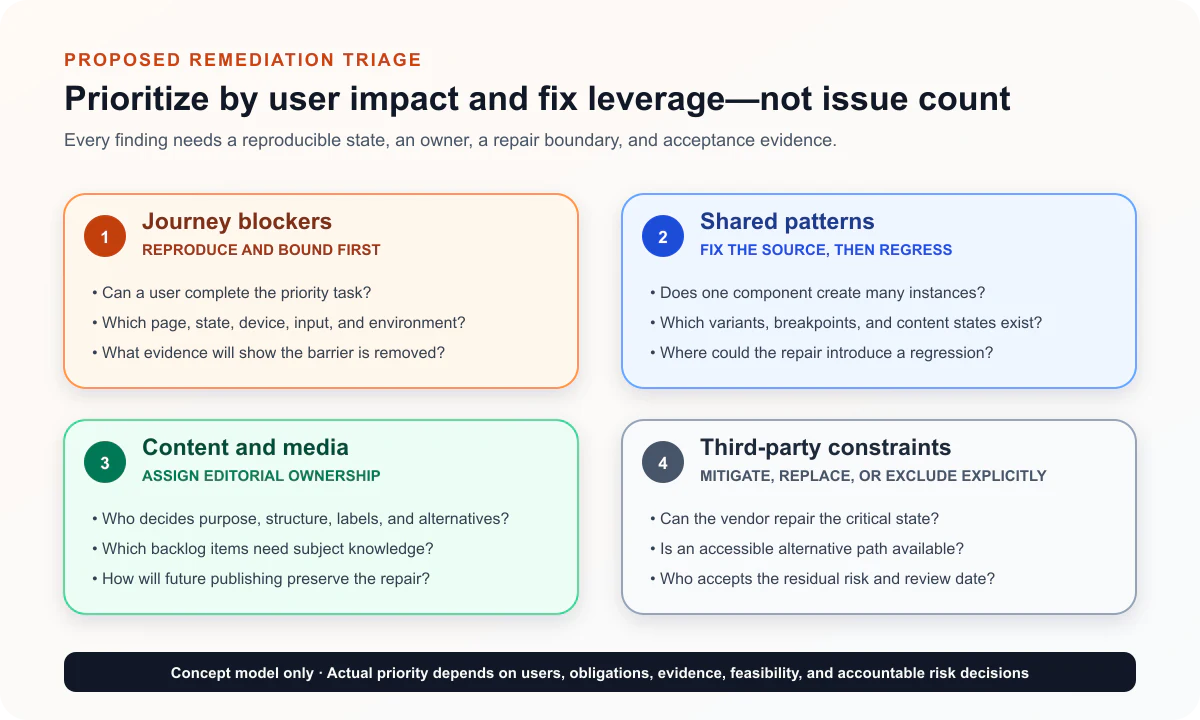
Triage findings into four different kinds of work
- Journey blockers: reproduce barriers that stop or materially disrupt a priority task. Record the route, state, input method, viewport, browser, assistive technology when relevant, expected behavior, observed behavior, and available workaround.
- Shared patterns: map repeated findings to the navigation, dialog, form field, accordion, card, media player, design token, or CMS template that creates them. Repair the source, then evaluate its variants and every priority journey that depends on it.
- Content and media: assign decisions that need subject knowledge—meaningful alternatives, heading structure, link purpose, instructions, transcripts, captions, error copy, and plain-language clarification—to accountable editors.
- Third-party constraints: separate what the team controls from consent, booking, chat, mapping, payment, or video tools. Seek a vendor repair, replace the dependency, provide an appropriate alternative, or record an explicit exception and review date.
Do not rank work by raw issue count alone. Combine severity in an actual journey, reach across templates, recurrence, affected user need, feasibility, legal or policy input, and the risk of the proposed change. The model does not provide a universal scoring formula because the accountable team must define those weights.
Define the smallest useful release as a scope contract
A remediation release becomes testable when the team can name its boundary. A practical first cut might include:
- the current production property and one identified release candidate rather than every microsite and historical campaign;
- a declared standard and level chosen by the accountable owner, plus the exact policy or contractual context if one applies;
- representative templates and all states inside two or three priority journeys, such as finding a service, submitting an inquiry, or booking a consultation;
- shared navigation, forms, dialogs, media, notifications, responsive states, keyboard behavior, zoom and reflow, and relevant third-party steps;
- named browser, device, viewport, input, and assistive-technology combinations appropriate to the scope and evaluation plan;
- automated checks, manual inspection, task-based evaluation, content review, exception handling, release records, and monitoring ownership.
Dynamic or very large sites may need a representative sample, but sampling is not permission to skip unique critical states. The sample should reflect templates, content types, functions, technologies, and priority journeys, with its selection logic recorded.
Build now, operate manually, and defer deliberately
| Decision | First release | Why |
|---|---|---|
| Build now | Repair priority-journey blockers and shared component causes; add focused regression checks; record release evidence. | This creates a complete learning and acceptance loop around the declared scope. |
| Operate manually | Review uncertain findings, content alternatives, third-party updates, and user feedback with named people. | Human judgment is part of the work and should not be disguised as missing automation. |
| Add after evidence | Broader component-library coverage, CMS authoring checks, more environments, and monitoring depth. | Expand where recurring defects or publishing patterns show the highest leverage. |
| Exclude explicitly | Certification, universal legal assurance, unsupported properties, and any claim not covered by the evaluation. | A smaller honest statement is more useful than an undefined promise. |
Implementation decisions should preserve meaning and traceability
Use native semantics before adding ARIA
Choose elements and interaction patterns that already express the required role, name, state, relationship, and keyboard behavior. Add ARIA only where it accurately completes semantics the platform does not provide.
Repair tokens and primitives before page patches
Contrast, focus visibility, spacing, target size, typography, field structure, and dialog behavior often belong in design tokens and shared primitives. Local overrides make future regressions harder to see.
Keep finding, code change, and evaluation evidence linked
A finding record should identify the affected journey and pattern. The implementation record should point back to it. Acceptance evidence should show which environment and method evaluated the repaired behavior.
Test states, not only routes
Empty, loading, error, validation, expanded, disabled, authenticated, responsive, and zoomed states can carry different barriers even when the URL is unchanged.
Treat content governance as part of the system
CMS fields, author guidance, validation, preview, and review responsibilities should make accessible publishing easier without pretending software can judge every alternative or instruction.
Keep third-party boundaries visible
Wrap or configure vendor tools where useful, but do not mask a dependency the team cannot repair. Track vendor versions, mitigations, alternatives, owners, and reassessment triggers.
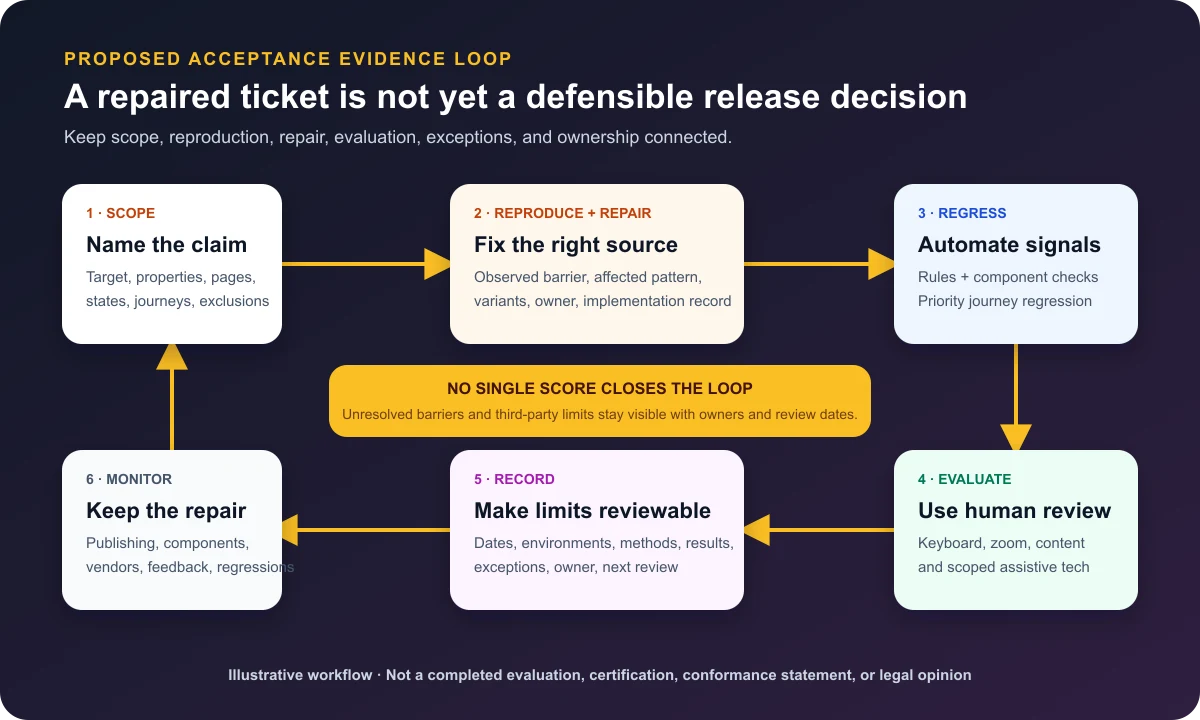
Acceptance evidence needs more than a passed ticket
For each priority barrier or pattern, keep a small, reviewable evidence chain:
- Scope: identify the property, version, journey, page or component, state, environment, target, and evaluation question.
- Reproduction: preserve observed behavior, expected behavior, steps, user impact, input and assistive technology when relevant, media, and uncertainty.
- Repair: link the design or code decision, files and components affected, content changes, known side effects, reviewer, and deployment version.
- Automated regression: run applicable rules and deterministic tests, recording the tool, version, configuration, environment, and result without converting “no flag” into a universal pass.
- Human evaluation: apply the defined manual, keyboard, zoom, responsive, content, task, and appropriately scoped assistive-technology methods with qualified judgment.
- Release record: state what passed within the defined scope, what remains open or excluded, who accepted it, dates, residual risks, monitoring owner, and next review trigger.
The exact evaluation plan should come from people with the relevant expertise. User involvement can expose practical barriers that technical conformance checks do not fully explain, but a small user session should not be relabelled as proof of complete conformance.
Risks and guardrails
Score chasing
Use scores to spot and monitor some issues. Never let a number replace a scoped evaluation or a priority user journey.
Overlay dependence
Do not assume a client-side widget repairs source structure, content, interaction, vendor states, or every user need.
Patch proliferation
Prefer a verified component or content-model repair over dozens of page-specific exceptions that drift apart.
Unqualified claims
Keep development acceptance separate from certification, legal compliance, and claims outside the evaluated scope.
Testing theater
Record environments, methods, expertise, dates, results, and limitations so a checklist cannot imply work that did not happen.
Post-launch regression
Give content, design-system, vendor, feedback, and release monitoring to named owners with specific review triggers.
Limitations and deliberately excluded claims
This concept does not show that any website is accessible.
- No real website, codebase, content, component library, third-party tool, user journey, or finding was evaluated or repaired.
- The four lanes and six steps are Leeonex-authored planning devices, not a standard, certification program, or universal evaluation methodology.
- WCAG conformance cannot be inferred from this article, its diagrams, an automated score, a partial sample, or a list of completed tickets.
- WCAG addresses many accessibility needs but does not address every user need. Real evaluation needs an appropriate scope, expertise, and methods.
- Leeonex is not claiming certification authority or providing legal advice here. Organizations should obtain qualified accessibility and legal guidance when their risk or public claim requires it.
- No claim is made about compliance, reduced legal risk, fewer barriers, faster delivery, lower cost, improved usability, conversion, traffic, leads, or revenue.
What evidence would permit a stronger story later?
A verified delivery story would need the approved project scope, site versions, target, page and state inventory, priority journeys, technologies, included and excluded properties, findings, tools and versions, evaluator identities and expertise, implementation records, dated automated and human evaluation results, unresolved exceptions, monitoring records, approved visuals, and permission to publish.
An outcome claim would need still more: a defined baseline, comparable end state, measurement window, source records, exclusions, attribution limits, independent review where appropriate, and approved wording. A higher score or smaller backlog would not by itself prove a better experience.
Lessons for a website owner
- Define the release claim before collecting evidence for it.
- Protect priority journeys and unique states from the false comfort of a whole-site average.
- Repair shared design, code, and content causes before chasing individual instances.
- Combine automation with knowledgeable human evaluation, and record the limits of both.
- Keep third-party barriers, exclusions, exceptions, and residual risk visible to the person authorized to decide.
- Treat accessible publishing and regression control as operating responsibilities after release, not as a one-time project phase.
What to bring to a first consultation
- the production URL and any staging or authenticated areas;
- the target standard, policy, contractual requirement, or public statement the accountable owner expects to support;
- priority audiences, tasks, journeys, page types, and dynamic states;
- current audit reports, automated outputs, user feedback, support records, and known workarounds—with sensitive data removed;
- CMS, framework, component library, hosting, analytics, forms, media, consent, scheduling, payment, and other vendor boundaries;
- release deadline, design constraints, content owners, technical owners, evaluator access, and who can approve exceptions;
- examples of recent regressions and how content or code currently reaches production.
A useful first outcome is not a promise of instant conformance. It is a clearer boundary: what must be evaluated, what can be repaired in the current system, where specialist review is needed, what evidence acceptance requires, and who owns the site after release.
Continue with the requirements and the right service
Use the website accessibility requirements checklist to define the broader target, journeys, workstreams, evidence, ownership, exceptions, and monitoring brief. If remediation sits inside a new or redesigned marketing site, explore Leeonex's company website development service. Return to the case-study hub for other clearly labelled educational build blueprints.
Standards and evaluation references used for this concept
The model is informed by the W3C Web Content Accessibility Guidelines 2.2, its web accessibility evaluation overview, the WCAG-EM overview, and WAI's evaluation report template. Those sources do not endorse this article, Leeonex, or the proposed delivery model.
Problem-aligned next step
Turn the current finding list into a bounded remediation release.
Share the site, priority journeys, known evidence, platform, vendors, deadline, target, and decision owners. Leeonex can help map the website-development scope and make the remaining specialist or legal dependencies explicit before implementation starts.
Discuss the remediation release