
The short answer: specify the exception path before the model
A useful AI document processing requirements document defines the business outcome, representative document families, structured output and source evidence, field-specific validation, human review authority, safe downstream writes, security controls, and post-launch ownership. OCR, rules, specialist extractors, or multimodal models are implementation choices inside that contract.
Start with one coherent document family and one useful outcome: for example, turn supplier invoices into reviewed draft records, not “automate accounts payable.” Name what remains manual and which action the system must never take without approval. This creates a pilot that can be accepted or rejected with evidence.
Observe
Keep source evidence
Route
Send uncertainty to an owner
Reconcile
Prove the system handoff
Define the complete workflow boundary
“Extract fields from PDFs” is a component task, not a production workflow. Documents arrive through email, upload, scan, API, or a shared folder. They may be duplicates, password-protected, incomplete, low-resolution, rotated, malicious, or the wrong type. After extraction, someone or something must validate the result, decide what to do, write to a system, and resolve mismatches.
| Boundary | Requirement question | Failure if omitted |
|---|---|---|
| Intake | Which documents, channels, and quality limits are accepted? | The system processes the wrong file or silently drops one |
| Interpretation | Which fields, tables, types, and source spans are required? | A plausible value cannot be verified |
| Decision | Which rules pass, route, reject, or escalate the record? | Confidence becomes an unsafe approval rule |
| Handoff | How is a reviewed result written, retried, and reconciled? | Duplicate or missing downstream records |
Map the current process before adding AI. The existing AI workflow automation readiness checklist helps confirm that the trigger, owner, decision, exception, and source systems are stable enough to automate. If people cannot agree on the correct output today, a model will not create a reliable operating rule for them.
Write requirements across six operating lanes
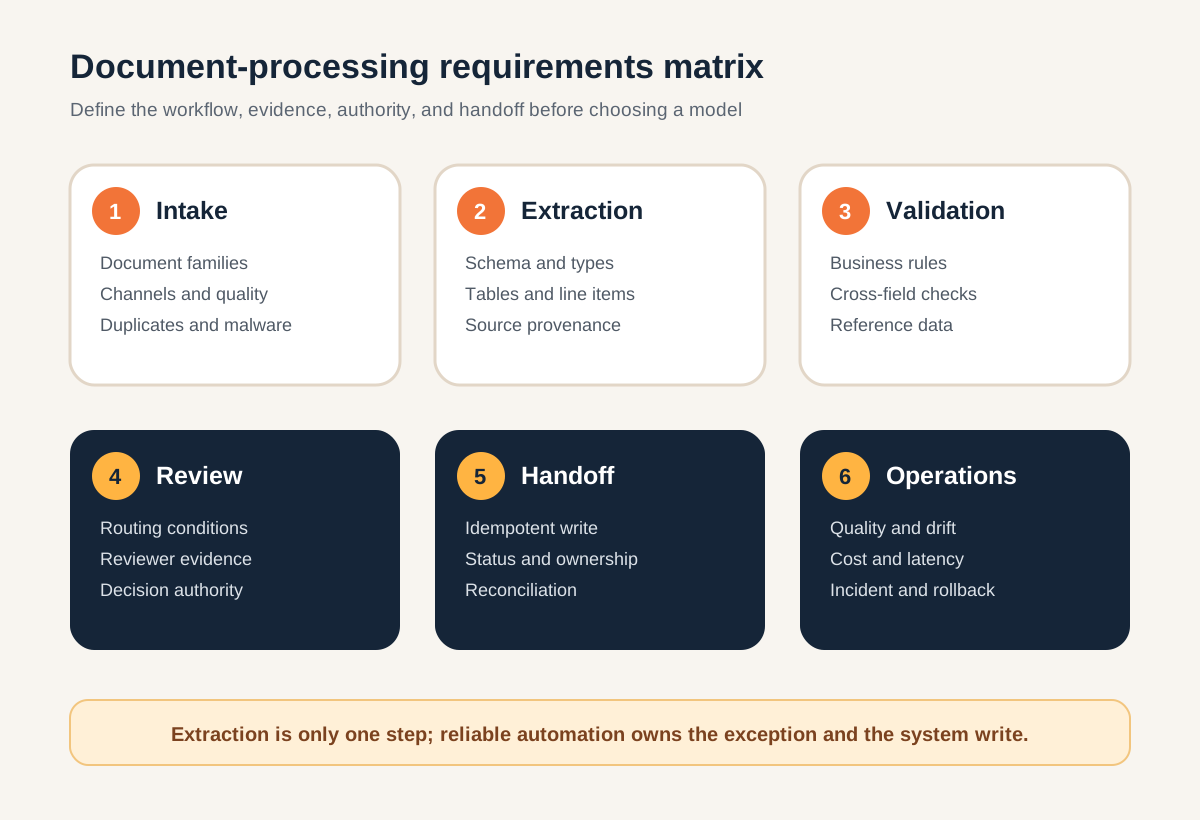
- Intake: document types, layouts, languages, page counts, digital and scanned files, handwriting, image quality, channels, duplicates, unsupported files, and security checks.
- Extraction: field names, types, required and optional states, tables, line items, normalization, units, null behavior, and page or bounding-box provenance.
- Validation: totals, dates, identifiers, reference data, allowed ranges, duplicate keys, cross-field rules, and differences that require a person rather than automatic correction.
- Review: routing conditions, evidence shown, reviewer roles, permitted actions, service expectations, escalation, corrections, notes, and an audit trail.
- Handoff: target system, status model, idempotency key, retry behavior, partial failure, attachments, reconciliation, and who owns records that cannot be written.
- Operations: quality sampling, drift checks, latency, cost, queue depth, vendor incidents, version changes, rollback, retention, and accountable business and technical owners.
Build a representative evaluation set before tuning
Collect documents that represent the population the system will actually receive, not only clean examples that demonstrate the happy path. Include ordinary layouts and material variations: scans, photos, skew, handwriting, multi-page tables, missing fields, ambiguous labels, duplicate submissions, unexpected currencies, and documents that should be rejected.
Keep the acceptance set separate from documents used to configure prompts, templates, rules, or custom models. Record the expected document class, field values, source locations, validation result, route, and downstream action. Then report errors per field and document family; a single page-level accuracy percentage can hide the one field that creates the costly mistake.
Vendor documentation supports this context-specific approach. Google Cloud's Document AI evaluation guide explains the precision-recall tradeoff when a confidence threshold changes. Microsoft notes that confidence is available at different extraction levels and that visually different documents can behave differently in its Document Intelligence guidance.
Measure the complete pilot
- Wrong, missing, and extra values by field
- Classification and rejected-document behavior
- Table and line-item structure
- Review rate and correction reasons
- Duplicate and retry behavior
- Downstream reconciliation failures
- Processing latency and queue age
- Cost per completed, accepted record
Design an evidence-preserving human review loop
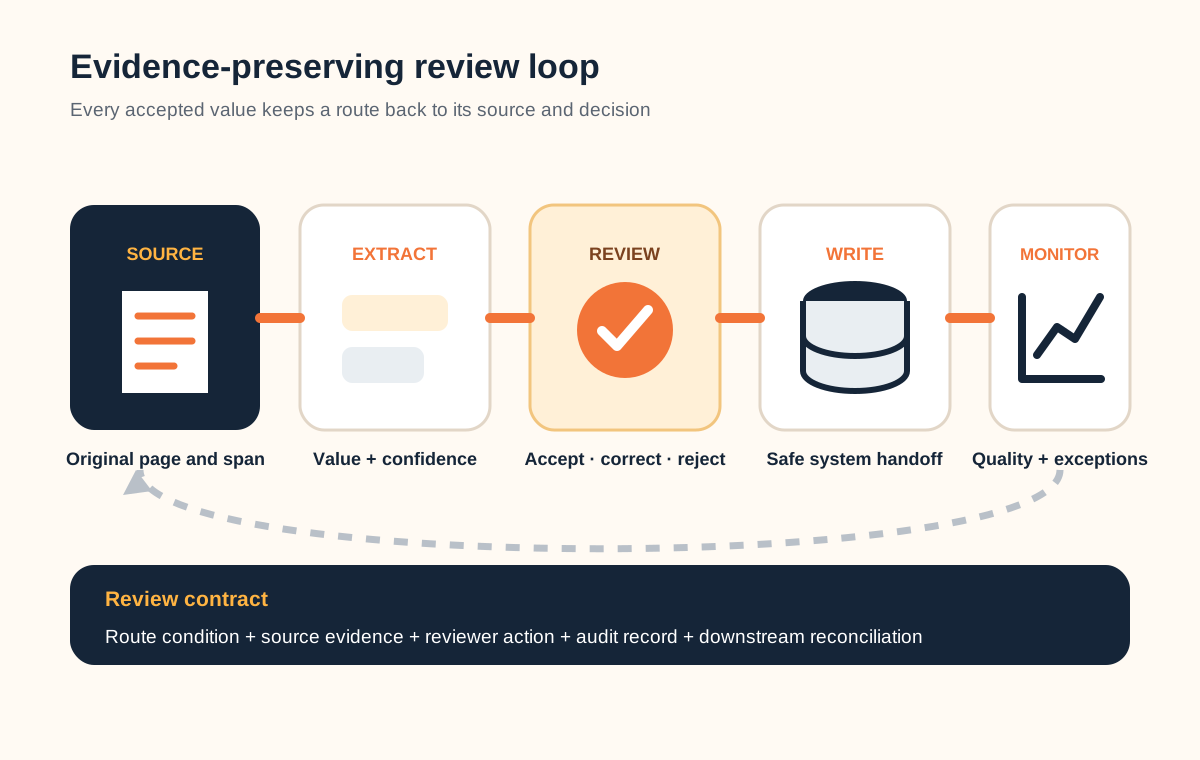
Confidence can help route work, but it is not authority. AWS tells users to choose thresholds from use-case sensitivity and to discard or increase scrutiny for results below the chosen boundary in its Textract best practices. A threshold should therefore be calibrated per field and document family on your evaluation set, then combined with deterministic business rules and the cost of error.
Show reviewers the proposed value beside the source page and highlighted span, plus the validation rule that failed. Let them accept, correct, reject, or escalate without leaving the queue. Record the original output, reviewer action, final value, actor, time, and downstream status. Corrections can improve evaluation and configuration, but they should not silently retrain or alter production behavior without change control.
NIST's voluntary AI Risk Management Framework Core treats governance, mapping, measurement, and management as continuing lifecycle activities. That is a useful operating model here: define human roles, document risk and assumptions, measure behavior, and keep a response path for model or vendor change.
Accept the workflow, not the extraction demo
A pilot passes when representative documents reach the correct final state with known error, review, cost, latency, and recovery behavior. Test the normal path and the edges: an unsupported file, duplicate upload, missing required field, low-confidence critical value, reviewer correction, target-system outage, retry, partial write, and reconciliation mismatch.
| Gate | Evidence | Decision owner |
|---|---|---|
| Document fit | Evaluation results by family and material variation | Process owner |
| Decision safety | Field risk, rule behavior, review routing, correction trail | Domain and risk owners |
| System integrity | Idempotency, retries, status transitions, reconciliation | Application owner |
| Operate | Queue, quality sampling, cost, alerts, incident and rollback runbook | Operations owner |
When the workflow writes to an ERP, CRM, storage platform, or another business system, use the API integration requirements checklist to define authentication, rate limits, retries, idempotency, observability, and ownership at that boundary.
Complete this document-automation requirements brief
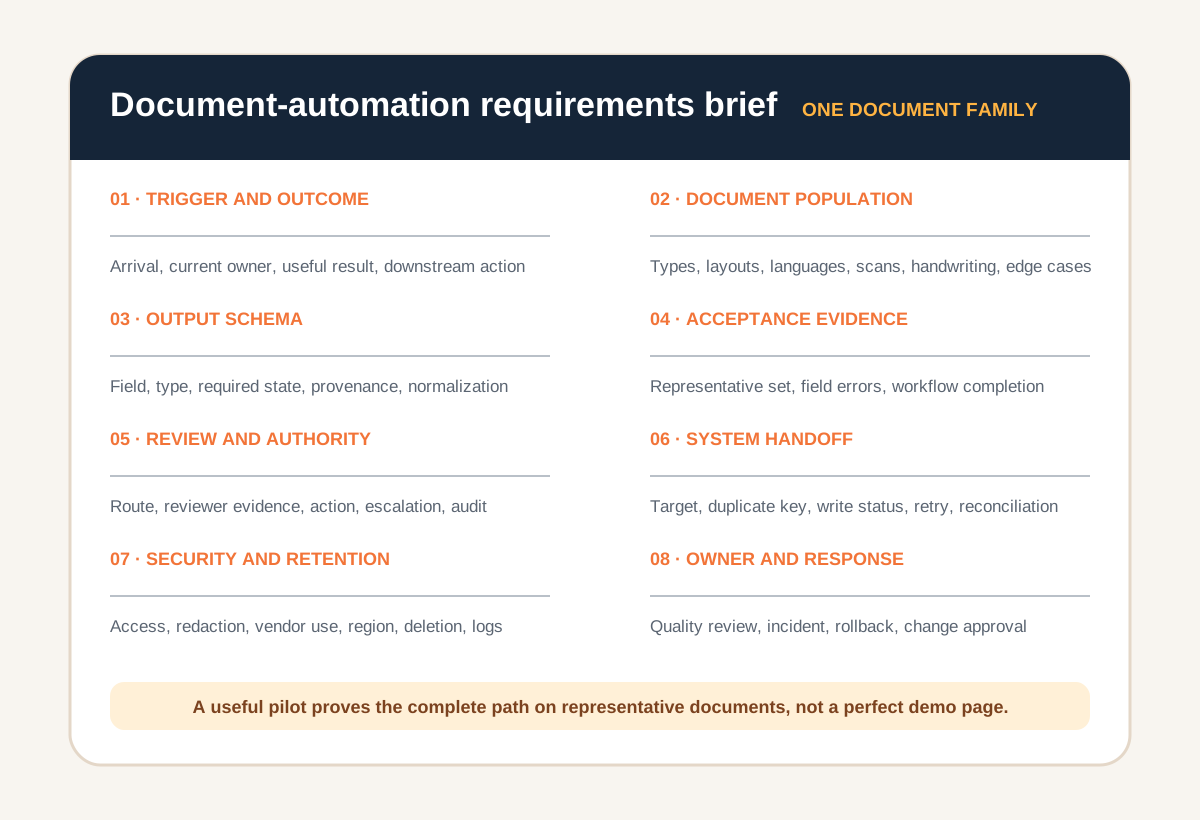
Complete one brief per coherent document family and business outcome. If invoices, contracts, identity documents, and customer emails have different schemas, risk, reviewers, and target systems, they are separate scopes even when one vendor can process all of them.
Leeonex's AI automation services can help map the current workflow, choose a bounded technical approach, build the review and integration path, and define a production-readiness gate. The smallest useful first version may be assisted review rather than straight-through automation; that is often the safer way to create evidence without hiding risk.
Frequently asked questions
What should AI document processing requirements include?
Requirements should define the workflow outcome, document families and intake conditions, output schema and source provenance, validation rules, field-specific acceptance evidence, exception and human-review paths, downstream write behavior, security and retention controls, monitoring, and accountable owners.
Should document automation use OCR, rules, or an AI model?
Choose after defining the behavior to prove. OCR may be enough for stable text capture, rules may validate known formats, specialist document models can extract common structures, and multimodal or language models may help with variable semantics. A hybrid is often appropriate, but every component should pass the same workflow acceptance gate.
What confidence score should trigger human review?
There is no universal safe threshold. Confidence is vendor- and model-specific, and the right route depends on field risk, document population, error cost, validation results, and reviewer capacity. Calibrate per field on representative documents, combine confidence with business rules, and retain review for costly or irreversible actions.
How do you test an AI document processing pilot?
Freeze a representative evaluation set that includes ordinary documents and meaningful edge cases. Measure field-level errors, missing and extra values, table or line-item behavior, exception routing, reviewer corrections, duplicate handling, downstream reconciliation, latency, and cost. Keep the set separate from examples used to configure the system.
When should document processing remain manual?
Keep the process manual or use a simpler assisted tool when volume is low, documents are highly variable, the output changes case by case, reviewers cannot define a stable decision, the downstream action is high risk, or the cost of building and operating the control loop exceeds the value of the bottleneck removed.