
Automate evidence handling before decision authority
AI lead qualification requirements should keep verified fit, stated intent, observed engagement, inferred information, missing evidence, and the final human decision separate. Start by using AI to extract, normalize, summarize, and identify gaps. Grant routing or CRM write authority only where policy, confidence, recovery, and monitoring are explicit.
A lead score is not the workflow. The workflow begins when an inquiry arrives and ends when the right owner receives enough evidence to act, the contact receives an appropriate response, and the CRM records what happened. A faster wrong rejection or duplicate opportunity is not an improvement.
If the intake itself is unreliable, begin with the website lead form requirements checklist before adding qualification. Durable receipt, validation, consent context, deduplication, and an owned follow-up path are prerequisites, not downstream cleanup.
Turn sales policy into an evidence ladder
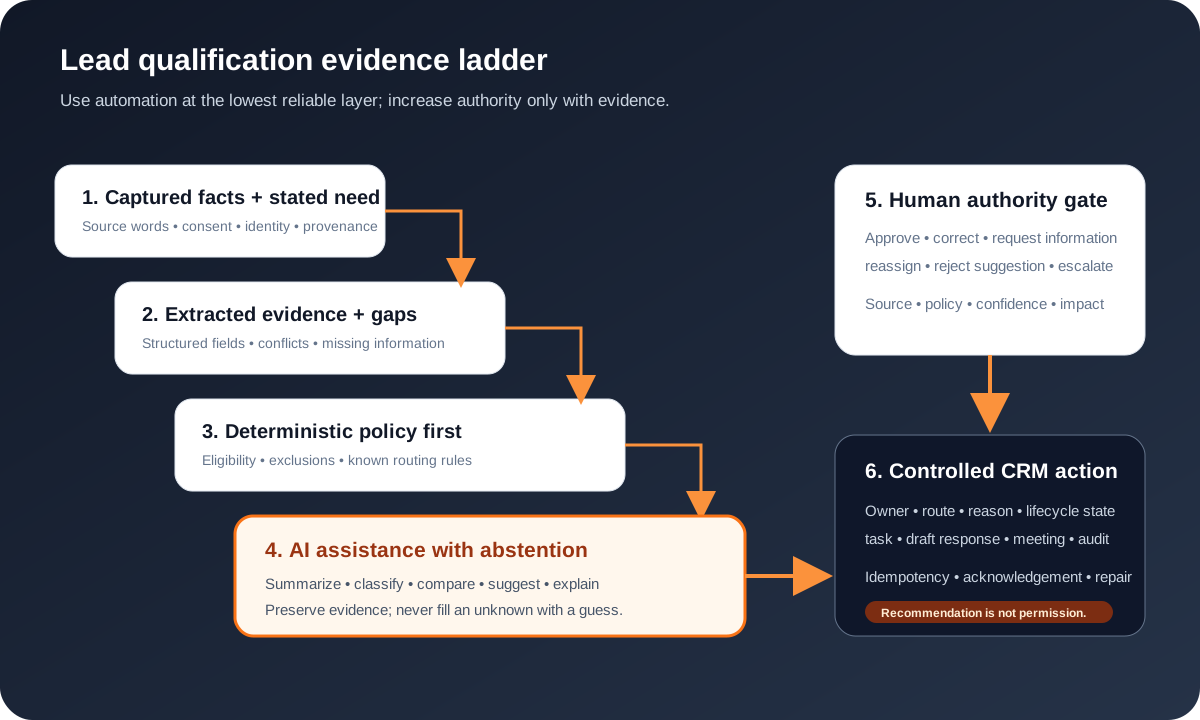
Write qualification policy without AI first. For every route, define eligibility, positive fit, exclusions, intent, readiness, missing-information behavior, owner, response, and permitted CRM transition. Name evidence that can support each criterion and whether it comes from the person, an internal system, an approved enrichment source, or a model inference.
Keep fit and engagement visible separately. HubSpot's current lead-scoring documentation distinguishes fit scores based on properties from engagement scores based on actions, with combined scores available as a separate view. That separation is useful even if you use another CRM: a suitable company that is not ready now is a different case from a highly active contact outside the business's service boundary.
Version the policy, prompts, structured output schema, examples, threshold, and action mapping together. Store the source evidence, policy version, model or rule version, output, confidence or abstention, reviewer decision, CRM write, and correction. Historical labels can reflect inconsistent selling, capacity limits, or past bias; treat them as evidence to review, not truth to reproduce automatically.
Cover the lanes that make qualification operational
Intake and identity
Forms, inboxes, chat or calls, stable IDs, duplicate and merge rules, company/contact association, language, consent, source, attachments, and malicious input.
Evidence and enrichment
Authoritative fields, provenance, freshness, allowed providers, unsupported inference, missing data, conflict handling, retention, and deletion.
Policy and assistance
Fit, exclusions, intent, readiness, extraction schema, deterministic rules, model role, confidence, abstention, explanation, and versioning.
Review and routing
Queues, owner, priority, service level, approve, correct, request information, reassign, disqualify reasons, override, escalation, and appeal or recovery.
CRM and communication
Field mapping, lifecycle transitions, write permissions, idempotency, task and meeting creation, response approval, templates, suppression, and audit history.
Evaluation and operations
Truth set, edge cases, segment checks, extraction accuracy, unsupported claims, routing quality, latency, review load, drift, incidents, rollback, support, and change control.
State scale in business units: inquiries per channel and day, peak bursts, languages, fields and attachment sizes, duplicate window, enrichment calls, model requests, review queue, response target, CRM writes, retry horizon, retained evidence, and support hours. Separate a fast acknowledgement from a completed qualification decision.
Define the CRM boundary before connecting the model
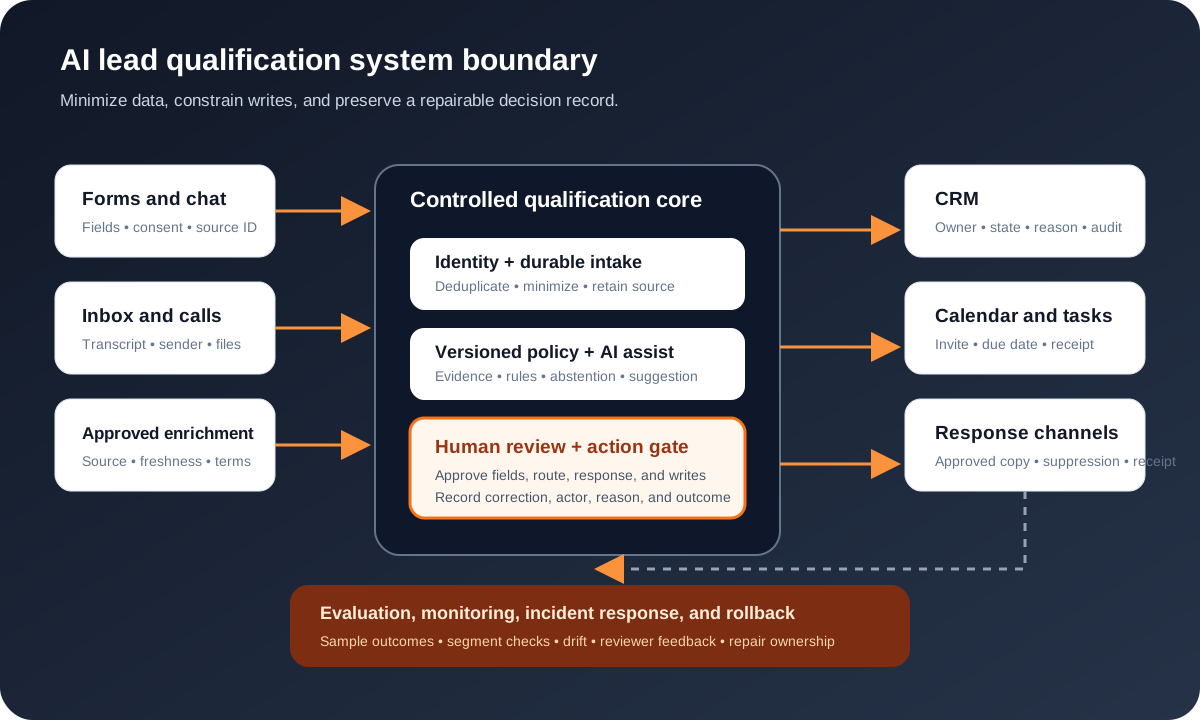
Decide which system owns the raw inquiry, contact identity, company, consent, account relationship, lifecycle stage, owner, score, qualification reason, activity history, meeting, and opportunity. The AI layer should receive only needed fields and should not become an accidental system of record through hidden prompts, logs, or vector stores.
For every boundary define field mapping, direction, trigger, authorization, data minimization, freshness, deduplication, correlation ID, retry, rate limit, timeout, partial success, dead-letter or review queue, reconciliation, and repair owner. Keep an immutable decision record while allowing ordinary CRM fields to be corrected through normal governance.
If the process spans several inboxes, forms, enrichment tools, CRM workflows, and schedulers, the AI workflow readiness checklist helps test whether the underlying process is stable enough to automate. Use deterministic rules when they resolve the case; reserve model assistance for unstructured language or ambiguity that genuinely needs it.
Evaluate decisions in context, then monitor the live path
Create a versioned evaluation set from approved, de-identified or safely handled examples covering common inquiries, missing fields, conflicting evidence, multiple services, existing accounts, spam, unsupported regions, sensitive data, prompt injection, ambiguous intent, and valuable edge cases. Record the expected extraction, route, abstention, review need, and action.
Measure field extraction accuracy, unsupported claims, evidence citation, correct abstention, route agreement, harmful false rejection, duplicate and CRM write behavior, latency, cost, review time, reviewer disagreement, integration recovery, and segment-level differences relevant to your operation. Downstream meetings and wins can inform review, but they arrive late and are affected by sales execution and capacity.
The NIST AI Risk Management Framework calls for contextual evaluation, documentation, privacy and bias examination, safe failure, monitoring, and feedback channels. Translate that into named owners, alert thresholds, sampled review, rollback, incident handling, change approval, and a way for staff to report wrong or harmful outcomes.
Use this controlled qualification pilot worksheet
- Choose one route: one inquiry source, one offer, one receiving team, and one outcome worth improving.
- Write policy: fit, exclusions, intent, readiness, required evidence, missing-data behavior, and human authority.
- Map records: source fields, provenance, CRM owner, permitted reads and writes, duplicate keys, and retention.
- Bound AI: extraction schema, allowed tools, confidence, abstention, review triggers, prompts, versioning, and fallback.
- Build the truth set: representative and edge cases, expected outputs, reviewers, disagreement process, and pass conditions.
- Release gradually: shadow, assist, approve, then automate only narrow actions that earn authority through evidence.
Leeonex's AI workflow automation service can help scope the deterministic rules, model-assisted steps, human checkpoint, CRM integration, and evaluation plan as one bounded system rather than a stand-alone scoring prompt.
AI lead qualification requirements FAQ
What should AI lead qualification requirements include?
Include intake channels, identity and duplicate handling, consent and data provenance, fit and exclusion policy, intent and readiness evidence, extraction and scoring behavior, confidence and abstention, human-review triggers, routing, response rules, CRM fields and permissions, replay protection, evaluation datasets, outcome feedback, monitoring, privacy, security, support, and rollback.
What is the difference between lead scoring and lead qualification?
Lead scoring assigns values or categories from selected fit and engagement signals. Qualification is the wider decision process: verify what is known, identify missing evidence, apply sales policy, choose a route, obtain human confirmation where needed, and record the outcome. A score can inform qualification without being the decision itself.
Should AI automatically reject or disqualify leads?
Usually start with prioritization, summarization, missing-information requests, or a review queue. Automatic rejection is harder to justify because data may be incomplete, model output may be wrong, and the business may lose a valuable or sensitive inquiry. If any automatic action is allowed, define narrow policy, evidence, confidence, appeal or recovery, audit history, monitoring, and accountable ownership.
How should an AI lead qualification workflow be evaluated?
Use a versioned set of representative and edge-case inquiries with approved expected routes. Measure extraction accuracy by field, unsupported claims, correct abstention, routing outcomes, review load, CRM write correctness, duplicate behavior, latency, failure recovery, and performance across relevant segments. Monitor downstream outcomes, but do not treat historical conversion labels as unquestionable truth.