
The short answer: cost follows the delivery boundary
Custom software cost is driven by the complete behavior a team must understand, design, build, test, release, and support—not by a generic price per screen. A defensible estimate names the first-release boundary, assumptions, exclusions, delivery pressures, confidence level, and evidence that will change it.
That is why an honest early answer is often a range. Two projects called “a customer portal” can differ materially when one has a single role and clean data while the other needs delegated permissions, legacy migration, real-time billing, audit evidence, and a no-downtime cutover.
Boundary
What release is being priced?
Pressure
What makes delivery harder?
Confidence
Which assumptions are tested?
Describe eight cost-driver lanes
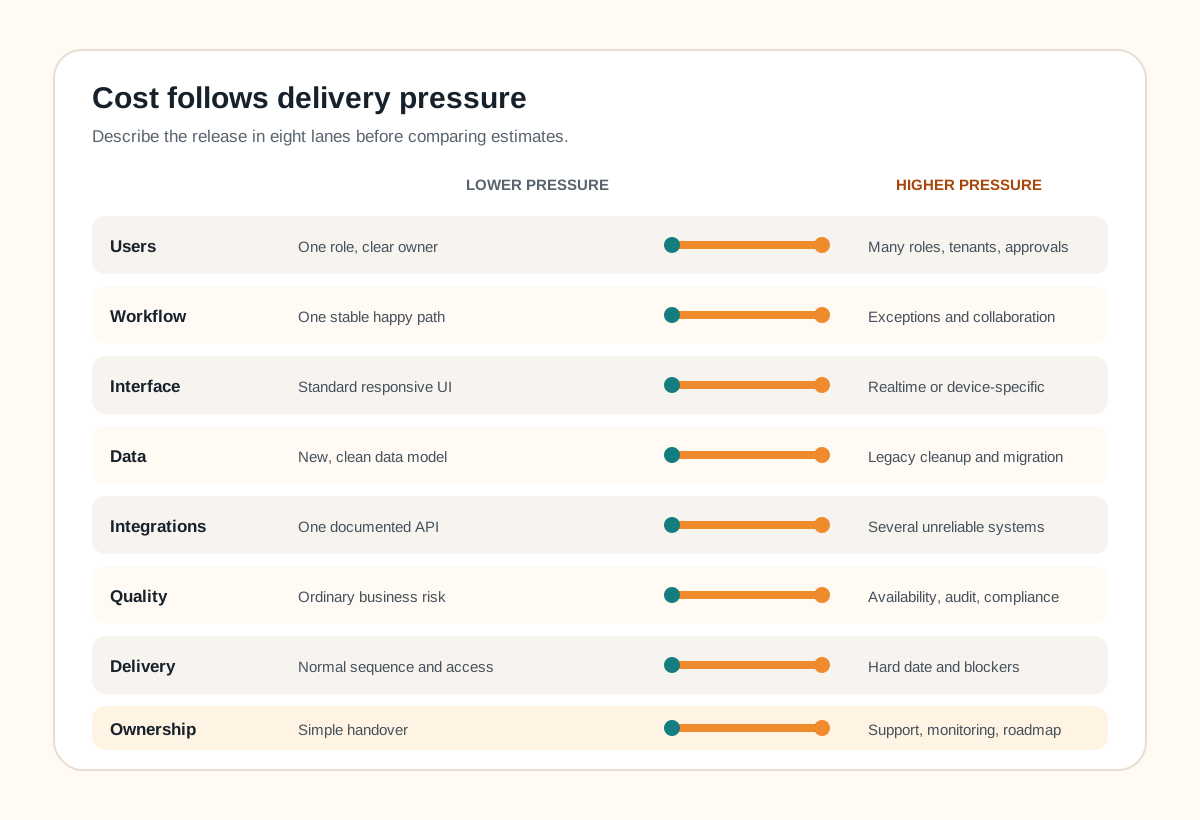
| Lane | Lower pressure | Higher pressure |
|---|---|---|
| Users | One role and clear owner | Many roles, tenants, approvals |
| Workflow | One stable happy path | Exceptions, queues, collaboration |
| Interface | Standard responsive UI | Dense, realtime, device-specific UX |
| Data | New or clean small dataset | Legacy model, cleanup, migration |
| Integrations | Documented managed API | Several systems, weak sandbox, sync |
| Quality | Ordinary business risk | High availability, audit, compliance |
| Delivery | Normal sequence and access | Hard date, parallel platforms, blockers |
| Ownership | Simple launch and handover | Monitoring, support, roadmap, SLAs |
Score each lane low, medium, or high and add a one-sentence reason. This is not a pricing formula. It is a conversation tool that exposes where discovery, technical spikes, specialist review, or contingency may be justified.
Feature lists miss expensive behavior between screens: who may change a record, what happens when a provider is unavailable, how an old identifier maps to a new model, and which evidence proves a release is acceptable. Capture those rules as testable scenarios.
A hypothetical example: “customer upload” is not one scope
In a lower-pressure release, one authenticated account owner uploads a small CSV, reviews validation errors, and confirms the import. In a higher-pressure release, delegated users upload large files containing sensitive records while background jobs deduplicate customers, preserve relationships, notify several roles, update a third-party system, and produce an audit trail. The visible request sounds similar; the delivery boundary is not.
A useful estimate writes the accepted version as scenarios and names the limits: file types and size, roles, validation, duplicate policy, processing time, failure recovery, integration behavior, evidence, and support ownership. If those choices are open, show them as assumptions or options rather than pricing the most convenient interpretation silently.
Match estimate precision to evidence
The U.S. Government Accountability Office describes reliable cost estimates as comprehensive, well documented, accurate, and credible. Its software guidance also notes that iterative delivery creates opportunities to refine estimates as teams learn what users need. That principle scales down: document the basis, state uncertainty, and update the forecast when evidence changes.
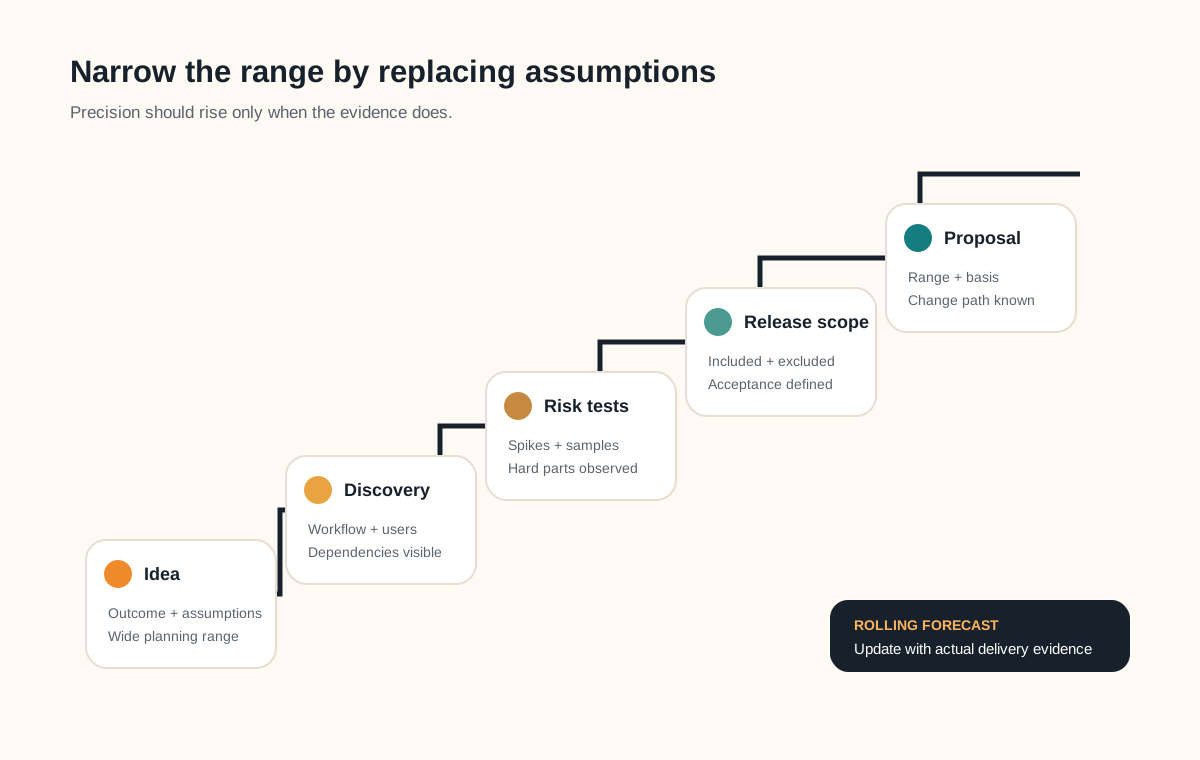
- Planning range: outcome, rough boundary, material unknowns, and explicit confidence.
- Discovery forecast: mapped workflow, roles, data, dependencies, constraints, and prioritized release.
- Delivery proposal: acceptance evidence, responsibilities, assumptions, exclusions, governance, and change path.
- Rolling forecast: actual progress, discovered complexity, decisions, and updated remaining work.
A technical spike is useful when one risk could change the architecture or estimate: an undocumented legacy interface, offline behavior, large migration, unusual permission rule, or AI evaluation requirement. Fund the smallest experiment that can replace an important assumption with evidence.
See the official GAO Agile Assessment Guide and Cost Estimating and Assessment Guide for the underlying estimating and monitoring principles.
Normalize proposals before comparing totals
Put every proposal on the same comparison sheet. Check the included roles and capacity, discovery and design, environments, data migration, integrations, content, test coverage, security review, infrastructure, launch, warranty or support, handover, and taxes or third-party fees. Record buyer responsibilities and dependencies beside the price.
Comparison rule
Compare the same outcome, release boundary, evidence, responsibility split, operating period, and uncertainty—not two totals with the same project label.
Also separate the estimate from the commercial model. A fixed price, time-and-materials engagement, or phased approach changes how uncertainty and change are governed; it does not make the underlying work disappear. Use the fixed price versus time and materials guide to choose that control model after the cost boundary is visible.
Reduce cost by shrinking uncertainty and ownership
- Keep one complete workflow. Remove secondary roles and variants before removing the evidence that makes the release useful.
- Buy commodity capabilities. Use managed auth, payments, messaging, search, or infrastructure where the fit and ownership tradeoff are sound.
- Prepare data early. Profile sources, remove avoidable cleanup, and define migration acceptance before developers discover it during launch.
- Answer product questions quickly. A named owner and regular review cadence prevent waiting and rework.
- Test the expensive unknown. Resolve the integration, device, performance, or model-quality risk before committing to the surrounding build.
Do not “save” by quietly deleting security, accessibility, testing, monitoring, or recovery controls the real system needs. Instead, narrow the product boundary until the required quality fits the available investment.
Complete this estimate input brief
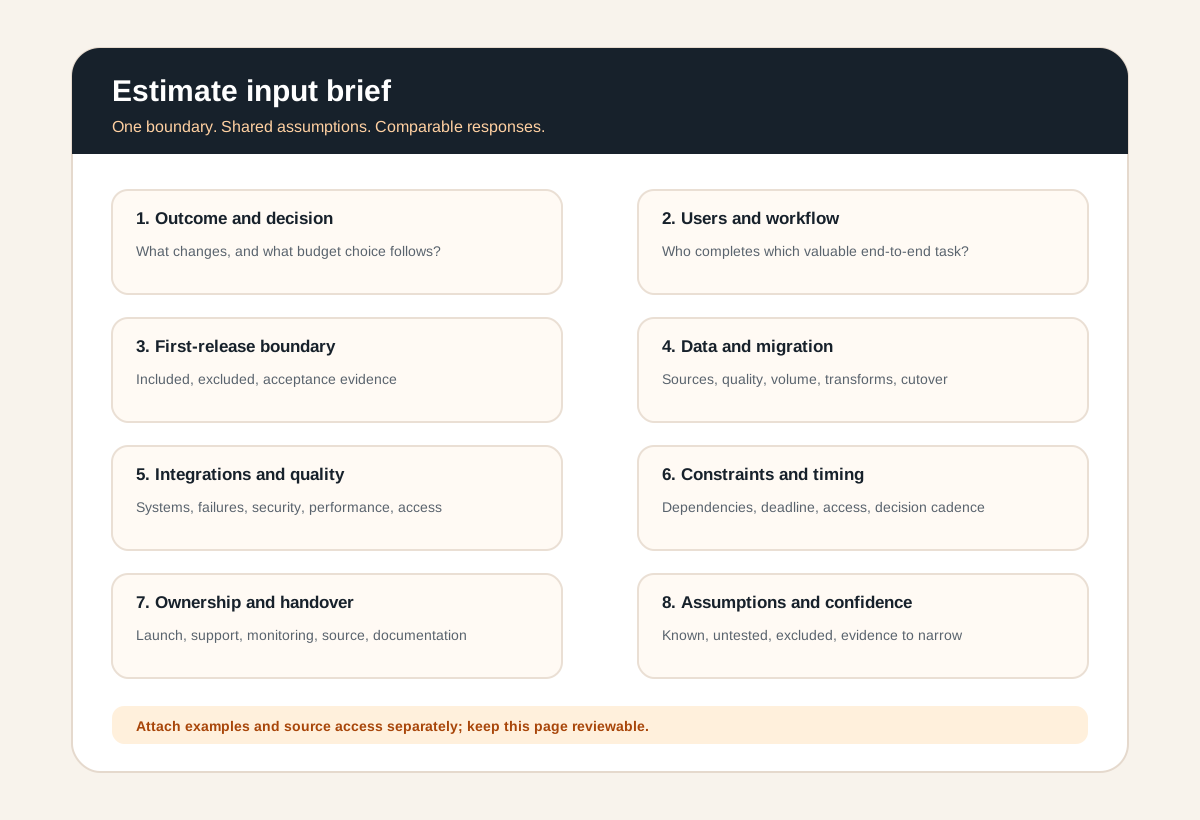
Write one page covering the business outcome, users, current process, essential release, explicit exclusions, data sources, integrations, quality constraints, deadline or sequencing need, buyer responsibilities, post-launch owner, known assumptions, and the decision this estimate must support. Attach examples and source access separately.
If the boundary is still disputed, run a focused software discovery phase. If several partners will quote, use the software development RFP checklist so each responds to the same problem and evidence requirements.
Custom software cost FAQ
What factors affect custom software development cost?
The main factors are the number and variety of users and workflows, interface depth, data model and migration work, third-party integrations, security and quality requirements, platform and release constraints, delivery uncertainty, and post-launch ownership. The cost is shaped by the behavior and evidence required, not simply by screen or feature count.
Can a custom software project be estimated before discovery?
It can receive a broad planning range if the outcome, users, first-release boundary, assumptions, exclusions, dependencies, and confidence level are explicit. A delivery commitment should usually follow enough discovery or technical testing to expose material workflow, data, integration, migration, security, and operational risks.
Why do software estimates from different vendors vary so much?
Proposals may price different scope boundaries, quality levels, roles, delivery models, assumptions, risk allowances, launch responsibilities, and support periods. Normalize those items before comparing totals. A lower figure is not comparable when it excludes discovery, design, testing, migration, infrastructure, project control, or handover that another proposal includes.
Should a software estimate be a fixed number or a range?
Use a range when important uncertainty remains and state what evidence would narrow it. A fixed amount is more credible for a bounded deliverable with explicit acceptance, dependencies, buyer responsibilities, exclusions, and change rules. Precision should reflect evidence rather than sales confidence.
How can a buyer reduce custom software cost safely?
Reduce the first release to one complete valuable workflow, reuse suitable managed capabilities, postpone unsupported roles and edge cases, test risky integrations early, clean migration data before engineering, provide fast product decisions, and define launch evidence. Do not cut the quality controls needed for the system's actual risk.