
Define trustworthy retrieval, not a smarter search box
A useful enterprise search software requirements checklist defines which work the search product supports, which sources it can inspect, whose permissions apply, how quickly changes and deletions propagate, how results are ranked, what evidence an AI answer must cite, and who can detect and repair a bad outcome.
Cover user tasks, source inventory, connectors, object identity, metadata, content extraction, identity mapping, document-level access, freshness, deletion, keyword and semantic retrieval, filters, citations, administration, audit history, evaluation, observability, cost, and failure recovery. Then test every option against the same queries and the same forbidden-result cases.
Write a search contract before choosing technology
Pick one consequential search task: finding the current customer agreement, locating an approved operating procedure, researching an incident, or identifying the owner of a product decision. Record the user role, source systems, permitted scope, expected evidence, freshness requirement, forbidden exposure, next action, and accountable owner. Include one ambiguous query and one query that should return nothing.
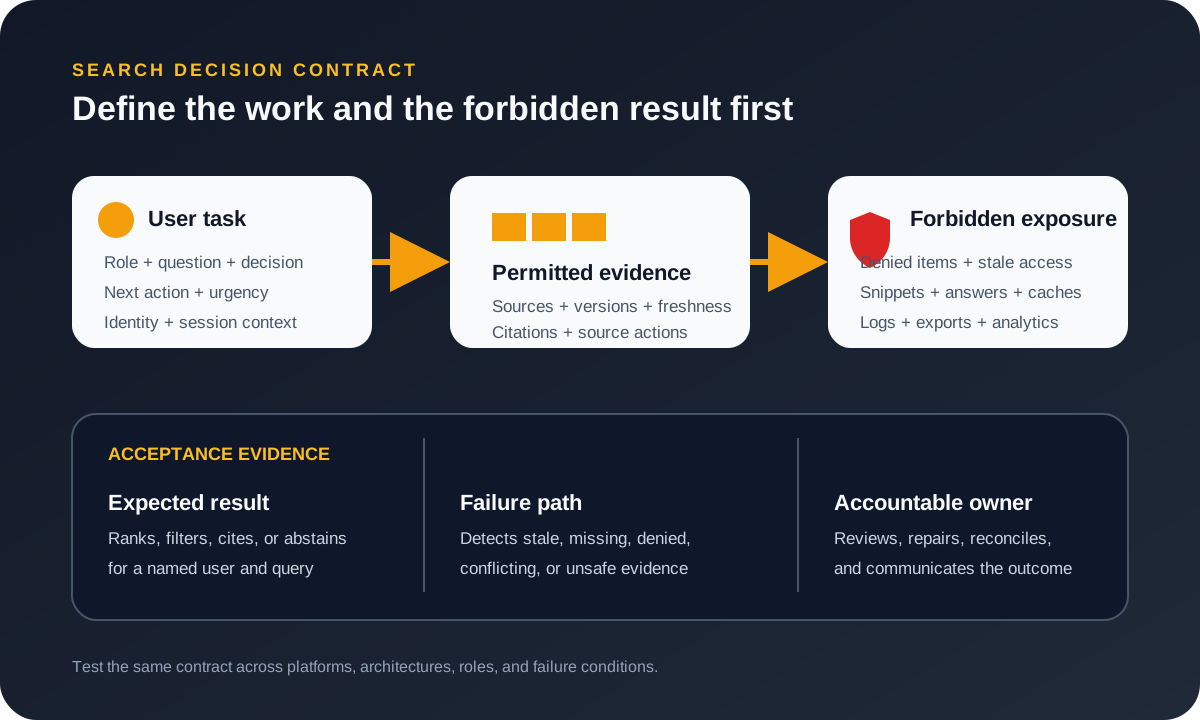
The contract prevents a polished demo from hiding a weak product boundary. A result can be relevant but obsolete, authoritative but forbidden, current but duplicated, or well cited but useless for the next action. Score these dimensions separately rather than compressing them into one vague “accuracy” measure.
Use the software acceptance criteria checklist to turn each contract into observable scenarios. Search quality should be a release gate with named evidence, not a subjective review after the connectors are already live.
Cover the requirement lanes that make search operable
Users and tasks
Roles, recurring questions, decisions, source expertise, languages, accessibility, result actions, escalation, and unacceptable mistakes.
Sources and connectors
Repositories, object types, APIs, change feeds, attachments, scans, structured fields, source links, rate limits, ownership, and connector support.
Identity and permissions
SSO identity, source accounts, groups, guests, nested membership, sharing links, tenant boundaries, deny rules, revocation, and service credentials.
Retrieval and presentation
Exact match, keyword, semantic and hybrid search, filters, facets, synonyms, spelling, dates, versions, snippets, source labels, and result actions.
AI answer behavior
Eligible tasks, citations, source preview, conflicting evidence, insufficient evidence, prompt injection, model fallback, latency, feedback, and abstention.
Operations and governance
Administration, connector health, sync history, schema changes, lifecycle reconciliation, analytics, audit, export, retention, support, cost, and incident response.
“Supports SharePoint, Slack, and Drive” is not enough. For every connector, specify supported object types, historical depth, incremental update method, attachment handling, metadata and link preservation, permission semantics, retry behavior, rate limits, deletion handling, diagnostics, and the owner who repairs it when the source changes.
Preserve permissions through every copy and transformation
Search often copies source content into parsers, chunks, indexes, embeddings, caches, analytics, evaluation sets, and answer histories. Authorization must govern every surface. Microsoft’s current Graph connector documentation says external content can carry access-control entries and that connectors must honor source permissions, including external group models. That is a useful design baseline even when using a different platform.
Treat identity mapping and permission sync as product data. Name what happens when a user cannot be mapped, a group is nested, a source denies access, a shared credential is used, a document is moved, or membership is revoked. NIST’s Zero Trust Architecture centers protection on resources and explicit authentication and authorization rather than network location; a search interface behind SSO does not replace item-level enforcement.
Define measurable propagation expectations for new content, edits, permission changes, and deletions. Test the most dangerous delay: a person loses access in the source while a copy, snippet, citation, generated answer, cache, log, or export remains available. Keep an evidence trail that explains which identity, policy snapshot, sources, and retrieval path produced a result.
Evaluate retrieval before evaluating generated answers
Build a judged query set from real work: exact names, acronyms, broad concepts, current policies, old versions, conflicting sources, misspellings, known-item lookups, no-answer cases, and queries whose correct result differs by role. Record which items should appear, which must not, the acceptable freshness, and the action the user should be able to take.
If the product generates answers, grade source coverage, permission safety, citation support, conflict handling, and abstention before writing style. The RAG versus fine-tuning guide explains why retrieval and model behavior are separate choices. OWASP’s prompt-injection guidance also notes that RAG does not remove prompt-injection risk, so retrieved content must remain untrusted input rather than hidden instructions the system automatically obeys.
Keep raw retrieval evidence available beside any synthesis. A generated answer should show inspectable sources, distinguish current and superseded material, surface disagreement, and say when evidence is insufficient. Never let the model become the permission engine, records authority, or final approver for a consequential business action.
Assign authority across ingestion and query paths
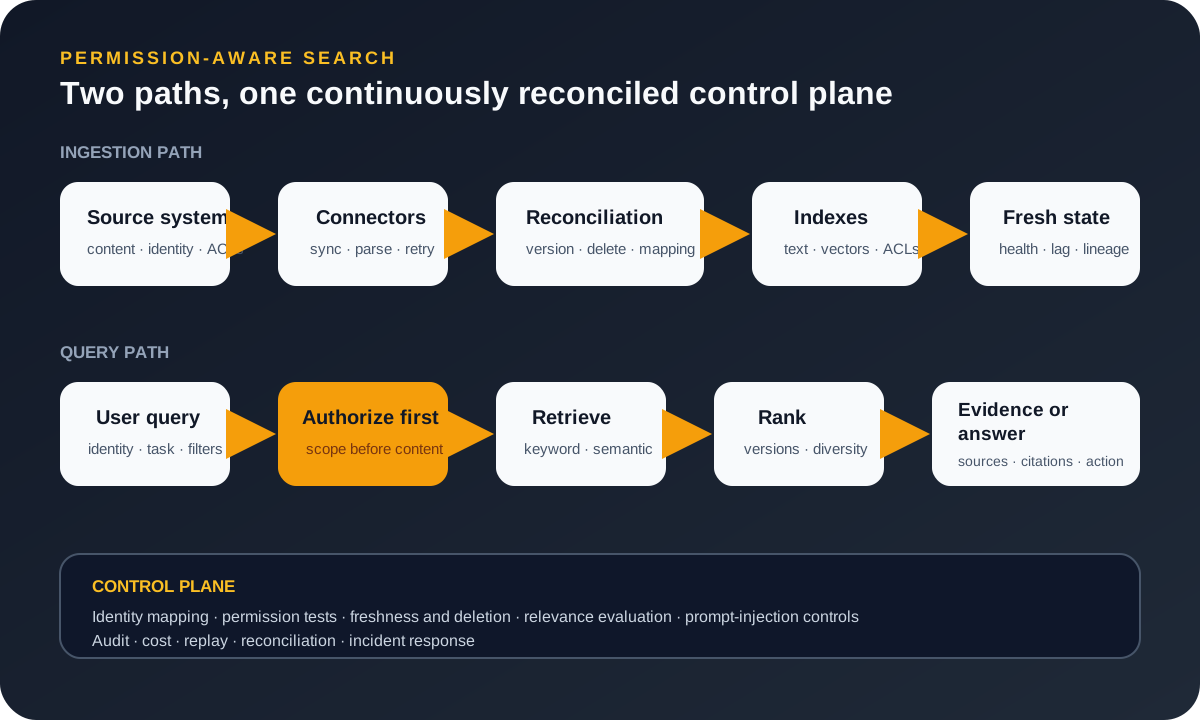
The source should usually remain authoritative for content, ownership, and access. The search platform owns normalization, indexing or live retrieval, ranking, and search operations. The product layer owns the user task, result presentation, feedback, answer behavior, and downstream action. Write who resolves every disagreement between them.
Connectors will fail partially. A token expires, an API throttles, a parser skips an attachment, a schema changes, or a deletion event is missed. Require checkpoints, idempotent replay, dead-letter or exception queues, per-source health, last-success timestamps, lag indicators, sampled reconciliation, and a safe stale state. The API integration requirements checklist provides a deeper contract for those boundaries.
Choose buy, extend, or build by boundary fit
Buy and configure
Standard repositories, compatible identity and ACL models, acceptable freshness, strong administration, useful relevance, and commercial terms that fit indexed content, queries, connectors, AI use, and support.
Extend a platform
The core search and permission model fits, but a focused connector, identity mapping, ranking rule, domain workflow, source preview, action, or evaluation harness is missing.
Build a focused product
Search is inseparable from a proprietary workflow, unusual sources or authorization, differentiated domain behavior, or an existing product surface that must own the complete experience.
Do not rebuild commodity search infrastructure for novelty. Do not buy a broad platform if its connector or permission model cannot represent the source of truth. A bounded hybrid is often sensible: a managed search engine plus custom connectors, authorization filters, evaluation, and product UX. Leeonex’s AI feature development service focuses on that product boundary, including evaluation and safe fallbacks.
Complete this enterprise search pilot worksheet
- Task: Name one user, question, decision, and next action.
- Corpus: List source systems, object types, authoritative versions, and excluded material.
- Identity: Map user, group, guest, tenant, shared-credential, and unmapped-user behavior.
- Lifecycle: Set expectations for creation, edit, permission change, move, archive, and deletion.
- Quality set: Prepare representative, ambiguous, adversarial, and no-answer queries by role.
- Answer boundary: Decide whether results, summaries, or generated answers are allowed and what evidence each must show.
- Failure plan: Name detection, owner, safe state, replay, reconciliation, and user communication for each dependency.
- Exit decision: Define the evidence that supports buying, extending, building, narrowing, or stopping.
Keep the first pilot narrow enough to inspect every result. A small, permission-diverse corpus and a difficult query set reveal more than connecting every repository to a demo. Expand only after access, freshness, relevance, evidence, and recovery work together.
Enterprise search software requirements FAQ
What should enterprise search software requirements include?
Include user tasks, source systems, connector scope, object identity, metadata, content extraction, identity mapping, document-level permissions, update and deletion freshness, keyword and semantic retrieval, filters, AI answers and citations where used, administration, audit history, observability, cost controls, migration, evaluation queries, adversarial access tests, and failure recovery.
Is enterprise search the same as RAG?
No. Enterprise search is the broader information-access product: connectors, permissions, indexing or live retrieval, query behavior, results, administration, and lifecycle controls. Retrieval-augmented generation can use that retrieval layer to ground an AI answer, but a search product can work without generated answers and a RAG demo is not automatically secure enterprise search.
How should permission-aware enterprise search be tested?
Test the same queries as users with different roles, including removed users, changed group membership, restricted folders, shared links, deleted documents, duplicate titles, cached answers, and connector failures. Verify that forbidden content never appears in results, snippets, citations, generated answers, logs, exports, analytics, or caches.
Should a team buy, extend, or build enterprise search?
Buy when available connectors, identity mapping, permission semantics, search quality, administration, and commercial terms fit. Extend when the core platform is suitable but a focused connector, ranking rule, workflow, or interface is missing. Consider a custom product when the search experience is inseparable from proprietary workflows, unusual authorization rules, or a differentiated product feature.