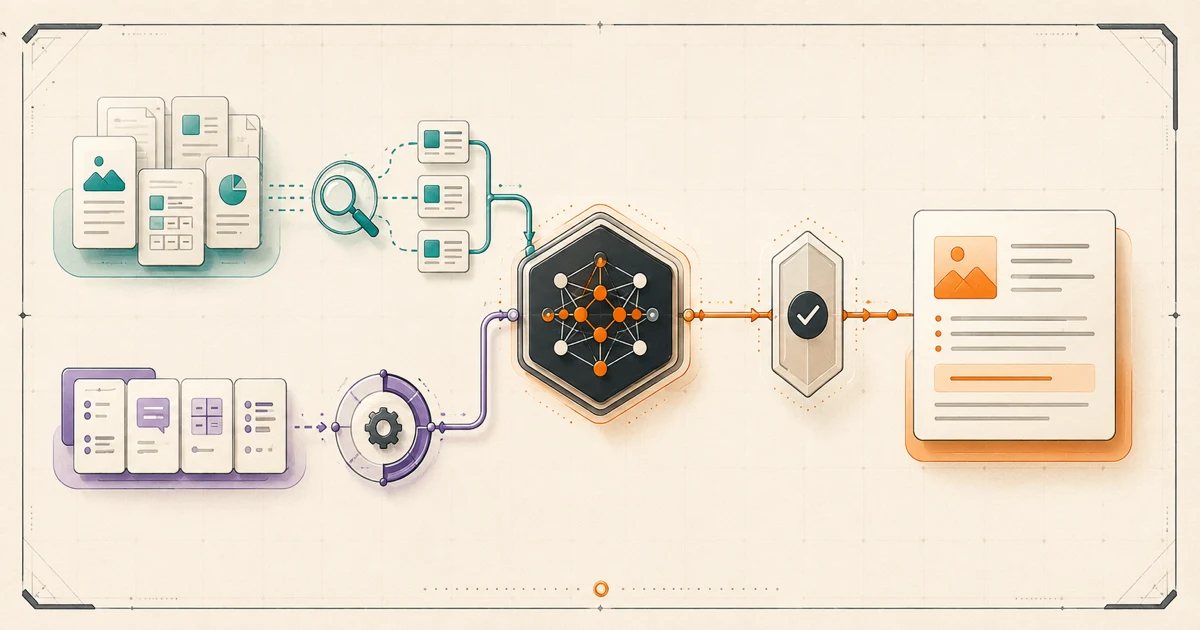
The short answer: use RAG for a knowledge gap and fine-tuning for a proven behavior gap
Use retrieval-augmented generation when an AI feature needs current, private, permissioned, or sourceable information at request time. Consider fine-tuning when the model repeatedly misses a narrow behavior, format, or task pattern after clear prompting and examples. Use both only when separate evaluation evidence shows that both gaps exist.
Start one step earlier: define the product task and collect representative failed cases. Sometimes the answer is a better prompt, a smaller deterministic workflow, a corrected source, an output validator, or a clearer product boundary—not RAG or a training job. Architecture should respond to measured failure, not to whichever technique sounds more advanced.
Knowledge gap
Retrieve authorized evidence for this request.
Behavior gap
Improve a repeatable task or response pattern.
Decision gate
Compare candidates on the same evaluation set.
Diagnose where the failed answer was created
Take each failed example and trace it. Was the required fact absent from available context? Was the correct source present but not retrieved? Did permission filtering remove it—or fail to remove another user's data? Did the prompt leave the task ambiguous? Did the model ignore an expected schema? Did a validator or tool fail after generation? One disappointing output can hide several different causes.
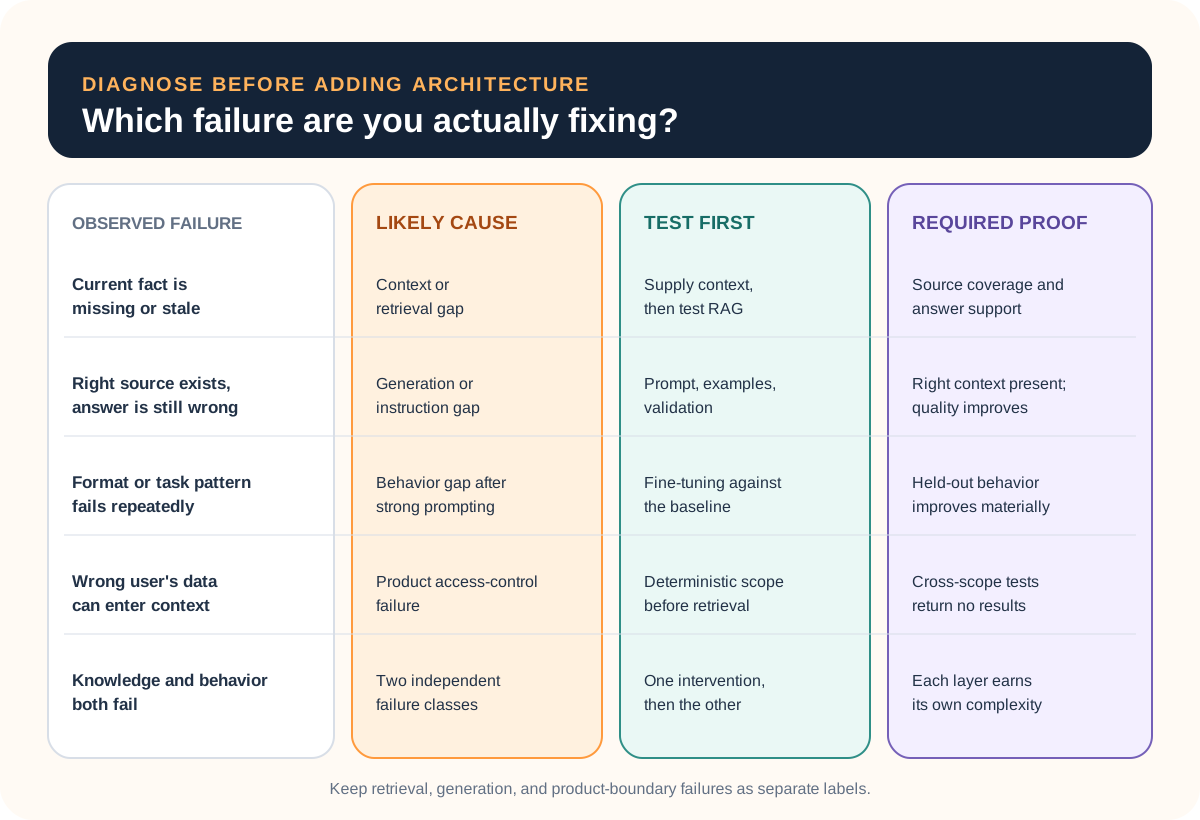
Maintain at least three labels in the evaluation set: retrieval failure, when the necessary source was not selected; generation failure, when the right evidence was present but the response was wrong; and product-boundary failure, when permissions, validation, fallback, or the surrounding workflow was wrong. That separation prevents a model change from masking a search or access-control defect.
RAG changes the context available at request time
A RAG system retrieves relevant information from an external source and places selected evidence into the model's context before generation. Knowledge remains outside the model, so a team can update the source, re-index content, apply metadata filters, and show supporting references without retraining model weights.
OpenAI's retrieval documentation describes semantic search over vector stores and shows that results can include chunks, similarity scores, file origins, and attribute filtering. Those are implementation capabilities, not a guarantee of a correct answer. The team still has to decide what is indexed, how content is chunked, which fields control access, how freshness is maintained, and what happens when retrieval finds weak or conflicting evidence.
Choose RAG as a candidate when answers depend on frequently changing policies, product documentation, account-specific records, a large private corpus, or citations a user can inspect. Test keyword, semantic, and hybrid retrieval where appropriate; measure whether the correct evidence appears before grading the final prose.
Fine-tuning changes learned behavior through examples
Fine-tuning continues training a supported base model on examples for a target task. Depending on the provider and method, it may improve classification, instruction following, style, format consistency, or performance on a narrow repeated behavior. It creates another versioned model artifact that needs suitable data, evaluation, release control, monitoring, and an upgrade plan.
The OpenAI model-optimization guide puts evaluation first, then prompting, and fine-tuning only for applicable use cases. It also notes potential benefits such as learning from more examples than fit in one request and using a smaller model for a particular task. Provider availability, supported methods, models, pricing, and lifecycle policies change, so verify the current platform before committing the architecture.
Fine-tune only after the team can describe the residual behavior failure and curate examples that demonstrate the desired output. Split training and test data, protect sensitive content, review labels, establish the untuned baseline, and compare the tuned model against that same held-out set. If a few clear examples in the prompt solve the problem, training may add ownership without enough product value.
Compare the interventions on product constraints
| Pressure | Prompt and examples | RAG | Fine-tuning |
|---|---|---|---|
| Changing facts | Useful when context is small | Strong candidate | Poor update mechanism |
| Source evidence | Only if supplied | Can return source references | Not a citation layer |
| Repeated behavior | First intervention | Does not train behavior | Candidate after baseline |
| New ownership | Prompt and eval versions | Corpus and retrieval pipeline | Dataset and model lifecycle |
| Primary proof | Task-quality comparison | Retrieval plus answer quality | Held-out behavior quality |
Microsoft's current RAG and fine-tuning comparison similarly frames RAG around dynamic information and fine-tuning around specialized tasks, while documenting the data, compute, maintenance, and overfitting concerns of tuning. Use vendor guidance to understand capabilities, then validate the product decision with your data and acceptance criteria.
Keep retrieval and tuning inside a controlled product boundary
Neither technique supplies authentication, authorization, business validation, human approval, or incident response. A RAG system must apply the user's permissions before content reaches the model. A fine-tuned model must not be treated as the authority for access or consequential actions. Deterministic application controls still decide what data and tools are available and whether an output may proceed.
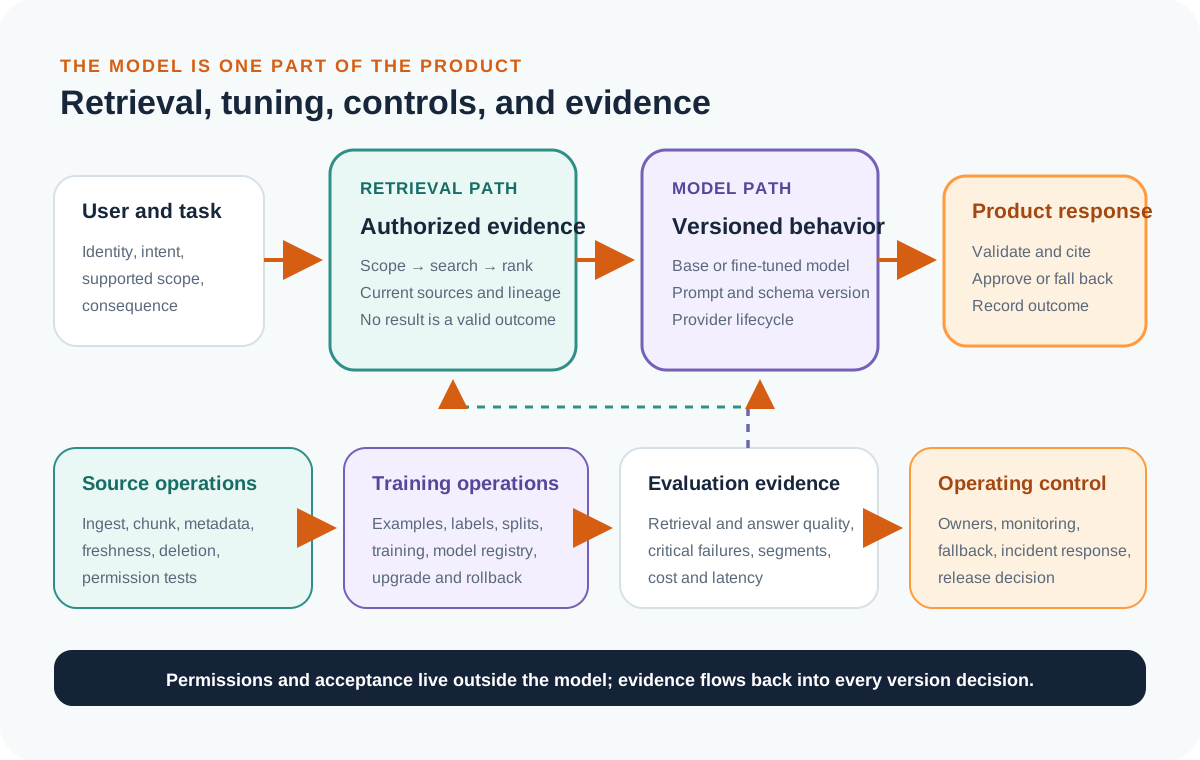
Use the enterprise search software requirements checklist when the product must connect several repositories, preserve source permissions and deletions, evaluate retrieval by role, and operate search as a maintained service rather than one model call.
The Leeonex permission-aware semantic search concept demonstrates the retrieval side of this boundary: apply scope before search, preserve source lineage, make access decisions inspectable, and re-check authorization when a result opens. It is a reproducible concept, not a client outcome.
The broader AI feature production-readiness checklist covers the surrounding evaluation, data, fallback, monitoring, economics, and ownership gates that still apply after the model adaptation path is chosen.
Sequence the pilot so each layer earns its complexity
- Define one supported user task, non-goals, consequence, and fallback. Collect representative, ambiguous, adversarial, and critical-failure cases.
- Establish a baseline with a current suitable model, explicit instructions, a small number of good examples, and deterministic output validation.
- Label the remaining failures as missing context, retrieval, generation behavior, or product boundary. Choose one intervention for the dominant class.
- For RAG, grade source coverage and relevance before final answers. For tuning, compare a held-out set before and after training. Keep critical failures separate from averages.
- Measure latency, cost per completed useful task, correction, fallback, and operational workload—not model quality alone.
- Add a hybrid only when each layer has an independently proven role. Record rollback, version, owner, and review triggers.
AWS's comparison guidance explicitly notes that RAG and fine-tuning can be combined. That possibility is not a reason to start with both. A layered system introduces two data pipelines, two failure surfaces, and more version combinations to evaluate.
Complete this RAG versus fine-tuning decision brief
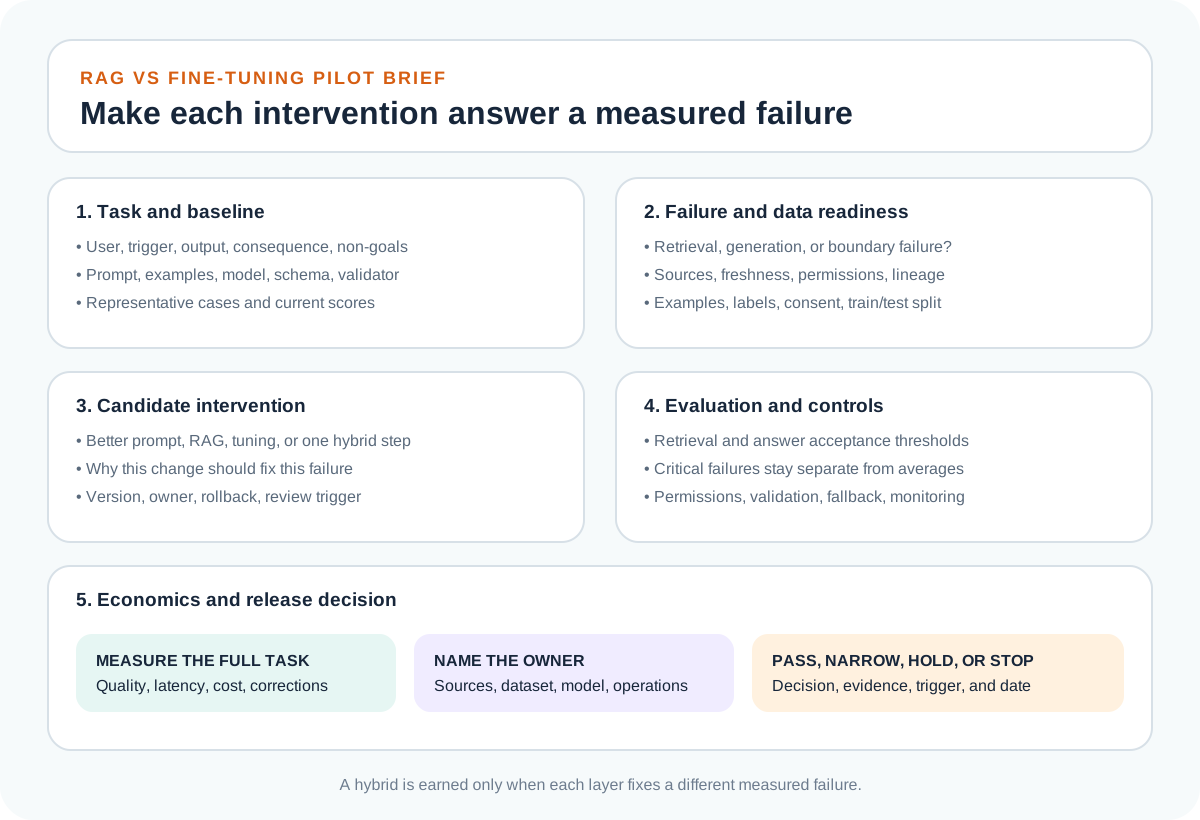
Record the supported task, baseline, failure distribution, source and permission boundary, training-data readiness, candidate intervention, acceptance threshold, critical stop conditions, cost and latency assumptions, release owner, and next review trigger. Attach the evaluation version so a future model, prompt, index, or dataset change can be compared against the same contract.
Leeonex's AI feature development service can help turn a promising use case into a bounded retrieval, tuning, or hybrid pilot with evaluation and fallback designed from the start. The smallest useful result may still be a stronger prompt and product workflow.
Frequently asked questions
Is RAG better than fine-tuning?
Neither is universally better. RAG is usually the candidate when an answer needs current, private, or sourceable knowledge. Fine-tuning is a candidate when the model repeatedly fails a narrow behavior, format, or task despite strong instructions and examples. Some products need both, and many need neither until a baseline evaluation proves the gap.
Can fine-tuning teach an AI model company knowledge?
Fine-tuning can adapt task behavior using training examples, but it is generally a poor substitute for a maintained source of changing company facts. Retrieval keeps knowledge outside the model so it can be updated, filtered, and linked to evidence. Test the actual task because terminology, stable domain patterns, and model-provider capabilities vary.
Can RAG and fine-tuning be used together?
Yes. A system can retrieve authorized, current context and use a fine-tuned model for a narrow response behavior. The hybrid earns its complexity only when separate evaluations show that retrieval fixes the knowledge failures and tuning fixes the remaining behavior failures.
Should a team try prompt engineering before fine-tuning?
Usually yes. Establish an evaluation set, improve instructions, context, examples, output schemas, and deterministic validation first. Fine-tuning becomes easier to justify when a recurring behavior gap remains, suitable training data exists, the target model supports the method, and the measured gain is worth training and versioning work.
What should a RAG proof of concept measure?
Measure retrieval relevance and coverage separately from final-answer quality. Include permission isolation, source freshness, citation support, unsupported questions, latency, cost, fallback behavior, and representative user cases. If the right source was never retrieved, changing the generation prompt alone will not repair the knowledge path.