Answer first
A useful semantic-search V1 proves that permitted users can find supported sources—not that a model can produce fluent answers.
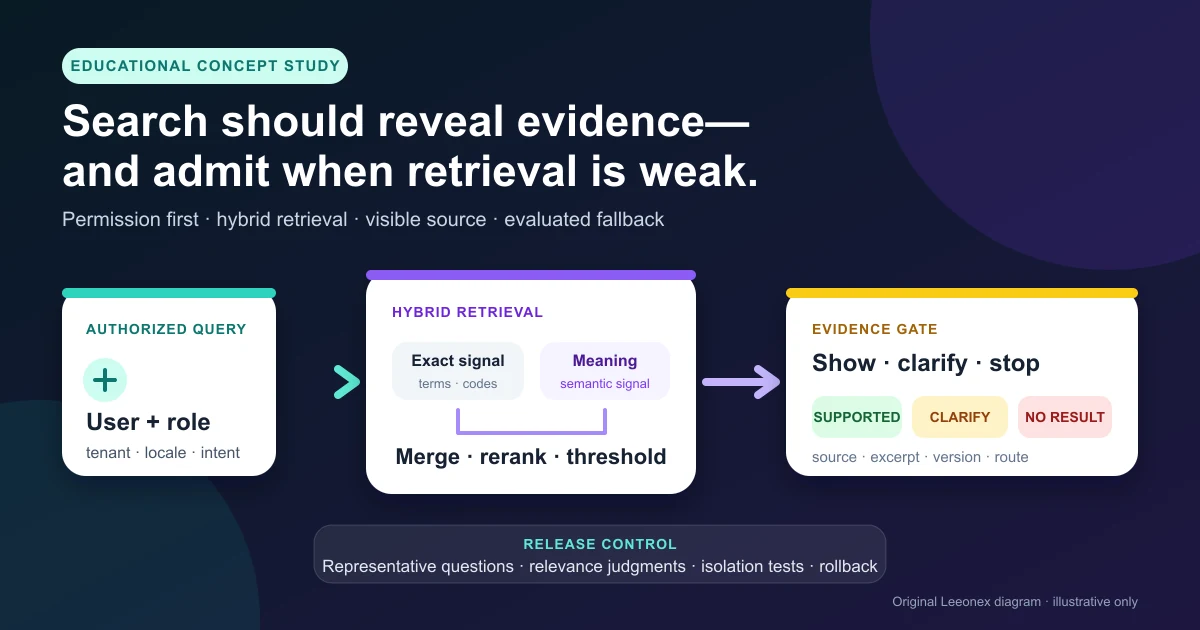
Start with one governed corpus and one retrieval job. Check the user's access before searching, combine exact and semantic signals, rerank a bounded candidate set, and show the source, excerpt, version, and freshness behind each result. When support is weak, ask for clarification or show an honest no-result state.
Build the evaluation set before debating models. Representative questions, relevance judgments, permission probes, stale-content cases, and known failures create a release gate. Generated answers, broad connectors, personalization, and agentic actions can wait until retrieval is observable and trustworthy enough to support them.
Illustrative discovery conversation — not a client quotation
“Let AI answer our knowledge base” becomes a retrieval and access problem before it becomes a generation problem.
B2B product lead
“Customers say they cannot find the right policy or implementation note. Can we add AI search and let it answer questions?”
Leeonex
“Which sources are authoritative, who may see each one, what does a good result look like, and what should happen when the evidence is weak or conflicting?”
B2B product lead
“Access varies by account and role. Content changes often, and a plausible answer based on an old document would be worse than no answer.”
Leeonex
“Then start with retrieval, not generated answers: authorize first, search one governed corpus, show source evidence and freshness, and use representative questions to decide whether the feature is ready.”
This is Leeonex-authored teaching material. It represents no real buyer, customer, corpus, query, document, product, search result, quotation, implementation, launch, accuracy, adoption, or outcome.
Starting situation and buyer
This concept is for B2B teams whose knowledge exists but cannot be retrieved reliably inside the product.
The intended buyer is a product leader, knowledge owner, or AI feature team responsible for a permissioned help center, policy library, implementation catalog, research archive, or customer workspace. Users know the answer probably exists, yet exact-word search misses paraphrases and filters cannot express their intent.
The pressure appears as repeated support questions, long browsing sessions, copied links in private channels, or users opening the wrong version. The tempting response is a conversational answer box. But generation can make poor retrieval sound complete and can blur whether a source was current, authoritative, or allowed.
The constraints are product constraints: sources have different owners and lifecycles; one account must not discover another's content; exact codes still matter; freshness is uneven; a short query may be ambiguous; and relevance changes with the user's job. Search quality cannot be separated from this operating context.
Product owner
Owns the user job, first corpus, result experience, acceptable failure modes, release boundary, and evidence required before scope expands.
Knowledge owner
Owns source authority, lifecycle, metadata, duplication, archival rules, access labels, and the content gaps search cannot repair.
Platform owner
Owns identity, authorization, ingestion, index versions, retrieval services, observability, rollback, privacy, security, and operating custody.
Search evaluator
Maintains representative questions and judgments, reviews regressions and weak results, and signs off on changes to ranking, thresholds, or corpus scope.
Core flow
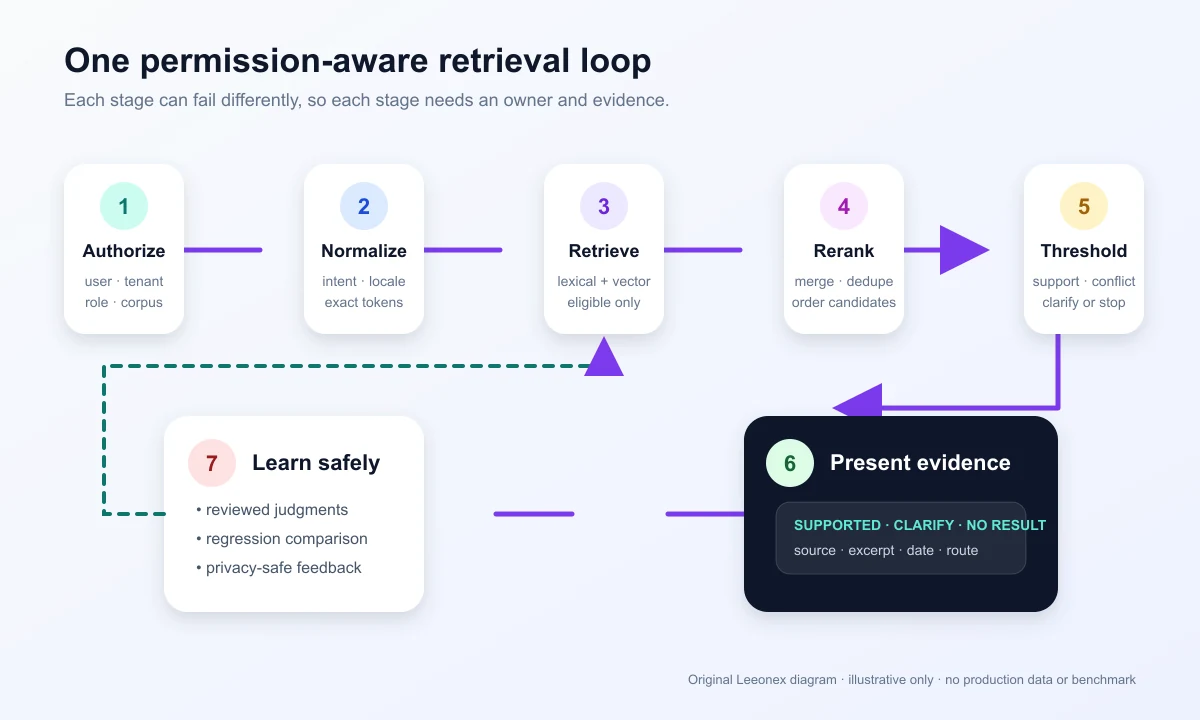
The retrieval loop turns a query into supported results, a clarification, or a useful no-result state.
First, resolve the user, account, role, locale, and feature context. Normalize the query without removing exact identifiers that may carry meaning. Build an eligible search boundary from the same authorization policy used by the source experience, then retrieve lexical and semantic candidates only from that boundary.
Next, merge and deduplicate candidates by stable source identity. Rerank a small set using the query, title, section text, metadata, source authority, and freshness signals the product has approved. Apply evaluated thresholds and diversity rules so near-duplicate chunks do not occupy every result position.
Finally, present evidence: source name, relevant excerpt, version or date, and a route to the governed record. If the query has multiple plausible meanings, ask a bounded clarifying question. If no candidate meets the release criteria, say so and offer a filter, browse path, or escalation. Record privacy-safe feedback for evaluation rather than silently treating clicks as truth.
Smallest useful scope
Prove one search job on one governed corpus before adding an answer engine.
V1 needs one user group, one source family, one language, a clear authority rule, and a limited query job such as finding the right implementation note. Include ingestion, metadata validation, permission propagation, chunking, lexical and vector indexing, reranking, evidence-rich results, and a stable source link.
Create an evaluation set from recent real-shaped questions while removing private material the team cannot use. Include exact terms, paraphrases, abbreviations, vague questions, conflicting versions, stale sources, no-answer cases, restricted documents, and queries that should return different results for different roles.
Define judgments and release criteria before tuning. For each query, record relevant, acceptable, misleading, and forbidden candidates; whether clarification is required; and what an honest no-result state should do. Keep a holdout set so each model, index, chunking, or ranking change can be compared without tuning only to the examples already seen.
Architecture and implementation decisions
Keep source truth, access policy, index records, ranking, and product presentation inspectable as separate layers.
Ingest through a versioned pipeline that records source identity, content checksum, owner, authority, effective dates, tenant and role labels, language, parser version, chunk boundaries, index version, and deletion state. Reconcile the index with the source so updates and removals do not depend on best-effort event delivery.
Enforce access before candidate generation with a design matched to corpus size and permission complexity: separate indexes, filtered retrieval, or another reviewed isolation pattern. Test titles, snippets, facets, counts, caches, logs, and analytics—not only document bodies—for cross-account leakage.
Keep lexical retrieval for identifiers and exact language, vector retrieval for conceptual similarity, and reranking for final ordering. Store stage outputs and configuration versions for a privacy-approved diagnostic sample so weak results can be traced to ingestion, eligibility, recall, ranking, thresholds, or UX.
The interface should disclose the source and freshness without pretending a relevance score is a probability of truth. If later scope adds a generated summary, it should cite only eligible retrieved passages, distinguish source conflict, preserve a route to the original, and fall back when support is insufficient.
Risks and guardrails
Search risk lives in unauthorized candidates, weak evidence, stale sources, and quality changes the team cannot explain.
- Authorize the user and filter eligible content before retrieval; a post-search redaction step can still reveal titles, snippets, counts, or ranking signals from restricted material.
- Keep stable document, section, tenant, language, version, and permission identifiers so index records can be traced, updated, deleted, and reconciled with their source.
- Use hybrid retrieval when exact identifiers, product names, error codes, and policy phrases matter alongside conceptual similarity. Semantic ranking should not erase exact matches.
- Separate candidate retrieval from reranking, thresholds, and presentation so each stage can be inspected and evaluated instead of collapsing quality into one opaque score.
- Show title, source, relevant excerpt, date or version, and a link to the governed record. A score alone does not tell a user why a result is trustworthy.
- Treat low support, conflicting sources, stale content, empty results, and permission-filtered gaps as product states with clarification or escalation paths—not prompts to improvise.
- Version the corpus, chunking, embedding, lexical settings, reranker, thresholds, and evaluation set. Make index rebuilds repeatable and keep a rollback path.
- Minimize logged query and content data, define retention and access, remove deleted sources from every index, and test isolation with adversarial cross-account queries.
Build now, validate later
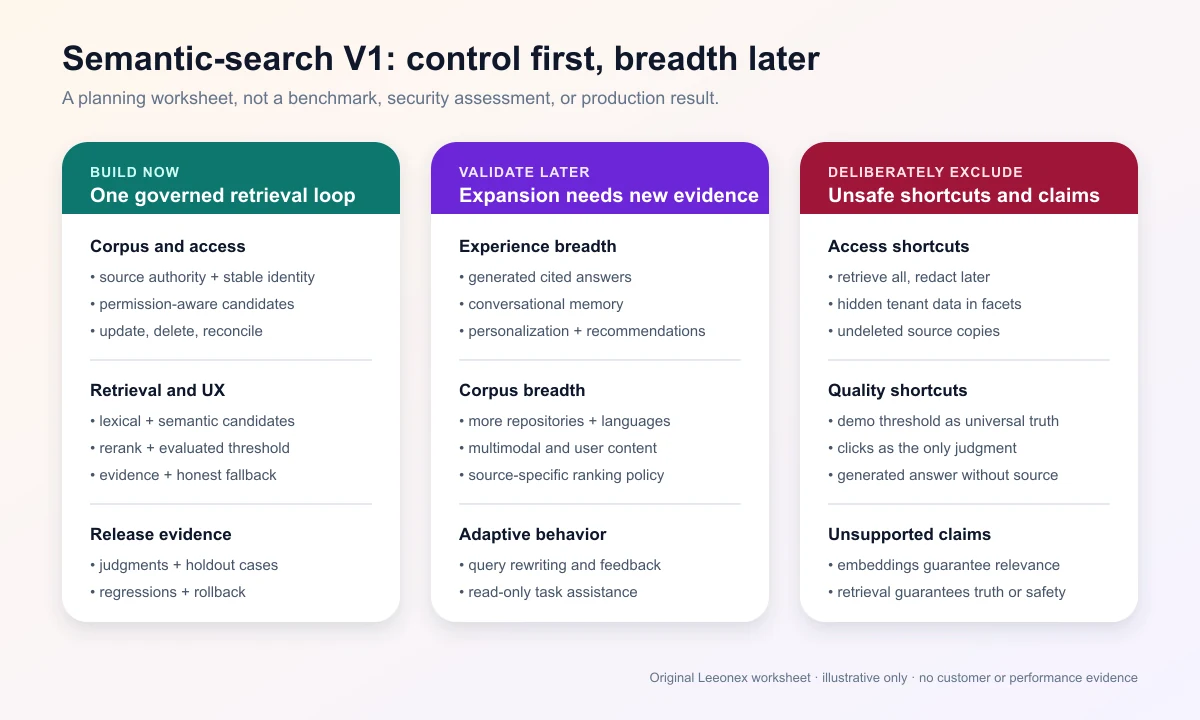
Permission, traceability, evaluation, and honest fallbacks belong in V1; generative breadth does not.
Build the source inventory, stable identities, versioned ingestion, authorization boundary, hybrid retrieval, reranking, evidence-rich result UI, clarification and no-result states, evaluation set, regression report, observability, deletion path, and rollback now. These controls make the first feature testable and operable.
Validate generated answers, conversational memory, additional repositories, multilingual search, personalization, recommendations, query rewriting, multimodal content, automated synonyms, learning from clicks, user-submitted sources, and agentic actions only when the first corpus and user job provide evidence for expansion.
Deliberately exclude search over content the team cannot govern, post-retrieval permission trimming, silent indexing of deleted records, universal thresholds copied from a demo, click-through as the only relevance label, hidden source citations, and claims that embeddings or retrieval alone guarantee truth, security, or quality.
Limitations and evidence boundary
This concept proves no retrieval quality, permission isolation, freshness, latency, adoption, task saving, support reduction, or conversion.
No client, product, source system, corpus, account model, permission policy, document, query, index, embedding model, reranker, search log, evaluation set, user session, security test, or production environment was inspected. The four roles, seven stages, three outcomes, architecture, guardrails, and diagrams are proposed planning material—not implementation, privacy, security, legal, compliance, accessibility, or model-performance evidence.
Stronger delivery claims would require an approved source and permission model, production configuration, ingestion and deletion records, authorization and isolation tests, index reconciliation, representative evaluation protocol and judgments, regression reports, accessibility review, release history, telemetry, incidents, corrections, known gaps, and permission for public wording and visuals.
Any performance or business claim would also need a pre-agreed baseline and measurement window. Definitions might cover retrieval success, result relevance, forbidden-result rate, no-result rate, stale-result rate, time to a supported source, query reformulation, task completion, support contacts, adoption, or conversion. Sources, exclusions, confounding changes, attribution limits, verifier, and approved language would be required before publication.
Lessons and first consultation
Bring representative questions and governed sources—not only a preferred model or vector database.
A useful first brief explains who is searching, what decision they need to make, which sources are authoritative and permitted, how quality will be judged, and what the product should do when it cannot find enough support. These inputs make a first consultation concrete:
- The user job, intended buyers and roles, representative questions, current search complaints, examples of useful and harmful results, and the decisions users make after retrieval
- Authoritative sources, formats, owners, update cadence, version rules, duplicate and conflicting content, required metadata, languages, expected corpus size, and content that must stay excluded
- Identity and tenant model, role and document permissions, source-system APIs, deletion and retention rules, sensitive-query policy, hosting constraints, and security or privacy review owners
- A first evaluation set with relevance judgments, exact-match cases, no-result and clarification cases, access-control probes, latency and cost constraints, release and stop conditions, and telemetry the team is allowed to collect
Leeonex's AI product feature development service fits teams adding assistants, classifiers, recommendations, or semantic search with explicit quality and fallback expectations. The AI agent versus workflow automation guide helps decide whether retrieval should remain a read-only product feature or sit inside a more adaptive task flow, while the API integration requirements checklist helps expose source synchronization and ownership risks.
Explore the Leeonex case-study hub to compare other evidence types and product decisions. These systems can support discoverability and sales conversations, but none guarantees rankings, traffic, indexing, AI citations, trust, leads, conversions, retrieval quality, or commercial outcomes.
A problem-aligned next step
Map the retrieval and permission boundary before adding a fluent answer layer.
Bring the search job, source inventory, roles, failure examples, and representative questions. Leeonex can turn them into one focused AI product feature scope with an evaluation gate.