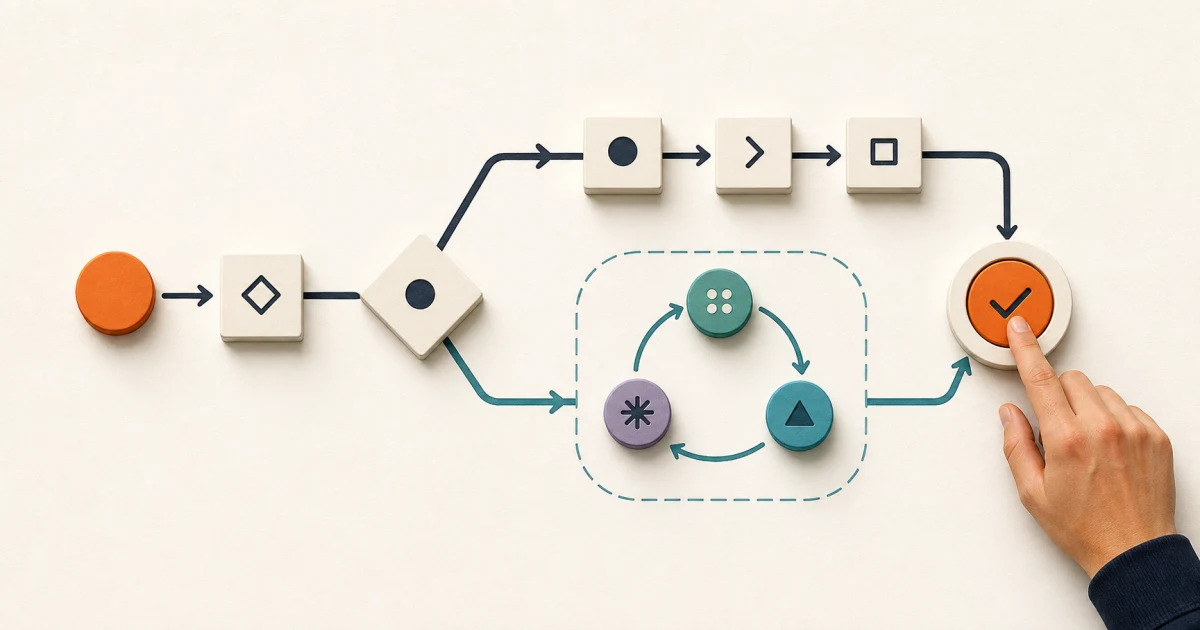
The short answer: automate the known path; bound the unknown path
Use workflow automation when the next step can be defined from known inputs, rules, and states. Use a bounded AI agent when the system must interpret variable information and choose among approved next actions to reach a clear goal. For many business processes, the strongest design is hybrid: deterministic intake, permissions, validation, and recording around one narrow agentic decision.
Do not start with “we need an agent.” Start with one task and ask what is genuinely unpredictable. If every branch can be written down, an agent adds variable behavior, latency, evaluation work, and operating cost without adding useful flexibility. If the path depends on reading unstructured material, investigating an exception, or selecting a tool from context, a fixed flowchart may become brittle.
Workflow
People define the path; software executes it consistently.
Bounded agent
The model chooses a next step inside named tools and limits.
Hybrid
Fixed controls contain one adaptive interpretation or action loop.
What actually changes between a workflow and an agent?
A deterministic workflow can include forms, API calls, timers, rules, queues, approvals, and even an AI step. It remains a workflow when people define what happens next. An agent changes the control boundary: a model evaluates the current state and decides which approved action, tool, or follow-up step to use.
This distinction matches the practical definitions in Anthropic’s guide to building effective agents and OpenAI’s practical agent guide: workflows follow predefined code paths, while agents let the model direct execution and tool use within guardrails.
| Question | Workflow automation | Bounded AI agent |
|---|---|---|
| Who selects the next step? | Rules and branches written in advance | A model, from approved options |
| Best input | Structured, validated, predictable | Variable text, documents, or exceptions |
| Main control | Branch logic and state transitions | Tools, permissions, instructions, exit conditions |
| How to test | Expected result for each rule and state | Representative cases, scoring, policy and tool-use checks |
| Typical failure | Missing branch or broken integration | Wrong interpretation, tool, sequence, or stopping point |
A chatbot is not automatically an agent. A classifier is not automatically an agent. A model that drafts a response inside a fixed approval flow is AI assistance. The architecture becomes agentic when the model controls how the task progresses.
Use the autonomy pressure test on one real task
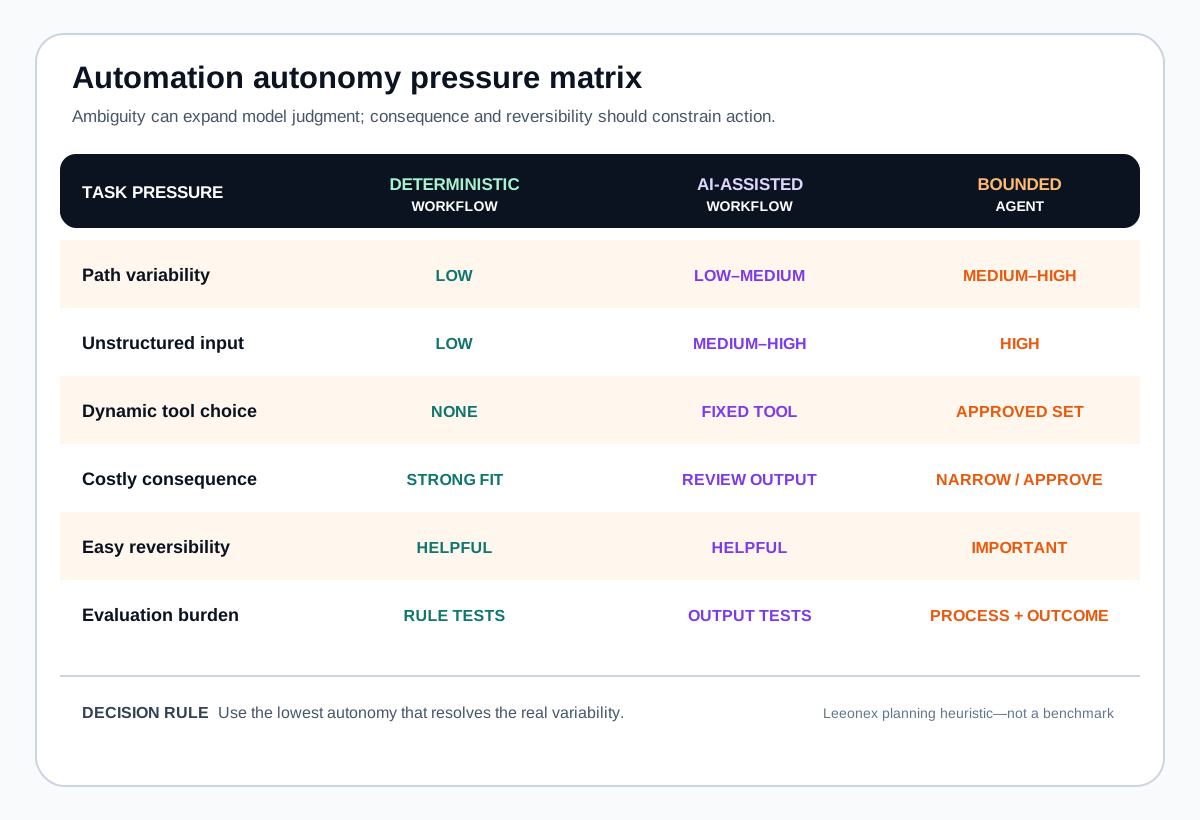
Score each dimension low, medium, or high using recent cases. High ambiguity increases the value of adaptive reasoning. High consequence reduces the safe autonomy boundary. Those pressures can exist together, which is why “complex task” does not mean “fully autonomous agent.”
- Path variability: Does the right sequence change materially from case to case?
- Input ambiguity: Must the system interpret prose, documents, images, or incomplete context?
- Tool choice: Can rules select the correct system and action, or does that depend on what is discovered?
- Consequence: Could an incorrect action affect money, access, customers, compliance, or irreversible records?
- Reversibility: Can the action be previewed, undone, reconciled, or routed for approval?
- Evaluation readiness: Do you have representative cases and a way to judge a correct process and outcome?
Consider inbound support triage. A workflow can validate required fields, detect account tier, and route known categories. AI can extract intent from a messy message. An agent might be justified only if it must investigate order history, consult policy, ask a clarifying question, and choose among approved remedies. A refund above a threshold can still require a person.
If the process itself is unstable, first use the AI workflow automation readiness checklist. Adding autonomy to unclear ownership or unreliable source data produces a harder-to-diagnose version of the same problem.
Design a hybrid boundary instead of debating labels
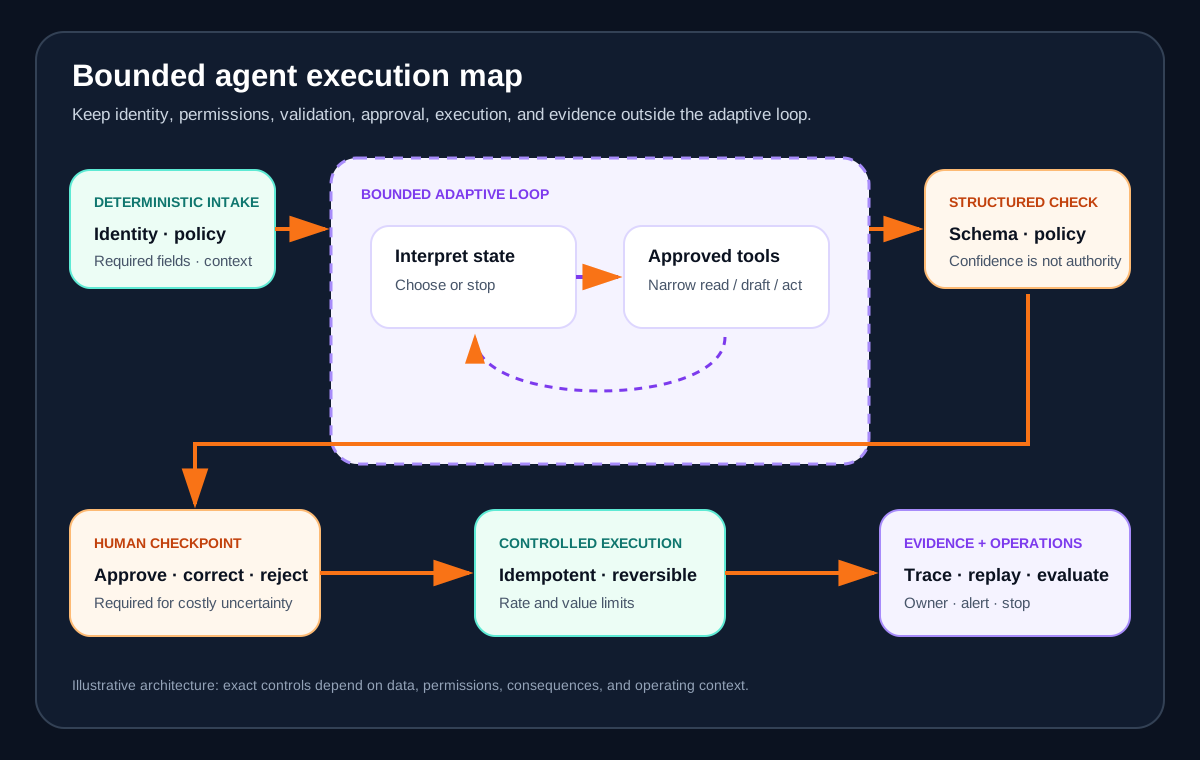
A useful production design separates six responsibilities. The fixed system validates the trigger and identity. The model gets only the context required for its task. Tools expose narrow actions rather than broad account access. Structured output is validated. Costly or uncertain actions stop for review. Every attempt, tool call, result, correction, and escalation is recorded for operations and evaluation.
Give the agent capabilities, not ambient access
A tool should perform one understandable job, enforce authorization server-side, validate its inputs, return a clear result, and expose predictable failure states. “Use the CRM” is too broad. “Find an account by verified identifier” and “create a draft follow-up assigned to this owner” are testable tools.
OWASP identifies excessive agency as a risk when a model receives unnecessary functionality, permissions, or autonomy. The practical response is not a warning banner. It is least-privilege tools, server-side rules, approval gates, rate limits, and a safe stop state.
Prefer one agent before a network of agents
Multiple agents add handoffs, state, cost, latency, and new ways to lose context. Start with one bounded loop and expand only when separate roles and evaluation criteria are demonstrably easier to operate. A deterministic router plus specialist tools may be simpler than several models negotiating the same task.
When the agent needs reliable access to several systems, the integration layer becomes part of the product. Use the iPaaS vs custom API integration guide to decide where connectors, custom services, retries, and reconciliation should live.
If the user job is finding supported knowledge rather than choosing and executing actions, keep the first product boundary retrieval-focused. The permission-aware semantic search concept study shows how authorization, hybrid retrieval, visible evidence, honest no-result states, and evaluation can form a smaller AI product feature without granting an agent tool access.
Evaluate the process, not just the final answer
An agent can reach a plausible result through an unsafe process. Evaluation should inspect whether it selected allowed tools, used the correct records, followed policy, stopped when required, handled tool errors, and produced evidence a reviewer can use.
Build a set containing ordinary, ambiguous, incomplete, conflicting, adversarial, disallowed, and tool-failure cases. Keep a separate holdout set for the decision to expand scope. Record completion, correct tool selection, correction rate, escalation rate, policy violations, time, and cost per completed case. These are evaluation options, not universal benchmarks.
Use risk language proportionate to the workflow. NIST’s AI Risk Management Framework organizes work around governing, mapping, measuring, and managing risk. For a small pilot, that can translate into a named owner, documented context and affected people, representative tests, monitored limits, and a response plan—not a large governance ceremony.
Set expansion and stop conditions before launch
- Start read-only, draft-only, or with a narrow reversible action.
- Limit tools, records, users, transaction value, and run duration.
- Require review when confidence is not evidence enough to act.
- Pause on a defined policy breach, repeated tool failure, or unreviewed queue growth.
- Expand one action class only after the previous boundary is understood.
Turn the decision into a one-page pilot brief
Use a real task and recent cases. If the team cannot name the goal, completion state, allowed tools, evaluation method, and accountable operator, the next step is discovery rather than production access.
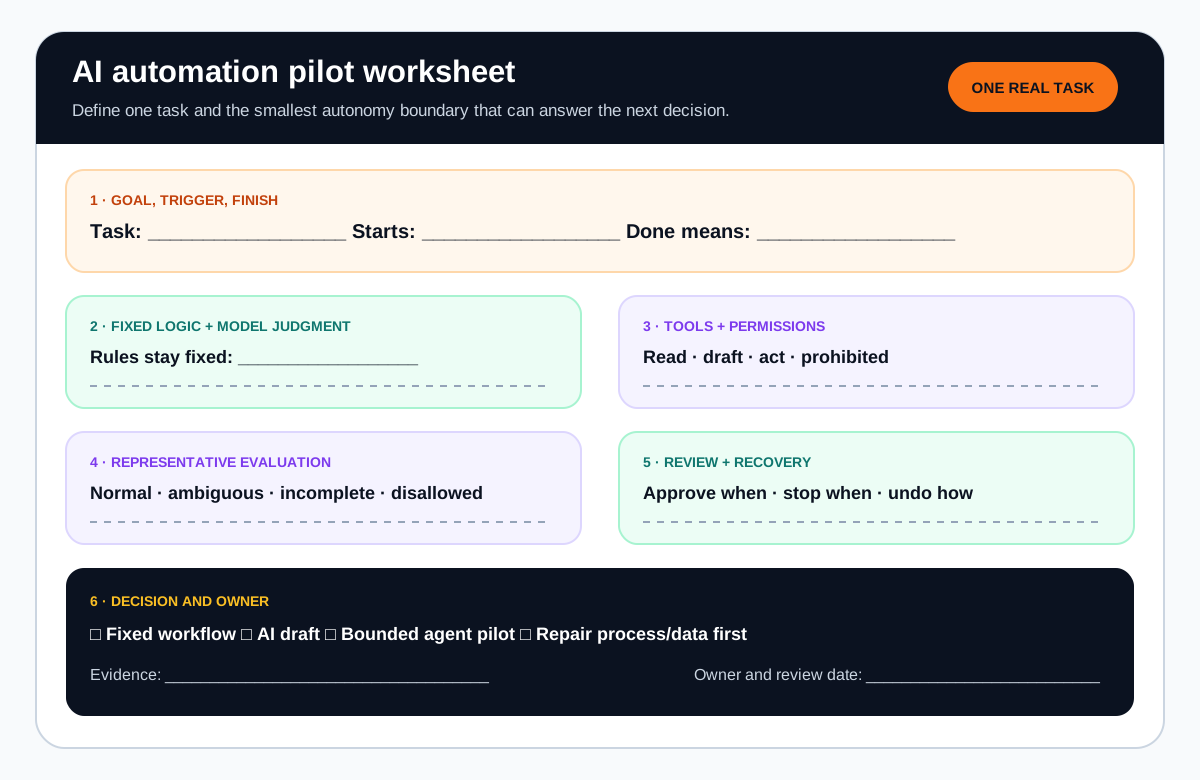
End with one of four decisions: use a rule-based workflow, keep AI draft-only, run a bounded agent pilot, or repair the process and data first. Leeonex’s AI workflow automation service and AI feature development offering can help turn that boundary into a scoped, evaluated product increment.
Frequently asked questions
What is the difference between an AI agent and workflow automation?
Workflow automation follows a path defined in advance: triggers, rules, branches, and actions are encoded by people. An AI agent uses a model to decide how to pursue a goal, which tool to use, or whether another step is needed within defined limits. A workflow may contain AI without becoming an agent if the model does not control execution.
When should a business use an AI agent?
Use a bounded agent when the task has meaningful variation, depends on unstructured information, and requires the system to choose among approved next steps. The goal, tools, permissions, completion conditions, evaluation cases, escalation path, and consequences still need to be explicit.
When is deterministic automation the better choice?
Use deterministic automation when inputs are structured, the path and rules can be stated, consistency and speed matter, or an incorrect action is difficult to reverse. AI can still assist with one narrow interpretation step while the surrounding workflow stays fixed.
Can an AI agent and workflow automation be combined?
Yes. A common production pattern is a deterministic workflow that validates input, calls an agent for a bounded judgment, checks the structured result, routes costly actions to a person, and records every tool call and outcome. This hybrid keeps flexibility where it helps and control where it matters.
How should an AI agent pilot be evaluated?
Test representative normal, ambiguous, incomplete, adversarial, and disallowed cases. Measure task completion, correct tool selection, policy compliance, correction and escalation rates, end-to-end time, cost per completed case, and recovery from tool failures. Set launch and stop conditions before the pilot begins.
Sources and further reading
- Anthropic: Building effective agents
- OpenAI: A practical guide to building agents
- NIST: AI Risk Management Framework
- OWASP: Excessive Agency
The autonomy pressure matrix is a Leeonex planning heuristic, not a security assessment, compliance framework, or performance benchmark. Legal, privacy, security, and domain review should match the data, users, and consequences of the specific system.