
The short answer: an AI feature is ready when the team can prove, constrain, recover, observe, and own it
Before production, define the exact task and non-goals; test a version against representative and critical failure cases; enforce the user's data and tool permissions; validate outputs; provide a truthful fallback; monitor quality, errors, latency, corrections, and cost; and name the people who can respond, roll back, narrow, or stop the feature.
A polished demo proves that a model can produce a useful result. It does not prove that the product will behave acceptably across real users, missing context, malicious input, provider failure, changing data, or a model update. Production readiness is the operating evidence around the capability, not confidence in a handful of examples.
Evidence
Cases, rubric, threshold, and known limits.
Control
Permissions, validation, fallback, and stop.
Ownership
Signals, response, release, and review.
Use five gates, and keep critical failures visible
The gates turn a vague launch review into five acceptance decisions. Each gate needs evidence, a named owner, and an explicit disposition: pass, narrow the scope, hold for missing evidence, or stop. Do not average away a critical permission or recovery failure because the feature scored well elsewhere.
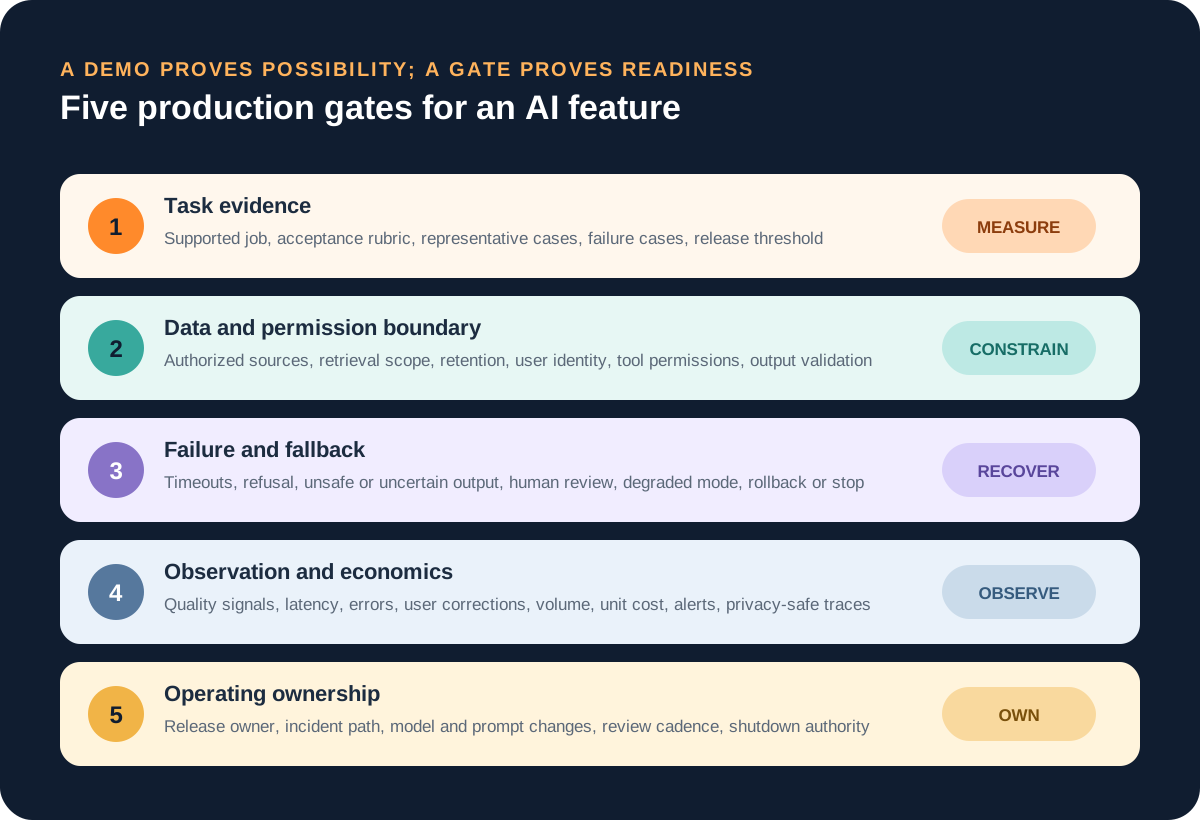
This is not a compliance certification. NIST describes its AI Risk Management Framework as voluntary guidance for incorporating trustworthiness into AI design, development, use, and evaluation. Use applicable risk, privacy, security, legal, and sector requirements with qualified reviewers; the checklist helps product and engineering teams make their implementation evidence reviewable.
Gate 1: define a supported task and test it like a product behavior
Write the user, trigger, authorized context, expected output, consequence, acceptable latency, and explicit non-goals. “Answer support questions” is too broad. “Draft a cited answer from the customer-visible knowledge base for an agent to approve” gives the team a testable task and a clear human checkpoint.
Build a versioned evaluation set from common cases, rare but consequential cases, ambiguous requests, missing context, conflicting sources, unsupported languages or formats, unsafe requests, and previous failures. Define a rubric with observable pass conditions. Track critical failures—such as exposing data or taking an unauthorized action—separately from average answer quality.
OpenAI's current evaluation guide shows the underlying contract clearly: an evaluation defines desired behavior, testing criteria, test data, and comparison to a reference or grader. Your implementation may use different tools, but the principle holds. Keep the cases and criteria stable enough to compare a prompt, model, retrieval, or workflow change before release.
If the team still has only a promising demo, the AI feasibility spike concept shows how to freeze one task, a representative case set, the current baseline, candidate versions, reviewer evidence, and a build, narrow, buy, or stop decision before product integration. It is an educational concept, not a client assessment, model benchmark, or measured result.
When the proposed change is retrieval or model training, the RAG versus fine-tuning decision guide helps separate missing-knowledge failures from recurring behavior failures and defines the evidence each intervention should produce.
For a concrete feature boundary, the evidence-preserving AI document comparison concept shows how immutable sources, deterministic changes, cited model observations, and reviewer decisions can remain separate and testable. It is an educational concept, not a client product or measured result.
For a revenue-operations example, the evidence-linked AI sales call notes concept separates transcript spans, model proposals, reviewer decisions, controlled CRM writes, and reconciliation. It is an educational concept, not a client feature, real call workflow, or measured result.
| Weak requirement | Production-ready question | Evidence |
|---|---|---|
| Be accurate | Accurate about which fields and sources? | Task rubric plus human-reviewed cases |
| Handle edge cases | Which failures are recoverable or critical? | Failure taxonomy and expected route |
| Keep users safe | What data or action must never cross the boundary? | Permission and adversarial tests |
| Scale affordably | At what volume, latency, and unit-cost assumption? | Load test and transparent cost model |
Gate 2: enforce data and tool permissions outside the model
Map every source and tool the feature can reach. For data, record authority, freshness, tenancy, identity, allowed fields, retention, deletion, and whether content can appear in prompts, traces, evaluations, or reviewer queues. Retrieval must apply the product's permission rules before context reaches the model; an instruction telling the model not to reveal a record is not an access-control system.
For actions, use an allowlist, typed inputs, deterministic validation, least-privilege credentials, limits, idempotency where appropriate, and explicit confirmation for consequential or hard-to-reverse steps. Separate proposing an action from authorizing and executing it. If a deterministic workflow is sufficient, the AI-agent-versus-workflow guide helps choose a smaller autonomy boundary.
Agentic features need additional threat review because untrusted content can influence tool selection and downstream actions. The OWASP GenAI Security Project publishes a securing agentic applications guide focused on practical design and deployment controls. Use it as one input to security review, not as a substitute for testing the actual product boundary.
Gate 3: design the truthful path when the feature cannot proceed
List predictable failure modes: timeout, provider error, invalid schema, unavailable source, conflicting evidence, low confidence, unsupported request, unsafe input, tool rejection, rate limit, and partial action. For each one, define what the user sees, what the system records, whether work can retry, and who takes over.
A fallback can request missing information, return only verified source material, switch to a deterministic result, queue the task, hand off to a person, preserve the existing manual process, or disable the feature. The right choice depends on consequence and reversibility. Do not silently replace a failed model with a second model if that route has not passed the same boundary and evaluation.
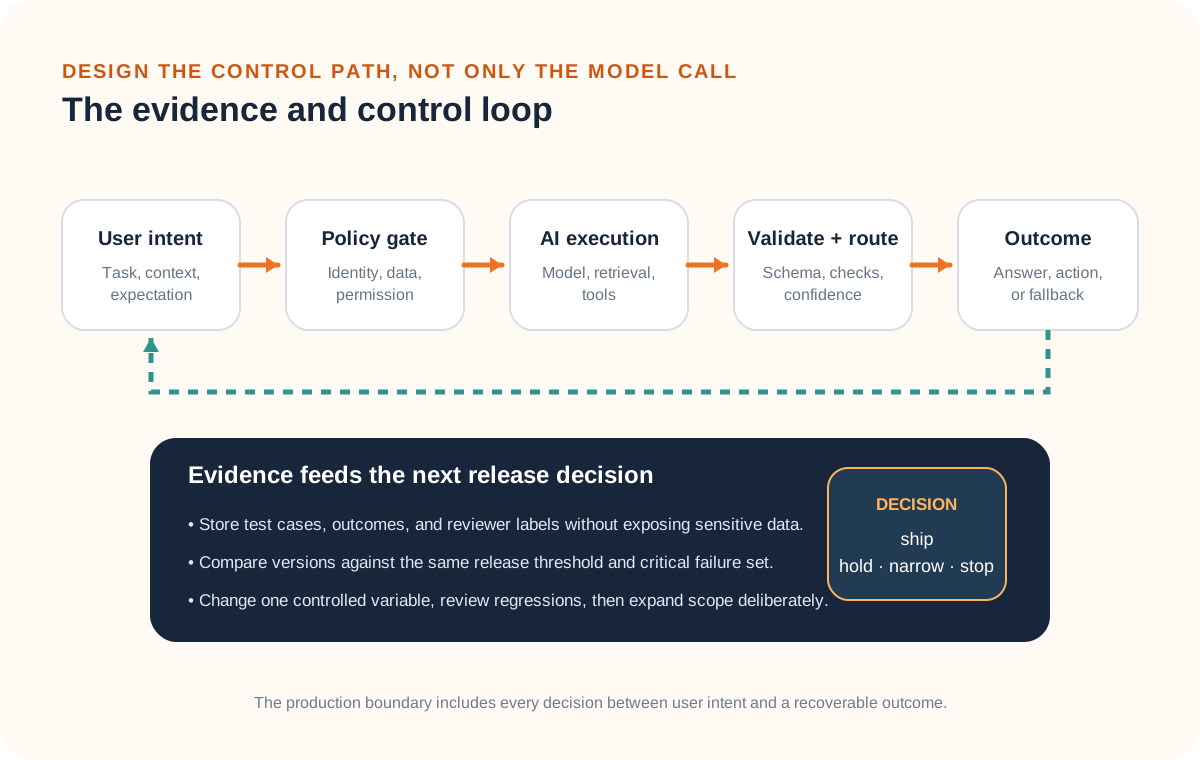
Gates 4 and 5: observe product quality and give someone authority to act
Monitor provider errors, invalid outputs, latency, retries, retrieval misses, tool failures, fallback rate, user corrections, approvals, abandoned tasks, volume, and cost per completed useful task. Aggregate signals should help the team identify weak segments without turning sensitive prompts and outputs into an uncontrolled log archive. Define retention and reviewer access before collecting production traces.
Model-token cost is only one part of economics. Include retrieval, storage, tool calls, observability, evaluation, reviewer time, support, retries, and provider minimums. State traffic and usage assumptions instead of presenting a universal estimate. Set alerts on the measures that can change the release decision, not every available metric.
Name a product owner for supported behavior, a technical owner for the release path, an incident owner, and the person who may disable or narrow the capability. Version the prompt, model, tools, retrieval settings, policy, and evaluation set. Define which changes require a full gate review and when production evidence is added back to the test set after privacy review.
Launch a controlled pilot when the value is real but the evidence is still narrow
Restrict one or more dimensions: users, tasks, data sources, tools, volume, languages, business units, or consequence. Keep the normal fallback available. Tell pilot users what the feature supports, how to verify or correct it, and where work goes when the AI cannot complete the task.
Define stop conditions before launch: a critical permission failure, unsafe action, unacceptable reviewer disagreement, repeated unavailable fallback, material cost excursion, or an incident the team cannot diagnose. Also define expansion evidence. “No complaints” is not enough; compare outcomes to the task rubric and review the failure distribution.
If the team is still deciding whether the workflow has the data, owner, repetition, and human checkpoint needed for automation, use the earlier-stage AI workflow readiness checklist. Once the task is proven and the release boundary is clear, AI feature development can focus on the smallest useful, testable integration rather than a broad AI mandate.
For a customer-facing support use case, continue with the AI customer support requirements checklist to specify approved knowledge, action permissions, escalation evidence, and the human handoff packet.
Record the launch decision in one acceptance brief
Link the supported task, non-goals, evaluation version and results, critical failures, data and tool boundary, fallback routes, expected volume, latency and cost assumptions, monitoring dashboard, incident path, owners, residual risks, approver, and next review trigger. Avoid placing secrets or unnecessary user data in the brief; point to controlled sources of truth.
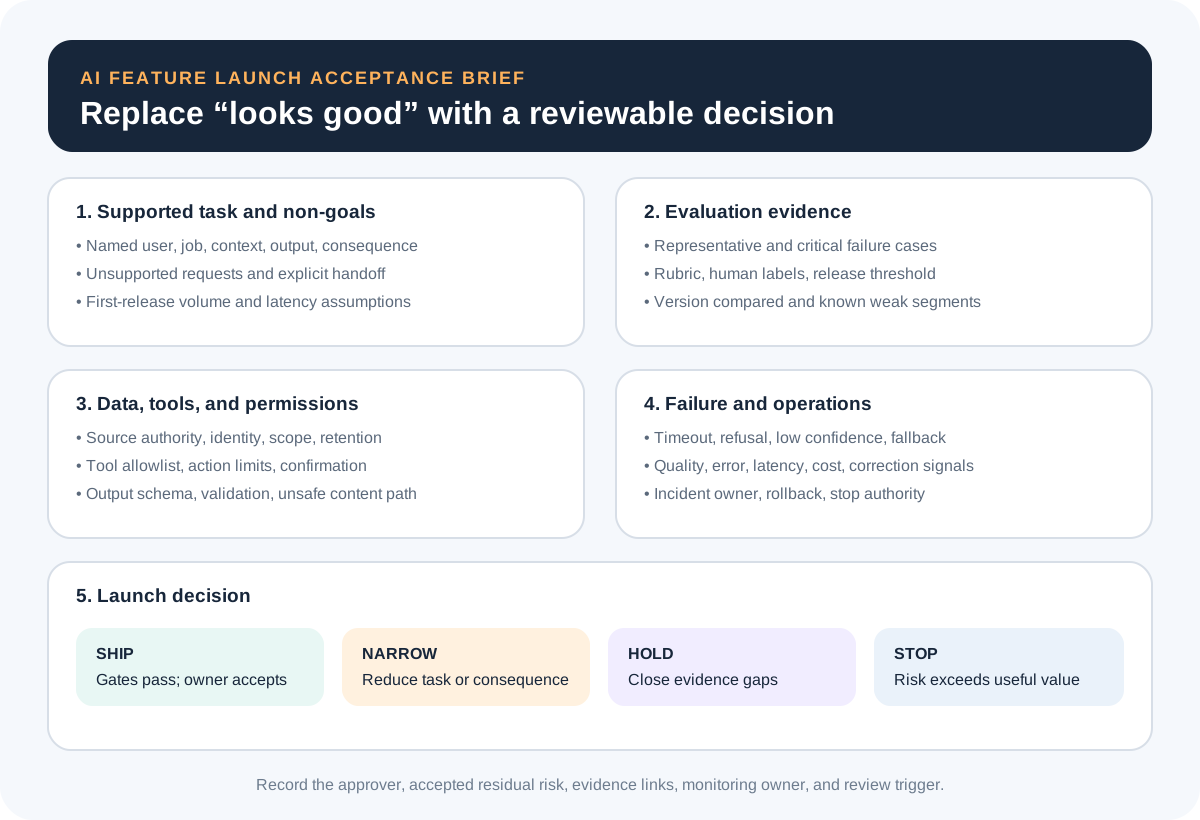
The decision may be ship, narrow, hold, or stop. Narrowing is often productive: remove a tool, require approval, reduce the supported task, limit sources, or preserve a manual step until stronger evidence exists. A smaller feature with an honest operating boundary is more useful than a broad promise the team cannot measure or recover.
AI feature production readiness FAQ
What makes an AI feature production-ready?
A production-ready AI feature has a narrow supported task, a representative evaluation set and release threshold, authorized data and tool boundaries, validated outputs, explicit fallback behavior, quality and operational monitoring, cost and latency assumptions, a rollback or shutdown path, and named owners for incidents and future changes.
How should a team evaluate a generative AI feature?
Start with real and adversarial cases for the supported task, define a rubric with observable pass conditions, establish human-reviewed reference labels where appropriate, track critical failures separately from average quality, compare prompt and model versions on the same set, and add production failures or corrections back into the evaluation set after privacy review.
Does every AI output need human approval?
No. The checkpoint should match the consequence and reversibility of the outcome. Low-impact suggestions may need user verification and easy correction; external messages, record changes, financial actions, or other consequential steps may need explicit approval, tighter validation, or deterministic execution outside the model.
What should happen when the AI feature is uncertain or unavailable?
Define a truthful fallback before launch: ask for missing information, limit the response to verified sources, return a deterministic result, queue the task, hand off to a person, preserve the existing manual workflow, or disable the feature. The product should not improvise a confident-looking answer when the safe path is to stop.
When should an AI feature launch as a pilot?
Use a pilot when the task is valuable but evidence is still limited. Restrict users, tasks, data, tools, volume, or consequences; monitor the five gates; define stop conditions; and state what evidence is required before expanding. A pilot is a controlled production boundary, not a label for missing safeguards.