Define the learning promise before choosing an LMS
A useful learning management system requirements checklist defines who learns, how they gain access, which content version they receive, what activity and assessment evidence is kept, who reviews exceptions, what completion or credential means, and how the record reaches the systems that need it.
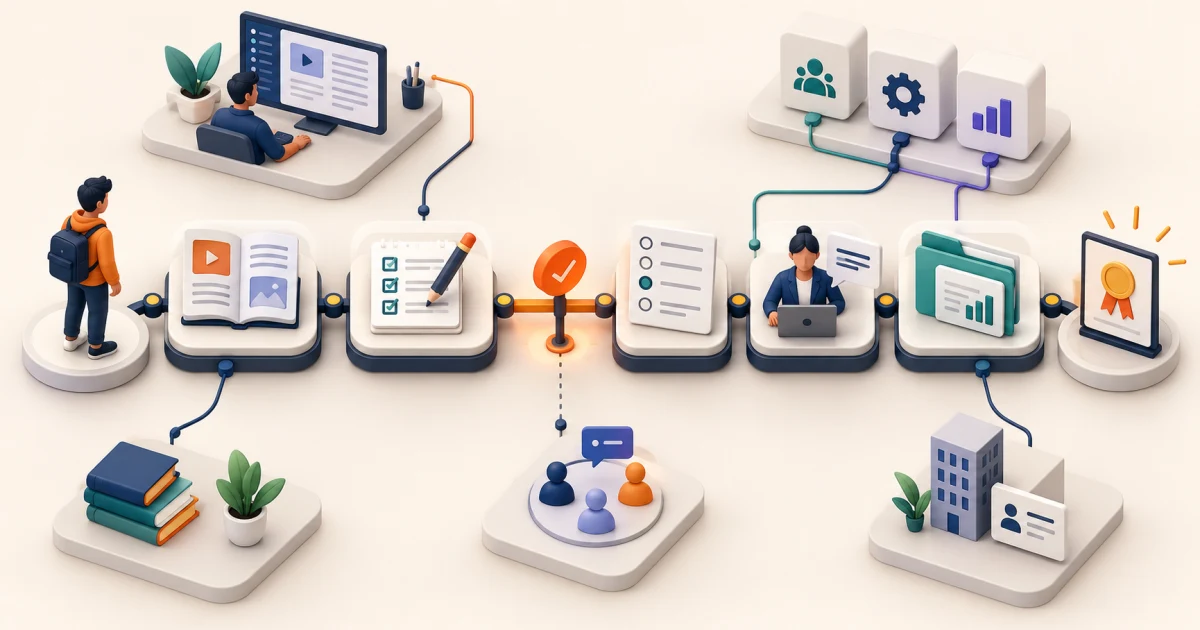
Start with one complete learning journey: enrollment, access, content, practice, assessment, instructor or manager review, completion, credential, reporting, and support. Include one failed launch, accessibility need, changed enrollment, repeated attempt, manual correction, and expired requirement. Use that journey to compare configuration, extension, and custom build.
A long feature list cannot tell you whether the platform preserves the right evidence. Attendance is not assessment; opening content is not completion; completion is not necessarily competence; and a certificate is not trustworthy unless its issuing rule and historical record remain explainable.
Write a learning evidence contract for one course
Choose a course that exposes the real operating model: several audiences, prerequisite content, an external activity, multiple attempts, an instructor-reviewed task, a completion deadline, and a credential that expires. Record the learner identity, tenant or organization, enrollment source, assigned path, content and assessment versions, access window, accommodations, attempt policy, completion rule, reviewer, credential, and downstream obligations.
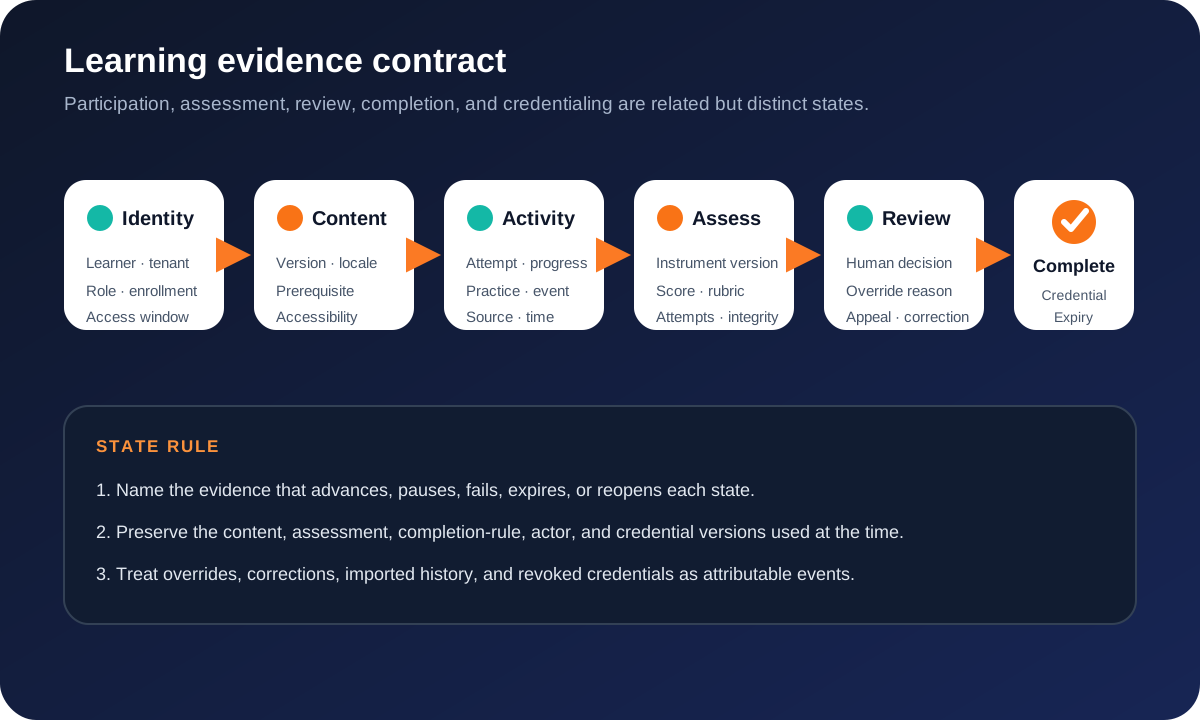
Define every state with entry evidence, allowed actions, owner, exit evidence, and recovery path. “In progress” might mean the learner opened a module, submitted one activity, or resumed an imported attempt. Those meanings should not be interchangeable. Treat not started, assigned, available, active, submitted, awaiting review, passed, failed, complete, expired, withdrawn, and corrected as business states rather than interface labels.
Version content, assessment, completion rules, and credentials. When a course or policy changes, decide whether existing learners stay on the assigned version, migrate with explicit equivalence, or restart affected work. A latest-only record can make yesterday's completion impossible to explain.
Cover the requirement lanes that complete the learning journey
Audience and access
Organizations, tenants, learners, instructors, managers, administrators, guests, age or region rules where applicable, identity, SSO, invitations, enrollment, entitlement, delegation, and offboarding.
Catalog and pathways
Catalogs, cohorts, programs, curricula, prerequisites, equivalence, due dates, recurring assignments, waitlists, approvals, recommendations, localization, and version-aware availability.
Content and delivery
Authoring ownership, pages, files, video, live sessions, external tools, packages, accessibility support, rights, captions, transcripts, progress, bookmarks, offline needs, and content retirement.
Assessment and review
Question banks, assignments, attempts, randomization where appropriate, rubrics, grading, instructor review, feedback, integrity controls, accommodations, appeals, corrections, and moderation.
Completion and records
Rules, evidence, credits, certificates, badges where justified, expiry, renewal, revocation, transcripts, manager attestations, imports, historical versions, exports, and verification.
Platform and operations
Permissions, audit history, notifications, search, integrations, APIs, analytics, privacy, retention, migration, performance, availability, backup, support, content governance, and change control.
Define scale in learning terms: active learners, organizations, enrollments, concurrent launches, courses, versions, languages, media delivery, assessment submissions, grade or activity events, reports, integrations, and administrator bulk actions. Use representative peaks and observable response or processing thresholds rather than an undefined promise to scale.
Separate product analytics from learning records. A clickstream can help improve the interface, while a completion or credential may carry a different purpose, retention period, access model, and correction process. Do not collect detailed activity simply because the platform makes it available.
Use standards as testable boundaries, not procurement badges
The 1EdTech LTI specification defines a standard way for learning platforms to integrate remote tools and content, including a security model for messages and service authentication. If LTI matters, test the exact tool registration, deployment, launch context, identity and role claims, deep links, grade exchange, retry, revocation, and error behavior you need. A checkbox does not prove the whole workflow.
Apply the same discipline to SCORM, xAPI, content packages, credential formats, or roster and grade interfaces. Record the required version and profile, who is producer and consumer, which identifiers must remain stable, how duplicates and corrections work, what is retained, and how conformance will be tested. ADL's LMS selection guide includes a requirements matrix approach; use standards as specific scored requirements inside that decision, not as a substitute for it.
Accessibility belongs in the core requirements. W3C's guidance for accessible learning management systems covers both an accessible authoring interface and support for authors producing accessible content. Test learner and author journeys with representative assistive technologies, content, media, assessments, tables, dialogs, time limits, and external tools. The related accessibility requirements guide provides a reusable method for assigning page, state, component, and evidence ownership.
Assign authority across the learning ecosystem
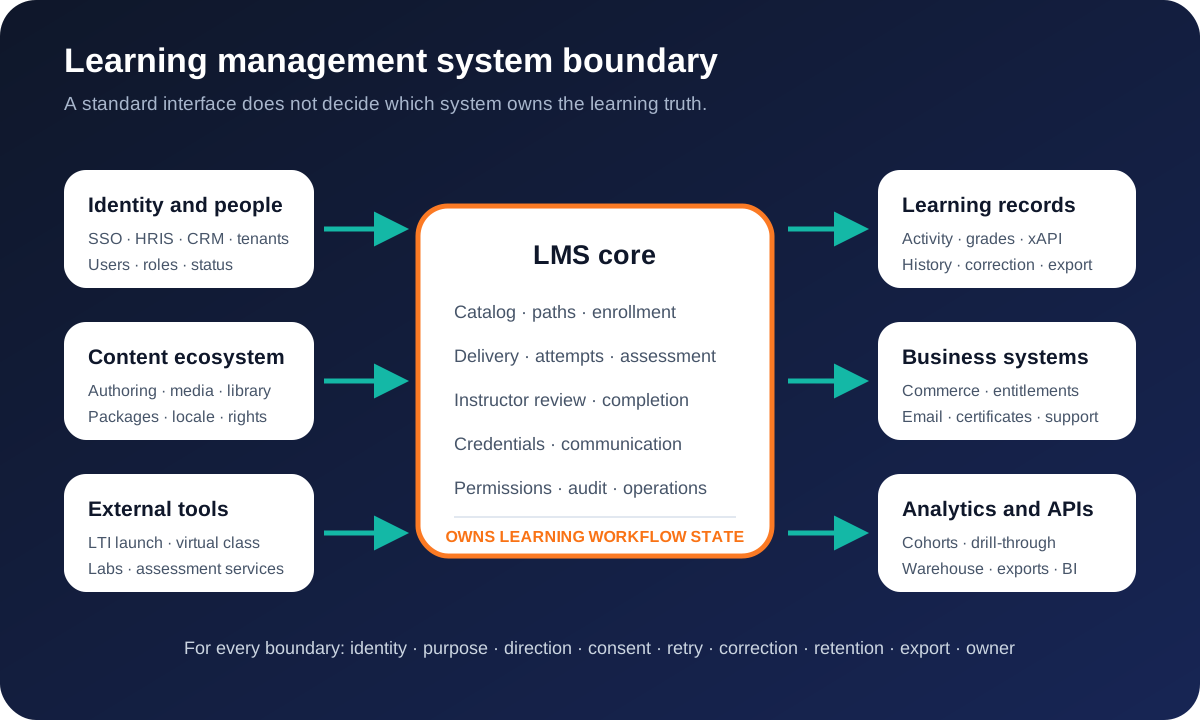
Name the authority for people, organizations, roles, employment or customer status, catalog, content source, enrollment, entitlement, activity, scores, completion, credentials, commerce, communication, and analytics. One person may have several identities across HR, CRM, SSO, partner, or ecommerce systems; define the matching and correction process instead of silently merging records.
For each integration, record purpose, stable identifiers, fields, direction, trigger or cadence, consent where needed, ordering, idempotency, retries, corrections, retention, monitoring, reconciliation, export, and owner. When enterprise identity is part of the scope, the SaaS SSO requirements checklist goes deeper on tenant discovery, provisioning boundaries, session controls, recovery, and administrative ownership.
Build reports from explicit learning definitions. Completion rate needs a population, assignment date, due-date policy, withdrawal rule, late-event rule, time zone, version treatment, exclusions, and drill-through. Keep an accountable correction path when an upstream identity, enrollment, content version, or grade was wrong.
Configure, extend, or build from the real differentiator
Configure
A mature LMS fits the audience, content, assessment, accessibility, credential, reporting, tenancy, and operating model with manageable administration.
Extend
The core LMS works, but a branded portal, enrollment workflow, integration, instructor tool, report, migration utility, or product surface is missing.
Build
The learning experience or commercial model is itself the product and creates durable value that packaged constraints repeatedly undermine.
Compare options with the same learning journey, content, users, integrations, and expected evidence. Include licenses, active or registered user rules, storage and media delivery, migration, implementation, authoring, integration tiers, support, administrator effort, accessibility remediation, upgrades, exports, and exit—not only the initial subscription or build.
A focused SaaS platform or custom web application can own a differentiated learning product or portal while standards-based services handle commodity delivery. Custom development is harder to justify when ordinary configuration or a smaller integration closes the actual gap.
Run a difficult-course pilot before migration or build
- Select one representative journey. Include the audiences, enrollment source, content types, assessment, review, completion, credential, and report that matter most.
- Prepare controlled samples. Use a real but safe content package, learner set, role matrix, historical records, and expected outputs.
- Test every role. Complete learner, instructor, manager, administrator, support, and auditor tasks with representative accessibility needs.
- Break the journey. Fail a launch, change an enrollment, exhaust attempts, interrupt an assessment, delay a review, duplicate an event, and take an integration offline.
- Correct the record. Amend an identity, score, completion, and credential without erasing the original event or losing downstream traceability.
- Prove operations. Run bulk administration, notifications, reports, exports, monitoring, backup or restore evidence, support escalation, and a content-version change.
- Write the decision. Record which needs are configuration, extension, integration, custom product scope, process repair, or deliberately out of scope.
Keep the first release narrow enough to verify. One audience, learning journey, content pattern, assessment route, credential, and reporting loop can expose the hardest boundaries without prematurely rebuilding a complete learning ecosystem.
Learning management system requirements FAQ
What should an LMS requirements checklist include?
Include audiences and tenancy, identity and roles, enrollment, catalogs and learning paths, content authoring and standards, delivery, accessibility, assessments, attempts, grading, instructor review, completion and credentials, communication, integrations, reporting, automation, privacy, security, migration, support, exports, retention, and measurable acceptance scenarios.
Should an organization buy, extend, or build an LMS?
Buy and configure when a mature platform fits the learning model and operating needs. Extend when the core LMS works but a portal, workflow, integration, report, or branded experience is missing. Build only when a distinctive learning product or business model creates durable value and the team can own accessibility, security, standards, content operations, support, and ongoing change.
Do SCORM, xAPI, or LTI compliance claims prove LMS fit?
No. Standards claims are shortlist signals. Buyers should test the exact content packages, tool launches, identities, roles, grade or activity exchanges, retries, corrections, exports, and security profile they need. Conformance to one interface does not prove the complete learning workflow, accessibility, reporting, or operating model.
How should an LMS be tested before selection or launch?
Run representative learner, instructor, administrator, manager, and support journeys using real sample content. Include enrollment changes, accessibility tasks, failed launches, multiple attempts, manual review, late completions, expired credentials, integration outages, data corrections, exports, restore checks, and historical reporting.