Define the evidence loop before comparing QMS features
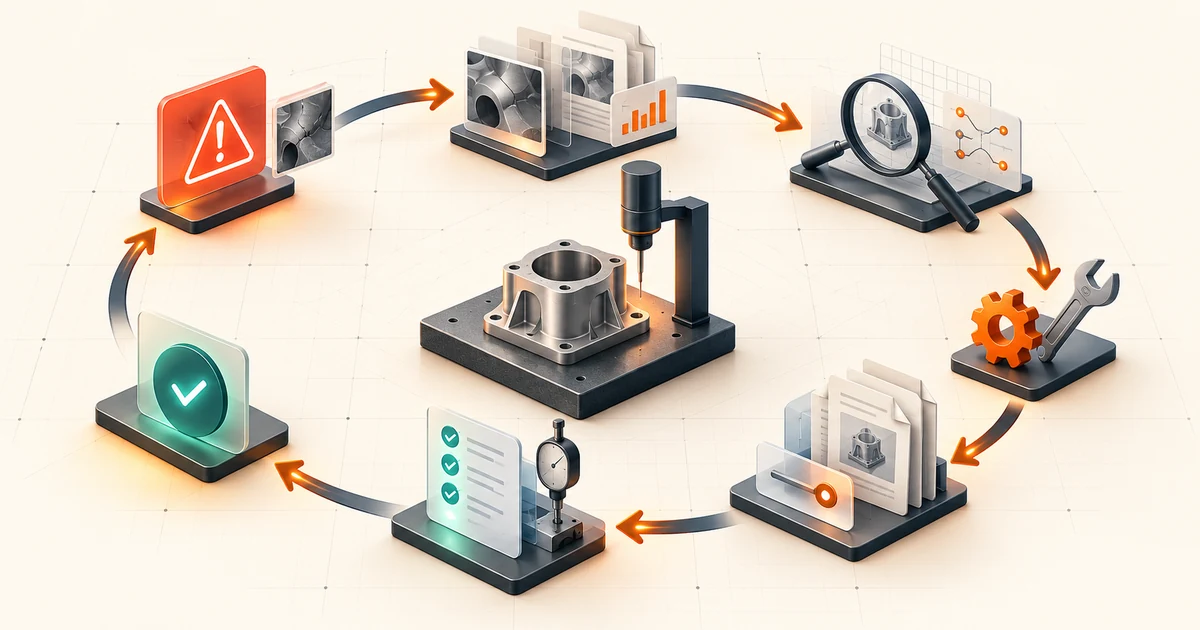
A useful quality management software requirements checklist defines how an issue is detected, contained, investigated, corrected, changed, verified, closed, trended, and retrieved as evidence. It must also define the identities, versions, permissions, approvals, timestamps, system boundaries, and recovery paths that keep those decisions trustworthy.
Cover quality events, nonconformance, complaints, audits, corrective action, controlled documents, change, training, supplier quality, equipment or calibration links, risk, reporting, records, integrations, migration, validation, and administration. Then test the shortlist with one difficult evidence chain instead of scoring feature names in isolation.
Write a quality event contract for one representative issue
Choose an event that crosses several controls: a customer complaint tied to a lot, an out-of-specification result, a supplier defect, a failed inspection, an overdue calibration, a service escape, or an audit finding. Record the product or service, item and lot where relevant, process, site, equipment, supplier, customer, source, time, evidence, severity, potential scope, immediate control, owner, and current decision state.
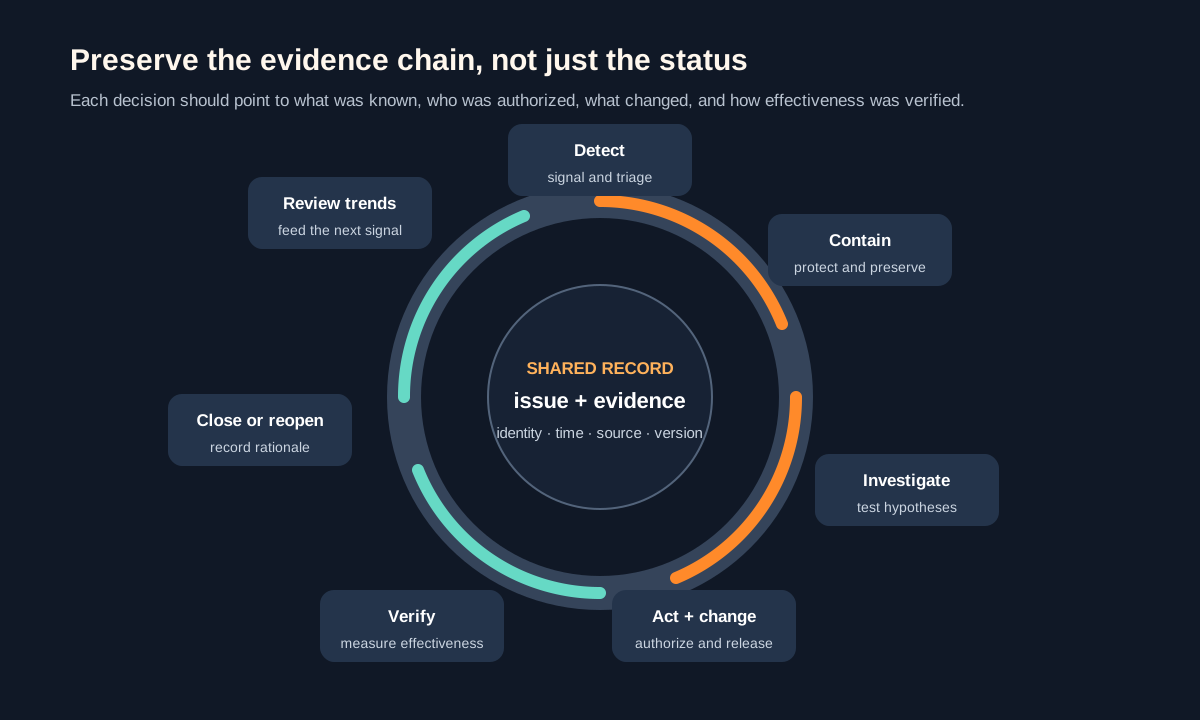
Keep facts, hypotheses, decisions, and actions distinct. A complaint is a signal, not automatically a confirmed defect. A suspected cause is not a verified root cause. Containment protects the customer or process now; corrective action changes the system; an effectiveness check tests whether the intended result persisted. Software should make those distinctions visible without forcing one universal process onto every event.
The current ISO 9001:2026 overview describes a process approach with documented information, controlled operations, performance evaluation, and improvement. It does not turn a generic software feature list into your QMS. Translate applicable standards, regulations, customer commitments, internal procedures, and risk decisions into your own evidence contract with qualified quality specialists.
Cover the requirement lanes that complete the quality loop
Event intake and triage
Source, event type, affected product or service, lot or case, attachments, duplicate detection, severity, reportability flags, routing, acknowledgement, containment, and escalation.
Investigation and decisions
Problem statement, scope, evidence requests, interviews, tests, hypotheses, causal analysis, review, conclusion, linked risks, justification, and reopening.
Actions and change
Correction, corrective action, owner, due date, dependencies, approval, affected process, controlled document, system change, supplier response, release, and rollback.
Verification and closure
Effectiveness method, baseline, measure, sample or interval, result, independent review where needed, failed-check branch, closure authority, and trend category.
Assurance processes
Audit program, plans, findings, supplier quality, complaints, inspections, training and competence, equipment or calibration references, management review, metrics, and recurring signals.
Platform controls
Roles, segregation, delegation, signatures, audit history, notifications, search, reporting, retention, export, privacy, integrations, configuration, validation evidence, migration, backup, and recovery.
Do not force every event through the largest workflow. Define event classes and escalation rules. A minor internal correction may need a short controlled record; a systemic issue may need cross-site scope, risk review, formal investigation, several actions, controlled change, training, regulatory assessment, and an independent effectiveness review. The system should preserve why the route changed.
For medical-device manufacturers in scope, the FDA says its Quality Management System Regulation became effective on February 2, 2026 and incorporates ISO 13485:2016 by reference. That is a sector-specific legal context, not a template for every organization. Regulated teams should map their exact products, jurisdictions, records, validation, signature, and inspection duties with qualified specialists before selecting software.
Connect documents, training, and change without hiding lineage
A quality event may reveal that a procedure, specification, work instruction, inspection plan, form, training assignment, supplier control, equipment setting, or software rule must change. Define the controlled object, owner, current approved version, proposed revision, review route, approval, effective date, obsolete status, distribution, acknowledgement or competence need, and evidence that the change reached the intended process.
Do not overwrite history. The event should retain the version that governed when it occurred, while the action links to the approved successor and its release. If an investigation is reopened after a procedure changes, a reviewer must still see which evidence and rules informed the original decision. Thedocument management requirements guide goes deeper on version lineage, authoritative records, access, retention, and retrieval.
Define electronic signatures by meaning, not appearance. Name which decisions require a signature, signer role, identity and authentication, displayed intent, timestamp, record version, delegation, refusal, invalidation, and export evidence. A drawn mark or approval button is not a complete signature control.
Training is also more than “assigned” and “complete.” Specify who is affected by the change, required competence, due date, material version, delivery method, assessment or observation, exemption, overdue handling, supervisor visibility, and the rule for performing work before completion.
Assign sources of truth across the QMS boundary
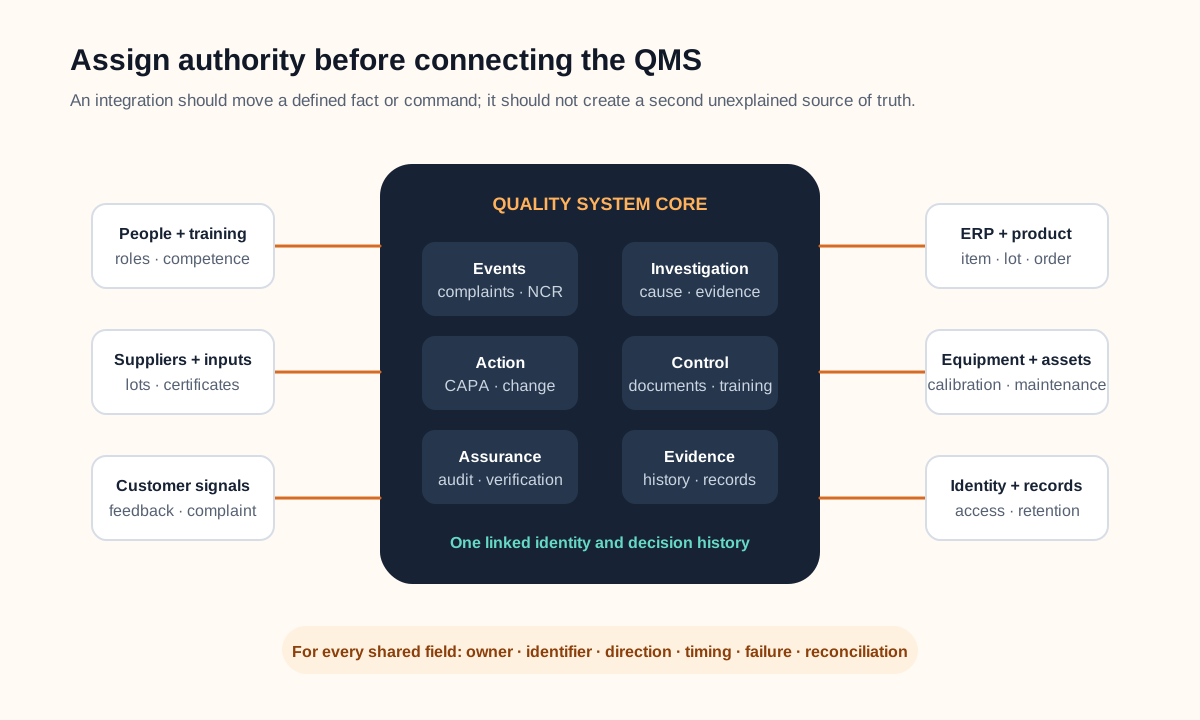
The QMS rarely owns every fact. ERP or product systems may own items, lots, suppliers, orders, and customers. Maintenance or calibration systems may own asset state. Identity systems own accounts and groups. Document platforms may own working files. Data platforms may calculate trends. The QMS should reference authoritative identities and preserve the quality decision made from a known version of those facts.
For each integration, define the source and target identifier, authoritative owner, direction, timing, expected latency, validation, duplicate behavior, deletion or deactivation, retries, alert owner, reconciliation report, manual repair, and retained evidence. Use the API integration requirements checklist for message contracts and recovery scenarios.
Audit history needs an event policy. NIST's audit and accountability guidance describes selecting event types and record content to meet an organization's auditing needs. Apply the same discipline here: decide which views, edits, state changes, approvals, delegations, exports, configuration changes, permission changes, and integration actions matter; then define actor, time, object, old and new value where appropriate, reason, and protection from ordinary editing.
Choose buy, extend, or build from the control gap
Buy and configure
Choose this when the operating model fits a maintained product and the gaps can be handled by configuration, procedure, or a smaller adjacent tool. Prove usability, reporting, export, implementation effort, and vendor operating boundaries.
Extend and integrate
Choose this when the QMS core fits but product identity, document control, equipment, supplier, analytics, or operator experience needs a governed extension. Keep the system of record and failure ownership explicit.
Build a focused workflow
Choose this when a narrow, valuable process is materially different and the organization can own validation, security, releases, support, records, and change. Avoid rebuilding a broad QMS when one integration or operator surface is the real gap.
Repair the process first
Choose this when event types, owners, approval authority, root-cause method, action rules, document control, or closure criteria are unresolved. Software will otherwise encode ambiguity and make reporting look more certain than the process is.
A custom portal or operator tool can be sensible when it narrows the daily interface while the QMS remains authoritative. A focused integration can remove duplicate entry without moving approvals. A dashboard can expose trend and workload without becoming the record. Leeonex's portal and admin development and API integration services can support those bounded delivery problems.
Use a one-event evidence-chain pilot worksheet
- Select a representative event with real cross-functional complexity and redact sensitive material where needed.
- Define the initial signal, affected identity, evidence, severity, scope, containment, notification, and triage deadline.
- Run an investigation with competing hypotheses, new evidence, an overdue task, a scope change, and a reviewer challenge.
- Create correction and corrective action, then link an approved document or system change and affected training.
- Fail the first effectiveness check, reopen the action, revise the plan, and preserve the decision history.
- Request an audit-ready view and export showing authority, timestamps, versions, evidence, linked records, and unresolved gaps.
- Interrupt an integration or notification, then prove monitoring, reconciliation, manual recovery, and duplicate safety.
Score each requirement as proven, unproven, failed, or not needed for the first release. Add an evidence request, owner, and blocker. The pilot passes when a reviewer can reconstruct what happened, why the organization acted, what changed, who authorized it, whether it worked, and what remains open.
Quality management software requirements FAQ
What should QMS software requirements include?
Include quality-event intake, classification, containment, nonconformance, complaints, investigation, root-cause evidence, corrective action, controlled change, effectiveness checks, document and record control, audits, training and competence, suppliers, risk, calibration or equipment links, traceability, permissions, audit history, notifications, reporting, integrations, migration, export, administration, validation, and recovery.
What is the difference between a QMS and document management?
Document management controls files, versions, review, approval, access, retention, and retrieval. A QMS also coordinates operational quality processes such as nonconformance, complaints, audits, investigations, corrective actions, change, training, supplier quality, verification, and management review. Document control is one boundary inside the wider quality system.
Should QMS requirements start from ISO clauses?
Applicable standards and regulations must be mapped, but software requirements should also follow the organization’s real processes, risks, records, decisions, and evidence. A clause-only checklist can miss cross-system identity, exception recovery, usability, migration, reporting, and operating ownership. Have qualified quality and regulatory specialists approve the final mapping.
How should QMS software be tested before rollout?
Rehearse difficult evidence chains: an incomplete complaint, a quarantined lot, a late investigation, conflicting root-cause hypotheses, an overdue action, a revised procedure, affected training, a failed effectiveness check, a reopened case, a supplier issue, and an audit request. Verify authority, timestamps, version lineage, permissions, notifications, integrations, exports, and recovery at every step.