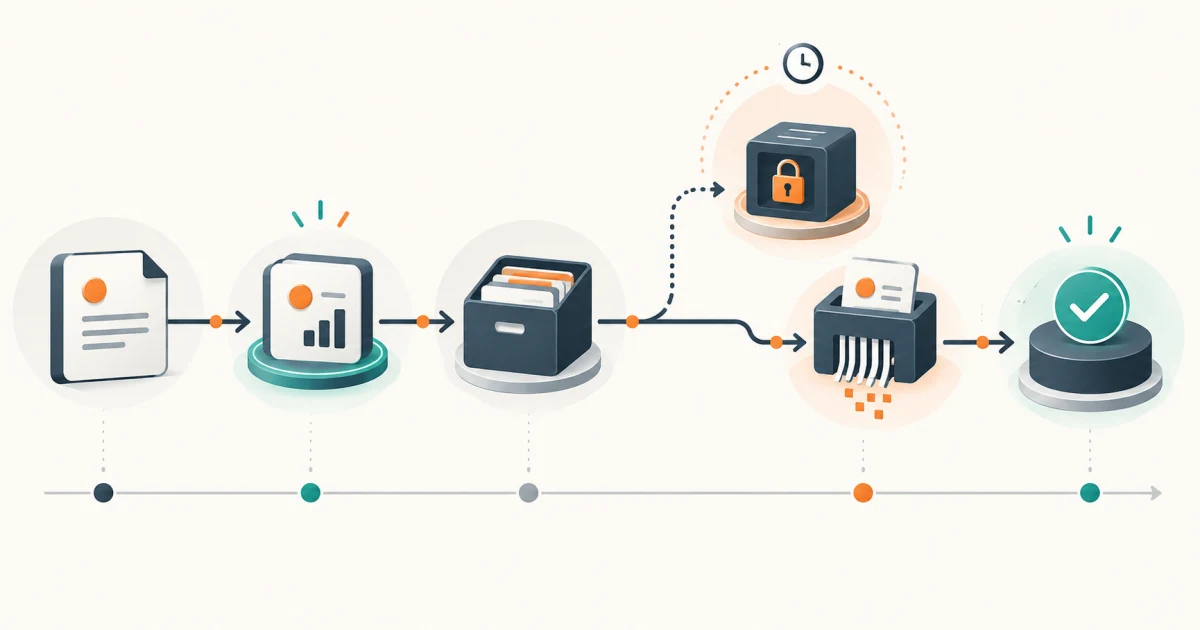
Retention is an executable data-lifecycle contract, not a table of dates
SaaS data retention requirements should identify each governed data class, why it is kept, who owns it, which event starts its clock, how long or under what rule it remains, which hold can pause disposition, what happens at expiry, where copies and derived data exist, and which evidence proves completion. A policy that cannot be mapped to product states, jobs, stores, restores, and operator decisions is not implementation-ready.
Start with one lifecycle: an end user leaves, a tenant cancels, a record reaches its expiry date, or an authorized erasure request is approved. Trace the relevant records through the primary database, files, search, caches, analytics, logs, integrations, exports, and backups. Then define the visible customer state, exception path, deadline, and proof for every copy.
This guide complements the SaaS backup and disaster-recovery checklist. Recovery protects availability; retention controls how long governed data remains and prevents a restore from reviving data that should no longer be active.
Give every retention rule eight explicit fields
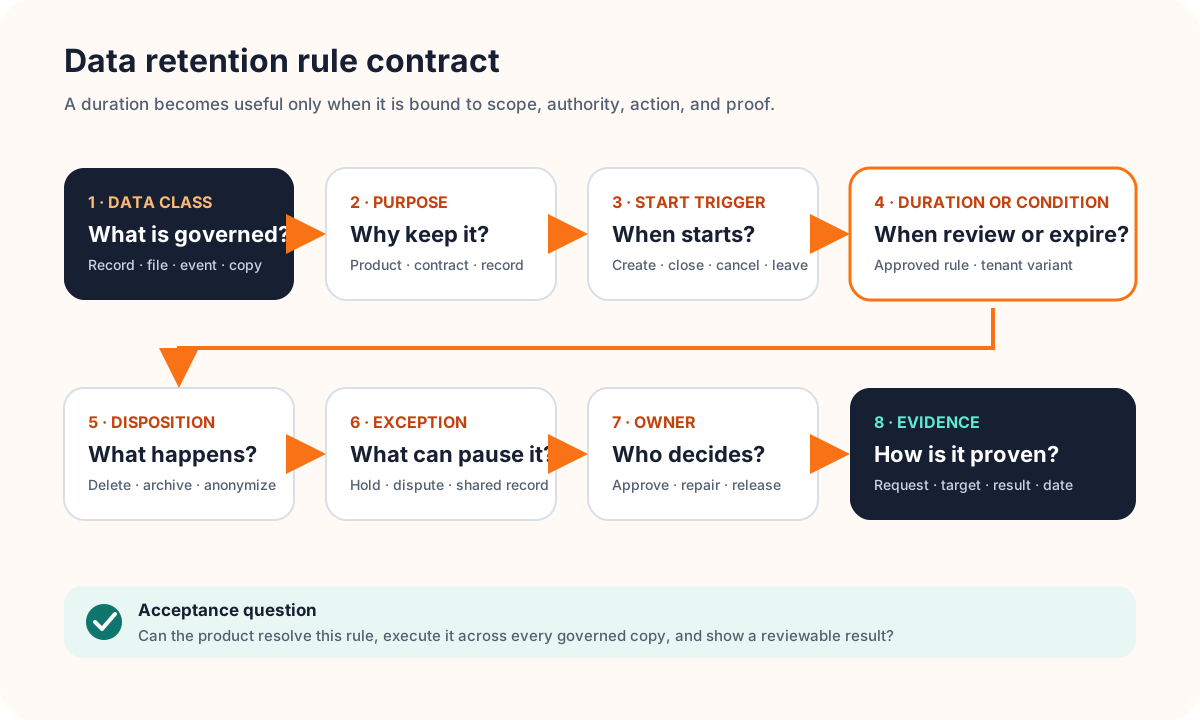
Write a rule as: data class, purpose, start trigger, duration or decision condition, disposition, permitted exception, accountable owner, and verification evidence. “Keep invoices for the required period” fails because the clock, jurisdiction, record boundary, authority, and final action remain unknown.
Do not invent retention periods in a product workshop. The EU GDPR, for example, states a storage-limitation principle rather than one universal number: identifiable personal data should not be kept longer than necessary for its purpose, subject to stated exceptions and safeguards. Use the official regulation text only as one input; contracts, sectors, countries, record types, security needs, and business obligations differ. Qualified owners must approve the actual schedule.
Inventory data by purpose and copy, not by database table
A useful inventory follows business meaning. Separate account identity, tenant configuration, business records, messages, files, payment references, support content, product analytics, security evidence, operational logs, exports, and trained or derived artifacts. The same field may appear in several contexts with different owners and clocks.
For each class, locate the authoritative record and every copy: replicas, object storage, search indexes, caches, queues, observability systems, warehouses, analytics tools, email, vendor systems, generated documents, user exports, and backup sets. Record the stable tenant or subject key that lets a controlled job find it. “We can query the main database” is not enough when a name remains searchable or a file remains downloadable elsewhere.
Keep retention separate from product status. Disabled, cancelled, archived, soft-deleted, queued for deletion, anonymized, held, and physically removed are different states. Name which state users see, which operations remain possible, and when an irreversible transition occurs. Microsoft's multitenant lifecycle guidance similarly distinguishes temporary deactivation from tenant offboarding and asks teams to define retention and re-onboarding behavior.
Cover eight SaaS retention requirement lanes
| Lane | Define | Acceptance evidence |
|---|---|---|
| Policy model | Data class, purpose, trigger, duration, disposition, exception, owner | Every in-scope class resolves to one approved and versioned rule |
| Identity and scope | Tenant, account, subject, record, file, derived and shared ownership | A request selects all and only the intended records |
| Lifecycle | Active, inactive, archived, held, queued, removed, anonymized states | Permitted actions and transitions are explicit for each state |
| Disposition | Delete, anonymize, aggregate, archive, transfer, or review | The final state cannot expose or reconstruct prohibited data |
| Copies | Files, search, caches, queues, logs, analytics, vendors, exports | Every governed copy reports completion or a named exception |
| Holds | Authority, scope, reason, access, review, release, conflict precedence | A hold pauses only authorized disposition and later resumes correctly |
| Recovery | Backup expiry, isolation, restore filtering, re-deletion, reconciliation | A restore does not silently reactivate expired records |
| Operations | Jobs, permissions, notices, evidence, alerts, retries, reporting, owners | A failed or overdue lifecycle action is visible and safely repairable |
NIST's Privacy Framework is intentionally jurisdiction-neutral, but its practical building blocks are useful: establish policies for review, transfer, alteration, and deletion; make data available for authorized review; and align the data lifecycle with the system lifecycle. The NIST Privacy Framework FAQ also warns that using a framework does not itself prove legal compliance.
Make deletion an idempotent, observable workflow
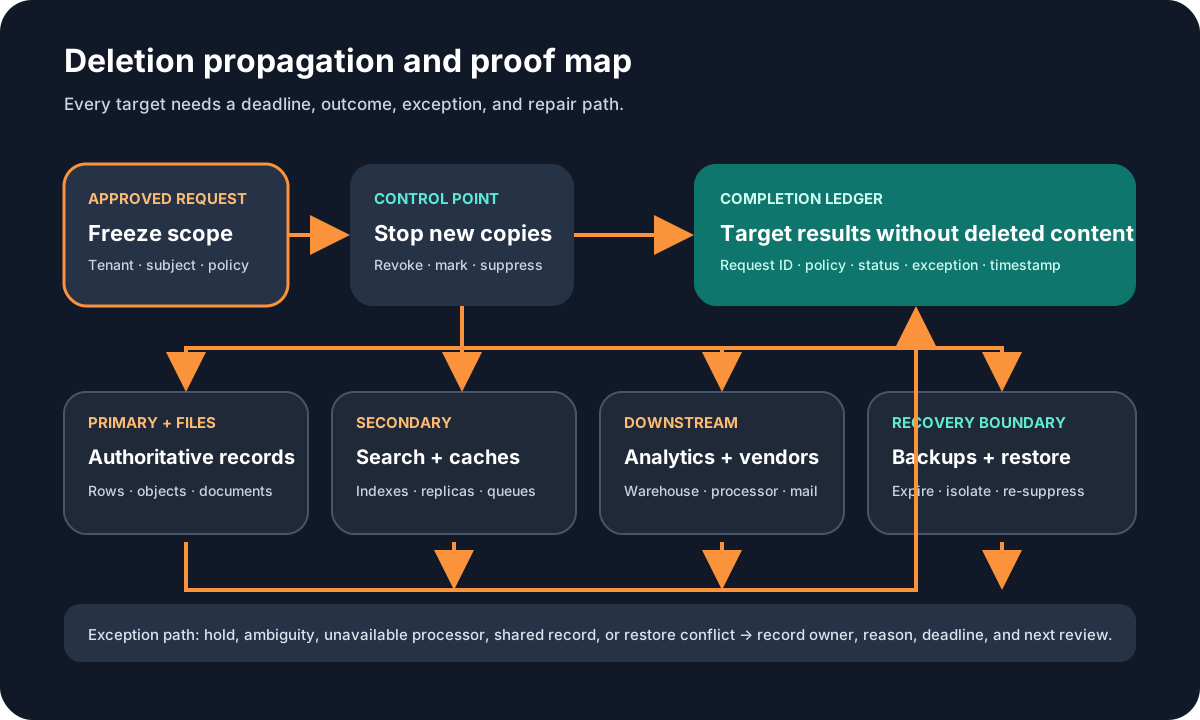
Give each approved lifecycle action a request ID, policy version, scope snapshot, approver, effective time, required targets, target-specific deadline, attempt history, result, exception, and completion state. Repeating the same request should not widen its scope or produce inconsistent side effects. New copies must not appear after the cutoff because a late queue or connector replayed old data.
Delete or transform in dependency order. Stop new processing, revoke access, mark the authoritative state, propagate to secondary stores and processors, verify results, and retain a minimal completion ledger that does not recreate the deleted content. Decide what happens when one vendor is unavailable, an identifier is ambiguous, or a shared business record cannot be removed without affecting another party.
For customer-controlled exit, pair the workflow with the SaaS customer data export checklist. Export and deletion need an explicit sequence, entitlement window, format, verification, and support path; neither should be an undocumented manual database task.
Model holds as governed exceptions, not permanent flags
A hold needs an authorized issuer, reason, legal or business basis, data scope, start, review date, permitted access, audit trail, release authority, and precedence over routine disposition. Protect the hold from ordinary administrators, but do not let it become an invisible “keep forever” switch.
Decide whether a hold preserves an immutable copy, blocks deletion of the live record, or stores a narrow evidentiary subset. Show authorized operators which rule is suspended and why, without exposing sensitive case details broadly. When the hold is released, recompute the disposition from the approved policy and original trigger rather than starting a fresh full retention period by accident.
Design backup expiry and post-restore controls together
Document which backups contain each data class, the backup clock, immutability and access controls, expiry, destruction evidence, restore environment, and tenant isolation. If an expired record remains inside a protected backup until that set ages out, state how it stays beyond ordinary use and how a restore prevents it from returning to production service.
The UK Information Commissioner's erasure guidance explains that backup handling depends on the retention schedule and technical mechanisms, and emphasizes clarity about what happens to backup copies. Treat that as regulatory guidance for its scope, not a universal implementation recipe.
Run a restore test with records that are active, expired, held, and deleted. Restore into isolation; replay the disposition ledger or suppression set; reconcile search, files, jobs, and downstream copies; then prove that only permitted data can re-enter active service. Microsoft's multitenant storage guidance makes the same architectural connection between recovery, tenant lifecycle, retention, and offboarding.
Use this one-lifecycle acceptance worksheet
- Trigger: Which event starts the lifecycle, who authorizes it, and when does it become effective?
- Scope: Which tenant, subject, record classes, identifiers, shared records, and derived artifacts apply?
- Rule: Which approved policy version, purpose, duration, disposition, and customer choice apply?
- Copies: Which live stores, files, search, caches, queues, logs, analytics, vendors, and exports exist?
- Exceptions: Which hold, dispute, security, financial, or shared-record condition can change the action?
- Recovery: What remains in backup, for how long, under which access, and what happens after restore?
- Evidence: Which request ID, target results, deadlines, alerts, ledger, and customer notice prove outcome?
- Owner: Who repairs failure, approves an exception, releases a hold, and reviews the rule later?
Use representative test data and negative cases: wrong tenant, reused identifier, delayed connector, partial failure, duplicate request, new copy after cutoff, active hold, and restore from an older backup. A small first implementation is credible when one complete lifecycle is policy-approved, automated where safe, visible to operators, and accepted with evidence.
If that lifecycle crosses product, admin, integration, and support boundaries, a focused SaaS platform development scope can define the minimum data model, jobs, controls, and operator tooling before engineering expands the feature set.
Frequently asked questions
What should SaaS data retention requirements include?
Include data classes and purposes, record ownership, the event that starts each clock, duration or decision rule, archive and deletion behavior, customer configuration, legal or investigation holds, tenant offboarding, derived data, logs, files, search, integrations, backups, restore controls, permissions, notices, evidence, monitoring, and named owners.
Is there one standard retention period for SaaS data?
No. Retention depends on the data, purpose, contract, jurisdiction, sector, customer commitment, security need, and approved exception. Product teams should not invent a universal number. Ask accountable legal, privacy, records, security, and business owners to approve the schedule, then make the software enforce and evidence it.
Does deleting a tenant mean deleting every record immediately?
Not necessarily. Deactivation, offboarding, end-user erasure, contractual deletion, record expiry, and an authorized hold are different events. Requirements should state what becomes inaccessible immediately, what is queued for deletion, what must be retained, what remains in backups, and how each exception is recorded and later released.
How should backups handle deleted SaaS data?
Define backup retention, expiry, access, restore isolation, and post-restore suppression or re-deletion. A restore must not silently reintroduce expired data into active service. Test the full sequence with representative tenant records and keep evidence of the result.