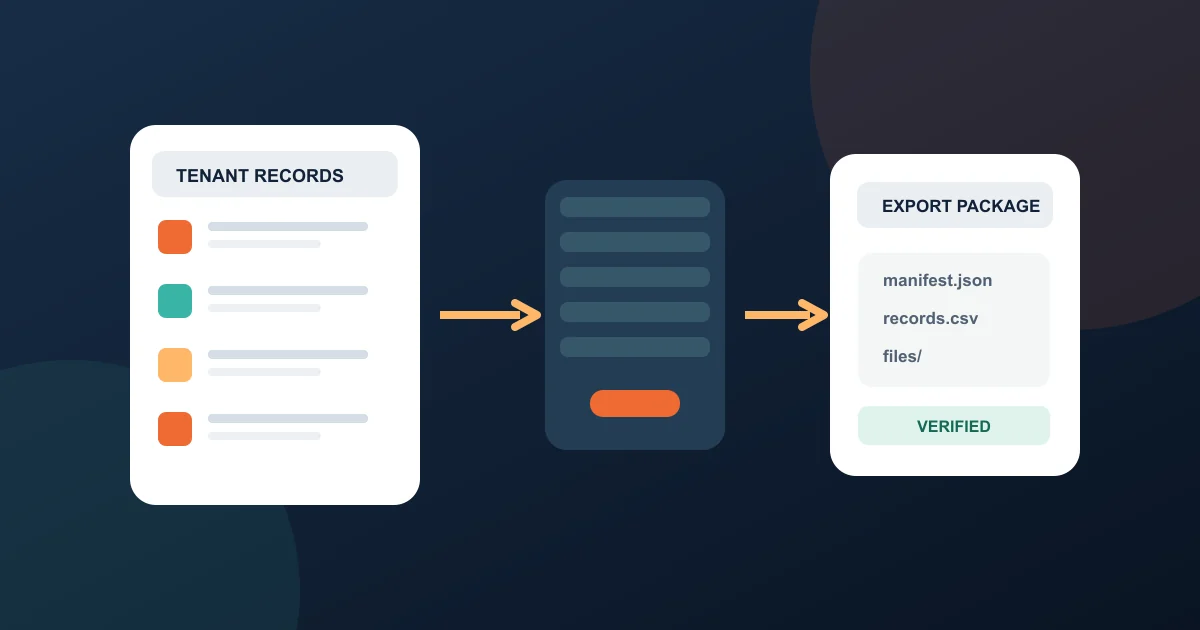
The short answer: specify a usable package, not an Export button
A SaaS customer data export requirement should state exactly which tenant records and files leave the product, how their relationships and meanings survive, who may request the package, how it is delivered and removed, and how someone proves it can be read without the original app. The acceptance test is a neutral import or inspection, not a successful download.
Picture a B2B team changing systems after several years. A CSV of account names is little help if project records refer to missing users, attachments are absent, or status codes have no dictionary. The product owner should first agree on what a customer can reasonably use and what must remain private to other tenants or the operator.
This guide addresses the product feature and engineering contract. A customer's rights under privacy law are a separate question. The European Commission explains that the GDPR portability right applies in particular circumstances to personal data concerning an individual. It is not a blanket definition of every field a B2B tenant must receive. Ask legal and contract owners to define the obligations for your product.
Make coverage a product decision
Start from the domain inventory, not database tables. List customer-created records, user identities relevant to interpreting those records, comments, uploaded files, links between entities, configurable rules, and activity history. For each class, record who owns the information, whether it is included, its format, and any contractual or privacy review. The same record may contain customer-entered text and operator-only fraud signals; exporting the row wholesale can cross a boundary.
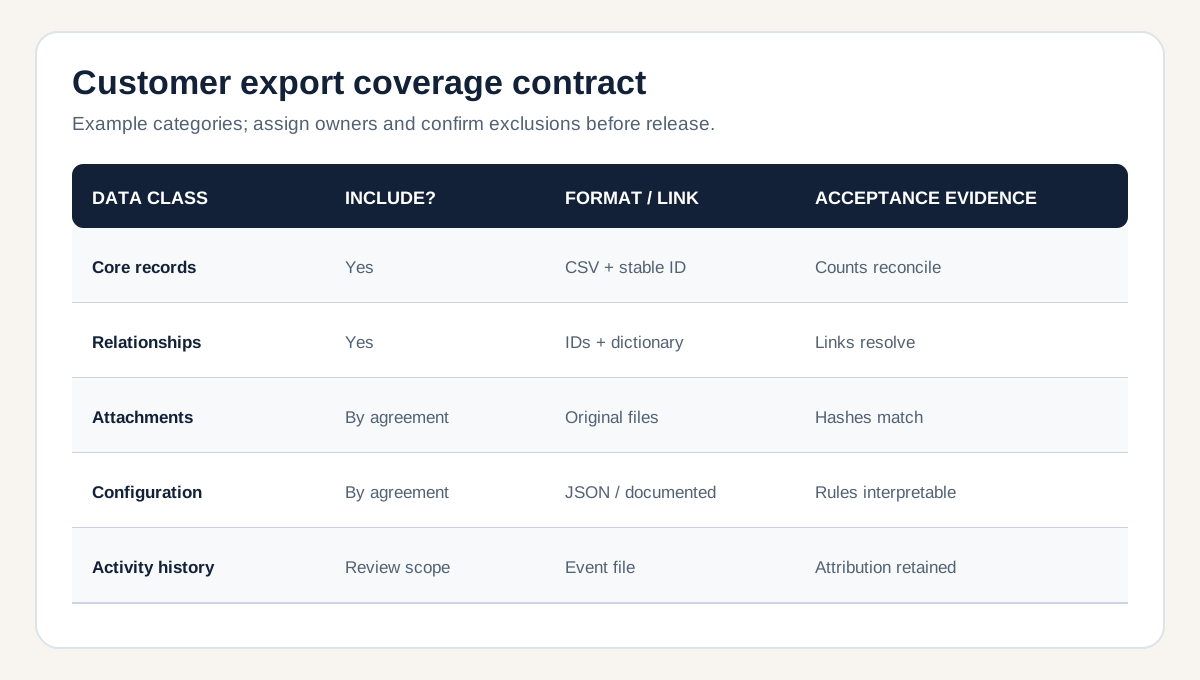
Use three labels for every field: include, exclude with reason, or resolve before launch. A vague “all customer data” statement hides work. Give special attention to deleted records, historical versions, metadata, linked organizations, and files stored outside the main database. Decide whether an export is a current snapshot, a selected date range, or a complete history.
Keep this distinct from disaster recovery. The SaaS recovery checklist concerns restoring the operating service after failure. A customer export must be interpretable outside that service. The two capabilities can share inventories, but they have different success tests.
Design the package so its meaning survives
Choose formats for the shape of the data. CSV is convenient for flat tables but does not itself describe foreign keys, nested values, file links, or code meanings. JSON may preserve structure, but a consumer still needs a schema. An archive can combine tables, original files, a manifest, and a data dictionary. Specify character encoding, timestamps with time zones, stable identifiers, null values, units, enumeration meanings, and schema version.
For a customer with projects, tasks, and attachments, one useful arrangement is a manifest listing package version and export time; separate project and task files with stable IDs; an attachment directory referenced by those IDs; and a dictionary explaining columns and statuses. That is an illustrative design, not a universal standard. The buyer should be able to join a task to its project and open the attachment without asking the original SaaS app to interpret it.
Define consistency, too. If the export runs while users keep editing, record the snapshot boundary or an agreed cutoff and document anything that changed afterward. Large datasets may need an asynchronous job with visible progress, failure, retry, and expiry. The first version may be operator-assisted if demand is rare, provided the manual path meets the same authorization, coverage, and verification requirements.
Protect the request and the temporary copy
An export endpoint is a bulk-read operation. Verify the requester's current tenant and role on the server, including every child record and attachment. Do not accept a tenant ID in a URL as authority. OWASP's API guidance explains why object-level authorization must be checked where data is fetched. In a multi-tenant product, an ordinary user should never be able to change an identifier and receive another account's package.
Agree on who can start an export, whether a second approver is needed, where the encrypted package is staged, how the requester is notified, how long the download is available, and when temporary copies are deleted. Log request, approval, creation, download, failure, and deletion events without copying secrets into the log. Rate-limit or queue repeated large jobs so one tenant cannot exhaust shared capacity.
If a customer asks for scheduled or API exports, treat that as a separate delivery path with credentials, rotation, monitoring, and a failure owner. The API integration requirements guide covers retry and reconciliation when another system consumes the data automatically.
Test the exit path with a neutral reader
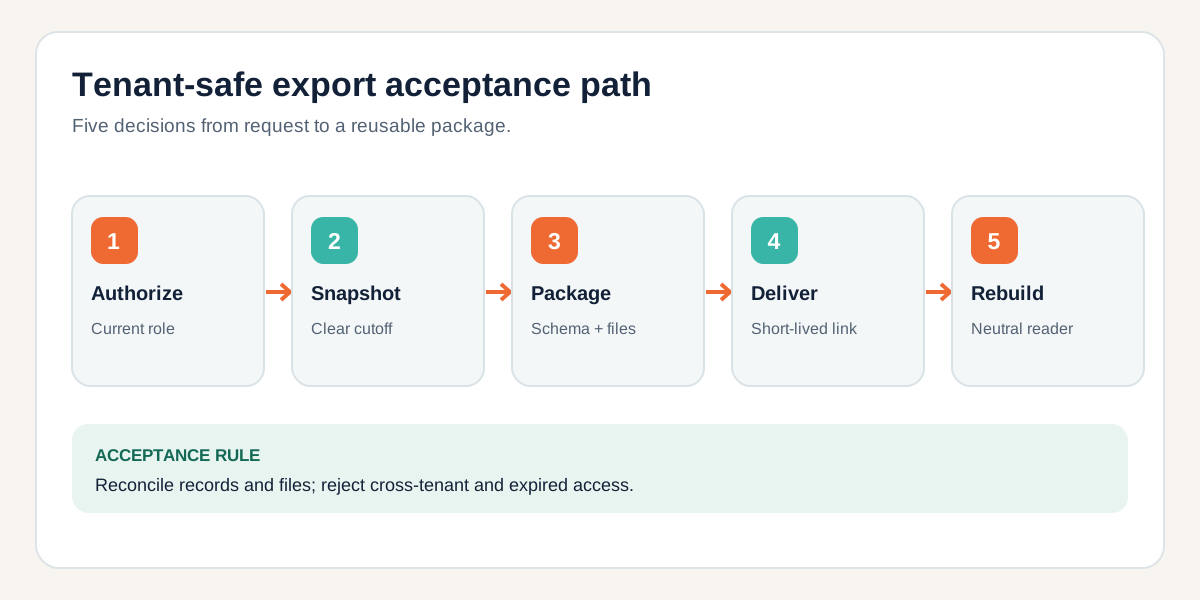
Run a representative test tenant with records at different lifecycle states, several roles, files, and linked entities. Count entities at the agreed snapshot, reconcile package counts, follow sample relationships, open files, and verify checksums or equivalent integrity evidence. Then give the package and documentation to someone who did not build the exporter. Can they reconstruct a useful view in a clean tool?
Test the forbidden cases as carefully: a member without export permission, a revoked administrator, a guessed job ID, a cross-tenant attachment, a deleted account, and an expired download link. Confirm partial jobs do not present a misleading “complete” package. A provider's storage success log only proves a file was created; it does not prove content completeness.
Write down the observation and owner for every failed check. Re-run the neutral-reader exercise when the data model changes materially. This is especially important when the product adds a new module that the export inventory did not originally cover.
A first-release export brief you can hand to a team
- Purpose: name the customer request and whether it is a self-service download, assisted exit, or recurring integration.
- Boundary: list included record classes, files, history, configuration, explicit exclusions, and review owners.
- Package: specify formats, schema version, keys, manifest, documentation, cutoff, and maximum expected size.
- Control: name requester roles, approvals, staging location, link expiry, deletion, event log, and capacity limits.
- Proof: name reconciliation counts, cross-tenant denial cases, neutral reader, and release acceptance owner.
Take this brief into a scope discussion before estimating screens or background jobs. Leeonex's MVP and SaaS development service can help design the product boundary and first implementation slice. The related SaaS permissions guide helps define which roles can initiate a bulk data operation.
When the export is part of a complete customer exit, continue with the SaaS customer offboarding control concept. It places this package inside a broader authority, access cutoff, retention, deletion, exception, and closure-evidence workflow. It is an educational concept, not a client project, completed deletion, legal opinion, or measured result.
SaaS customer data export FAQ
Is a CSV download enough for a SaaS customer data export?
Only when the product's relevant data is genuinely flat and the file preserves all fields the customer needs. Relational records, attachments, history, and configuration usually require multiple files, stable identifiers, and a documented manifest or schema.
Should a SaaS export include audit history?
Decide this explicitly with product, security, and contract owners. If the customer needs attributable history to interpret a record or meet an agreed exit obligation, include the applicable events and their field definitions. Exclude internal security telemetry or third-party data unless there is a clear basis to share it.
How do we prove that an export is complete?
Define expected counts and relationship checks for an agreed snapshot, verify attachments and checksums, and load a sample into a neutral environment using only the package documentation. Test denied and cross-tenant requests as well as the successful path.