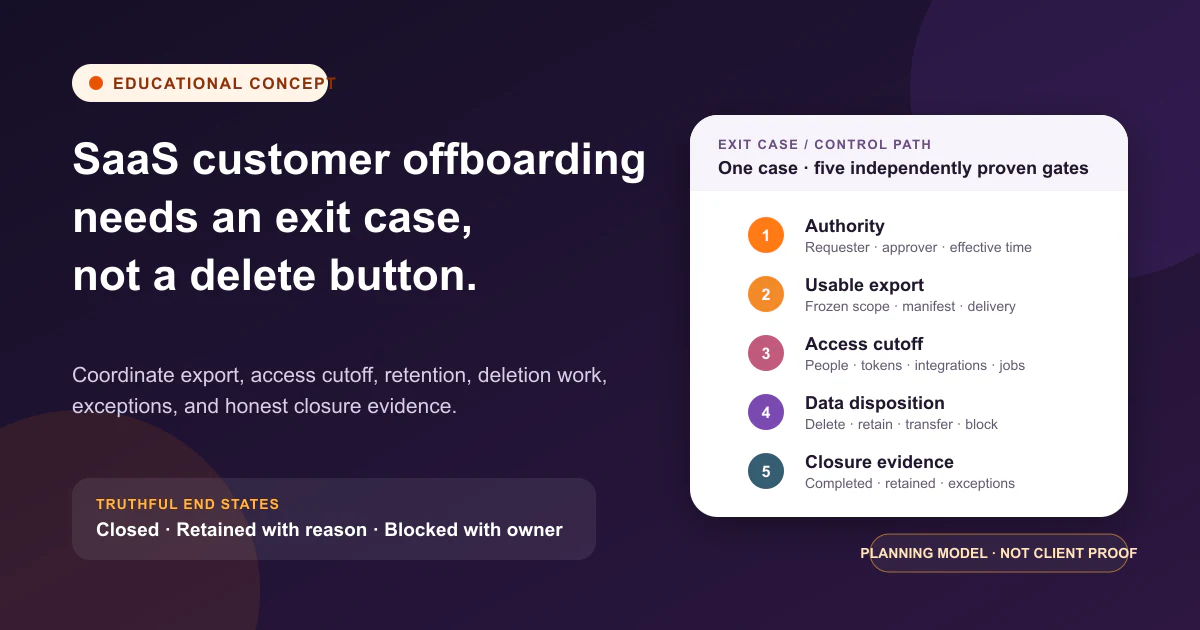
The short answer: close one exit case, not just one account
Scope SaaS customer offboarding as one versioned exit case with an authorized requester, effective time, frozen tenant scope, usable export, separate human and machine access cutoff, record-level retention decisions, idempotent deletion work, and a closure packet that says what completed, what remains, why it remains, and who accepted any exception. Never let one “deleted” flag stand in for all of those facts.
Cancellation, deactivation, termination, retention, and deletion are related but not interchangeable. A subscription may end while API tokens still work. A workspace may be hidden while scheduled jobs continue. Primary records may be removed while invoices, security logs, backups, or legal-hold material remain under a different rule. The product should make those boundaries visible rather than compressing them into a promise it cannot prove.
Evidence boundary
This is a Leeonex-authored educational concept. The company, dialogue, workflow, states, counts, diagrams, controls, and evidence packet are illustrative. They do not describe a client engagement, production product, completed export, access revocation, deletion event, security assessment, legal review, launch, or measured outcome.
The starting situation: cancellation exists, but accountable offboarding does not
The intended buyer runs a B2B SaaS product with real tenant accounts, users, files, integrations, subscription state, and operational history. Customers can cancel through billing or support, but the work after cancellation is distributed across tickets, scripts, vendor consoles, identity settings, and team memory. Nobody owns the complete end state.
The trigger may be voluntary cancellation, contract expiry, non-payment, policy breach, merger, migration, or a privacy request. Those reasons can change notice, appeal, export, retention, and reactivation rules. The product must preserve the reason and authority without pretending one workflow fits every exit.
Illustrative conversation
This fictional composite helps a buyer recognize a common scoping problem. It is not a client quotation, transcript, testimonial, or record of a Leeonex engagement.
SaaS product lead
“When a customer cancels, support disables the workspace and asks engineering to delete the data. Can we make that a self-service button?”
Leeonex
“Who is allowed to request the exit, what must the customer receive first, and which identities, tokens, integrations, records, files, logs, invoices, and backups follow different rules?”
SaaS product lead
“Those steps sit in different tools. We can close the subscription, but we cannot show that every access path ended or explain what remains afterward.”
Leeonex
“Then the smallest useful product is not a delete button. It is one accountable exit case that coordinates export, access cutoff, retention decisions, deletion work, exceptions, and honest closure evidence.”
Four roles keep the exit accountable
Customer authority owner
Defines which tenant roles may request, approve, cancel, or challenge an exit and how authority is rechecked at the effective time.
Product and support owner
Owns the customer-facing sequence, notice, export handoff, exception communication, reactivation boundary, and support playbook.
Platform owner
Owns lifecycle states, tenant-scoped jobs, credentials, integrations, idempotency, retries, observability, and technical acceptance evidence.
Policy owner
Defines applicable retention and deletion rules with legal, privacy, finance, security, and contractual input rather than asking code to invent policy.
One person may hold more than one role in a smaller company, but no responsibility should disappear. Engineering cannot infer legal retention from a database schema, and support should not certify deletion from a closed ticket.
The core flow: one case coordinates five independently proven gates
Create the exit case before destructive work begins. Give it a stable identifier, tenant boundary, request source, requester, approver, reason, policy version, commercial effective date, technical execution window, and current state. If the request is withdrawn or blocked, preserve that decision rather than deleting the case history.
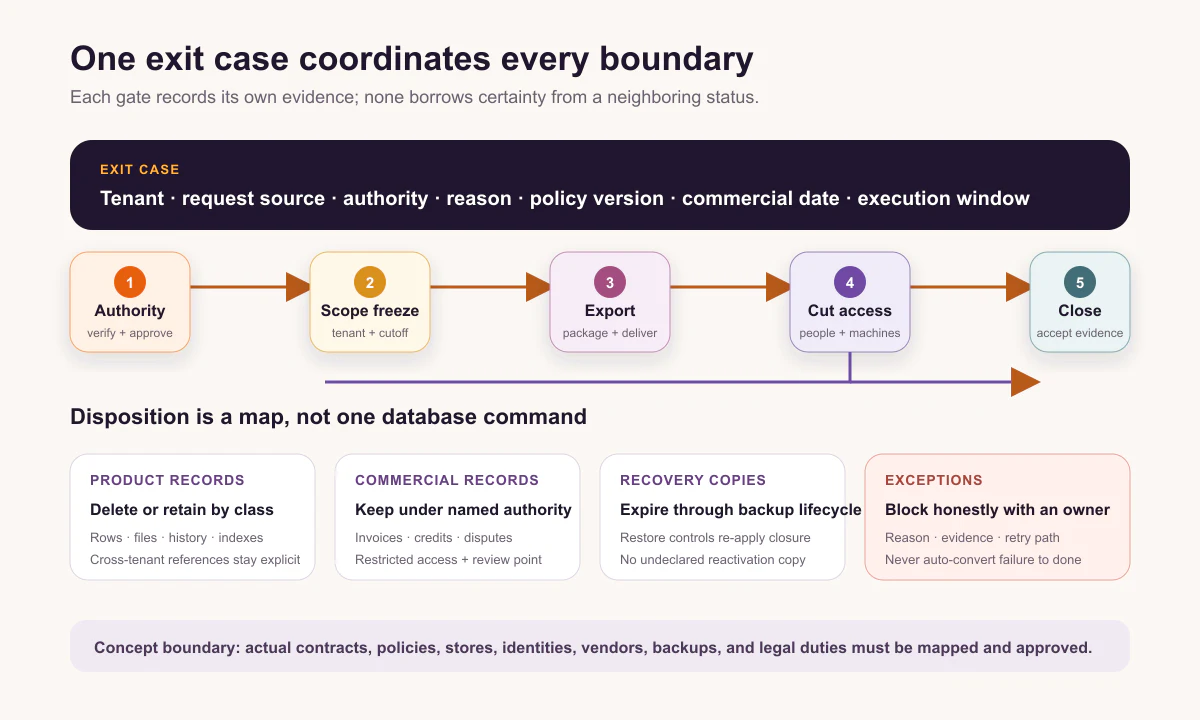
Authority
The requester, approver, tenant, effective date, reason, and any notice or cooling-off period are explicit.
Export
The agreed customer package has a frozen scope, snapshot boundary, reconciliation checks, delivery evidence, and expiry.
Access cutoff
People, sessions, service accounts, API keys, webhooks, SSO links, support impersonation, and scheduled jobs are addressed separately.
Disposition
Each data class is deleted, retained under a named rule, transferred, anonymized where valid, or blocked with an owner.
Closure evidence
The case closes only with completed checks, retained-item explanations, unresolved exceptions, and a named acceptance owner.
Export and access cutoff need an explicit order. A customer may need temporary read access while an export runs, or the product may freeze writes at the effective time and deliver an asynchronous package later. Choose the contract deliberately. Do not leave a full administrator session open merely because the export job is slow.
The SaaS customer data export requirements guide explains coverage, packaging, secure delivery, and neutral inspection. This concept starts one level higher: it shows how that export fits into the complete customer exit and why a successful download is not closure.
The smallest useful scope is assisted offboarding with product controls
Do not begin with a universal self-service delete button. Start with one eligible customer type, one exit reason, one tenant boundary, one export contract, and a controlled operator queue. The product should enforce state transitions and record evidence; trained owners may still approve exceptions and run unusual vendor steps manually.
| Build for the first release | Keep outside the first release | Why |
|---|---|---|
| Versioned exit case and state transitions | One-click deletion for every termination reason | Preserve authority and policy differences before adding autonomy. |
| Tenant-scoped export with acceptance checks | Scheduled exports and every historical format | Prove one useful package before multiplying delivery modes. |
| Human and machine access inventory | Organization-wide identity redesign | Close product-specific paths without hiding a larger IAM project. |
| Data-class disposition map and job evidence | Unsupported claim that every copy disappears instantly | State retained, delayed, blocked, and deleted work honestly. |
Build now
- Authorized request and approval record
- Effective-date and scope freeze
- Export job, manifest, delivery, and expiry
- Session, token, service-account, and integration cutoff
- Data-class disposition tasks with retries
- Exception queue and closure packet
Defer deliberately
- Every jurisdiction and contract variation
- Automatic legal-hold interpretation
- Instant purge from immutable backups
- Arbitrary customer-selected export schemas
- Self-service restoration after closure
- Deletion certificates that exceed available proof
Implementation choices: preserve authority, idempotency, and an inspectable trail
Model the exit as a state machine rather than a loose series of background jobs. Useful states may include requested, authority verified, scheduled, export preparing, export delivered, access cutoff, disposition running, exception review, closed, and cancelled. State names should describe facts, not optimism. “Deletion requested” and “deletion verified” must not collapse into the same state.
Every worker should accept the exit-case identifier and a frozen tenant scope, produce a durable result, and be safe to retry. A repeated revocation should not recreate access. A repeated export job should not silently shift to a newer snapshot. A repeated deletion request should not lose the original evidence or convert a blocked item into success.
Separate the system boundaries
- Identity: expire sessions, revoke recovery paths, remove SSO assignments where owned, disable service accounts, rotate shared secrets, and record vendor-side steps.
- Product data: map tenant records, files, comments, configuration, versions, derived indexes, and cross-tenant references by disposition.
- Integrations: stop schedules and outbound webhooks, reject inbound credentials, drain or quarantine queued work, and record delivery ambiguity.
- Commercial systems: coordinate the subscription effective date, final invoice, credits, refunds, disputes, and finance-retained records without letting billing become the product authority source.
- Recovery copies: document backup expiry and restore controls. If an old backup is restored, the deletion or suppression ledger must prevent closed-tenant data from quietly returning to service.
The SaaS data retention requirements guide goes deeper on policy-to-system mapping. Use it to define lifecycle events, policy versions, holds, disposition jobs, and acceptance evidence before automating a retention branch.
Design reactivation as a new decision
A cooling-off window may allow cancellation to be withdrawn before destructive work starts. After access cutoff or data disposition begins, “undo” becomes a different recovery question. State which phases are reversible, who can authorize reversal, what credentials must be recreated, and which data cannot be restored. Do not keep undeclared copies merely to make future reactivation convenient.
The outcome is a truthful closure packet, not a green checkmark
Close the case with a compact record another accountable person can inspect. Include requester and approver, tenant and policy version, reason, effective times, export snapshot and package checks, delivery and expiry, revoked access paths, integration results, disposition by data class and store, retained items and authority, backup treatment, failures, retries, manual actions, unresolved exceptions, and the final acceptance owner.
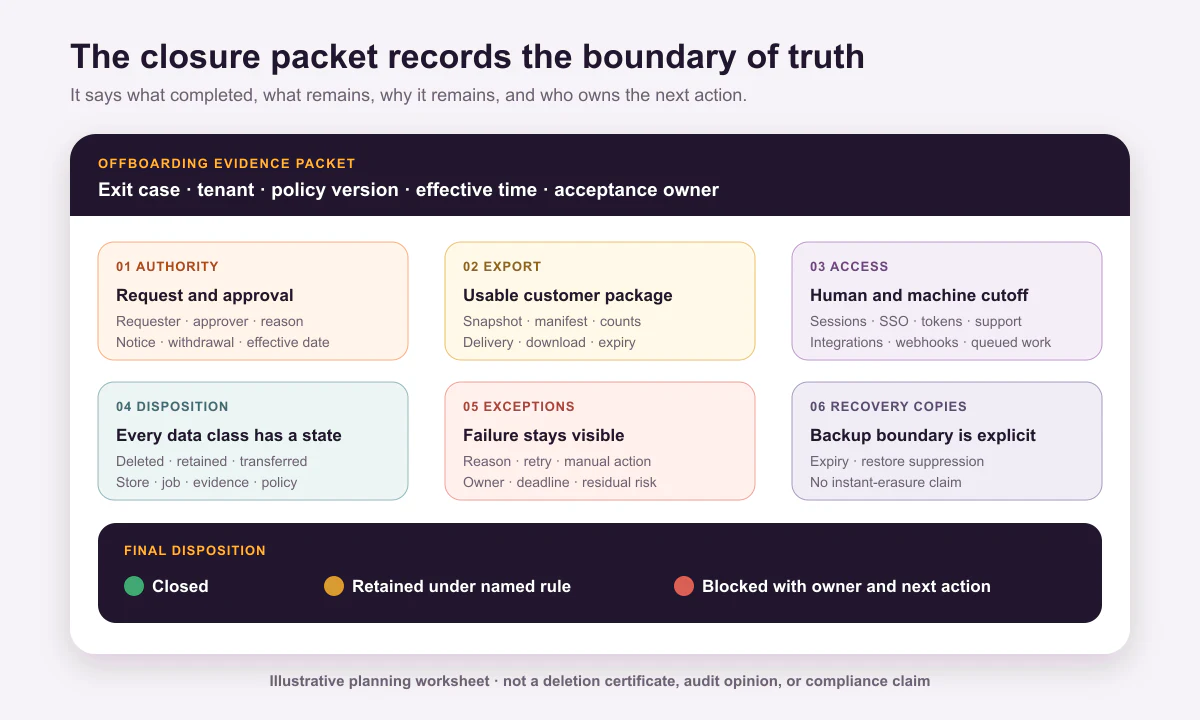
Closed
Required gates completed and the acceptance owner approved the evidence and declared residual boundary.
Retained
Named data remains under an approved rule, access boundary, owner, and future review or expiry point.
Blocked
A task failed or authority is unresolved; the item keeps a reason, evidence, retry path, and accountable owner.
A customer-facing summary may be simpler than the internal packet, but it should not say more than the evidence supports. “Your workspace is no longer accessible; specified records are retained under the stated policy” is more honest than “all data permanently deleted” when backups, invoices, security records, or dispute material remain.
Risks and guardrails
- Recheck current authority when the exit becomes effective; approval captured weeks earlier may no longer be valid.
- Freeze the tenant and export scope so a late membership or cross-tenant reference cannot change unnoticed mid-run.
- Require step-up authentication and, where appropriate, separation of request and approval for destructive actions.
- Deny new writes and credentials at the chosen cutoff while treating queued, in-flight, and vendor-side work explicitly.
- Keep evidence logs free of exported secrets or full customer payloads; record identifiers, counts, versions, checks, and protected references instead.
- Rehearse failures: partial export, expired link, revoked approver, provider timeout, undeletable file, restore from an old backup, and a legal hold arriving during execution.
- Alert on cases stuck beyond their expected window and prevent “closed” while required gates remain incomplete.
Limitations and what this concept deliberately excludes
This concept does not inspect a real customer agreement, privacy request, retention schedule, tenant model, identity provider, billing platform, integration, database, object store, log system, backup, deletion mechanism, legal hold, vendor, or security control. It does not define legal duties or a universal retention period, notice window, export format, erasure method, certificate wording, or architecture.
It excludes organization-wide IAM redesign, contract negotiation, privacy-rights administration, tax and accounting interpretation, immutable-backup redesign, data residency, merger or insolvency procedures, vendor procurement, incident response, and proof of regulatory compliance. A completed workflow does not prove every physical copy vanished, every obligation was satisfied, risk fell, support effort declined, or customer trust improved.
Stronger public claims would require an approved project record, the actual policy and system inventory, versioned workflow, tested authorization and denial paths, export reconciliation, credential and integration evidence, disposition results, exception records, verification owners, measurement windows, and publication permission. Until then, this page remains a planning model.
Lessons for a SaaS buyer
- Cancellation is a commercial event; offboarding is a cross-system control process.
- Export, access cutoff, retention, and deletion need separate success evidence.
- Assisted execution can be the right first release when the product still needs a reliable state and evidence model.
- Retained data is not automatically a failure when the rule, owner, access boundary, and expiry are explicit.
- A blocked state with an owner is safer than a false completed state.
Review the SaaS billing and entitlements concept when plan changes and access authority are already drifting. Explore the Leeonex case-study hub for more clearly labelled concepts and Leeonex-owned work. Each study states what is real, proposed, or still unverified.
What to bring to a first SaaS offboarding consultation
You do not need a finished retention engine or deletion map. Bring the real exit path, the systems it crosses, the promises already made, and the questions nobody can currently answer.
- The current cancellation, suspension, non-renewal, and termination paths and who can trigger each one
- The tenant, user, role, SSO, service-account, token, integration, webhook, and support-access model
- The customer export promise, existing package, delivery method, and known coverage gaps
- A data-store and file inventory, including search indexes, analytics, queues, caches, logs, backups, vendors, and derived data
- Retention, deletion, finance, tax, fraud, dispute, legal-hold, and contract decisions already approved by accountable owners
- Billing provider behavior, open invoices, credits, refunds, payment disputes, and the commercial effective date
- Expected exit volume, largest tenants, job-duration constraints, support capacity, failure paths, and reactivation policy
- The evidence customers, operators, auditors, or internal approvers actually need at closure
Define the exit contract before adding the delete button
Leeonex SaaS platform development can help map the lifecycle state, roles, export boundary, credentials, integrations, disposition jobs, exception queue, and closure evidence into a maintainable product scope. The work can begin with an assisted control plane rather than an unsafe self-service promise.
Plan the offboarding workflow