Answer first
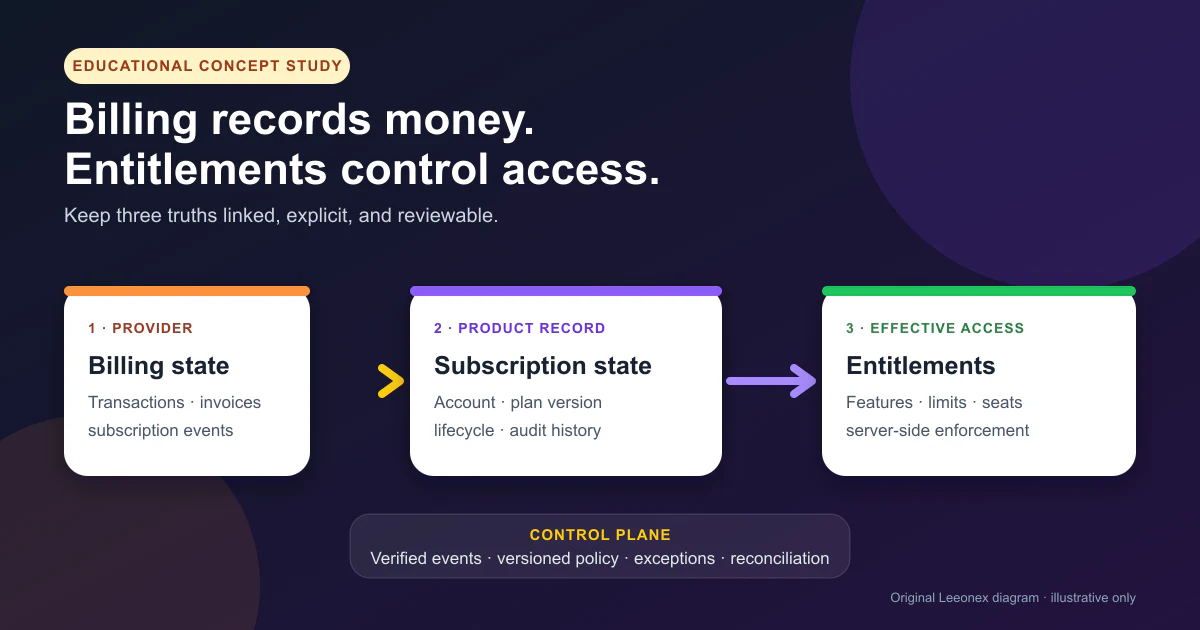
Billing records what happened commercially; entitlements decide what an account may use inside the product.
Do not turn a payment-success flag into the product's access model. Verify and retain billing events, apply them once to an internal subscription record, compute explicit entitlements from versioned policy, and enforce those entitlements at server-side product boundaries. Keep provider state, subscription state, and effective access linked but separate.
The smallest useful release supports one account model, a small plan catalog, one checkout and account-management path, explicit upgrade, downgrade, grace, cancellation, and reactivation rules, plus an operator view for exceptions and reconciliation. More pricing complexity can wait until those controls are observable and testable.
Illustrative discovery conversation — not a client quotation
“Check whether payment succeeded” becomes a product-policy problem as soon as access can change over time.
SaaS founder
“We have plans in our billing provider. Can the product just check whether the latest payment succeeded?”
Leeonex
“What access does each plan grant, when should a change take effect, and what happens during a retry, refund, grace period, manual exception, or delayed webhook?”
SaaS founder
“Support needs to explain and sometimes correct access, but nobody should edit provider records or production data blindly.”
Leeonex
“Then the first scope is a controlled boundary: verified provider events update internal subscription state, explicit policy computes entitlements, the product enforces them, and operators get a reviewable exception path.”
This is Leeonex-authored teaching material. It represents no real founder, customer, subscription, provider account, payment, product, support case, quotation, implementation, launch, revenue, or result.
Starting situation and buyer
This concept is for SaaS teams whose commercial rules are starting to affect product architecture.
The intended buyer is a SaaS founder, product leader, or billing operations owner with a working product or MVP. The team may have a hosted checkout and a few prices, but access logic is scattered across provider metadata, database flags, client-side checks, support messages, and manual edits.
The pressure usually arrives through a real edge: an upgrade must be immediate, a downgrade should wait until renewal, payment retry should not erase customer work, a refunded purchase should be reviewed, a workspace has several members, or support cannot explain why the provider and product disagree.
The constraint is not only API integration. Pricing language, account ownership, access promises, finance policy, provider event behavior, product authorization, historical records, and operator permissions meet at one boundary. If those decisions remain implicit, retries and exceptions expose the inconsistency.
Product owner
Owns plan promises, upgrade and downgrade timing, grace behavior, cancellation rules, and which commercial experiments belong in the first release.
Billing owner
Owns provider configuration, prices, tax and finance handoffs, refund rules, reconciliation expectations, and operational approval for corrections.
Platform owner
Owns event verification, subscription state, entitlement policy, access enforcement, migrations, observability, recovery, and technical custody.
Support or finance operator
Investigates mismatches through approved tools, records reason and evidence, communicates with the account, and escalates policy or money decisions.
Core flow
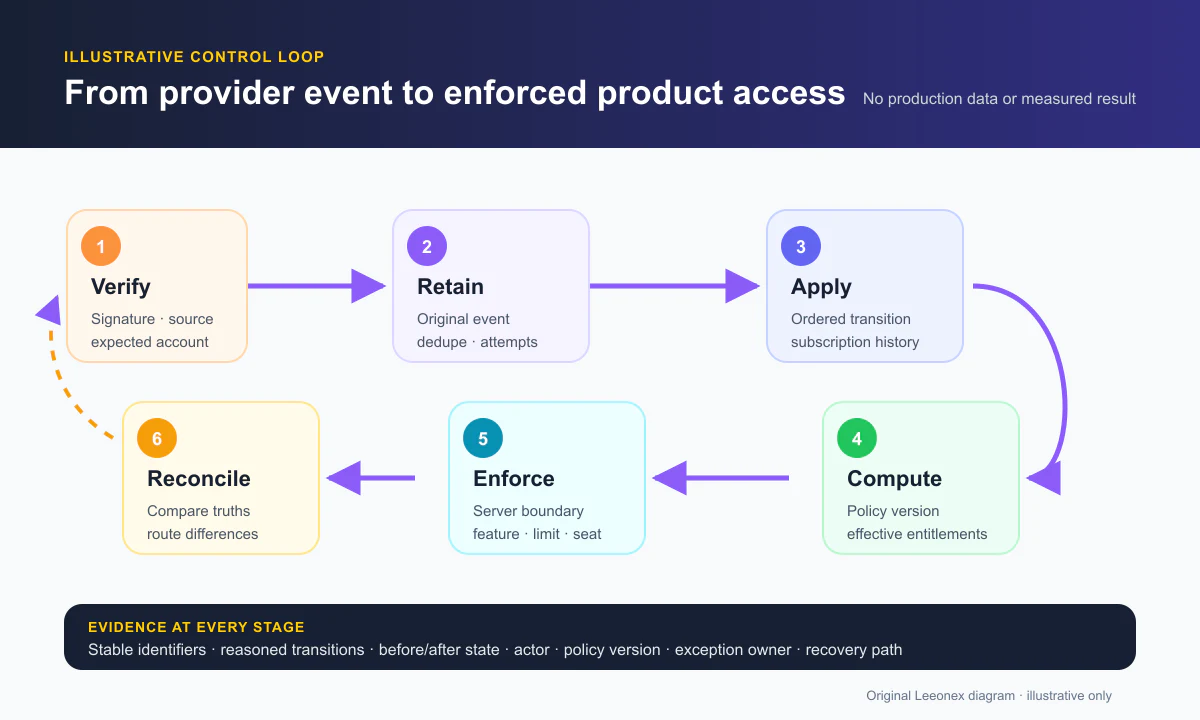
The control loop turns an untrusted delivery event into a reviewable product-access decision.
First, receive a provider event through a narrow endpoint, verify its signature and expected account, record the original payload with its stable identifier, and acknowledge delivery without performing an unbounded chain of product work. Invalid events are rejected; valid events can be processed again safely.
Next, interpret the event against the latest provider object and internal mapping. Apply a permitted transition to the internal subscription record only if the event has not already been applied and does not lose to a newer version. Record the previous state, new state, cause, policy version, and processing result.
Then compute effective entitlements for the account: named features, limits, seats, or actions that the product understands. Server-side checks enforce that snapshot at protected boundaries. Finally, scheduled reconciliation compares provider records, internal subscription state, and effective access; differences become operator work with a reason and recovery path.
Smallest useful scope
Prove one commercial lifecycle before building a pricing engine.
V1 needs one account boundary, one billing customer per billable account, a small versioned plan catalog, checkout for a new subscription, account management through an approved provider or product path, and explicit transitions for trial, active, grace, scheduled downgrade or cancellation, ended, and reactivated.
Define a compact entitlement vocabulary before implementation. Prefer stable product capabilities such as “create project,” “invite member,” or a named usage limit over price identifiers embedded throughout the codebase. A provider price maps to a plan version; that plan version maps to product entitlements.
Include replayable webhook handling, an operator-readable event history, basic reconciliation, alert ownership, approved manual correction, acceptance examples for every lifecycle transition, and a migration or rollout plan for existing accounts. A billing page without these controls is only the visible edge of the work.
Architecture and implementation decisions
Put policy and history between provider events and product access.
Use a durable webhook inbox or equivalent event record with a unique provider event key, received time, verification result, processing attempts, last error, and applied outcome. Process asynchronously where possible so a provider retry does not create duplicate side effects and a slow entitlement update does not hold the delivery endpoint open.
Store provider customer, subscription, price, item, and invoice references as external identifiers rather than internal primary keys. Keep internal account and subscription records stable when members, emails, price versions, or provider presentation changes. Sensitive provider fields and full payload retention need an explicit minimization and access policy.
Model entitlement policy as versioned data or well-bounded code, not scattered conditions. The result should explain which plan version, subscription state, exception, and policy version produced access. Cache effective entitlements only with deliberate invalidation and a safe failure mode; stale access is a product and security decision, not merely a performance detail.
Separate commercial correction from access correction. A support operator may request a replay, refresh provider state, or apply an approved temporary exception, but should not create a hidden payment, refund, or permanent permission by editing production fields. Every path needs least privilege, reason, actor, time, before-and-after state, and recovery instructions.
Risks and guardrails
Access drift grows in the gaps between delivery, policy, and enforcement.
- Treat the billing provider as the authority for provider-side transactions, not as a live authorization service for every product request.
- Verify webhook signatures, retain the original event, deduplicate by stable provider identifiers, and make processing safe to retry.
- Model internal subscription state and effective entitlements separately so commercial events can be interpreted through explicit product policy.
- Apply ordering and version rules deliberately. A late event must not silently overwrite a newer subscription state just because it arrived last.
- Enforce entitlements on the server at the protected resource or action boundary; navigation, hidden buttons, and client claims are not authorization.
- Use account-level identifiers that survive email changes and user turnover. Define how workspaces, members, subscriptions, and provider customers relate.
- Route unknown mappings, policy conflicts, partial provider failures, and reconciliation differences to a bounded operator queue instead of guessing.
- Make manual corrections time-bounded, reasoned, approved where needed, and visible in an append-only audit history with a path back to normal policy.
Build now, validate later
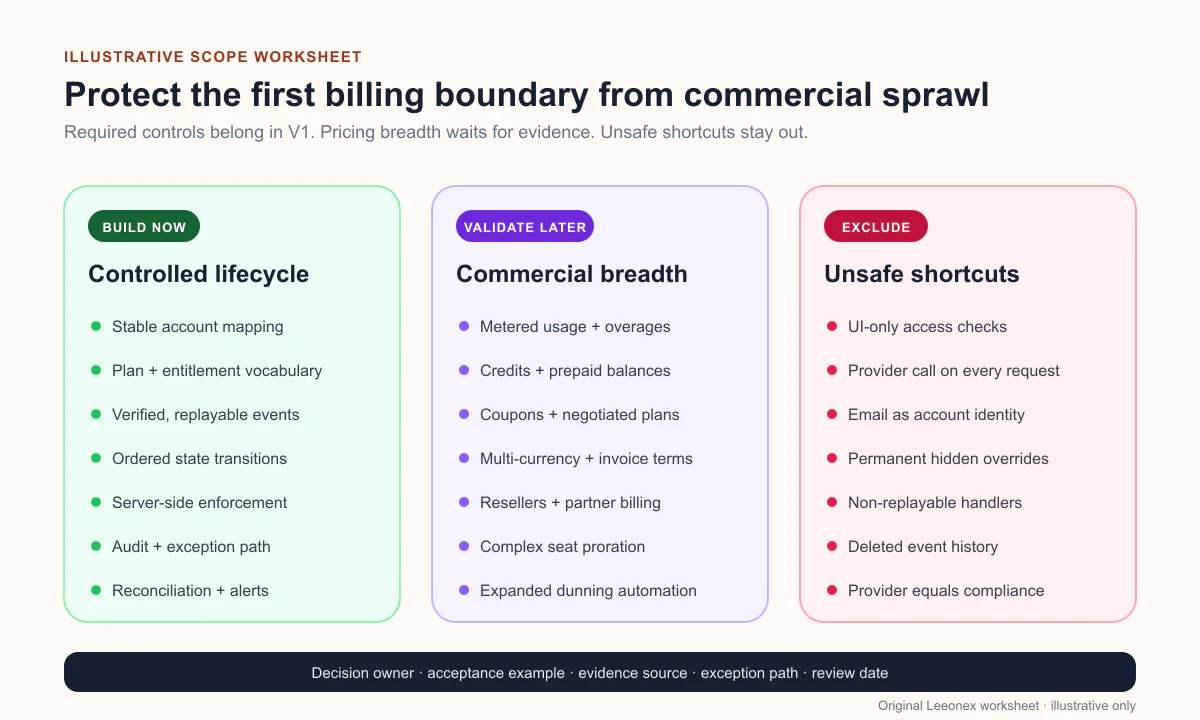
Correctness controls belong in V1; commercial breadth does not.
Build the stable account mapping, plan and entitlement vocabulary, verified event inbox, idempotent and ordered state transitions, server enforcement, audit history, exception queue, reconciliation, alerts, acceptance examples, and migration path now. They are the minimum controlled boundary.
Validate annual billing, metered usage, prepaid credits, consumption overages, coupons, negotiated enterprise plans, reseller billing, multiple currencies, invoice terms, plan families, add-ons, complex seat proration, and automated dunning expansion only when the commercial model and buyer evidence require them.
Deliberately exclude authorization based only on UI state, provider status fetched on every request, email as account identity, permanent manual flags with no owner, event handlers that cannot be replayed, silent deletion of billing history, and claims that a payment provider alone makes the product compliant.
Limitations and evidence boundary
This concept proves no billing accuracy, access correctness, reliability, support saving, retention, revenue, or compliance.
No client, product, account model, price catalog, provider configuration, tax rule, contract, subscription, payment, refund, entitlement, codebase, event log, support workflow, financial control, or production environment was inspected. The four roles, six stages, three truths, policy choices, guardrails, and diagrams are proposed planning material, not implementation or legal, accounting, tax, security, or compliance advice.
Stronger delivery claims would require an approved scope and data model, provider and product configuration, signed event evidence, idempotency and ordering tests, entitlement and authorization tests, migration records, reconciliation results, access reviews, runbooks, incidents and corrections, known exceptions, and client permission for public wording and visuals.
Any performance or business claim would also need a pre-agreed baseline and measurement window. Definitions might cover unmatched records, stale access duration, duplicate processing, exception volume, time to resolution, payment recovery, support contacts, conversion, churn, or revenue. Sources, exclusions, confounding changes, attribution limits, verifier, and approved language would be required before publication.
Lessons and first consultation
Bring the commercial lifecycle and access promises—not only a provider name.
A useful first brief explains who pays, who belongs to the account, what each plan permits, when access changes, which system owns each fact, and who resolves exceptions. These inputs make a first consultation concrete:
- Current plans, prices, account and workspace model, promised features or limits, upgrade and downgrade timing, trial, grace, cancellation, refund, and reactivation rules
- Billing provider, tax or invoicing responsibilities, checkout path, customer portal, provider identifiers, webhook types, API limits, sandbox access, and existing production records
- Protected product actions, server enforcement points, roles, seat or usage limits, support permissions, manual exception policy, audit needs, and customer communication owners
- Known failure cases, reconciliation cadence, migration constraints, monitoring and alert owners, rollback expectations, acceptance examples, and claims the team wants evidence to support later
Leeonex's SaaS platform development service fits products that need roles, modules, billing hooks, operator tooling, and maintainable access boundaries. The single-tenant versus multi-tenant SaaS guide helps define account and isolation boundaries, while the MVP scope checklist helps keep commercial complexity out of the first useful release.
Explore the Leeonex case-study hub to compare other evidence types and product decisions. These systems can support discoverability and sales conversations, but none guarantees rankings, traffic, indexing, AI citations, trust, leads, conversions, or commercial outcomes.
A problem-aligned next step
Map the entitlement boundary before another pricing rule reaches production.
Bring the account model, plans, lifecycle rules, protected actions, provider constraints, and known exceptions. Leeonex can turn them into one focused SaaS platform scope.