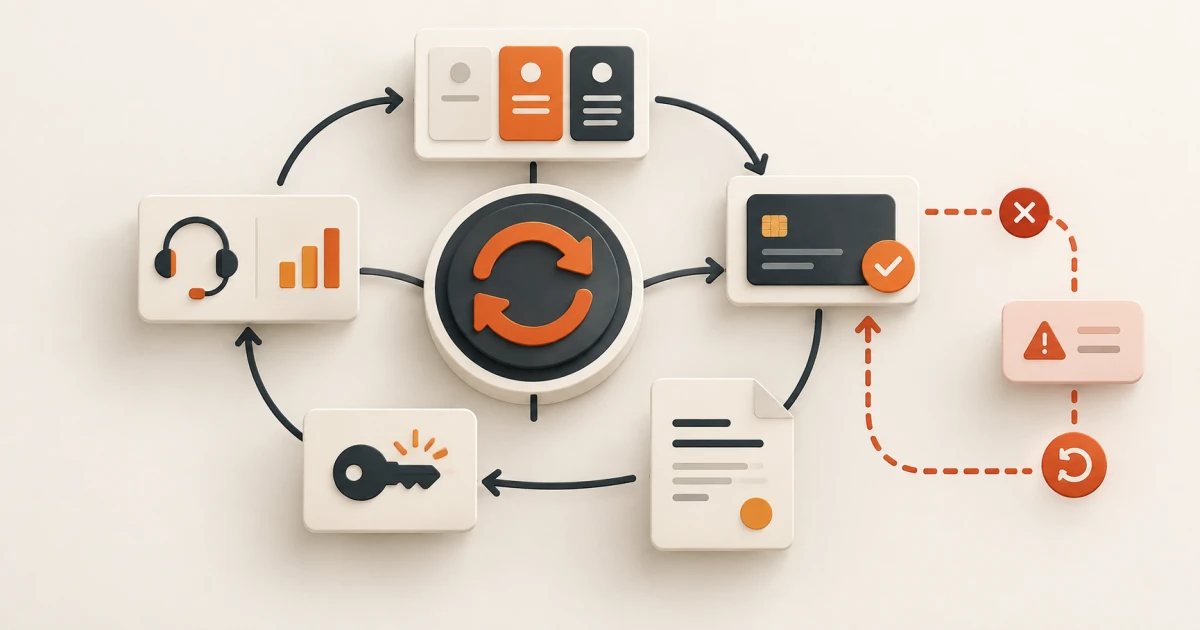
The short answer: design billing as a revenue-to-access system
SaaS billing is ready when commercial rules, billing-provider state, product entitlements, customer communication, finance evidence, support actions, and failure recovery agree across every important lifecycle transition. Implementing checkout is only one step.
Buy commodity payment and subscription capabilities when they fit, but explicitly own the policy around them: who the customer is, what they bought, when access starts or changes, which system is authoritative, how events are retried and reconciled, and what support may override.
Commercial truth
Offer, contract, quantity, timing.
Product truth
Entitlements, limits, access, grace.
Operating truth
Events, support, finance, recovery.
Define eight billing requirement lanes
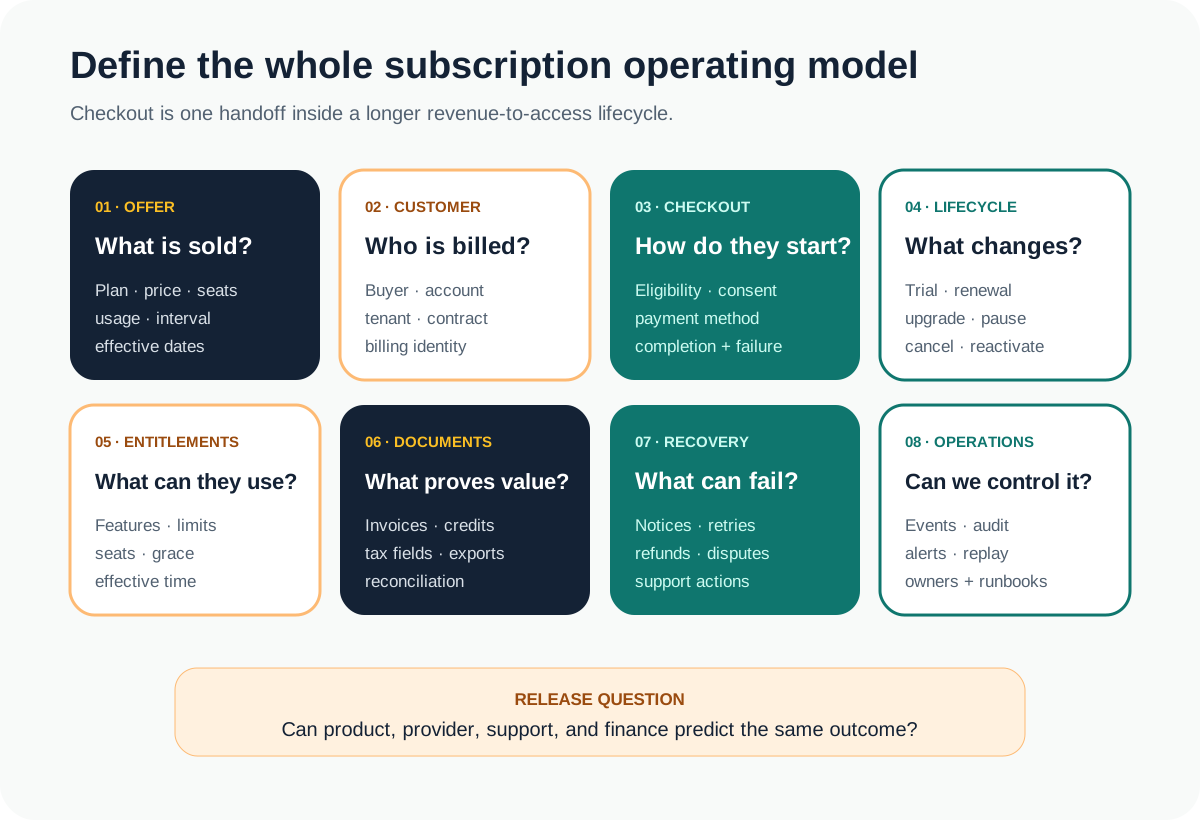
| Lane | Decisions to record | Launch evidence |
|---|---|---|
| Offer | Plans, prices, currency, interval, quantity, usage | Versioned catalog and examples |
| Customer | Buyer, account, tenant, contract, tax identity | Stable identity mapping |
| Checkout | Eligibility, payment method, consent, completion | Success and failure task tests |
| Lifecycle | Trial, activation, renewal, change, pause, cancel | State-transition table |
| Entitlements | Features, limits, seats, grace, effective time | Allowed and denied product cases |
| Documents | Invoice fields, credit notes, tax and exports | Finance-reviewed samples |
| Recovery | Failure notices, retries, disputes, refunds, overrides | Exception runbooks |
| Operations | Events, reconciliation, audit, alerts, ownership | Replay and recovery exercise |
Keep legal, tax, accounting, card-data, and marketplace obligations visible but do not let software teams guess them. Name the qualified adviser or internal owner who decides what applies to each selling entity, customer type, geography, product, and payment method.
Buy billing capabilities; own the product policy
A managed provider can supply checkout, payment collection, invoices, retries, customer portals, taxes, or usage-metering capabilities depending on the product chosen. That does not decide the SaaS offer or how provider facts change product access. The Stripe subscription integration guide illustrates the decisions that remain around flat-rate, per-seat, tiered, and usage-based pricing, checkout interfaces, trials, and billing timing.
Start with the simplest offer that supports the first customer decision. Each additional interval, currency, coupon, negotiated term, add-on, seat rule, usage meter, and grandfathered price creates lifecycle combinations for product, finance, support, and testing. Complexity belongs in the roadmap only when a real commercial need justifies its operating cost.
Requirement formula
When [billing event or time] occurs for [customer state], the system must [commercial and product behavior]. [Owner] verifies [provider, product, customer, and finance evidence], including [failure and replay case], before [release gate].
If the provider boundary, data ownership, credentials, webhooks, and failure behavior are still unclear, use the API integration requirements checklist to specify the integration contract before coding provider endpoints.
Separate provider state from product entitlement policy
Payment status, invoice status, subscription status, contract status, and product access are related but not identical. A first payment may require customer action. A renewal can fail while a grace period remains. Cancellation may happen now or at period end. An enterprise customer may pay by invoice under different terms. A refund or dispute may require review rather than an immediate account deletion.
| Illustrative state | Product question | Policy to define |
|---|---|---|
| Trial | Which features and limits apply? | Start, end, conversion, notice, missing payment method |
| Pending activation | Is access withheld or limited? | Authentication, timeout, retry, customer recovery |
| Active | What exactly is entitled? | Plan, seats, usage, add-ons, effective dates |
| Past due | Does access continue temporarily? | Grace, notices, retries, support path, restriction |
| Cancel scheduled | What remains until period end? | Access, export, reversal, data-retention communication |
| Ended | What is removed or retained? | Entitlement removal, export, reactivation, deletion |
Provider names and behavior vary. Stripe, for example, documents subscription states including trialing, active, incomplete, past due, canceled, unpaid, and paused, and notes that status transitions need explicit handling. Use the provider's current documentation as an implementation source, then map it into a smaller product policy that your team can explain and test.
Design one observable revenue-to-access flow
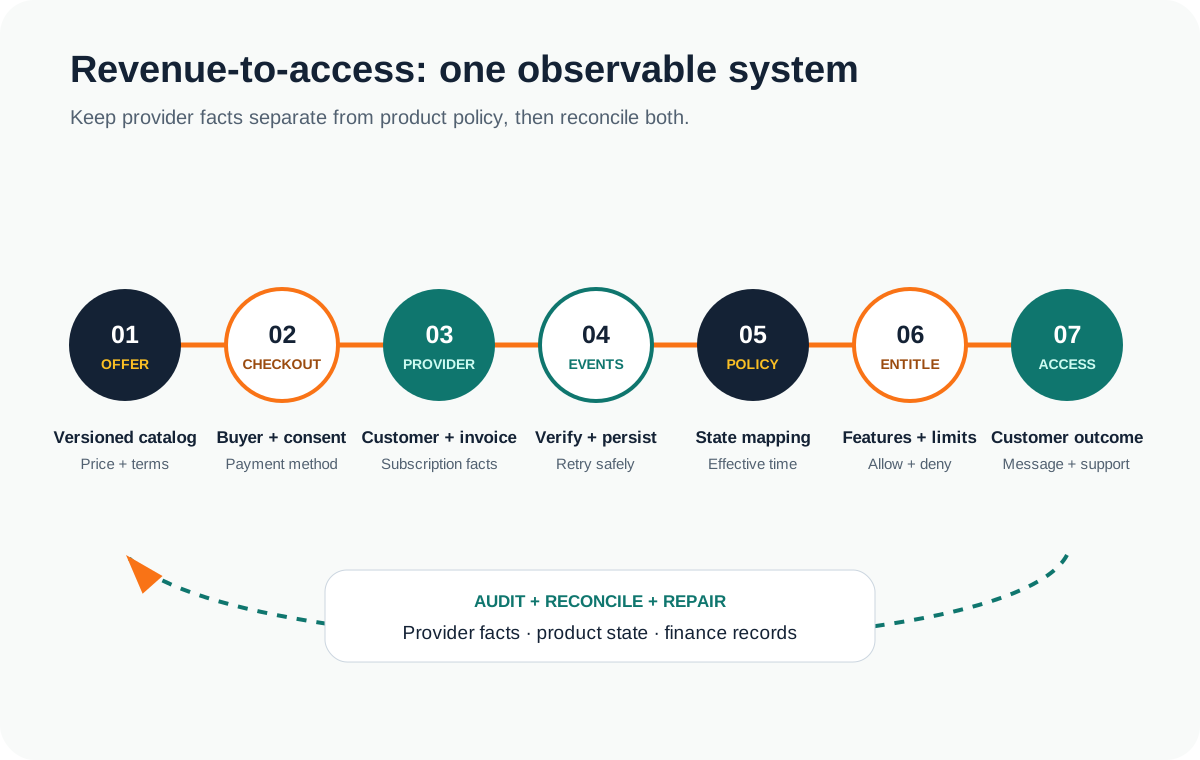
- Version the offer. Preserve which plan, price, quantity, interval, and terms the customer selected.
- Map identity. Connect the provider customer and subscription to the correct account, tenant, contract, and billing contact.
- Ingest signed events. Verify origin, persist enough context, acknowledge quickly, and process outside the request when appropriate.
- Make processing repeatable. Duplicate, delayed, retried, or out-of-order delivery must not grant or remove access twice.
- Apply product policy. Translate provider facts into versioned entitlements and effective times.
- Reconcile. Compare provider, product, and finance records and provide a repair path for mismatches.
Stripe's current webhook guidance requires signature verification and recommends returning a successful response before complex processing. Its subscription webhook documentation shows how recurring payment and subscription changes coordinate with product access. Treat those details as provider-specific inputs, not a universal data model.
Design customer recovery and support actions before failure
For each important failure, define what the customer sees, what the product allows, which notification is sent, what support can inspect or change, what finance sees, how long the state lasts, and how the system returns to normal. Include payment authentication, failed renewals, expired cards, delayed bank payments, invoice corrections, disputed charges, webhook failure, and a mismatch between provider and product state.
Avoid unrestricted “fix billing” controls. A support action should be narrow, authorized, explained, auditable, reversible where possible, and linked to the underlying customer and provider record. If an operator can grant a temporary entitlement, define its reason, expiry, reviewer, customer communication, and reconciliation behavior.
The product's role and tenant model also matters. Use the SaaS permissions requirements checklist to decide who may view billing details, change plans, manage payment methods, download invoices, or apply support overrides inside a workspace.
Test transitions, time, retries, and reconciliation
A happy-path test proves very little. Create a transition matrix for initial purchase, trials, authentication-required payment, failed activation, renewal, failed renewal, upgrade, downgrade, quantity change, usage close, scheduled cancellation, immediate cancellation, reactivation, refund, dispute, and manual support action. For each case, verify provider state, product entitlement, customer message, invoice or credit document, support visibility, finance export, audit record, and alerting.
Test duplicate delivery, delayed delivery, reordered events, handler downtime, schema or API-version change, and replay after a partial failure. Verify that reconciliation can find and repair drift without editing production data blindly. Run these checks against realistic test subscriptions, not only synthetic event payloads that lack connected records.
Stripe's billing integration testing guide recommends testing subscription lifecycle notifications and provides test clocks to advance billing objects through time. Equivalent sandbox and time-simulation capabilities should be part of provider selection when renewals, trials, or usage periods are central to the product.
Assign billing decisions across four owners
Product and commercial
Offer, eligibility, lifecycle policy, entitlement, customer experience.
Engineering
Integration, identity mapping, state processing, security, tests, recovery.
Finance and advisers
Selling entity, documents, reconciliation, accounting, tax and legal review.
Support and operations
Customer diagnosis, approved actions, communication, escalation, monitoring.
Name one release owner who can see whether each decision has an owner and evidence. That person coordinates the boundary; they do not replace finance, legal, tax, security, product, or engineering judgment. Record unresolved decisions as risks with a next action, not as implementation assumptions.
Turn the checklist into a SaaS billing launch brief
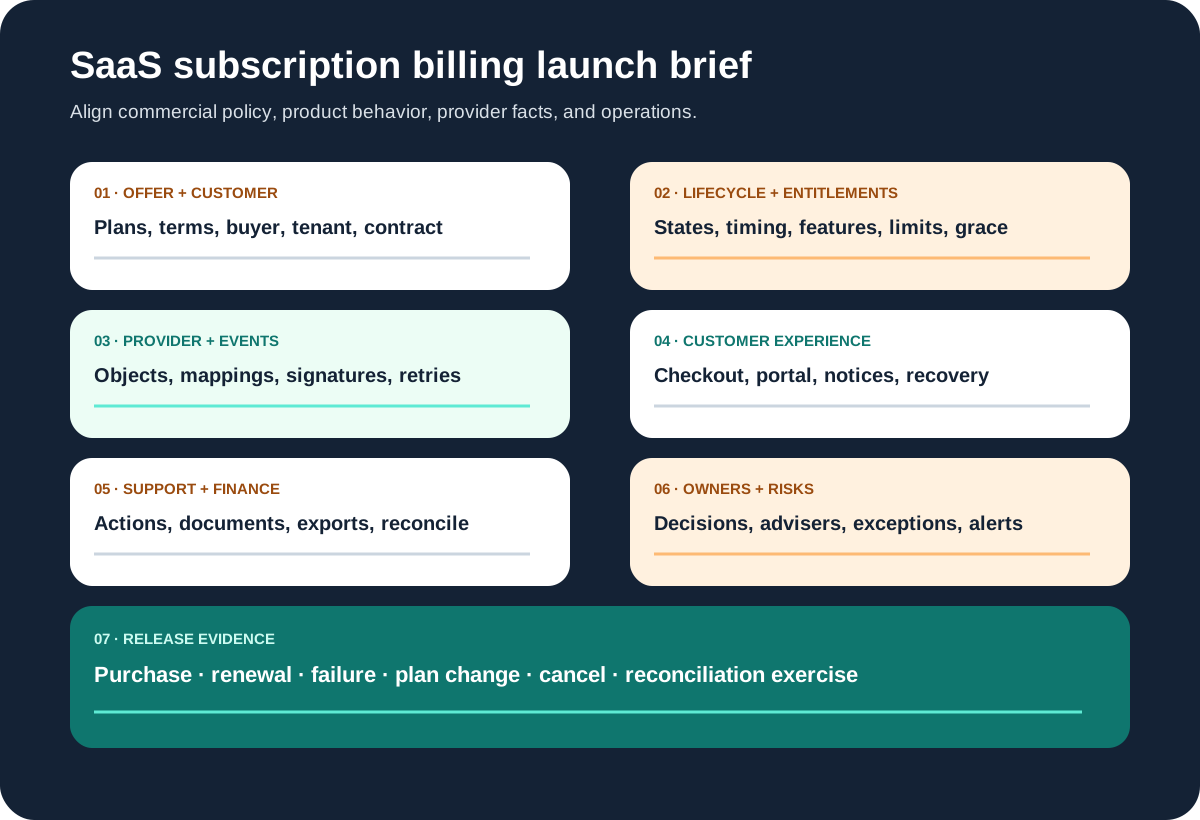
Keep the starting brief compact: offer and catalog, customer and tenant identity, lifecycle states, entitlement table, provider boundary, event contract, checkout and portal journeys, invoices and finance outputs, customer communication, recovery cases, support actions, reconciliation, monitoring, decision owners, release evidence, and explicitly deferred complexity.
Walk through one new purchase, one renewal, one failed payment, one plan change, one cancellation, and one mismatch recovery with product, engineering, finance, and support. If the group cannot predict the same result, the requirement is not ready.
Leeonex can help scope the smallest maintainable SaaS platform release or implement the provider boundary through API integration services. Start with the commercial and access policy; the provider configuration should implement those decisions, not invent them.
SaaS subscription billing requirements FAQ
What are SaaS subscription billing requirements?
SaaS subscription billing requirements define how offers, customers, contracts, checkout, payment methods, invoices, taxes, trials, renewals, plan changes, cancellations, refunds, failed payments, entitlements, customer communication, support actions, reconciliation, audit evidence, and system ownership should behave across the full subscription lifecycle.
Should a SaaS product build or buy subscription billing?
Most teams should buy commodity payment and billing capabilities unless the billing engine itself is a genuine differentiator. The SaaS product still owns its offer model, customer mapping, entitlement policy, user experience, support rules, data reconciliation, monitoring, and the integration that connects provider state to product access.
Should product access depend directly on payment status?
Not through an unchecked one-to-one rule. Translate provider states and business policy into explicit product entitlements. Trials, payment authentication, grace periods, failed renewals, scheduled cancellation, disputes, refunds, manual invoices, and enterprise contracts can require different access behavior. Record the policy and test every transition.
What should be tested before launching SaaS billing?
Test initial purchase, authentication-required and failed payments, trials, renewals, upgrades, downgrades, quantity or usage changes, proration, coupons, tax and invoice details, cancellation timing, refunds, disputes, failed-payment recovery, duplicate and delayed events, support overrides, reconciliation, alerts, and restoration from provider truth.
Who should own SaaS billing requirements?
A named product or commercial owner should decide the offer and customer policy. Engineering owns integration behavior and evidence, finance owns accounting and reconciliation needs, support owns customer-resolution workflows, and legal or tax specialists review obligations where needed. Shared ownership works only when decision rights and exception paths are explicit.