Answer first
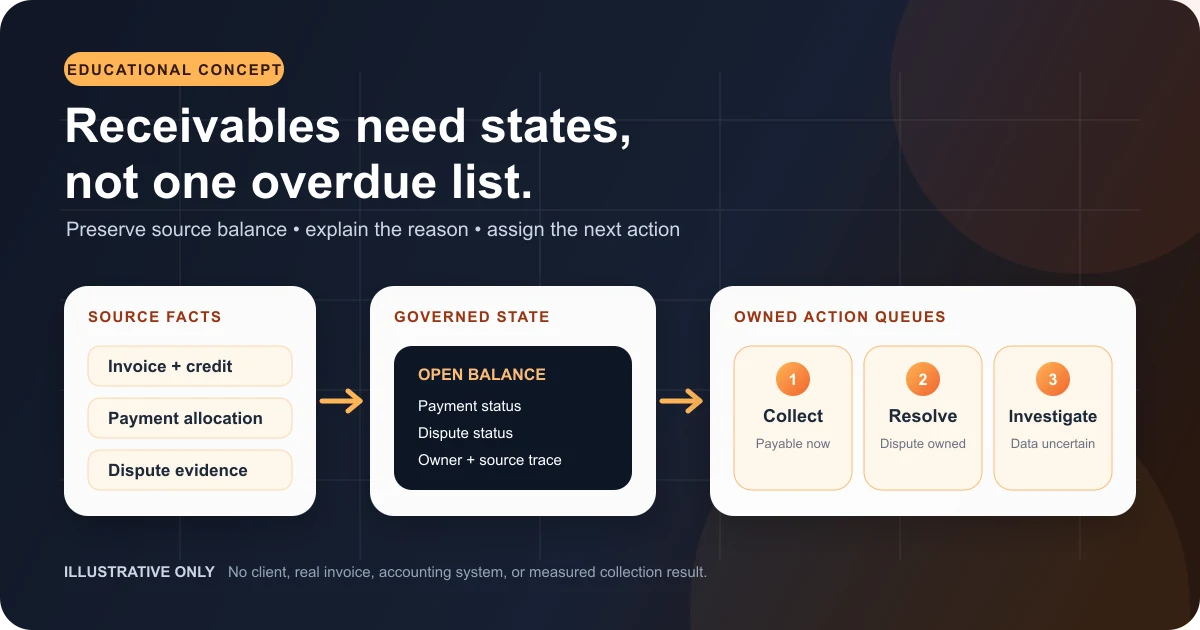
Model why money is open before ranking who to contact.
Scope an accounts receivable dashboard around states and next actions, not one undifferentiated overdue total. Preserve the source invoice balance, allocate payments and credits using approved rules, and keep commercial disputes, promises to pay, ownership, and data-quality problems as separate facts. Then route each open record to collect, resolve, or investigate.
The smallest useful release covers one bounded entity and source path, shows the reason and owner behind every queue item, and reconciles to a dated finance extract before release. It is an operational management view—not a replacement ledger, statutory report, cash forecast, credit model, or claim that a dashboard will improve collections.
Evidence boundary
This is a Level E educational concept study. Leeonex has not implemented, tested, operated, or measured this workflow for a client or real finance team. The dialogue, roles, invoice states, queues, counts, diagrams, architecture, technology labels, and acceptance examples are illustrative planning material—not accounting advice, a product screen, financial record, testimonial, benchmark, collection result, or business outcome.
Starting situation and intended buyer
The balance may be correct while the action list is wrong.
This concept is for a finance operations leader, controller, business owner, or product team whose aging report does not explain what should happen next. A customer may have paid part of an invoice, challenged one line, received an unallocated credit, promised payment after a milestone, or raised a service issue that another team must resolve. A generic overdue bucket collapses those different situations into one number.
The operational cost appears in duplicate outreach, account managers and finance contradicting each other, disputed invoices aging without owners, collectors working from stale exports, and month-end totals that cannot be traced back to the source. The dashboard problem is therefore not simply chart selection. It is agreement about identity, balance, state, ownership, evidence, and the permitted next action.
Finance policy remains authoritative. The product should make approved rules visible and testable, not infer write-off, revenue, tax, foreign-exchange, expected-loss, or legal meaning. Where the source is incomplete or two systems disagree, the interface should show an investigation state rather than invent certainty.
Illustrative discovery conversation — not a client quotation
“Overdue” is not enough information to choose the next action.
Finance operations lead
“Our aging report says a large balance is overdue, but some invoices are disputed, some are partly paid, and several have no clear owner. Can the dashboard tell us what to chase?”
Leeonex
“Which system owns the invoice, how are payments and credits allocated, what pauses ordinary collection, and who can approve each next action?”
Finance operations lead
“The ledger has the balance, CRM notes have the dispute, and account managers keep promises to pay in messages and spreadsheets.”
Leeonex
“Then the first release is not one prettier aging chart. It is a reconciled state model that separates collection, dispute resolution, and data investigation, with ownership visible beside every open balance.”
This exchange is Leeonex-authored teaching material. It describes no real customer, quotation, finance team, invoice, payment, dispute, implementation, or result.
User roles and decision ownership
Separate financial meaning, collection work, commercial resolution, and data stewardship.
Finance policy owner
Approves balance, aging, allocation, credit, dispute, write-off, period, and reconciliation rules. The dashboard cannot invent accounting meaning.
Collections operator
Works the collectible queue, records contact and promises, schedules the next review, and escalates exceptions without editing source balances.
Dispute or account owner
Resolves commercial questions, missing evidence, service issues, and customer commitments that make an open balance different from an ordinary overdue invoice.
Data and product owner
Owns source contracts, identifiers, transformations, access, refresh, observability, reconciliation tests, and the controlled release of rule changes.
A small company may combine these roles, but it should not merge their decisions. A collector can record an action without changing the ledger balance. An account owner can resolve a commercial dispute without approving accounting treatment. The system boundary should enforce that distinction.
Core workflow
Preserve source truth, derive an explainable state, then assign one owned next action.
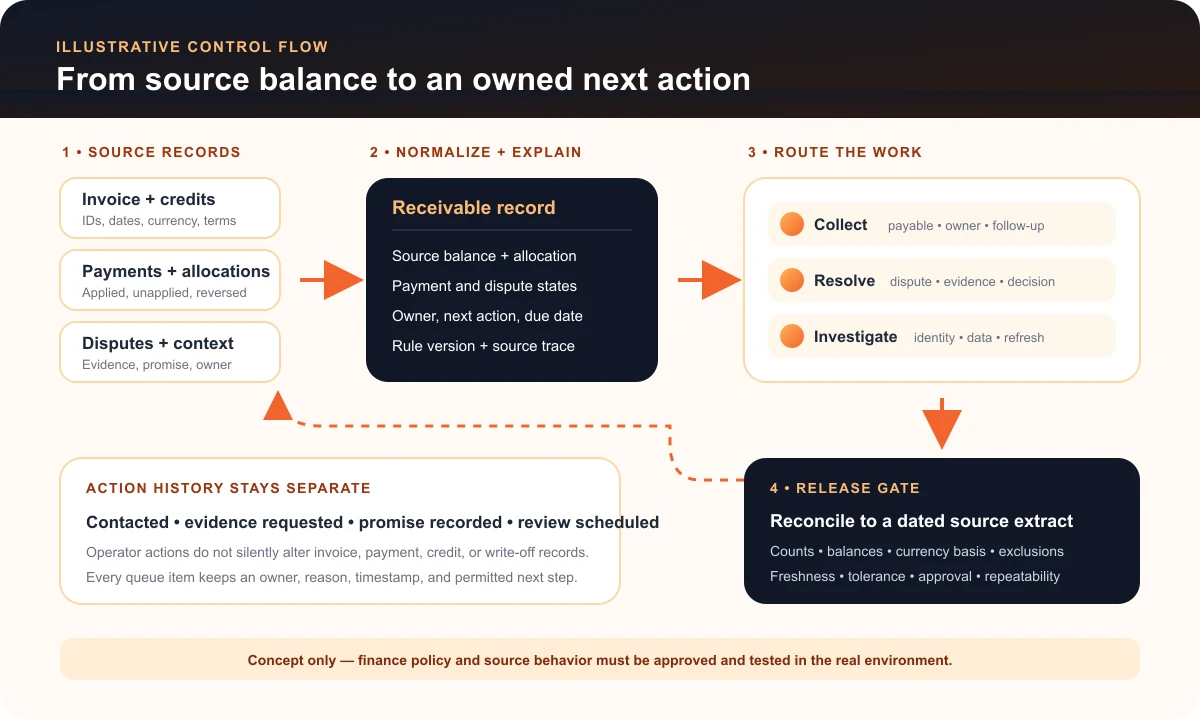
Begin with authoritative records and stable identities. An invoice may be connected to credit notes, payments, payment allocations, reversals, customer and contract records, and a dispute case. Keep the original values and timestamps. A normalized operational model can derive a remaining balance and state, but every displayed result should trace back to the contributing source records and rule version.
Next, classify the work without changing its financial meaning. A collectible invoice enters a collection queue. A documented commercial or service dispute enters a resolution queue with a named owner and evidence request. A duplicate identifier, unapplied payment, missing allocation, stale source, or impossible balance enters an investigation queue. Unknown is a valid state when the alternative is false confidence.
Finally, record the operational action separately: contacted, evidence requested, promise received, follow-up scheduled, dispute accepted or rejected, source correction requested, or resolution confirmed. The dashboard may surface and filter that history. It should not silently post a payment, issue a credit, write off a balance, or decide customer policy.
Smallest useful scope
Prove one receivables control loop before adding prediction or automation.
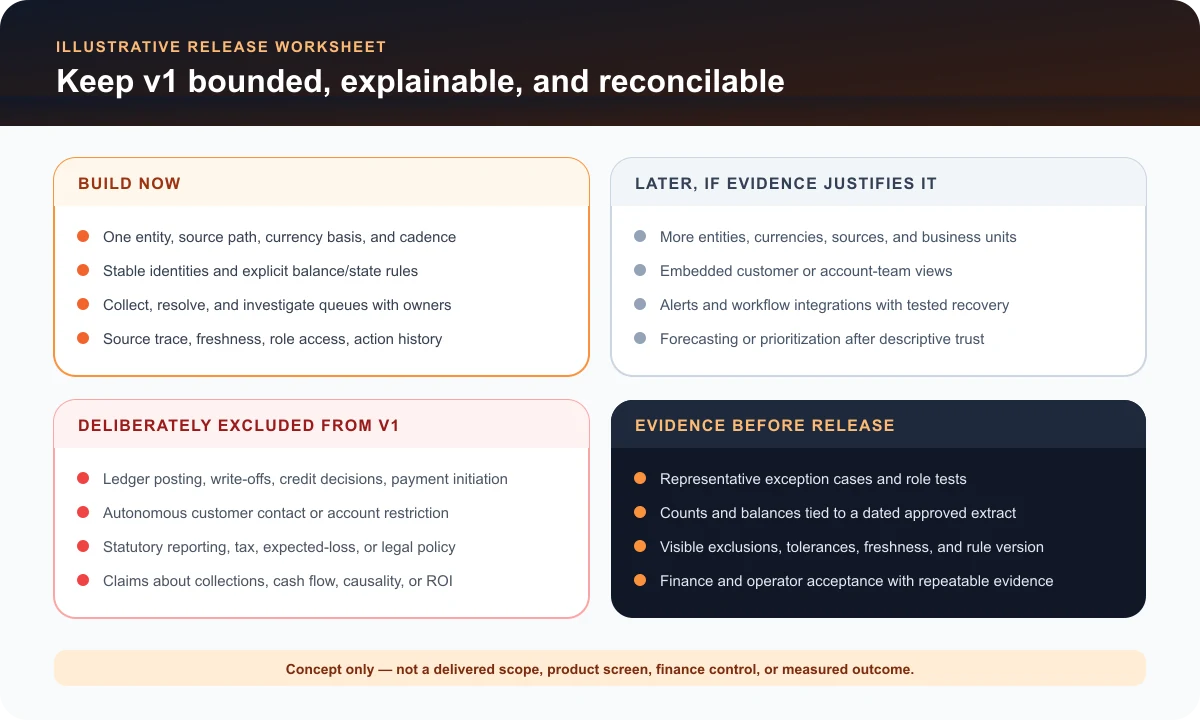
Build now
- One legal entity, approved base currency or clearly bounded currency view, invoice source, payment source, and refresh cadence
- Stable identities for invoices, credit notes, payments, allocations, customers, disputes, owners, and action history
- Explicit states for open, partly paid, disputed, promised, resolved, credited, written off, and unknown records—using only states finance approves
- Three separate queues for collect, resolve, and investigate, each with a reason, owner, next action, due date, freshness, and source trace
- A dated reconciliation that ties dashboard balances and record counts to an approved source extract, with visible exclusions and tolerances
Later or deliberately excluded
- Predictive payment dates, customer risk scores, automated prioritization, or generated collection messages before the descriptive state is trustworthy
- Autonomous emails, calls, account restrictions, payment retries, credit changes, write-offs, ledger postings, or other money- or relationship-changing actions
- Every entity, currency, business unit, region, historic system, collector strategy, and executive forecast in the first release
- Replacing the general ledger, invoicing platform, CRM, ticketing system, document store, or approved finance close process
- Treating ordinary dashboard filters as evidence of collection effectiveness, causality, liquidity, solvency, or future cash receipt
The first release can be useful without serving every finance question. If one source export and a governed spreadsheet solve the decision safely, that may be the right starting point. Build a custom interface only when repeatable ownership, queue work, permissions, source trace, and reconciliation justify it.
Architecture and implementation decisions
Keep the source record, derived state, and operator action in separate layers.
Source adapters should ingest invoices, credits, payments, allocations, customers, and approved dispute records without overwriting their original identifiers or timestamps. A normalized receivables model can then express the relationships and derived state. Versioned rules should calculate queue eligibility and aging only after finance defines the grain, date basis, currency basis, exclusions, and correction policy.
Build the dashboard from a read model optimized for the actual questions: which balances are collectible, blocked by a dispute, waiting for an internal decision, missing an owner, or inconsistent with the source? Drill-down should explain the displayed amount and state. It should show contributing records, rule version, freshness, and the action history permitted for that role.
Scheduled ingestion may be safer and sufficient for a daily collections cadence. Real-time events are justified only when a fresh payment or dispute must immediately change customer contact. In either model, observability should distinguish a healthy refresh, partial source, rejected record, stale view, and failed reconciliation rather than serving yesterday's data as if it were current.
Risks and guardrails
Design for corrections, disagreement, and sensitive customer context.
Keep accounting balance, operational collection status, dispute status, customer promise, and internal ownership as separate facts with named source authority.
Use stable source identifiers and idempotent ingestion where possible; test duplicate, late, reversed, unapplied, reallocated, credited, and corrected transactions.
Display source timestamp, dashboard refresh, policy version, currency basis, excluded records, and reconciliation status beside affected totals and queues.
Never remove an invoice from attention merely because a dispute flag exists. Route it to an owned resolution path and retain the open economic balance defined by finance.
Restrict customer, contract, payment, note, export, and write-off data by role; log sensitive access and changes when policy or regulation requires it.
Treat state-rule changes as controlled releases with representative cases, finance approval, downstream impact review, version history, and rollback or restatement guidance.
Acceptance evidence
Test difficult records and tie the result back to a dated source.
Acceptance should use representative records, not a clean demo set. Include full and partial payment, payment before invoice, unallocated cash, credit note, reversal, duplicate import, dispute opened and resolved, promise missed, owner changed, late-arriving correction, closed period, deleted CRM note, and unavailable source. Confirm what each role sees and may change.
Reconcile record counts and balance totals to an approved, timestamped extract at the same grain, date basis, entity, and currency basis. Document exclusions and tolerance rules. The product is not release-ready when the team can make the totals match only by manual edits that the next refresh will erase.
Limitations and evidence needed
This concept proposes a boundary; it proves no finance policy, implementation, or outcome.
The diagrams do not define statutory aging, revenue recognition, expected-credit-loss, write-off, tax, foreign-exchange, insolvency, contract, privacy, or collection policy. They do not show a real dashboard or record. Actual scope depends on the jurisdictions, entities, currencies, accounting system, contracts, team authority, data quality, close process, and security obligations involved.
Stronger implementation claims require approved policies, permissioned source records and contracts, tested transformations, role and access tests, representative exception cases, repeatable reconciliations, operator acceptance, release evidence, and a real observation period. Stronger outcome claims additionally require a baseline, end state, unit, window, calculation, exclusions, attribution limits, verifier, and publication approval.
Lessons for a real project
An honest control view makes ambiguity actionable instead of hiding it.
First, agree on the source and state contract before debating chart types. Second, treat disputes and data defects as owned workflows rather than filters that remove uncomfortable balances from view. Third, make freshness and reconciliation part of the interface. Finally, measure whether people can explain and act on the queue before expanding the dashboard.
Use the dashboard data-readiness checklist to test source access, identity, definitions, freshness, and ownership. If the team is still choosing the delivery model, compare a configured BI workspace, embedded analytics, and a purpose-built interface with the BI tool versus custom dashboard guide. Browse the case-study hub for other honestly labelled implementation blueprints.
What to bring to a first consultation
Bring one reconciled period and the exceptions people currently solve by hand.
- The decisions the view must support, their cadence, the people who act, and examples of what happens after an invoice enters each queue
- Redacted aging reports, invoice and credit-note extracts, payment and allocation examples, unapplied cash, reversals, partial payments, and known reconciliation differences
- Current dispute types, evidence requirements, customer-contact policy, promises to pay, escalation paths, owners, service-level expectations, and resolution records
- Source-system identifiers, exports or APIs, field definitions, time zones, currencies, legal entities, close calendar, correction behavior, and refresh constraints
- A representative case set covering paid, partly paid, disputed, credited, written off, duplicated, missing-owner, late-arriving, and unknown records
- Accounting, legal, privacy, security, retention, access, audit, export, accessibility, hosting, budget, and team-ownership constraints
Leeonex's operations reporting service is the closest fit when the main job is a repeatable operator queue with visible state, ownership, freshness, and action. A discovery may still conclude that source cleanup or configuration inside the existing finance platform is more responsible than a custom build.
Problem-aligned next step
Map one month of open balances before designing the dashboard.
Leeonex can help trace invoice, payment, dispute, owner, and action records; define the smallest honest state model; and identify the reconciliation evidence a release would need. The result may be a focused report, an integration, a governed workflow, or a decision not to build custom software yet.
Discuss your receivables workflow