Answer first
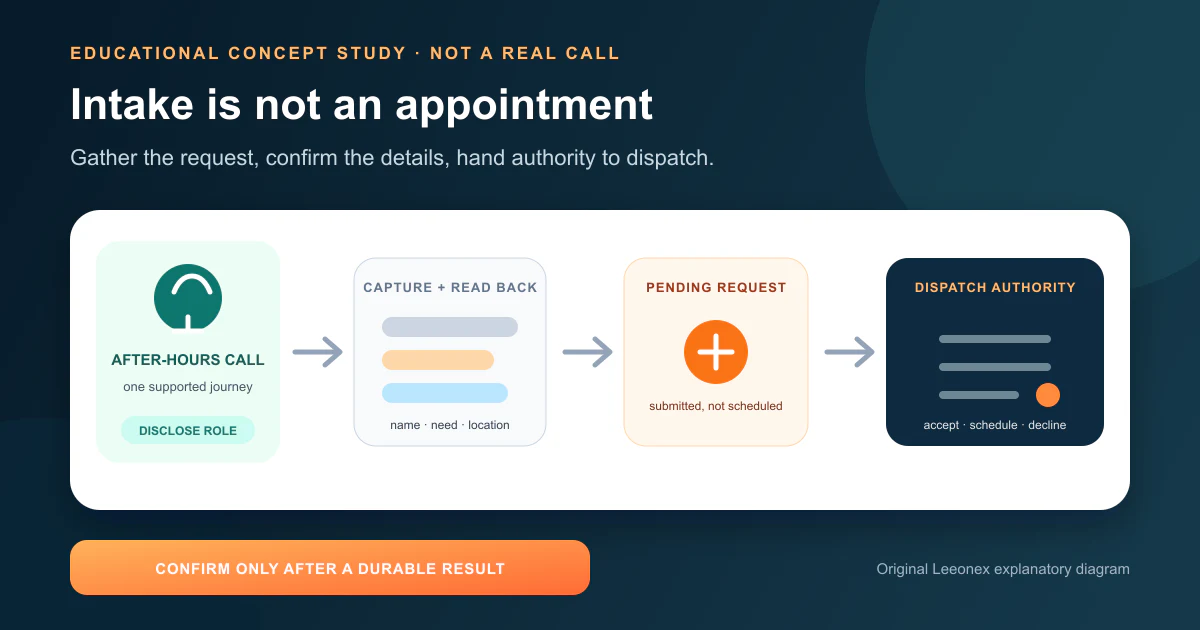
An after-hours voice assistant should create a reviewable request, not borrow authority from tomorrow’s dispatcher.
Start with one bounded call journey. Tell the caller that the assistant is automated, explain what it can do, gather only the fields needed for review, and read back critical details. When the caller agrees, create a pending request with a durable ID and a realistic response expectation.
Keep booking authority outside the conversation until an approved scheduling system or dispatcher returns a committed result. The smallest useful release connects the spoken receipt, stored request, human decision, and final notification so the team can prove they agree. Natural speech is useful; it is not evidence that an appointment exists.
Evidence boundary
This is a Level E educational concept study. Leeonex has not implemented, operated, evaluated, or measured this system for a client or service business. The conversation, roles, call journey, request fields, record states, counts, diagrams, architecture, controls, and acceptance examples are illustrative planning material—not a caller quotation, transcript, product screen, booking, legal approval, launch, or performance claim.
Starting situation and intended buyer
The operational risk begins when a polite receipt sounds like a promise.
This concept is for a service business owner, operations leader, dispatch manager, or product team that receives useful demand after the staffed phone line closes. Callers may leave incomplete voicemail, try several numbers, or assume silence means no help is coming. The team wants better intake without giving software authority it does not possess.
The constraint is usually not speech generation. The real work is defining which calls are supported, what information is safe to collect, how critical details are corrected, which system owns availability, when a dispatcher accepts responsibility, and what the caller should hear when the answer is still pending.
Use the broader AI voice agent requirements checklist to compare channel, audio, action, transfer, evidence, and operating requirements. This study takes one narrower buyer problem and turns it into a first-release decision sequence.
Illustrative discovery conversation — not a client quotation
Separate “we received your request” from “a technician is booked.”
Operations lead
“We miss calls after 6 p.m. Can an AI receptionist collect the job and tell the caller when a technician will arrive?”
Leeonex
“Which system owns technician availability, and when does a request become an accepted appointment?”
Operations lead
“The dispatcher checks location, service type, contract status, travel, and capacity the next morning. Nothing is confirmed during the call today.”
Leeonex
“Then the first release should create a clear pending request and set a response expectation. It should not sound like a scheduler before the scheduling authority exists.”
This exchange is Leeonex-authored teaching material. It describes no real operator, caller, company, quotation, call, workflow, appointment, implementation, or result.
User roles and decision ownership
Give each decision to the role that can actually verify it.
Caller
Explains the need, corrects critical details, chooses a permitted contact path, and hears whether the result is pending or confirmed.
Dispatcher
Reviews service eligibility, location, urgency, capacity, duplicates, and special handling before accepting, scheduling, or declining the request.
Service owner
Defines supported call types, promises, escalation rules, response windows, service boundaries, and the operating owner for unresolved requests.
Product and risk owner
Owns disclosure, consent, data handling, evaluation, tool permissions, incident response, model changes, and the kill switch.
A caller can confirm what they said. They cannot confirm internal eligibility or capacity. A model can produce a candidate record. It cannot grant itself authority. A dispatcher can accept work only within an approved service process. Making those boundaries visible is part of the product design.
Core workflow
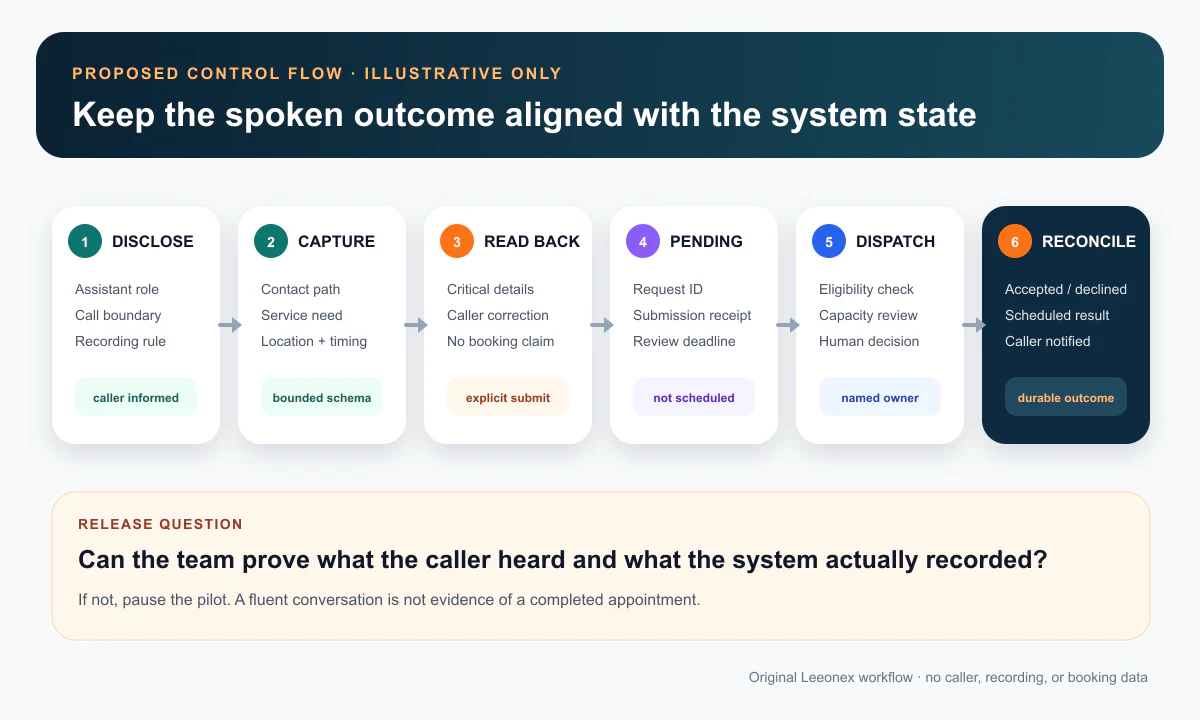
Use six states to keep the call, request, and final outcome traceable.
The assistant first discloses its role and boundary. It captures a small schema, then reads back the details most likely to break fulfillment if wrong. On caller approval it submits a pending request—not a booking—and states what response should follow and by when.
A dispatcher reviews eligibility and capacity, records one accountable outcome, and lets the authoritative scheduling or service system commit the final state. Reconciliation then checks that the request record, dispatch decision, schedule, and caller notification agree. Disagreement becomes visible work instead of a silent customer promise.
Smallest useful scope
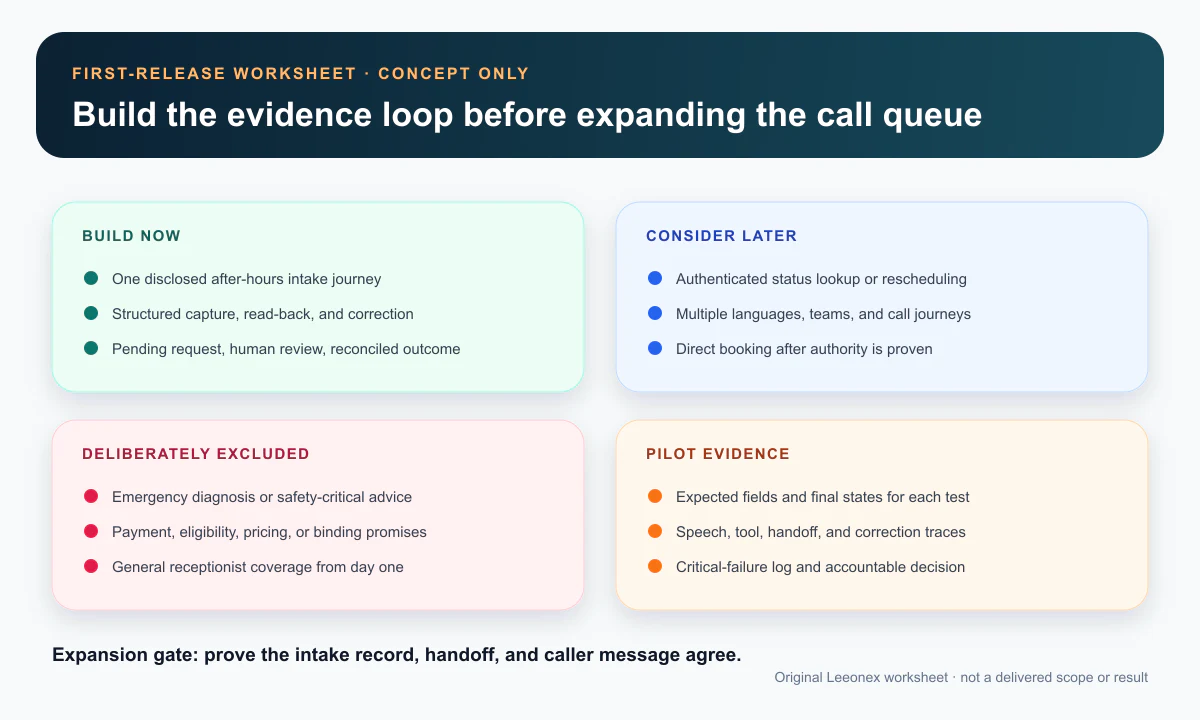
Build one dependable intake loop before a general receptionist.
Build now
- One inbound after-hours journey for a defined service area, language, caller type, and response window
- A plain disclosure that the caller is speaking with an automated assistant and that the request is not yet an appointment
- A small request schema covering contact path, service need, location, preferred timing, access notes, and a caller-provided urgency description
- Read-back and correction for names, phone details, addresses, dates, and other fields whose error would break the handoff
- A pending request record with a unique ID, captured source, transcript or evidence policy, review deadline, dispatch queue, and caller-facing receipt
- Human accept, schedule, decline, duplicate, unsupported, and needs-clarification outcomes with reconciliation back to the caller message
Later or deliberately excluded
- Direct appointment booking until the authoritative availability and scheduling rules can return a durable confirmed result
- Emergency diagnosis, medical or safety advice, eligibility decisions, price commitments, payments, contract changes, or other consequential actions
- Every service, location, language, caller segment, outbound campaign, and general-reception question in the first release
- Voice biometrics or identity claims based on a familiar-sounding caller; sensitive account actions require an approved identity path
- Automatic learning from unreviewed calls or silent prompt, model, tool, and policy changes that make evaluation results irreproducible
“Later” is not a promise. Each expansion needs its own call contract, permission boundary, failure path, representative test set, and accountable launch decision. If a simple structured voicemail or human answering service meets the need with less risk, that may be the right first scope.
Architecture and implementation decisions
Design around committed states, not a convincing voice demo.
Keep conversation separate from authority
The model can gather and propose structured values. Trusted application code validates the schema, service boundary, permissions, duplicate key, and state transition before any record or appointment changes.
Model the request state explicitly
Draft, submitted, accepted, scheduled, declined, duplicate, unsupported, and unresolved mean different things. The spoken message must come from the committed state, not from a likely next step.
Design the handoff as a product surface
Dispatch needs the caller goal, confirmed details, corrections, uncertainty, attempted actions, evidence reference, and open question—not a long transcript with no decision context.
Reconcile asynchronous outcomes
Telephony, intake, queue, scheduling, and notification systems can disagree. A reconciliation job and an exception queue should surface records whose spoken receipt, stored request, and final notification diverge.
Every tool path also needs a normal integration contract: typed inputs, authentication, authorization, rate limits, idempotency, retries, timeouts, acknowledgements, monitoring, and recovery. The API integration requirements checklist helps expose those dependencies before the voice layer makes them harder to see.
Risks and guardrails
Treat uncertainty, transfer, and shutdown as first-class behavior.
- Define emergency, distress, abuse, vulnerable-caller, unsupported-language, accessibility, and caller-requested-human paths before the happy path. Do not improvise safety-critical guidance.
- Resolve disclosure, consent, recording, retention, deletion, outreach, privacy, and sector obligations with accountable specialists for the actual jurisdictions and use case.
- Apply retry and clarification limits. Repeated low-confidence capture, silence, noise, interruptions, unsupported requests, or tool uncertainty should transfer or stop safely instead of trapping the caller.
- Use typed tools with allow-listed fields, server-side validation, idempotency, timeouts, explicit error states, least privilege, and an acknowledgement from the authoritative system.
- Protect phone numbers, addresses, access instructions, recordings, transcripts, account details, and service notes with role-based access, retention rules, redaction, audit evidence, and tested deletion.
- Version prompts, models, voices, tools, policies, evaluation sets, and disclosure wording. Treat a material change as a release that needs regression evidence and rollback.
What evidence a pilot would need
Evaluate the conversation, record, handoff, and notification as one outcome.
A future pilot should define expected behavior before anyone calculates success rates. Use synthetic audio and privacy-approved representative calls, then record results by scenario and configuration version. At minimum, acceptance evidence should cover:
- The opening disclosure is audible, accurate, and appropriate for the approved call and recording policy.
- Representative names, numbers, dates, locations, corrections, accents, noise, interruptions, silence, and dropped calls produce the expected field or fallback behavior.
- The assistant never says booked, dispatched, confirmed, eligible, priced, or paid unless the authoritative system has committed that exact result.
- Repeated submissions, retries, callbacks, timeouts, and delayed acknowledgements do not create duplicate jobs or contradictory caller notifications.
- Emergency, unsupported, identity-sensitive, out-of-area, abusive, and caller-requested-human cases reach the approved transfer or safe-stop state.
- A dispatcher can understand the request, see uncertainty and corrections, take one accountable action, and return the final outcome without reconstructing the call.
- Every test preserves the expected call behavior, request state, tool trace, human decision, caller message, configuration version, and critical-failure result.
Only after that baseline exists should the operator define a measurement window and consider call completion, correct request capture, human correction, transfer completion, response time, unresolved records, duplicate rate, caller abandonment, critical failures, or operating cost. None of those outcomes has been measured for this concept.
Limitations and stronger proof required
This blueprint cannot prove that a voice workflow is safe, useful, compliant, or commercially worthwhile.
It does not choose a telephony provider, model, voice, transcription architecture, jurisdictional disclosure, consent method, recording policy, identity method, emergency rule, accessibility accommodation, service policy, retention period, or scheduling contract. Real callers, accents, noise, interruptions, connectivity, tool behavior, staffing, and legal duties can invalidate the proposed flow.
A stronger public delivery study would require an approved project record, implemented call and tool paths, representative test evidence, release dates, operating owners, incident and reconciliation records, approved visuals, and permission. An outcome claim would additionally need a defined baseline, end-state window, calculation, exclusions, attribution limits, verifier, and approved wording.
Lessons for a qualified buyer
The voice is the interface; the promise boundary is the product.
Narrow the journey
One frequent call with a known fallback teaches more than a general receptionist demo with undefined authority.
Name every state
If pending and booked are not different in data and language, the system will eventually make a false promise.
Prove the handoff
The useful outcome is not a fluent call; it is a trustworthy request reaching the right owner with a reconciled response.
What to bring to a first consultation
Bring the real call boundary before a model or vendor shortlist.
- A representative after-hours call journey, its frequency, current answer path, caller expectation, accepted outcome, and the failure that would cause real harm
- Supported services, locations, languages, hours, response windows, contract or eligibility checks, urgency labels, and explicit emergency or unsupported boundaries
- The exact fields dispatch needs, examples of corrections and duplicates, who reviews them, and what makes a request ready to accept, schedule, or decline
- Telephony, CRM, ticketing, field-service, calendar, scheduling, notification, and identity systems—including which one owns each final state
- Disclosure, consent, recording, privacy, security, accessibility, retention, deletion, audit, sector, and jurisdiction constraints with accountable owners
- A privacy-approved test set, critical failures, human-handoff destination, operating hours, response target, incident owner, rollback path, budget, and support model
Prefer to compare other evidence levels first? Browse the Leeonex case-study hub. Every study states what is evidenced and what remains illustrative.