
The short answer: specify the whole call, not just the voice
AI voice agent requirements should define the supported call journey, caller context, turn-taking behavior, knowledge and action boundaries, identity and confirmation rules, human transfer, evidence, evaluation cases, monitoring, and safe-stop conditions. Natural speech is useful, but it is not proof that the agent understood the caller or completed the right action.
Start with one journey such as collecting structured intake, answering from approved policy, checking an authenticated status, or arranging an appointment. Write the expected final system state and fallback before choosing a voice, telephony provider, or model. The release succeeds only when the caller hears a truthful result and the trusted system records the same outcome.
This guide is channel-specific. Use the broader AI feature production-readiness checklist for shared governance gates and the AI customer-support requirements guide when the primary problem is support knowledge and case resolution rather than live audio.
Choose one call journey and one consequence boundary
“Answer our phones” combines many different products. List the call types the pilot may receive, who may call, what context is available before speech begins, supported languages and hours, identity needs, allowed outcomes, and consequence of error. Then classify each journey as answer, gather, read-only lookup, bounded action, transfer, or unsupported.
A useful first pilot is frequent, narrow, measurable, and able to fall back without hiding a costly mistake. A public-hours answer or structured intake is different from cancelling an order, changing an account, taking payment, or making an eligibility decision. Do not let conversational fluency expand the permission boundary.
OpenAI's current voice-agent guide separates full-duplex, realtime, and chained architectures and recommends evaluating both the conversation and the completed task. Choose architecture after deciding whether the team needs a continuous speech experience, visible intermediate text, replaceable speech stages, or extra policy checks before a response or action.
Use a conversation-to-action contract for every journey
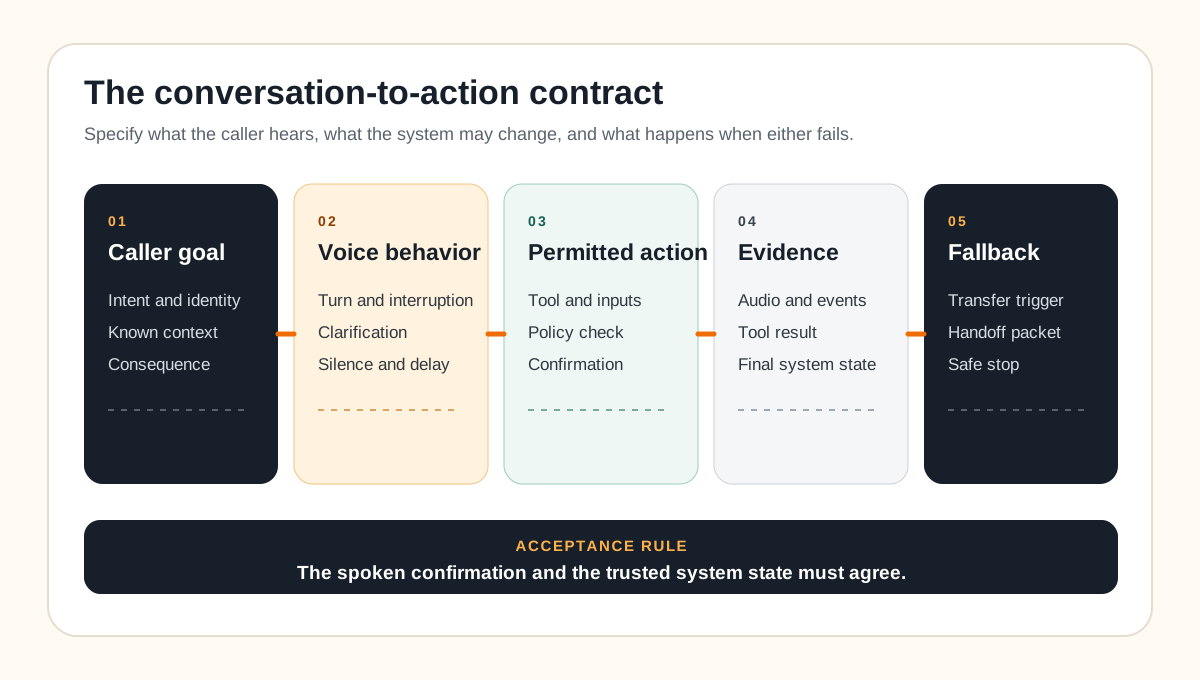
A script describes the happy path; a contract defines what must remain true when the caller interrupts, corrects a name, changes the request, fails identity, or the backend times out. Record five connected fields for each material call journey:
- Caller goal. The intended outcome, known context, identity state, and consequence of a wrong result.
- Voice behavior. How the agent greets, discloses, listens, clarifies, confirms, yields to an interruption, fills silence, and handles unsupported speech.
- Permitted action. The typed tool, validated inputs, policy check, authorization, and explicit confirmation required before state changes.
- Evidence. The audio or transcript policy, event sequence, tool arguments and result, final record, and versioned configuration needed to review the call.
- Fallback. The transfer trigger, handoff packet, destination, retry limit, and safe response if a person or system is unavailable.
Keep authority in trusted application code. The model may propose a tool call; the backend should validate identity, permissions, field values, policy, freshness, idempotency, and confirmation before execution. A spoken “that is booked” must follow a durable successful result, never a prediction that a tool will probably succeed. Apply the API integration requirements checklist to every action path.
Specify the audible behavior under real call conditions
Test accents, names, numbers, dates, language switches, background noise, weak connections, long pauses, overlapping speech, keypad input, voicemail, dropped calls, and callers who change their mind. Decide when the agent asks for clarification and when repeated uncertainty triggers transfer. For important names, addresses, dates, amounts, or commitments, define how it reads back and receives correction.
Measure timing by stage: call connection, speech detection, first acknowledgement, first useful response, tool start and finish, audio playback, and transfer. Do not set a universal latency claim without observing the actual stack. Track unwanted silence, overlap, interruption recovery, and task success separately, because a faster response can still use the wrong tool or cut off a correction.
OpenAI's Realtime conversation documentation makes interruption handling explicit: with some transports the server truncates unplayed audio, while a WebSocket client must stop playback and report where the response was cut. That is a product requirement, not a model setting to assume. Keep a keypad or human path where voice detection is unreliable or the caller needs more control.
Make failure and human transfer explicit call states
Define recovery for no speech, repeated low-confidence capture, ambiguous intent, unsupported language, identity failure, policy denial, tool timeout, uncertain action result, caller request for a person, distress, abuse, connection loss, and an unavailable transfer destination. Limit retries so the agent does not trap a caller in a polite loop.
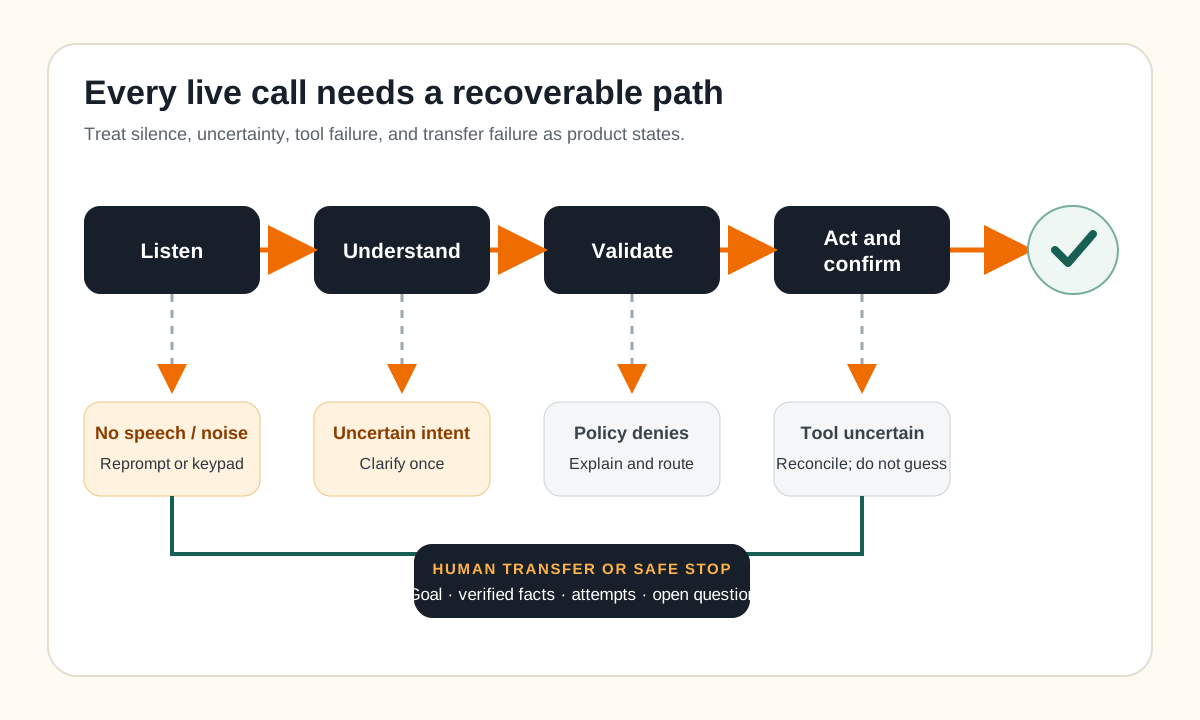
A transfer packet should contain the caller's stated goal, verified identity state, facts collected, corrections, tools attempted, trustworthy results, reason for escalation, and open question. Tell the caller what will happen next; do not claim a transfer completed until the telephony and queue state confirm it. Twilio's official voice documentation exposes call, recording, gathering, dialing, and status primitives, but the application must define the business meaning of each event.
Recording and detailed voice traces can contain sensitive audio. Twilio's voice-trace documentation notes that consent may be required depending on jurisdiction and use case. Decide disclosure, consent, access, redaction, retention, and deletion with the accountable legal, privacy, security, and sector owners before capturing production calls.
Evaluate the conversation, action, and recovery separately
Build a repeatable set of synthetic audio, privacy-reviewed recordings, and simulated multi-turn callers. For every case, define the expected intent, clarification, tool arguments, permission result, confirmation, final application state, and fallback. Include boundary values, mid-sentence corrections, silence, noise, interruptions, tool failures, and a caller who explicitly asks for a person.
Score recognition, task completion, tool correctness, authorization, confirmation accuracy, transfer quality, audible timing, and recovery as separate dimensions. Block release on critical failures such as cross-account disclosure, an unauthorized action, a spoken success with no committed result, a lost transfer, or a repeated action after a retry.
In operation, monitor call setup failures, dropped audio, unsupported journeys, clarification loops, transfers, tool denials and timeouts, reconciliations, caller corrections, latency stages, cost, incidents, and the proportion of calls reaching a verified outcome. Name owners for prompts, tools, telephony, knowledge, evaluation, privacy, incidents, and the kill switch.
A first-release AI voice-agent brief
Document one inbound or outbound journey, expected callers, supported languages and hours, identity boundary, approved knowledge, tool schema, confirmation rules, audio behavior, transfer destination, evidence and retention, evaluation set, critical failures, monitoring, owners, and excluded calls. Add one hard adjacent case that must transfer safely.
Run the pilot beside the existing call path, with a clear stop condition and a way to inspect disputed outcomes. The result may be a voice intake assistant, an answer-only line, an agent-assist layer, or one bounded action. That is stronger than promising a general receptionist before the organization can prove what the system heard or changed.
When the journey, controls, and evidence are clear, Leeonex's AI product feature development service can help scope a focused voice integration with measurable outcomes and safe fallbacks.
For a worked first-release boundary, see the after-hours AI voice intake concept study. It shows how to gather one service request, preserve a pending state, and hand appointment authority to dispatch without presenting illustrative planning as a client result.
AI voice agent requirements FAQ
What should an AI voice agent requirements document include?
Include the supported call journeys, caller and identity context, audio and turn-taking behavior, knowledge boundary, permitted tools, authorization and confirmation rules, transfer triggers, call evidence, retention, evaluation scenarios, monitoring, incident ownership, and safe-stop conditions.
How is a voice agent different from a text chatbot?
A voice agent adds telephony or live-audio transport, speech recognition, speech generation, interruptions, silence, background noise, pronunciation, dropped calls, and real-time timing. The underlying knowledge, tools, permissions, and workflow still require the same deterministic controls as a text agent.
What should an AI voice-agent pilot automate first?
Choose one frequent, bounded journey with a clear expected outcome and a low-cost fallback, such as gathering structured intake or checking a read-only status. Avoid starting with broad call handling or consequential actions that lack reliable identity, confirmation, reconciliation, and human transfer.