The short answer: compare workflows, then fund one question
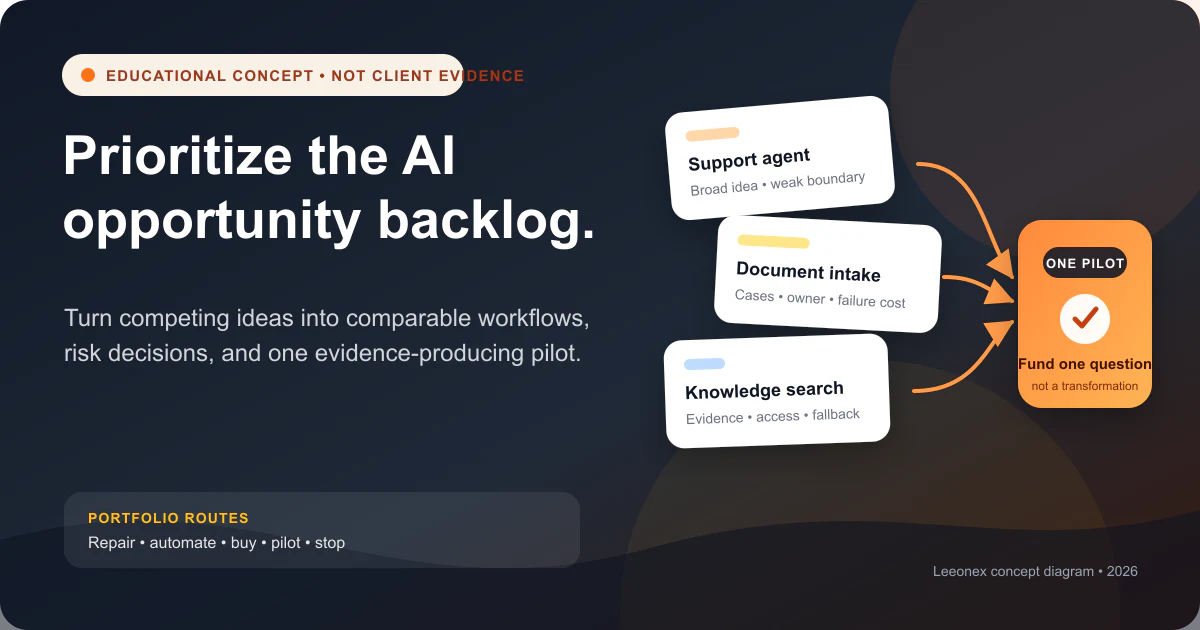
Prioritize AI opportunities by turning every idea into the same decision record: the workflow, user, current evidence, desired decision, technical boundary, failure cost, operating owner, and next uncertainty. Remove ideas that really need process repair or ordinary automation. Then fund one bounded pilot that can produce credible evidence for a stop, revise, buy, build, or expand decision.
A ranking score can help teams compare unlike requests, but it must never overrule a red-line risk or pretend to calculate ROI from guesses. The useful output is a documented reason for the next investment—not a colourful leaderboard that makes every idea look inevitable.
Evidence boundary
This is a Leeonex-authored educational concept. The opportunity backlog, discovery conversation, decision gates, pilot, counts, and diagrams are illustrative. They do not describe a client engagement, delivered pilot, feasibility assessment, security review, or measured business outcome.
The starting situation: many AI ideas, no comparable decision
The intended buyer is an operations leader, business owner, product leader, or transformation team with more AI requests than budget or attention. The ideas arrive in different forms. One team brings a polished vendor demo. Another brings a painful manual process. A senior stakeholder brings urgency. A technical team brings an interesting model capability. None of those is a shared basis for investment.
The central constraint is not idea generation. It is making unlike opportunities comparable without stripping away their consequences. A support draft, a supplier-risk decision, an internal knowledge search, and a payment action may all contain AI, yet they need different evidence, permissions, review, and tolerance for error.
Illustrative conversation
The dialogue below is a fictional composite used to explain the decision sequence. It is not a client quotation or a record of a Leeonex engagement.
Operations director
“Every department has an AI idea. Sales wants call summaries, finance wants document extraction, support wants an agent, and leadership wants a company-wide assistant. Which one should we fund?”
Leeonex
“Before comparing ideas, can we name the exact workflow, its owner, its current evidence, the decision AI would influence, and the cost of a plausible mistake?”
Operations director
“We have anecdotes and vendor demos, but the teams measure the work differently. Some ideas could probably be solved with rules or a better form.”
Leeonex
“Then the first useful outcome is not a model choice. It is a comparable opportunity portfolio, a reasoned route for every idea, and one pilot that can answer a specific business question.”
Four owners make the decision credible
- Business owner: owns the outcome, budget, and reason the workflow matters.
- Workflow owner: explains real cases, exceptions, policy, and how work is handled today.
- Technical owner: verifies systems, data access, integrations, evaluation, and the operating path.
- Risk owner: owns privacy, security, legal, compliance, or customer-impact questions appropriate to the use case.
One person can hold more than one role in a small company, but the responsibilities cannot disappear. A pilot without a workflow owner becomes a demo. A pilot without a risk owner pushes consequential decisions into engineering by accident.
Route every opportunity through the same six gates
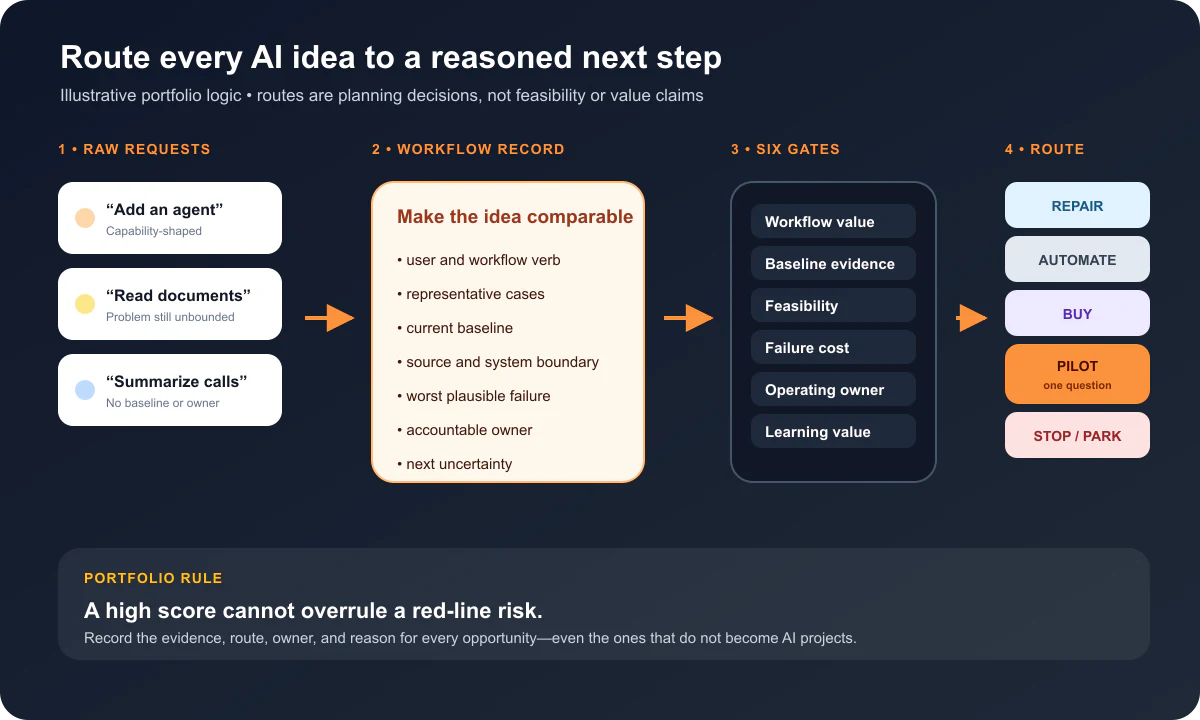
Start with a one-page opportunity record rather than a slide deck. Each idea must identify one workflow verb, one accountable user, representative inputs, the current decision, exceptions, connected systems, and the question a pilot would answer. If the team cannot complete that record, the opportunity is not ready to compete for build funding.
Gate 1
Workflow value
A defined operational problem, affected user, frequency, consequence, and decision that could improve—not a general wish to use AI.
Gate 2
Baseline evidence
Representative cases, current outcomes, exception patterns, and a measurable starting point that can survive scrutiny.
Gate 3
Technical feasibility
Accessible inputs, permitted data, integration paths, evaluation method, latency needs, and a realistic operating environment.
Gate 4
Failure cost
The worst credible error, who is affected, whether it is detectable and reversible, and where human authority must remain.
Gate 5
Operating ownership
Named owners for policy, data, review queues, exceptions, monitoring, access, and the ongoing cost after a pilot.
Gate 6
Learning value
A narrow test that resolves an expensive uncertainty and produces evidence for a stop, revise, buy, build, or expand decision.
Scores should be anchored to observable evidence. “High value” might mean a frequent queue with an agreed baseline, not an executive preference. “Feasible” might mean permitted digital inputs, a safe test environment, and evaluable outputs—not that a vendor completed a happy-path demonstration.
The existing Leeonex AI workflow automation readiness checklist goes deeper on scoring one workflow. This concept sits one decision earlier: it compares a portfolio and decides which workflow, if any, deserves that detailed readiness work first.
The route matters more than the rank
Every idea should leave the review with a route and a reason:
- Repair the process when ownership, inputs, states, or policy are unstable.
- Use ordinary automation when explicit rules and structured data solve the job more reliably.
- Buy or configure when a mature product fits the workflow and the operating constraints.
- Pilot when a valuable, bounded uncertainty can be tested safely.
- Stop or park when evidence is weak, the failure is unacceptable, or the likely learning does not justify ownership cost.
The smallest useful scope is one evidence-producing loop
A portfolio review is complete only when it protects the first pilot from expanding into a department-wide transformation. The proposed pilot should have one case type, one source boundary, one user role doing the review, one output, one evaluation set, and one accountable decision at the end.
Build now
- One approved workflow slice
- Representative evaluation cases
- Assistive or shadow-mode output
- Explicit review and stop controls
- Decision log and pilot readout
Consider later
- More departments or case types
- Additional model providers
- Broader integrations
- Limited automatic actions
- Portfolio-wide operating tooling
Deliberately exclude
- Company-wide autonomous agent
- Irreversible high-impact actions
- Unapproved sensitive data
- ROI claims without a baseline
- Production rollout by default
The cut list is not a permanent strategy. It protects the first learning cycle. If the pilot reveals that data access is the real constraint, the next investment may be integration or data governance rather than more model work. If ordinary rules handle most cases, that is a useful result, not a failed AI initiative.
Make architecture and operating choices before model choice
Keep the workflow system authoritative
The existing CRM, ticketing, finance, content, or operations system should remain the system of record unless replacing it is an explicit project decision. The pilot can read a bounded set of inputs and return a draft, label, extraction, or recommendation. Deterministic application logic should continue to own identity, permissions, validation, state transitions, retries, and audit history.
Separate interpretation from authority
AI may interpret variable language or prepare options without receiving permission to publish, pay, delete, change access, or make a material customer commitment. OWASP's Excessive Agency guidance recommends minimizing functionality and permissions and using human approval for high-impact actions. In the proposed pilot, that means the model has only the tools and data required for the bounded task.
Design the fallback as part of the product
If the model, input, source system, or validation fails, the case should return to a known manual route with context intact. The user must be able to see whether an item is waiting, blocked, rejected, or completed. A fallback that depends on an operator noticing a silent failure is not a fallback.
Choose build, buy, or hybrid by ownership
Buy when a product already fits the workflow, data terms, integration needs, and acceptable exit path. Build when the decision logic, experience, evidence, or system boundary is a genuine differentiator the team can maintain. Use a hybrid when a vendor capability can sit behind a Leeonex-owned workflow, evaluation, permission, and audit layer.
If an external platform or delivery partner is under consideration, use the AI automation vendor selection checklist to inspect evidence, data use, permissions, monitoring, commercial assumptions, and the exit path before procurement.
Treat evaluation as a maintained asset
The evaluation set should include ordinary work, difficult cases, known failure patterns, missing inputs, policy exceptions, and disallowed requests. Keep development examples separate from final evaluation cases so the team does not tune the pilot to a familiar demonstration. Record corrections and new exception types as evidence for the next version.
Risks and guardrails belong in the portfolio decision
Risk is not a final compliance box after an idea wins. It can change the route, scope, review design, data boundary, or the decision to proceed at all. NIST describes the AI Risk Management Framework as a voluntary resource for managing risks across the design, development, use, and evaluation of AI systems. Its practical value here is the discipline of governing, mapping, measuring, and managing risk through the lifecycle rather than treating a model demo as readiness evidence.
For generative AI, the NIST Generative AI Profile also emphasizes additional human review, tracking, documentation, and management oversight where appropriate. The specific controls still need to match the workflow and its real consequences.
| Risk question | Pilot guardrail | Evidence to retain |
|---|---|---|
| Can it expose or misuse data? | Approved source boundary, minimum fields, scoped identity, and retention rules | Data inventory, access decision, logs, and deletion test |
| Can a wrong output cause harm? | Assistive output, named reviewer, prohibited actions, and visible uncertainty | Reviewer decisions, corrections, rejected cases, and incident notes |
| Can the operation fail silently? | Explicit states, timeout, retry limits, alerts, and a manual fallback queue | State history, error events, fallback completion, and owner acknowledgement |
| Can cost or quality drift? | Versioned configuration, test set, usage limits, and change approval | Version, evaluation result, usage record, and release decision |
Write the pilot evidence contract before implementation
A pilot should answer one expensive question. “Can AI help?” is too broad. A better question might be: can an assistive system produce a complete draft for one approved request type while keeping unsupported statements visible and leaving final action with the trained operator?
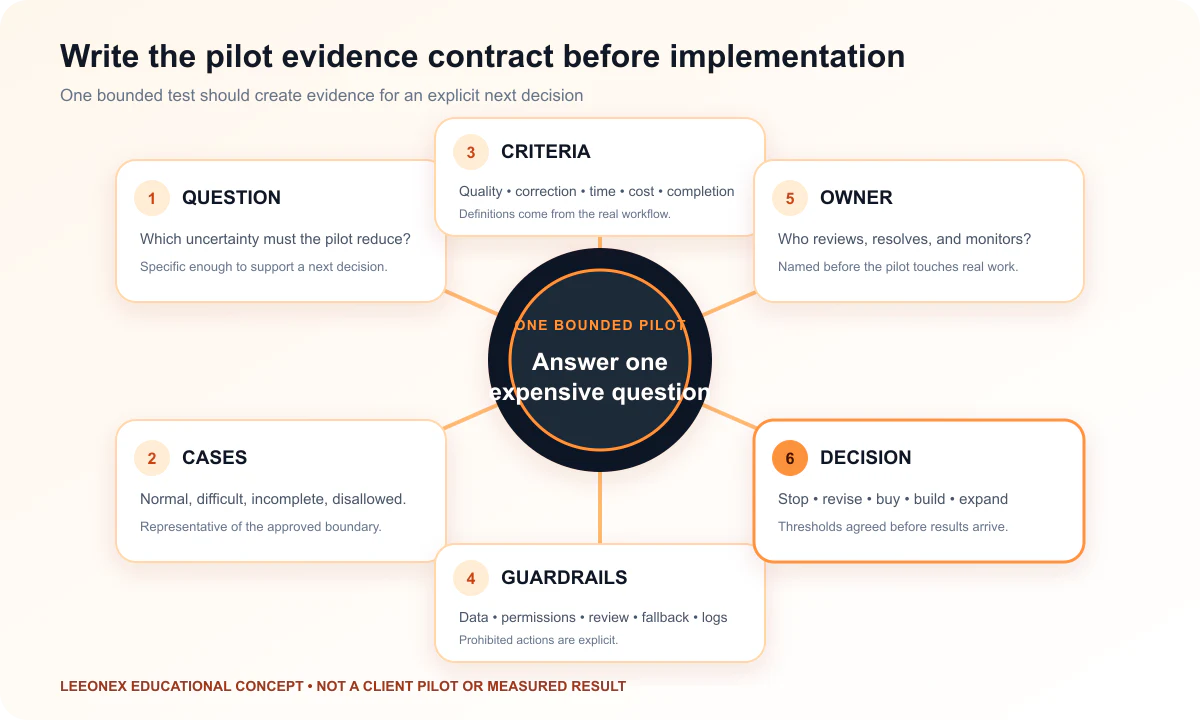
The contract needs six explicit parts
- Question: the one uncertainty the pilot is funded to reduce.
- Cases: the normal, difficult, incomplete, sensitive, and disallowed examples that represent the approved boundary.
- Criteria: task-level quality, completion, correction, review effort, latency, cost, and operational measures with definitions.
- Guardrails: data, permission, review, logging, fallback, and prohibited-action controls.
- Owner: who reviews cases, resolves failures, monitors the system, and signs the next decision.
- Decision: thresholds and qualitative evidence for stop, revise, buy, build, or limited expansion.
Accuracy alone is rarely enough. A classification can be accurate while its exceptions overload a queue. A draft can be factually sound while taking longer to verify than writing from scratch. A workflow can save handling time while increasing vendor cost or creating a difficult data obligation. Measure the operation, not only the model output.
No threshold is supplied in this concept because an acceptable error rate, review burden, cost, or response time depends on the buyer's real process and consequences. Those values must come from accountable owners and baseline evidence—not from a generic benchmark.
Limitations and what this concept deliberately cannot prove
- No real organization, workflow backlog, system, dataset, or production environment was assessed.
- The six gates are a Leeonex planning framework, not an industry standard, legal test, security assessment, or ROI calculator.
- The counts describe proposed scope only; they are not performance measures or evidence of project success.
- The diagrams are explanatory artwork, not client data, product screens, or proof that a pilot was delivered.
- Feasibility, acceptable risk, data rights, compliance, architecture, cost, and evaluation thresholds must be established for the buyer's actual use case.
- SEO, structured data, sitemaps, and AI-readable discovery files improve page eligibility and clarity; they cannot guarantee ranking, indexing, traffic, citations, leads, or conversions.
Stronger claims would require a real, approved portfolio; dated baseline records; a defined pilot and measurement window; representative evaluation cases; correction, incident, cost, and operating records; and permission to publish the identity, evidence, visuals, and exact wording. Until that exists, this page remains a concept study.
Lessons for teams deciding where AI belongs
- A workflow described with evidence is more investable than a capability described with enthusiasm.
- Process repair, ordinary automation, and buying software are successful portfolio outcomes when they fit better than AI.
- A red-line failure can stop a high-value idea even when its aggregate score looks attractive.
- The best first pilot is the smallest safe loop that changes an expensive decision, not the idea with the broadest demo.
- Operating ownership, evaluation, and fallback are part of the product scope from day one.
What to bring to a first AI portfolio consultation
You do not need a finished business case. Bring enough raw material to make the competing ideas concrete:
- the list of proposed AI ideas and who is asking for each one;
- three to ten recent examples from the underlying workflows, redacted where necessary;
- current volumes, waiting time, rework, errors, cost, or quality evidence—even if incomplete;
- the systems, data owners, access constraints, policies, and integration options involved;
- the worst outcome you will not let automation cause and the person accountable for that boundary;
- budget, timing, procurement, internal capacity, and the decision leadership expects after a pilot.
Leeonex's AI consulting service is designed for this pre-build decision: compare use cases, test feasibility and risk, choose build versus buy, and define a pilot only when the evidence supports one. If the first need is understanding the difference between a fixed workflow and a system that chooses its own actions, read the AI agent versus workflow automation guide.
You can also browse the Leeonex case-study library for other clearly labeled concepts covering AI workflows, product features, SaaS, web applications, mobile apps, dashboards, websites, and delivery models.
A practical next step
Turn the AI wish list into one defensible decision
Share the candidate workflows, available evidence, owners, constraints, and unacceptable failure. The conversation can end with a pilot, a buy recommendation, ordinary automation, process repair, or a clear reason to stop.
Discuss your AI opportunitiesSources and framework note
Sources were reviewed on 2026-09-08. The six-gate portfolio model and pilot evidence contract are Leeonex-authored planning devices, not claims that NIST or OWASP prescribe this exact method.