Answer first
Qualify with the page first, then ask the form for only what the first reply needs
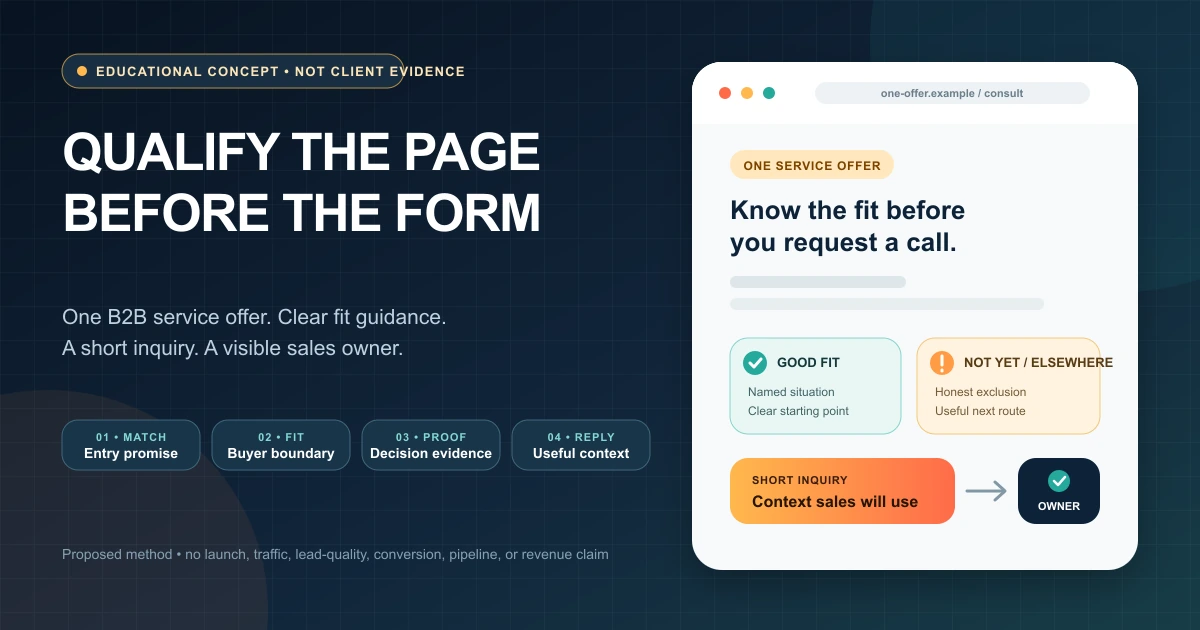
A B2B service landing page should help the right buyer recognize the offer, assess fit, inspect credible evidence, and understand the next step before giving up personal information. The form should collect the minimum context needed to accept, route, and answer the inquiry. Qualification is the whole decision path—not the number of required fields.
This is a Level E educational concept, not a real client page or measured funnel. It proposes one offer, four qualification layers, and six visible handoff states. It does not claim that a shorter form will increase conversion or that more explicit fit guidance will improve lead quality. Those are hypotheses that require real traffic, sales definitions, reconciled records, and an approved measurement window.
Starting situation and intended buyer
“Poor lead quality” can hide a message problem, a handoff problem, or an ownership problem
The recognizable situation is a focused B2B service page that receives some attention but creates an argument between marketing and sales. Marketing sees form submissions. Sales sees requests outside the engagement model, incomplete context, duplicate notifications, or leads nobody owns. The tempting fix is to make the form longer.
A long form may filter people, but it cannot repair an unclear offer, mismatched campaign promise, weak evidence, hidden exclusions, broken CRM mapping, or an unowned follow-up queue. It can also exclude a strong buyer who does not yet know the budget, timeline, or implementation detail the form demands.
This blueprint is for a service-business owner, marketing leader, revenue team, or sales-operations owner planning one campaign or service landing page. It is not a full website, CRM, or sales-process redesign. If the page already exists but the constraint is uncertain, begin with the broader website conversion audit checklist before assuming a rebuild is necessary.
Illustrative conversation — not a client quotation
Move the qualification decision out of the form where the buyer can see it
Illustrative service-business owner
The page gets inquiries, but sales says too many are not a fit. We want to add budget, timeline, company size, phone, and eight project questions to the form.
Illustrative Leeonex response
Which answers actually change the first reply, and which poor-fit visitors could make the same decision from clearer page content before they see the form?
Illustrative service-business owner
Sales mainly needs the service, the situation, and a way to respond. The real confusion is whether we handle small one-off jobs or only ongoing engagements.
Illustrative Leeonex response
Then the first release should make that boundary explicit, show credible decision evidence, keep the inquiry short, and prove that every accepted request reaches a named owner.
This dialogue is invented to teach a discovery pattern. It is not a quotation, testimonial, transcript, or evidence of a Leeonex engagement.
User roles and core flow
Design for the buyer's decision and the team's first response
The buyer is not the only user. Marketing owns message and traffic context; sales defines a useful inquiry; operations owns delivery and exceptions; and a privacy owner sets the data boundary. If these roles disagree, the form becomes a place to store unresolved policy.
Prospective buyer
Needs to recognize the problem, judge whether the service fits, understand the next step, and share context without completing a procurement questionnaire.
Marketing owner
Owns traffic context, message match, page evidence, analytics definitions, and the content changes that can be tested responsibly.
Sales owner
Defines what makes an inquiry useful, which details change the first response, who accepts each request, and what poor fit means.
Operations or CRM owner
Owns validation, destination fields, routing, duplicates, failed delivery, access, retention, and a visible exception queue.
Privacy or compliance owner
Reviews data collection, consent, notices, retention, regional obligations, and what must stay out of analytics and logs.
Layer 01
Match the entry promise
Keep the headline and opening proof aligned with the ad, search query, referral, or campaign that brought the visitor in.
Layer 02
Let the buyer assess fit
State the situation, buyer, engagement boundary, exclusions, and practical starting point before asking for personal information.
Layer 03
Show decision evidence
Use real process detail, approved proof, constraints, and answers to objections—not invented results or generic trust badges.
Layer 04
Ask for reply-ready context
Collect only the contact and project details the owner will use to route and write the first useful response.
Smallest useful scope
Build one complete inquiry path before adding qualification machinery
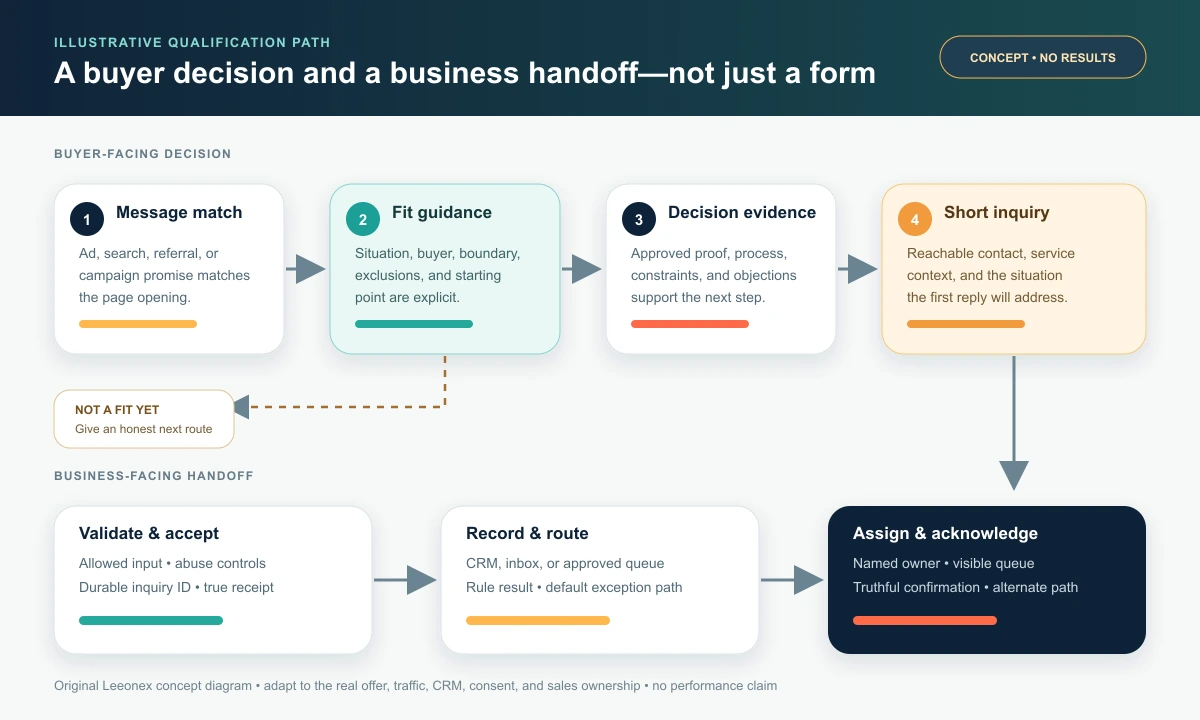
The smallest useful release starts with one real offer and one accountable receiving owner. It includes enough content for a visitor to understand fit, enough proof to make the action credible, a short form, durable receipt, routing, honest confirmation, and failure tests. It ends when the business can show where an accepted inquiry went and who owns it.
Build now
- One audience, one B2B service offer, one primary page promise, and one main inquiry action
- A traffic-source note that keeps the opening message consistent with the campaign or search intent
- A clear fit boundary: who the service is for, recognizable situations, important exclusions, and the smallest useful starting point
- A proof plan using approved process evidence, real credentials, or honestly labelled concept material
- A short accessible form whose fields each support routing or the first reply
- Server-side or provider-confirmed acceptance, a durable submission identifier, a named destination, default owner, and failure path
- A confirmation that explains what happens next without promising a response time the team has not operationally accepted
- An acceptance test covering mobile, keyboard, errors, spam controls, routing, destination receipt, ownership, and safe analytics
Later or deliberately excluded
- A full company website, brand redesign, CRM replacement, sales enablement program, or broad marketing-automation rebuild
- A scored quiz, account enrichment, chatbot, calendar routing, personalization engine, or multi-step application unless evidence shows it is needed
- Separate page variants for every audience, channel, region, service, or salesperson before the first path is reliable
- Automatic rejection of inquiries based on guessed budget, company size, email domain, or AI-generated fit scores
- A/B tests without sufficient qualified traffic, stable attribution, an agreed decision metric, and a defined observation window
- Claims that the page improves lead quality, conversion, pipeline, revenue, response time, rankings, or traffic before approved measurement exists
The supporting website lead form requirements guide goes deeper on fields, validation, accessibility, abuse controls, destination records, and acceptance tests. This study stays wider: it connects that form contract to the page content that should help a buyer qualify themselves first.
Architecture and implementation decisions
The page can be simple; the acceptance boundary must be exact
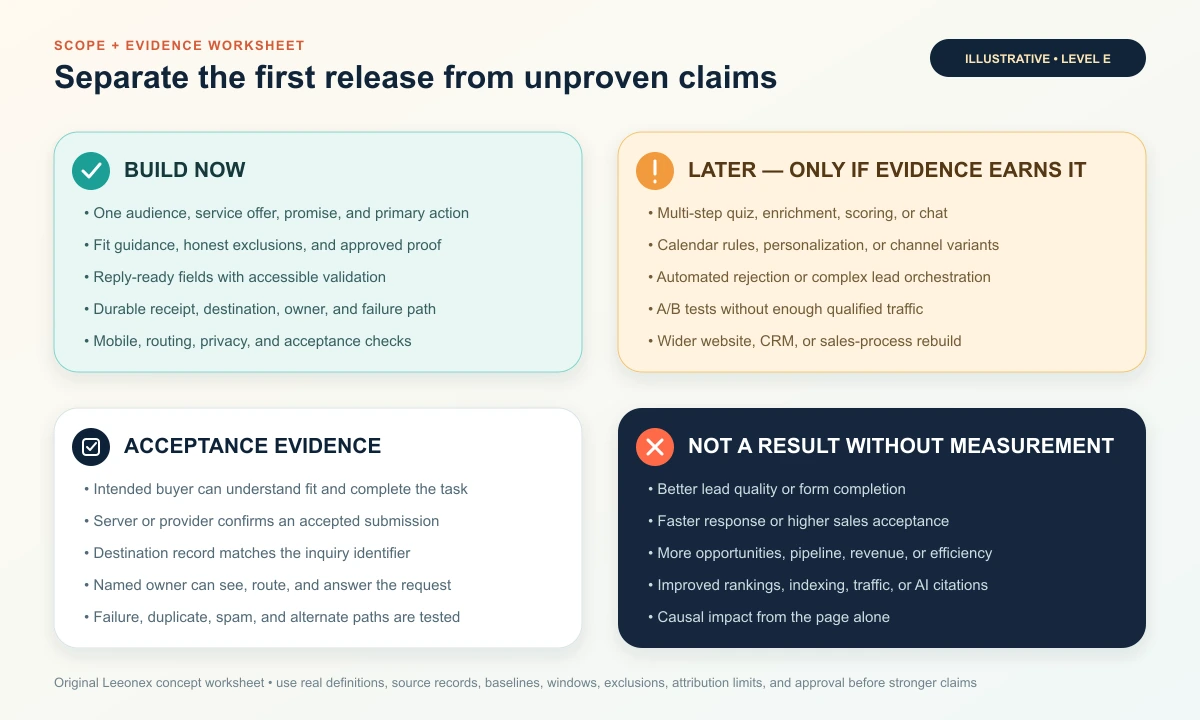
Render the core offer, fit guidance, and proof as fast, accessible content. Keep important qualification information in the page rather than hiding it inside a script-dependent quiz. Use a supported form provider or a server-controlled endpoint according to the field, routing, consent, resilience, and maintenance requirements—not because custom code or an embed sounds inherently better.
Validate allowed formats and lengths at the receiving boundary. Generate an inquiry identifier only when the request is accepted. Then record the page or campaign source, routing decision, destination result, and owner without copying sensitive free text into analytics. If the CRM is unavailable, either preserve a retryable record under an approved retention policy or show an honest failure with a working alternate contact route.
Entered
The visitor has supplied values, but nothing is accepted yet.
Validated
Client and server or provider checks confirm the allowed fields and formats.
Accepted
The receiving endpoint acknowledges the inquiry and issues a durable identifier.
Recorded
The inquiry exists in the approved inbox, CRM, queue, or equivalent system of record.
Assigned
A named person or visible team queue owns the next action, including unmatched cases.
Acknowledged
The visitor sees or receives truthful confirmation and a usable alternate path if needed.
Analytics should distinguish a CTA view or click, form start, validation failure, accepted inquiry, and downstream sales state. A click is not a lead, and an accepted inquiry is not an opportunity. Use the narrowest event vocabulary the business can reconcile with its system of record.
Risks and guardrails
The most expensive failure is telling both sides the handoff worked when it did not
- Do not make visitors disclose sensitive commercial detail merely to discover whether the service fits.
- Do not present a browser button click or optimistic success message as an accepted lead.
- Keep personal and free-text inquiry data out of analytics events, URLs, and routine error logs.
- Separate permission to reply to the inquiry from permission to send future marketing.
- Give unknown, duplicate, blocked, and failed-routing cases a visible queue and an accountable owner.
- Treat a CRM embed as a dependency with accessibility, performance, consent, outage, and data-handling consequences.
- Use honest fit language; do not manufacture urgency, scarcity, guarantees, testimonials, or performance figures.
- Let a person review ambiguous requests instead of silently rejecting them with a score nobody can explain.
A page can also qualify too aggressively. Hard budget ranges, company-size thresholds, and mandatory deadlines may encode the team's current assumptions rather than actual buying fit. Start with the decisions the first reply genuinely needs. Review rejected and ambiguous cases with people before automating exclusion.
Evidence, measurement, and limitations
This concept defines what to test; it does not prove the page will produce better leads
No real offer, buyer research, campaign, page, form, CRM, inquiry, sales queue, analytics property, consent flow, usability test, or pipeline record was inspected. The one-offer structure, four qualification layers, and six handoff states are teaching devices, not universal requirements. A referral page for a narrow specialist may need less explanation; a regulated or high-value procurement journey may need more.
The concept deliberately excludes legal conclusions, a full website or brand redesign, CRM replacement, sales compensation, broad lifecycle automation, a traffic plan, and guaranteed delivery or response times. SEO, structured data, sitemaps, and AI-readable discovery can improve eligibility and interpretation; they do not guarantee rankings, indexing, citations, traffic, trust, inquiries, conversions, pipeline, or revenue.
Evidence needed before stronger claims
- Approved offer, audience, traffic-source, page-version, and change log
- A written qualified-inquiry definition accepted by marketing and the people who respond
- Accepted submission records reconciled with the destination, routing result, and current owner
- Accessible task testing, real-device checks, performance evidence, and failure-path results
- Dated baseline and comparison windows with traffic quality, campaign changes, seasonality, and exclusions recorded
- Exact metric definitions for form starts, accepted inquiries, sales acceptance, response, opportunity, and revenue where relevant
- Analytics, CRM, sales, and privacy owners who verify the source records and approve public wording
- Approved screenshots or diagrams, redaction, rights, project identity or anonymization, and publication permission
Lessons for a similar buyer
Lead qualification is an operating agreement expressed through content, interface, and routing
The best field is often a paragraph on the page. When buyers can see the engagement boundary, starting condition, evidence, and exclusions, they can make a decision without surrendering data or waiting for sales to explain the offer.
Fewer fields are not automatically better. Every field should earn its place by changing routing or the first response. Everything else can move to a later conversation, an optional prompt, or the page itself.
Measurement begins with reconciliation. Before debating conversion rate, prove that accepted inquiries exist in the destination, have an owner, and use a shared definition of qualified. Otherwise marketing and sales are comparing different events.
What to bring to a first consultation
Bring the offer and the first reply—not a polished page brief
- The service offer and the one buyer situation the page should address
- Traffic sources, campaign copy, important search intent, and the current page if one exists
- Three useful inquiries and three poor-fit inquiries with private data removed
- The first reply sales wants to send and the information needed to write it
- The current form, destination inbox or CRM, field map, routing rules, and known failures
- Approved proof, credentials, constraints, exclusions, and objections the page may answer
- Consent, privacy, retention, regional, accessibility, and brand requirements
- A realistic owner for content, lead exceptions, analytics, and post-launch decisions
Those inputs are enough to identify whether the next step is clearer positioning, a focused page build, a smaller form, a repaired CRM handoff, or measurement on the existing page. Explore Leeonex's landing page development service or browse other honestly labelled blueprints in the case-study hub.
Problem-aligned next step
Review one real inquiry path before rebuilding the funnel
Leeonex can help map the offer, fit decision, page evidence, minimum inquiry context, and handoff to the person who must reply. The honest recommendation may be a new focused page—or a smaller change to the existing message, form, routing, or ownership.
Discuss your landing page