Answer first
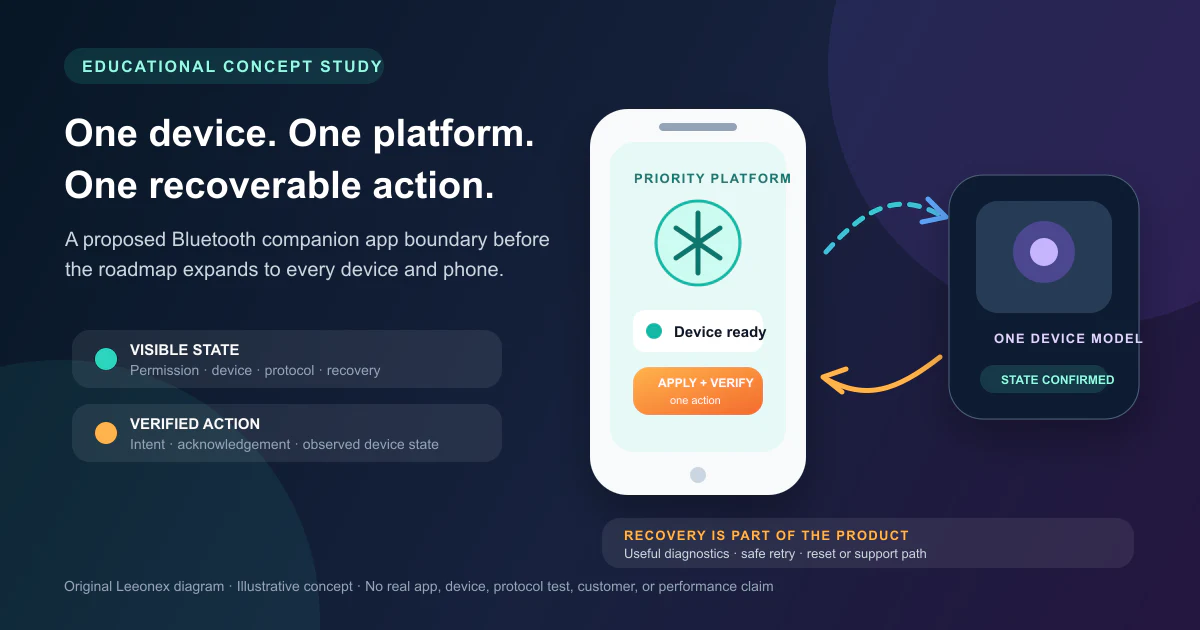
Scope one device, one priority platform, and one recoverable action before promising a universal companion app.
A Bluetooth companion app is useful only when the user can tell what state the product is in and recover when phone, permission, radio, protocol, firmware, or hardware state blocks the task. The smallest useful release should identify one supported device, establish an authorized connection, read its current state, apply one valuable configuration, verify what the device accepted, and explain the next action when that loop breaks.
Start with the platform and device combination that represents the real first buyer, not the broadest roadmap. Prove the risky native edge on physical hardware, define who owns every state, and turn failure details into safe user guidance and support evidence. Add another platform, device family, background mode, or firmware update only after the first loop is supportable.
Evidence boundary
This is a Level E educational concept study. Leeonex has not designed, implemented, connected, secured, tested, launched, or measured this proposed app for a client or device product. The conversation, device, screens, roles, states, architecture, diagrams, counts, technologies, and decisions are illustrative planning material—not a product demo, hardware test, testimonial, reliability result, or business outcome.
Starting situation and intended buyer
The hardware team says the protocol works; the product team still cannot define a supportable setup journey.
This concept is for a connected-device founder, product leader, hardware team, or operations owner planning a mobile companion for a sensor, controller, instrument, appliance, wearable, or other nearby device. A lab utility may already discover the radio and write values, while the commercial roadmap jumps to polished dashboards, multiple devices, firmware updates, both stores, accounts, sharing, and automation.
The buyer problem is not merely “Bluetooth development.” The phone can deny permission, the radio can be off, the wrong device can advertise a similar name, a product can already be claimed, a firmware revision can expose a different protocol, a connection can disappear mid-command, and the device can acknowledge a write without reaching the physical state the user expected.
A useful first release therefore needs an operating boundary as much as an interface. Product, mobile, firmware, security, hardware test, support, and release owners must agree what is supported, how the app knows, what the device owns, which failures can recover automatically, and when a person or device replacement is required.
Illustrative discovery conversation — not a client quotation
The first scope decision is compatibility and recovery, not screen count.
Product lead
“The device works. We need an iOS and Android app so customers can connect, change settings, and update it.”
Leeonex
“Which device revision, phone platform, and single action must work first—and what should the user see when the device cannot be found?”
Product lead
“We have two radio revisions, firmware is still changing, and support currently asks users to toggle Bluetooth until it works.”
Leeonex
“Then the first product is not every screen on both platforms. It is one supported device path with explicit states, verified commands, diagnostics, and recovery evidence.”
This exchange is Leeonex-authored teaching material. It describes no real founder, device, company, protocol, quotation, app, support history, or engagement.
User roles and decision ownership
Separate the person using the device from the teams that own its behavior and recovery.
Device user
Needs to know whether the phone, permission, nearby hardware, authorization, or device state is blocking progress—and what action is safe next.
Mobile product owner
Defines the valuable device action, supported phones and OS versions, release boundary, accessibility expectations, and what the app may not promise.
Hardware or firmware owner
Owns identifiers, services, characteristics, protocol versions, command behavior, device resets, security assumptions, and compatibility changes.
Support operator
Needs an understandable connection history, safe diagnostic details, reset guidance, and a route for cases that cannot be resolved inside the app.
Core product flow
Treat connection as a visible state machine around a valuable device action.
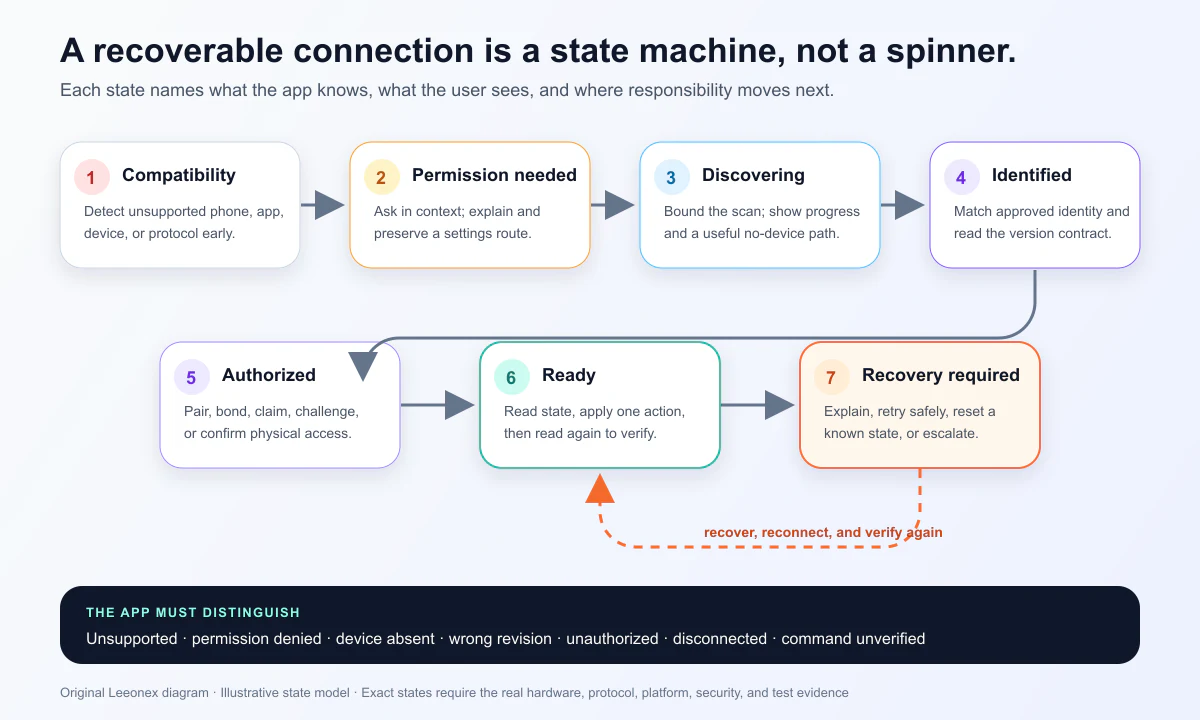
Begin before scanning. The app first checks whether the phone, OS, app build, permission state, device model, and known protocol range can support the intended action. It should ask for permission in context, explain why it matters, and preserve a route to settings when the user declines.
Discovery then produces candidates, not trustworthy devices. The app identifies the intended hardware from approved signals, proves the required authorization or claim, reads the current version and state, and only then enables configuration. A command moves through queued, sent, acknowledged, verified, or recovery-required states instead of disappearing behind one spinner.
Verification is a fresh read or physical confirmation defined with the hardware team. When it fails, the user receives a safe next step—retry, move closer, wake or power the device, update the app, reset a known state, or contact support with a limited diagnostic reference. The app never invents certainty from a transport event alone.
Smallest useful release
Build the narrow lane that can prove user value and operating control together.
Build now
- One named device model and radio or firmware compatibility range, with unsupported hardware detected before a write is attempted
- One priority mobile platform and a documented phone and OS test matrix selected from the real buyer and device estate
- One recoverable setup path: explain permission, discover, identify, authorize or claim, read current state, and confirm readiness
- One valuable configuration command with version checks, bounded retries, device acknowledgement, and a fresh read that verifies the resulting state
- A reset and reconnect path plus privacy-conscious diagnostic events that distinguish user action, phone state, transport state, protocol response, and device result
- A hardware-backed acceptance rig, release checklist, support playbook, and named owners for the mobile app, firmware, protocol, backend, and field escalation
Later or deliberately excluded
- Both stores, every phone, multiple device families, household or team sharing, and fleet management before one compatibility lane is supportable
- Background monitoring, continuous scanning, location-driven behavior, or silent reconnection before OS limits, battery cost, privacy, and user value are proved
- Over-the-air firmware updates inside the first app release unless firmware delivery, signing, interruption recovery, rollback, and support ownership already exist
- Wi-Fi provisioning, cloud automation, historical analytics, predictive maintenance, ecommerce, subscriptions, community, or marketing content around an unstable device loop
- A generic connection spinner, automatic retries without limits, or a universal error message that sends every failure to support without useful evidence
This cut is intentionally smaller than a generic mobile-app requirements list. Use the mobile app requirements checklist for broader product, backend, release, privacy, and ownership inputs. Here, the scope stays centered on the hardware-dependent path that can invalidate the whole product assumption.
Architecture and implementation decisions
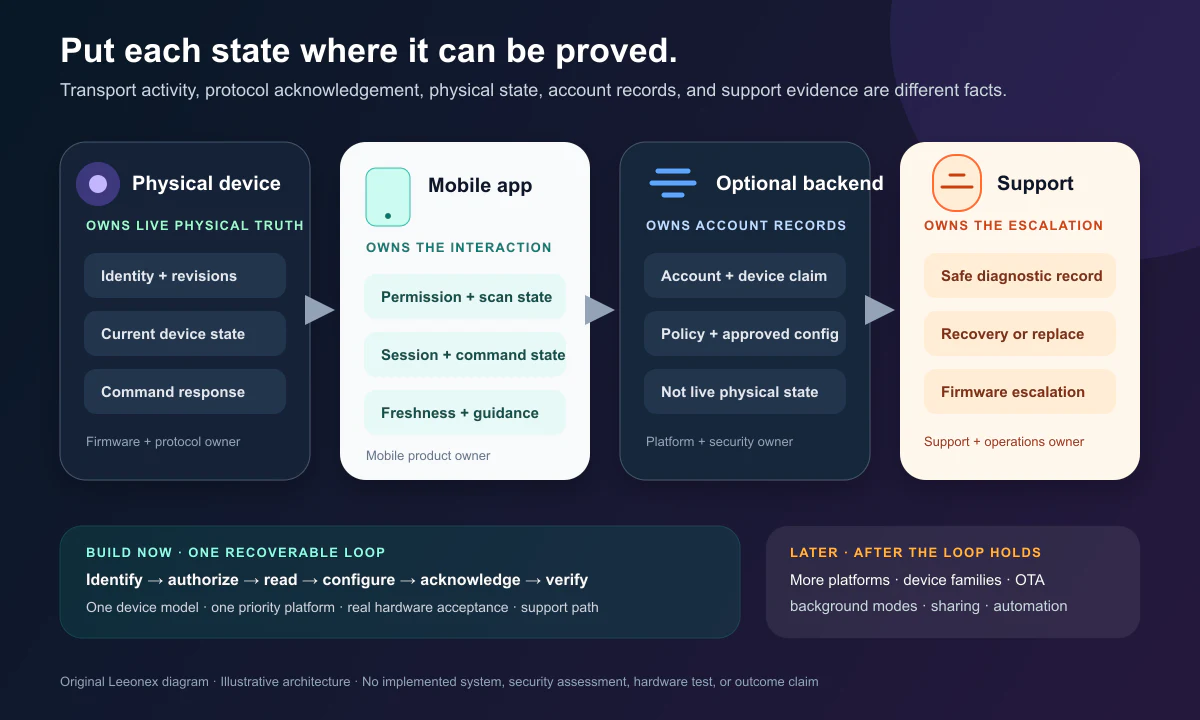
Assign each kind of state to the system that can truthfully own it.
Platform boundary
Start native on the priority platform when direct OS control, diagnostics, accessibility, or new Bluetooth behavior is the main uncertainty. A cross-platform shell remains possible when a tested native transport boundary can be owned.
Protocol boundary
Keep transport, protocol parsing, and product meaning separate. A byte was written, a device acknowledged it, and the requested physical state was observed are different facts.
Source of truth
Let the device own live physical state, the app own the current interaction, and an optional backend own account or claim records. Cached values need timestamps and visible freshness.
Test boundary
Use protocol fixtures and simulators for fast checks, but keep real hardware, representative phones, interference, sleep, reset, and interruption cases in the release gate.
The mobile client should expose a product-oriented device service instead of allowing screens to issue raw protocol operations. Beneath it, a transport adapter handles OS APIs and lifecycle events; a version-aware protocol layer validates and interprets messages; and an explicit state machine converts technical changes into user-visible steps. This separation also makes a simulator useful without pretending it replaces real hardware.
A backend is not automatically required for a nearby-device loop. Add it only for an owned responsibility such as account identity, device claim, configuration policy, approved content, or support case correlation. It should not silently become the source of live physical state when only the hardware can confirm that state.
The framework choice follows the risky path. The native versus cross-platform decision guide helps compare direct native implementation, a shared app with a native module, and other boundaries after a device-backed spike has shown the actual platform pressure.
Risks and guardrails
Do not let friendly connection language hide security, state, or support ambiguity.
Identify the intended physical device before authorization or configuration. Display names and radio proximity alone are not a trustworthy identity model.
Document whether pairing, bonding, app-level challenge, device claim, account ownership, or physical confirmation protects the action. Security language must match the real protocol.
Make permission denied, Bluetooth off, device absent, unsupported revision, already claimed, busy, disconnected, timed out, rejected command, and unverified state distinct product states.
Keep retries finite and commands safe to repeat where possible. Do not turn a delayed response into duplicate physical actions or a hidden configuration drift.
Never place secrets, personal data, complete identifiers, or sensitive device payloads into analytics or support logs. Record the minimum evidence with retention and access rules.
Treat firmware and protocol changes as app compatibility changes. Version contracts, test fixtures, release coordination, rollback, and field support need named owners.
Limitations and evidence needed
This blueprint cannot establish feasibility, compatibility, security, reliability, or user demand.
Bluetooth behavior depends on the real radio, antenna, firmware, protocol, mobile platform, phone hardware, OS version, permissions, background state, power state, interference, environment, and physical product. A diagram cannot show that the proposed loop is technically feasible or suitable for a medical, safety-critical, industrial, regulated, or other consequential use.
No implementation timeline, budget, connection percentage, setup success rate, recovery time, support reduction, adoption, energy use, store acceptance, or commercial outcome is claimed. Stronger public wording would require at least:
- Representative device, firmware, radio, phone, OS, permission, interruption, reset, interference, and recovery test coverage
- Versioned protocol documentation and named mobile, firmware, security, support, and release owners
- Definitions for setup completion, verified device action, recovery, abandonment, support escalation, and unsupported hardware
- Production or controlled-pilot logs with sensitive fields removed, plus a measurement window and documented exclusions
- Approved app screenshots, hardware photography, identity or anonymization, visual rights, and publication permission
Lessons for a connected-device team
A dependable first release is a shared hardware-and-software contract, not a set of mobile screens.
Narrow compatibility is not a failure when it is explicit and chosen from the first buyer. “One tested device revision on one priority platform” is more useful than “iOS and Android” with no supported matrix, recovery model, or owner for protocol change.
Connection is an operating process. Device identity, authorization, version negotiation, command semantics, verification, diagnostics, reset, release, and support all need product decisions. The experience feels simple only after those responsibilities are made visible to the delivery team.
Finally, the app should optimize for the valuable device task, not a green connection icon. A successful session ends with a state the user can trust—or a clear, bounded explanation of why the product cannot complete the action yet.
What to bring to a first consultation
Bring the device path and its unknowns, not a polished feature deck.
- The exact device model, hardware and radio revisions, firmware versions, regulatory constraints, available samples, and who can change firmware or protocol behavior
- Protocol documentation, service and characteristic definitions, identifiers, command and response examples, security design, reset states, timeouts, and known device-side failures
- Priority user, mobile platform, phone and OS range, region, accessibility needs, setup environment, expected distance, interference, power state, and connectivity assumptions
- One valuable first action, the state before and after it, unacceptable outcomes, recovery expectations, and the evidence that proves the hardware actually accepted the change
- Existing account, device-claim, cloud, analytics, support, privacy, security, release, app-store, and incident-response obligations
- Support tickets, setup instructions, lab notes, videos, logs, failed-device examples, field constraints, and any claims the commercial team currently makes about compatibility or reliability
Leeonex can use those inputs to define a device-backed technical spike, compatibility lane, first-release state model, test plan, and support boundary. Explore native app development or review other honest planning examples in the case-study hub.